Subscribe

RSS Feed (xml)

Powered By

Skin Design:
Free Blogger Skins

Powered by Blogger

Tuesday, December 31, 2024

Backburner Birding--2024 Birding Recap

So this past year has been momentous. I took a new job at the Palmyra Temple in Palmyra, New York in January, we finally sold our house in DelCo in July, and we bought a house and moved to Mendon, NY in August (new yard list up to 75 bird species by end of the year). So new job, new house, new lots of stuff. But not a lot of new birds. Or many birds at all, as birding took the biggest back seat in my life since I took a couple years mostly off to serve an LDS mission in Ecuador from 1988-1990.

By the numbers, I only saw 213 bird species this year. Ouch!

I did not leave the U.S. this year, and logged birds in only 11 states--including 199 in New York. Shoot, I just saw that. If I had been paying attention, I would have worked harder this week to have made sure that total got to 200. That's what happens when you aren't paying attention in the back seat!

I did not see any new birds for my World list or my North American list this year--the first year I haven't seen a new bird since 1987. 

Most of my birding this year was just an hour here or there before or after work. The only real birding games I tried to keep up with this year were my daily attempts to get my 20 Bird Minimum Daily Requirement and to get an All Time New Day Bird (a bird I hadn't ever seen before on that calendar day). I will have to count, but I got one or both of those on most days, though there were plenty of misses--including today (Dec 31) when I got neither.

Since I saw so few birds, it is hard to even come up with a 2024 Top 10 birds list for the year. but here goes

1. Wood Stork--the only rare bird I found myself this year, an October surprise up on the shore of Lake Ontario in Rochester, NY. Fortunately it stuck around for several days, so many people got to see it.

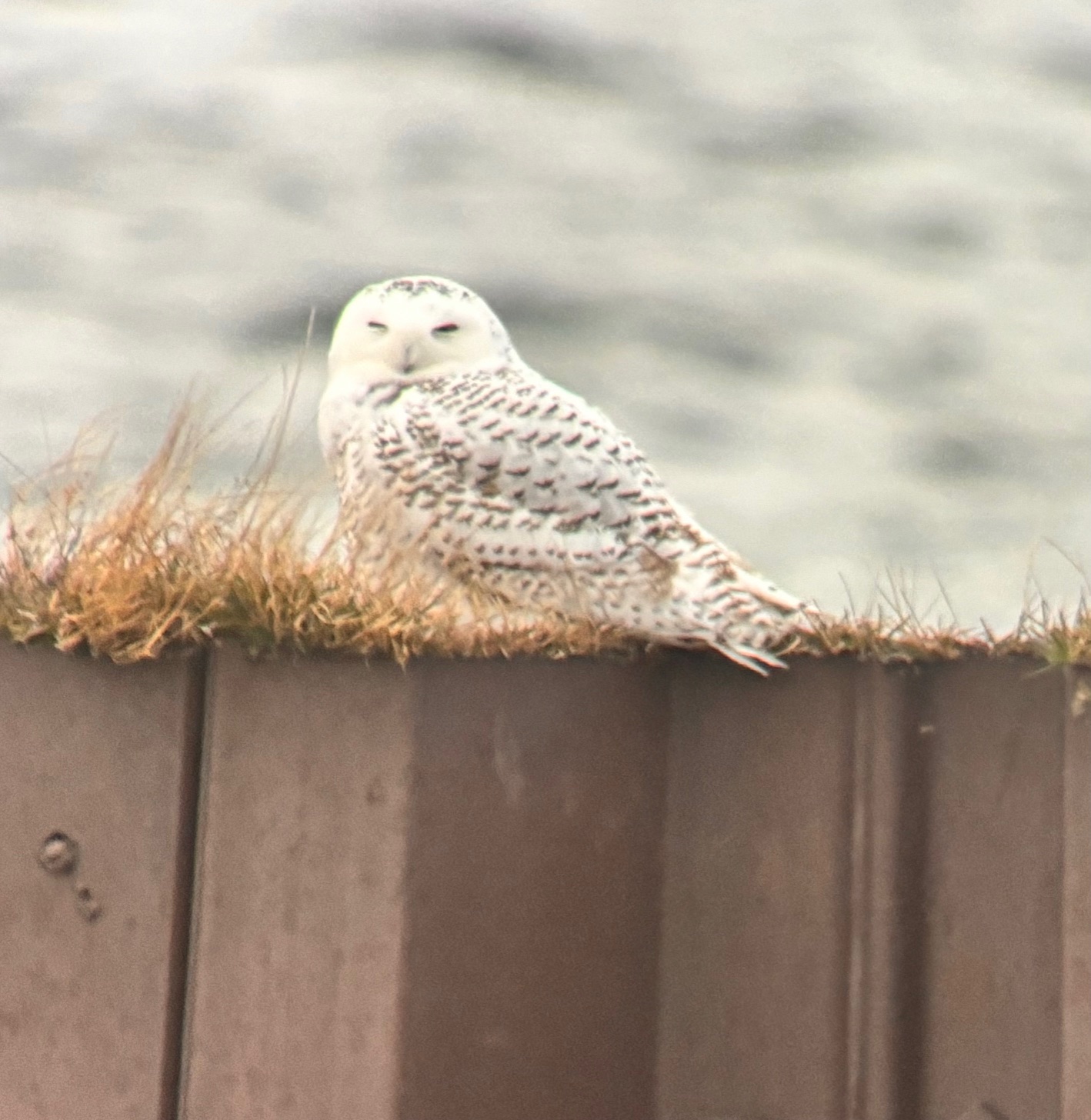
2. Snowy Owl--I haven't seen any for a few years, so nice to see one again at Sodus Point this fall. Definitely worth a quick drive up one afternoon between work shifts.
3. King Eider--I hadn't seen one since chasing one on the Texas coast back in 1998, so more than time to have seen one. Took several attempts to see one that spent a few weeks at Sodus Point back in February.

4. American Woodcock--since these were always a bit of a challenge to find in DelCo, it was nice to have several displaying every night at the Sacred Grove next door to my work, so I saw them over 15 times in April and May on the evenings I got out of work early enough to catch their twilight sky dances. 

5. Barred Owl--Always fun to hear them, and I heard them 15 times this year at the Sacred Grove, and saw one twice. 

6. Rough-legged Hawk--This was one of my top jinx Delco county birds, having narrowly missed it a few times--finally was able to see one at the Philadelphia Airport back in January. This may well be my last new Delaware County, PA bird ever.

7. Swainson's Hawk--a bird I see most years when I am out visiting family in Utah, but this was one that someone found in Wayne Co. New York and I drove over to see one afternoon in May before work.

8. Purple Sandpiper--Another bird I hadn't seen in a number of years, good to finally see one again three times up at Sodus Point on Lake Ontario.


9. Bonaparte's Gull--Uncommon in Philadelphia, nice to live where you can see them all the time--if you drive to the right place on Lake Ontario.  I saw them 24 days this fall (as opposed to only 8 times in 2023), a reliable get when needed as a new All Time Day Bird.

10. Swamp Sparrow--Like the Bonaparte's Gull, a fairly reliable All Time Day Bird many times this year at the Sacred Grove when needed quickly on the way to work (99 observations this year, as opposed to 27 observations in 2023 when I was birding more frequently).

Aside from the birds, it was actually a spectacular year for watching the sky.  I got to see my second full solar eclipse, my best views yet of the northern lights, and the great comet show this fall. So looking forward to what heavenly visions 2025 will bring--birdwise, astronomically, and otherwise!

Comet through my spotting scope

    
Aurora from my backyard in NY


Moon and Venus in fall NY sunset


Monday, January 01, 2024

Year of the Blue Jay/Tiyas/Di'di

My first bird of 2024 this morning was a Blue Jay I heard from inside before I even left the house. So 2024 will be the Year of the Blue Jay for me.

Enjoyed a couple hours of quick birding in the morning, managing 50 species including Mute Swan (new for my all time Jan 1 list) and lingering Red-necked Grebe and Common Loon in the impoundment at John Heinz NWR in Philly.

This is going to be a year of big changes. I will take the Lenape name for Blue Jay (Tiyas) with me as I move up to the land of the Seneca (where it is apparently called the Dí´di) to take a new job later this week.

Wednesday, August 16, 2023

Ask and Ye Shall Recieve

 A couple years ago I posted this on the eBird discussion group in Facebook--

Very happy that this year eBird overhauled their database so that we can report these exotic birds, track them in the database, but not have them show up in our birding totals for listing purposes. Great job eBird. 


So these Chukars from behind the Philly airport in 2020 are now officially in eBird--but they don't add to my county totals. Love it!

Chukars shown below my main Delaware County eBird list, listed with other exotics I've seen in the county, but not included on my main county list.


Tuesday, August 15, 2023

And Then There Were None

One of the things I love about birding is the window it provides onto the changing seasons, and the connection that fosters to the natural world. While we anxiously await the arrival of migratory breeding birds in the spring, you have to be paying even more attention to notice exactly when they disappear in the fall.

Wood Thrush (Source: Wikipedia)

I haven't heard a Wood Thrush in over a week, so this morning on my walk I stopped and listened and even tried some playback in my local park to see if any of the at least seven singing birds that had spent the summer there were still around. Nothing. Same with the local Red-eyed Vireos. While I will still find a few migrant thrushes this fall, especially if I get my NFC microphone up to record the nocturnal fall migration, the local birds have moved on.

Monday, August 14, 2023

July 2023 Road Trip

So this may be the road most travelled by for me, I-80 out to Utah and back. We've done this drive several times, and when we are in a hurry to get out West, this is our default drive--32 to 36 hours straight, depending on stops for food. We made a quick trip out for a family reunion in Grand Teton and Yellowstone. Not a lot of new birds for the year on the drive, and not much wildlife on the drive out, but the drive back was great, with a couple roadside Greater Sage Grouse in Wyoming and more Pronghorn than I've seen in a long time from Wyoming out halfway through Nebraska. 

Here's the eBird trip report, only 117 species, so again not a lot of new birds for the year, but nice to see some old friends, especially in Grand Tetons and Yellowstone. Note the gap in eBird checklists across Iowa--that's some major nighttime driving going on both ways there!  

6098 miles round trip, great scenery and time with family. Elk, Bighorn, Moose, Bison. No bears. A few birds. Good times.


Thursday, August 10, 2023

My 42nd Birdiversary!!!

Today marks 42 years as a birder. While I had been watching birds casually for awhile before then, 10 August 1981 is the day it really started for me, on a weeklong middle school field trip from the Portland suburbs out to the Malheur National Wildlife Refuge. An annual or semi-annual tradition at the time, middle school teachers at my school would take a couple van loads of kids out on what we called Project W--a weeklong camping and natural history adventure to SE Oregon. I was 12 years old and a self-described herper at the time, mostly interested in lizards, but after a week of seeing dozens of cool birds for the first time, I was hooked! The rest is history. 

 Here's an eBird checklist of the birds seen on that first birding trip. 

 Looking at the report, turns out one of my first birds was Clark's Nutcracker--a bird I got to see again last week in Yellowstone, and hadn't seen since before moving to PA almost 20 years ago.
Clark's Nutcracker (photo: Wikipedia)

So that's that! While I have 12 species in eBird checklists from before this date, 10 August 1981 is the day the light turned on. Thanks to my teachers and fellow students on that trip. And to the birds!

Here's my journal from this trip--apparently I was as scared of the dark as I was impressed by the birds!


Tuesday, August 01, 2023

Birding Boa Ogoi

Today I spent a beautiful morning out at Boa Ogoi (Shoshone:Big River AKA Bear River) with Darren Parry, a member of the Northwestern Band of the Shoshone Nation tribal council. We visited the site of the Bear River Massacre north of Preston, Idaho--where a US Army detachment attacked and massacred over 250 Shoshone men, women, and children at a winter village in 1863.

Daughters of the Utah Pioneers Bear River Massacre monument, Highway 91 north of Preston, ID

When I arrived at the Daughters of the Utah Pioneers (DUP) monument to the massacre on Highway 91, the most obvious birds were the non-native Rock Pigeon, European Starling, House Sparrows, and most recent new colonizer the Eurasian Collared-Dove. I wondered if it was fitting, or ironic? But listening closely, the native birds were still there as well--a Killdeer (Duck Valley Shoshone: pantei) piped up from a nearby horse pasture. A Yellow Warbler flew into the trees behind the monument and interpretive sign. A couple of Yellow-headed Blackbirds flew around the marsh, and two pairs of Sandhill Cranes (Duck Valley Shoshone: koanta) seemed to call to each other from opposite sides of the highway. White-faced Ibis and a lone Mallard (Duck Valley Shoshone: peye) flew over. Darren and I visited for awhile, and as we prepared to get in our cars, a pair of Red-tailed Hawks circled over a nearby field (eBird checklist with complete list of 16 species and coordinates)

One of six beautiful interpretive signs up the road from the DUP monument.


Picnic tables and interprerive signs up the road from the DUP monument


Memorial for the children killed during the massacre


We drove up the road a few hundred yards to a much more informative collection of interpretive signs installed by the state of Idaho with Shoshone input. It was more quiet up on this bench overlooking the valley, and a Swainson's Hawk watched us from a nearby fencepost (eBird checklist).


Roadside hot spring on the Northwestern Band of the Shoshone Nation land at Boa Ogoi

Several hot springs dot the landscape, and were an important feature making this a good wintering village site for the Shoshone. We drove down the river valley a ways to one set of bubbling and steaming springs right near the road. A miniature Yellowstone.  Along one hillside, a roadbank was pocked with Bank Swallow nesting holes, and almost two dozen swallows circled and swooped in the vicinity (eBird checklist).

For a contemporary Shoshone take on the Bear River Massacre, you can get Darren Parry's book--The Bear River Massacre: A Shoshone History--with notes on traditional Shoshone foods, prayers, life ways, and more recent history.

The Shoshone--who traditionally refer to themselves as Newe ("the People")--continue to be active at this massacre site. The Northwestern Band of the Shoshone Nation aquired over 700 acres along the river, including the massacre site, and are planning to build the Wuda Ogwa Cultural & Interpretive Center there. They have raised over $6 million of a required $8+ million (donate here) for construction, and are also conducting a multi-million dollar habitat restoration program on this land, including removing thousands of invasive Russian olive trees. Hopefully Boa Ogoi will continue to host its traditional human inhabitants, as well as its native wildlife (referred to as "our non-human kin"), for the forseeable future and until the end of time.

For more information:

The Bear River Massacre: A Shoshone History (book by Darren Parry)

Darren Parry's work with the Environmental Humanities Graduate Program at the University of Utah

2018 Salt Lake Tribune article on culture center plans

PBS video on ecological restoration at Boa Ogoi

Wuda Ogwa Cultural & Interpretive Center (information and online donation page)

Shoshoni Language Project


Wednesday, June 21, 2023

May 2023 Road Trip

Lat month my son Michael and I had a quick roadtrip out west, 7083 miles in 12 days. Not a lot of time for any real birding, but did log 175 species mostly from the highway. No surprises, but great scenery and fun to catch up with a few old bird friends--such as Upland Sandpiper on a fencepost in ND and Hammond's Flycatchers in Montana. I've covered most of these roads before, but taking a few detours here and there, and a new route home through OK, logged me 53 new counties--in most of which I was able to get at least an incidental eBird checklist posted--including Trimble County KY named after one of my ancestors (Robert Trimble).


Saturday, December 31, 2022

Top 10 Birds of 2022

Another year in the books, and another year where I didn't leave the U.S. and hardly traveled outside of Pennsylvania. Here's to more travels in the new year!  eBird has me down for only 279 species this year, with 224 of those right here at home in Delaware County, PA. So for sure I need to get out more!  That said, here are my Top 10 Birds of 2022.


Gray-headed Swamphen--Overdue new life bird for me, I picked it up on a quick trip to Florida for my youngest daughter's singing competition in May.  Been waiting to see this one for decades since they first became countable after escaping and colonizing Florida in the early 1990s. #Lifer


Gray Kingbird--Another overdue lifer for me, finally in Florida the right time of year for it. #Lifer


Hermit Warbler--a first record for Pennsylvania and Delaware County, found by visiting birders over the Thanksgiving Weekend and subsequently seen by hundreds of local birders as it played peek-a-boo with birders in a row of pine trees between an apartment building and a suburban church parking lot. Breaks the mind to imagine how many rare birds are lurking out there in unbirded marginal habitat! #NewCountyBird


White Ibis--a mind-bending new county bird for me. While not completely unexpected, it was found by a hiker along Ridley Creek in a heavily wooded section of the park, so another bird in a seemingly random spot. #CountyBird


Barnacle Goose--A new county bird for me, spotted by friends in a large Canada Goose flock that we monitor for rare geese at Springton Reservoir. It flew to a nearby Middle School field to forage and I was able to connect with it there. #CountyBird


Little Gull--another new county bird for me, long-wished for by several of us in the county, first one reported here in decades. I spent many days watching the river behind the PHL airport hoping to find one mixed in with migrating Bonaparte's Gulls, and on the best day finally was able to find a beautiful breeding plummeted adult bird very close to shore with over 400 Bonaparte's Gulls. #CountyBird


Long-eared Owl--very hard to find locally, a friend spotted one being mobbed by Blue Jays and a few of us were able to get there before it disappeared. A new Delaware County bird for me. #CountyBird


Arctic Tern--there was a major invasion of these birds in the Delaware Valley after strong onshore winds during their spring migration. I missed most of them and didn't get great looks, but a new county bird for me, so I'll take it! #CountyBird


Alder Flycatcher--a rare local migrant, great to get this for my yard list--a bird calling in the early morning of 31 May while I was listening in to my NFC microphone recording live on my rooftop. #NewYardBird


Horned Lark--another scarce local bird, heard flying over my house in October. #NewYardBird


Honorabler Mentions

Rare County Birds--Connecticut Warbler, Mourning Warbler, Red-necked Grebe, Black-bellied Whistling Duck, Stilt Sandpiper.

Rare Yard Birds--King Rail (NFC), Evening Grosbeak, Swamp Sparrow (new)


Monday, October 31, 2022

My 20th eBird Anniversary

 October 18 marks my 20th anniversary as an eBird user!  Can't believe it has been 20 years!  

As an old man, I now look back and see that on 18 Oct 1982, 20 years before I started using eBird, I was a young teenage birder with only 152 birds on my life list. 20 years before that I wasn't even alive and the Beatles had just released their first single, "Love Me Do."

20 years ago, eBird was brand new and still pretty clunky and rudimentary. I only used it a few times before I lost my password. I didn't start using it on a regular basis until creating a new profile in July 2005 when I was working with Audubon and starting to collaborate with Cornell Lab of Ornithology on the Great Backyard Bird Count and eBird promotion.

Here's what eBird looked like back in October 2002.


This was back in the days before the Google Maps functionality, when eBird had its own proprietary mapping function (which got Cornell and Audubon some cool patents that Google and others have since used). 

So 20 years of eBirding for me.  My first bird entered into eBird? A rare Northern Goshawk at Hornsby Bend Biosolids Management Facility, my old stomping grounds. I never entered any notes on that rare sightings--I should probably go back and do that sometime :-)


Wednesday, October 05, 2022

2022 Southeast PA Quad County Birding Challenge

 Back in 2020, I challenged birders in Philly, Delaware County, and Montgomery County to see which county could--

  • Find and report the most birds for the year on eBird
  • Have the most eBirders report 200+ species in the county that year
  • Have the highest eBirder total
  • Have the highest eBird yard list for the year
  • Have the most birders report over 100 species for their yard on eBird
It was a lot of fun, and boosted local birding big time (more details to be published elsewhere soon!). We ran the contest in 2020 and 2021, then added Chester County this year. I post monthly updates on social media to spur on the local birding.  Here is the latest update for the end of September.


We are having a lot of fun, even if other counties are kicking the crud out of my DelCo birders. I'm mostly interested in the eBirders over 200 and Yards over 100 categories, as they are categories anyone can really aspire to and represent increased levels of local birding for most birders.  

More People Enjoying More Birds More


Thursday, July 29, 2021

Great White Heron Chase in Philly

 For the past week or so, a Great White Heron has been hanging out on the Manayunk Canal in NW Philly about a half hour from my house. This morning I braved the traffic on I-76 and headed up there. I shouldn't have worried about parking, there was ample 2 hour street parking nearby, and I took the stairs down to the canal to look for the bird. I didn't have to even look for the bird, it was standing right there at the bottom of the stairs, twenty feet out in the canal, with a couple people standing their looking at it already.  Beautiful bird!


This is the presumed sixth occurrence of the Great White Heron in Pennsylvania, and a first for Philadelphia. Since 1973 it has been considered a subspecies of the Great Blue Heron (Ardea herodias occidentalis), but many consider it to be a valid species (see note here). It is normally restricted to south Florida and the Keys, so a great bird to see up here in Philly.

So a great bird, but also in a great spot. The steps down to the canal were covered in mosaics and murals, and the canal itself is a scenic pathway next to the Schuykil River. A great spot to spend a few moments watching a great bird.


Back up in the neighborhood, I spotted a sign for tomato pie, which induced me to stop at Marchiano's Bakery. A half pie (an enormous 12x18 inches) was $9.25 so I was helpless to resist. Love me some tomato pie, a great Philly and NJ dish if you haven't had it, well worth a stop!


Good bird, scenic neighborhood, great food--makes for a nice urban birding adventure!

Sunday, May 31, 2020

Birding Providence

My house is right on Providence Rd, in the township of Nether Providence in Pennsylvania, so when I am yard birding, I am literally birding Providence.
Birding Providence

But that's not the Providence I'm thinking of this week, after some interesting birding experiences.  For centuries, Providence has been used as a name for Deity, or for the foresight or beneficial intervention of God.  No matter your theology about Providence (there are even naturalistic or atheist traditions addressing it), it is fun to ponder and consider the magic that sometimes happens in birding.  Here are two examples from just one day this week.

1) My wife woke me up at 12:30 in the morning because she needed help with something.  While I am a Latter-day Saint, I am no angel, and am especially grumpy after being awoken from a deep sleep.  But after I composed myself, I got out of bed and helped her for half an hour.  After that, since I was already awake, I decided I would listen to my NFC microphone recording in progress, to see what might be migrating over my house.  I fell asleep with the earbuds in, but was awoken again just after 3am by the distinct loud churr call of a King Rail migrating over my house.  This is a very rare bird in my county, with very few records after their local breeding habitat was mostly destroyed by a Philadelphia airport expansion project over 20 years ago. If I hadn't gotten up to help my wife, I wouldn't have put in the earbuds, and I wouldn't have heard this cool bird and added it to my year and county list. So that was very Providential!

King Rail CHURRR call, Nether Providence, PA

2) Later that day several of us were social-distance birding together at the Delaware River behind the Philadelphia airport.  One of my friends went home for lunch, and missed a pair of Least Terns, rare for the county, as they flew past us.  We commented on how sometimes we make the wrong choices.  He texted us a few minutes later, with cell phone pics of a Mississippi Kite, another rare and hard to find migrant in the region, that had just flown over his house while he was doing yard work! Maybe he didn't make the wrong choice after all!  Forty-five minutes later, I had the thought that I should let my friends in Haverford know about the kite sighting.  They went outside as soon as they got my text, and almost immediately saw and photographed a Mississippi Kite flying over their yard!  This was ten miles away from where the bird was first seen, and its impossible to know if it is the same bird--what would the chances be? And what are the chances that I would think to text them at the exact moment they would need to go outside to see the bird--a lifer for one of them?  And my birding friend that missed the terns?  He later rejoined us just in time to see a second pair of Least Terns fly by. Amazing! Providential!

Of course it doesn't always happen that way.  Sometimes we don't see the bird.  Sometimes we barely miss it.  But it happens often enough that whether you call it God or karma or whatever, magic like this happens.  Sometimes you think of an unlikely bird, and then see one shortly thereafter. Or bizarre "coincidences" happen to put you in just the right place at just the right time to have a completely unexpected, yet providential, bird sighting. That's one of the things that I love most about birding--the skill, hard work, luck, and dare I say Providence, that has to come together to find a bird you are looking for, or to discover one that you couldn't expect.

Birding Providence.  One of my great joys of birding.


Sunday, April 19, 2020

In Praise of the Sun

The sun, dominating the horizon during my first hour of Outdoor Church
I missed sunrise this morning, as I didn't get outside until 45 minutes later.  But during my 4 hours of Outdoor Church in the yard, I became increasingly cognizant and appreciative of my relationship to the sun.

During the first hour, with the sun low on the horizon, the local weather station was showing a temperature of 36F, but there was still frost on our cars.  I was constantly dancing with the sun, to get warm, to position my body so that I could better see the birds in my yard.  Eventually, the sun climbed higher, as did the temperature.  But I was constantly looking around the sun--avoiding looking directly at it, yet looking to see where its light was most effectively making it possible to see and identify the loons, cormorants, and other birds as they passed by (see my eBird list here).

It was a perfect Sun day.  And though we still have one day of the week that carries its name, we are a culture committed to severing ourselves from the sun.  We use subterranean fossilized sunshine for most of our energy needs.  We are Hadean, rather than Celestially oriented. Our daily cycle, dominated by artificial lighting, is less and less tied to the sun.  Even our calendar, once dominated by Moonths and the passage of the sun, is now more dominated by fiscal years and quarterly financial forecasts.  Past societies literally built their most prominent buildings to line up with the passage of the sun.  The sun is shining, but we mostly just use it as a light source for our outdoor entertainments.

But sitting in my yard, I ponder all the ways the sun still sustains us--all the plants in my yard, also dancing to best catch the sun's rays, all the birds, all the other life forms, moving in daily and seasonal cycles with the sun.  All my food that needs the sun to grow. Light, warmth, and comfort. As a birder, I dance with those birds, as they dance with the sun.

It was a perfect Sun day, as should be they all!

Thursday, April 09, 2020

Birding the COVID-19 Shutdown

The COVID-19 pandemic has killed many people and disrupted the lives of many more.  While it is a terrible tragedy and scary for all of us, I've been birding a lot from my yard as well as local hotspots I can get to without having to bump into too many people.  I've got my NFC station up and running, and have already had a couple of Virginia Rails caught on tape.  I am currently #1 on eBird for the Delaware County this year, and my yard list is currently #1 in the county and #6 in Pennsylvania.

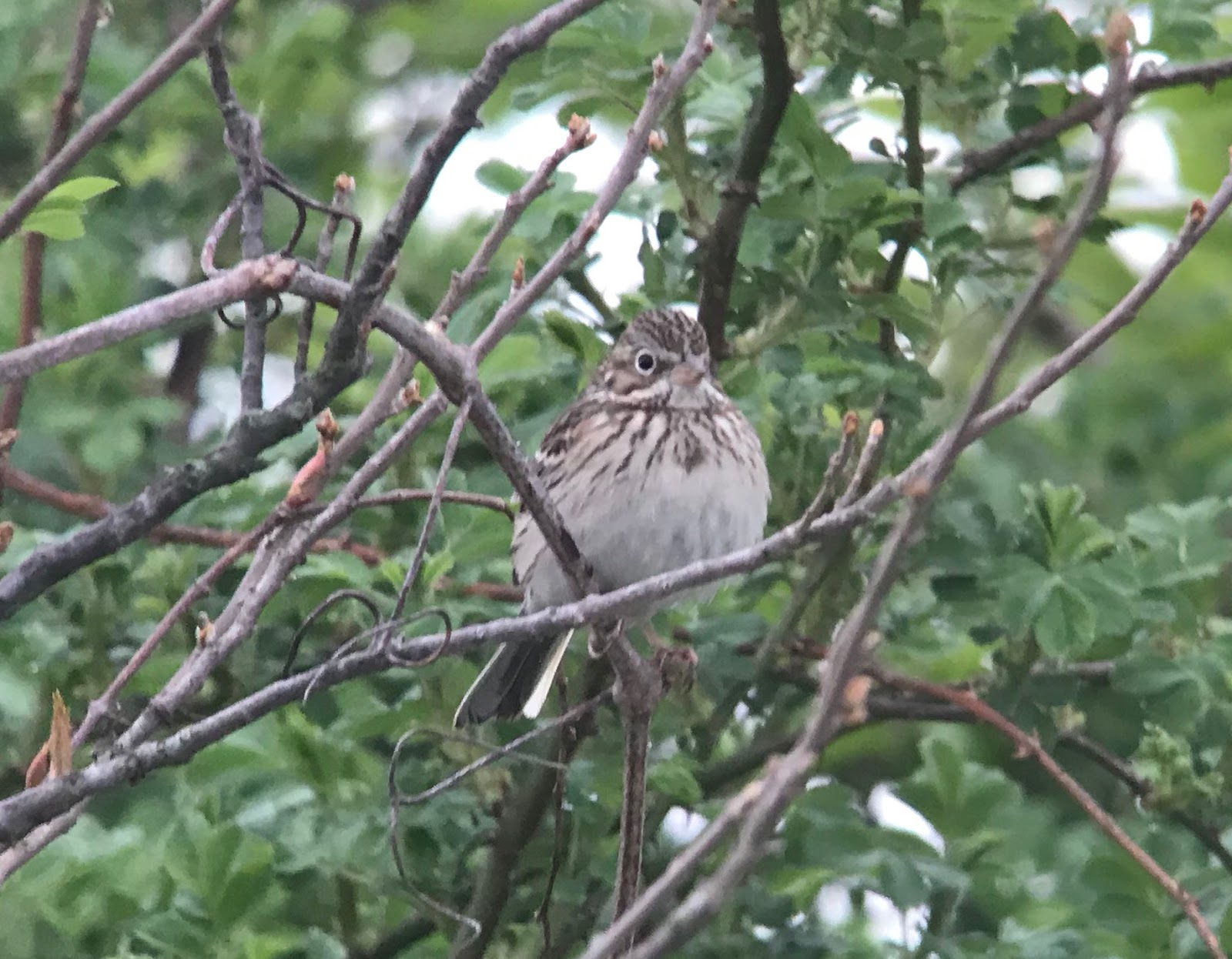
Today I was looking for Horned Larks and American Pipits--two tough birds to get in my county.  No dice in a field where they were seen yesterday (and missed by me later in the afternoon), but I did manage to get a photo of a Vesper Sparrow that has been hanging out there.  And just as I was going to leave, a Wild Turkey wandered across the field--my first for Delaware County and my overall county bird #235.  So, yay!

Vesper Sparrow, Glen Mills, Pennsylvania

After the fields at Glen Mills, I headed down to check my local patch, the Delaware River behind the Philadelphia Airport.  My first Forster's Terns of the year were hanging out on the low tide sandbar until the local Bald Eagles put them up.  21 Wilson's Snipe in a ditch, and 13 American Kestrels hunting on the airport runways were high counts.  On my way home, an American Coot--surprisingly tough to see in the county, was bird #128 for me in the county this year.

My heart goes out to everyone who is suffering.  For those who are able, enjoy your yard birds or birds close to home.  Be safe, be healthy, be well!

Saturday, February 08, 2020

Ornitheology Seminar

Looking forward to my latest five lecture series coming up next week at Widener University--Ornitheology: Birds as Symbols and Messengers of the Divine.  Lectures will include:

  1. Introduction and Birds in Australian Dreaming and African Animism
  2. Birds in Shamanic Cultures
  3. Ancient Middle Eastern and European Gods and Birds
  4. Birds in the Abrahamic Religions
  5. Eastern and Southeast Asian Religions and Birds

Tuesday, December 31, 2019

My Top Birds of 2019

As we wrap up another year, time to take a last look back at my birding for the year.  I had some great birding in my home county, but other than that, I didn't get a lot of birding in elsewhere this year, ending with a very meager 282 species for 2019 (my worst total in recent memory).  But here are my Top 10.

10. Harlequin Duck--rare in Pennsylvania, a very enjoyable sighting of a continuing female bird up in north central Pennsylvania when I had to drive up to give a talk in Williamsport in November.


9. Black Scoter--rare for the county, was able to find a beautiful pair on the river behind the Philadelphia airport during spring migration.

8. Least Bittern--pretty easy to find at the John Heinz NWR within a hundred yards of Delaware County, was glad to finally get one on the Delaware County side.

7. Red-headed Woodpecker--not seen in the county every year, I was happy to find a nice adult bird at Heinz NWR in early May.
Worst shot ever of Red-headed Woodpecker, John Heinz NWR

6. Yellow-throated Warbler--at the top of my wish list for the year for Delaware County, after missing a few in 2018.  A singing bird was found at Ridley Creek State Park in the spring and I was able to relocate it and enjoy it singing one Saturday afternoon in May.

5. Ross's Goose--rare but regular in the region, managed to get one for my yard list by scanning huge flocks of migrating Snow Goose that I was able to see one day after hearing that birds were moving through the area.

4. Blue Grosbeak--after missing this new bird for me for the county a mile from my home while sick this spring, I managed to find a nice male myself behind the Philadelphia airport later in the summer.
Not easy to shoot a Blue Grosbeak against a blue sky!  PHL airport, Delaware County, PA

3. American White Pelican--another first for me for Delaware County, seen the evening before flying south over the county, hoped they might have put down on the river for the night and was fortunate to find them down there the next morning.

More bad shots of good birds, American White Pelicans on the Delaware River

2. Brown Booby--probably my best solo find of the year, a review species for the state, a bird flying up the Delaware River behind the Philadelphia airport back in the spring.

1.  Laysan Albatross--a bird I've wanted to see since I was a kid in Oregon.  Finally got several from land on the north shore of Oahu in March.

I managed to squeak out 201 birds for Delaware County this year, passing 200 for the second year in a row.  But after hitting 200 in September I just saw one more for the year.  Too much attention to other things in my life, not enough birding.

As far as life birds, I only got four new birds for the year, thanks to a quick conference trip to Oahu in March--Laysan Albatross, Sooty Tern, Japanese Bush-Warbler, and Yellow-fronted Canary.

Looking back on the decade, some modest but good birding across the country and around the world, with trips to the Netherlands, Spain (long layover), Germany (airport birding on a layover), the United Arab Emirates (so great), Mexico (several research trips), Canada, and New Zealand (gotta get back!).  I only got 160 new birds this decade.  I would like to be getting at least that many, if not ten times as many, each year!

So for the coming decade, I would like to do much more overseas birding, and see most of the scattered regularly occurring birds I haven't seen yet in North America.  I've been to almost 40% of U.S. counties, and would like to boost that up to over 60% as well (maybe more).  And I'd like to hit all the Canadian provinces and territories--especially Nunavut.  If we stay in Delaware County, it would be nice to get over 275 on my county list, I doubt we will live here for me to get to 300 (Al Guarente is the only person with that total for the county in eBird, achieved this year after a lifetime of birding hear--congratulations Al!).

Best birding wishes to all for 2020 and for the 2020s!

Monday, December 16, 2019

100th Glenolden Pennsylvania Christmas Bird Count

When you are supposed to be birding the river for waterfowl, and all you get is this.
Saturday was the 100th Glenolden PA CBC.  I woke up very excited to try and help the count get to 100 species for the day.  It was a little wet and drizzly, but I left at 5:30 to look for owls.  Long story short--after 17 miles of driving and playing owl tapes, no owls.

I started the day up by the PHL airport to check out the river on that stretch, and wait for low tide at 9:00am to see if any good gulls showed up on the tidal flat.  But the birding was very slow, there wasn't anything around, and after an hour or so fog rolled in and I couldn't even see the river.

That was the theme for the day.  Fog and no birds.  By 11:30 without being able to see the river, I was only at 31 species, far below the 50+ I was hoping for in my area, and ten below my best morning of scouting last week.  Since I couldn't see the river, I took a longer lunch break than I otherwise would have.  It was really pretty pointless.

In the afternoon, the fog continued, then about 2:30 it finally lifted.  I hurried to Marcus Hook to look for swans, geese, and ducks--got the geese but no swans and the wind and heat shimmer off the water made it impossible to identify most distant ducks on the water.  By this point I was racing the sun to scour the 10 miles of river back to the airport.  No real surprises, most of the river was bare, making me wonder if I should have just stayed at Marcus Hook and prayed for better looks at the ducks there.

I ended the day where I started, at my favorite spot behind the PHL airport.  60 Brown-headed Cowbirds flew in at dusk, and as I refused to give up scanning the river after sundown, I was able to see a Wilson's Snipe flying over the river in the gathering darkness to end the day at 44 species.  Much lower than I had hoped.

If I do this area again, depending on the conditions, I would probably start at Marcus Hook for the waterfowl first thing (the fog killed me!) and work my way upstream, rather than the other way around.  But the possibility of owls or other grassland birds at the airport is alluring as well, though a much longer shot.  Oh well, the joys and travails of a CBC birder!  I've been doing Christmas Bird Counts for over 35 years.  Each one is a challenge.  And a memory.  This won't be one of my best, but I put in my best and learned a lot more about the fragmented urban habitats in Delaware County outside of Philly.  This count has experienced several years of bad weather lately, better luck next year!

Thursday, December 12, 2019

REVIEW: Field Guide to Bird Sounds of Eastern North America

So I've been sitting on this review for over a year--a very worthy title that I want to do justice to, but have struggled with how to review.  Here's the short of it--this is a pathbreaking book, representing an amazing new effort in birdsound identification that I want to be successful, but one that I am still struggling with.

Donna at 10,000 Birds has a great review of the book here.  If you haven't read that yet, it's a great place too start.

Take a look at the sample pages--they show what a great design this book has, with spectrograms of most of the bird sounds of the 520 bird species normally found east of the 100th meridian.  These are made from the 5400+ audio files that accompany the book, found online at www.petersonbirdsounds.com.  Checking out this excellent website, you quickly notice that there are more sounds here than included in the field guide.  That's one of the first difficulties of treating a subject like this--there just isn't room in a standard bird guide to cover every sound one might hear out there.

I am very intregued by the system that Pieplow created to classify bird sounds.  Unfortunately, I haven't put in the time to learn his nomenclature, so I'm not sure how useful it is.  So this book creates a whole new way to classify and understand bird sounds--which is great on one level, but seemingly requires significant time and effort to learn and use.  Time and effort I haven't been able to put in yet, and am not sure I will ever get around to.

So I recommend this as an amazing resource, but would like to hear more from folks who have actually used it to learn and identify bird vocalizations.  What is the best way to use this book?  How have you used it to actually learn and identify birds?


Scouting for Suburban Philly Christmas Bird Count

This year for the Glenolden Christmas Bird Count I've inherited a 10 mile stretch of the Delaware River downstream from Philly, from the PHL International Airport to Marcus Hook on the Pennsylvania/Delaware state line (see below).

My Glenolden CBC area from Marcus Hook, PA (left) to PHL International Airport (right)

Over the past week, I've scouted out more small urban woodlots, marinas, petrochemical complexes, and abandoned industrial landscapes than I have in a long time.  So far I've found 50 species in my area, and am hoping for more during the actual count on Saturday (though projected rain may hurt).

Abandoned industrial facility, Marcus Hook, PA
So far my biggest take away from scouting--there just aren't as many birds as I would expect for so m much open space.  Is it just a surfeit of exotic vegetation creating bad habitat, or is something else going on?  We hear about declines in bird populations, and it is a bit shocking how thin the bird numbers are.  In a half mile stretch of road near this abandoned complex above, there were only 41 individuals of 12 species--pretty much all urban adapters.  I would have thought there would be more sparrows in all the brush, but it was pretty slim pickings.  

I love this time of. year when I get to explore usually marginal birding areas for potential habitat and lingering migrants or vagrant wintering birds.  So far I've found a lingering (Western) Palm Warbler near the base of the Commondore Berry Bridge and three late Pine Warblers in Marcus Hook.  Hope they stick around for the count on Saturday, and that I can find a few more goodies tucked away here and there in the habitat pockets of Marcus Hook, Chester, Eddystone, Essington, and Tinicum Twp!

Nature Blog Network Fatbirder's Top 1000 Birding Websites