Subscribe

RSS Feed (xml)

Powered By

Skin Design:
Free Blogger Skins

Powered by Blogger

Friday, August 11, 2006

Latest Thoughts on Bird Flu

In the past six months, we've learned a lot about how bird flu is and isn't spread. Here's a great summary of what we know and are still looking at from Richard Thomas of BirdLife International:

1) The highly pathogenic form (HPAI) of H5N1 arose in poultry and H5N1 remains almost exclusively a poultry disease.

2) The major spread of the virus is caused by the international poultry trade, as has been stated publicly more than once by the United Nations Food and Agriculture Organization. As such, the US Govt should be investing in tighter border security if it wishes to prevent H5N1 entering the country. The recent report about tonnes of Chinese poultry meat entering the New York restaurant chain shows the US is playing Russian Roulette with H5N1. It is not the only recent report of poultry/poultry product smuggling into the US from infected areas.

3) Four human deaths have been caused by close contact with wild birds: women who were plucking swans for feathers in Azerbaijan. All other human cases have been caused by close contact with infected poultry or (in a very limited number of instances) through human-human transmission.

4) The total number of wild birds infected is in the thousands (cf. hundreds of thousands, as opposed to millions of infected chickens).

The biggest possible wild bird outbreak is currently ongoing at Ubsu-Nur, a lake that straddles the Russia-Mongolia border where there are reports of up to 10-15,000 dead birds. However, there is no official Russian Govt confirmation of the outbreak being H5N1, and early on there were reports of many dead rodents and fish at the lake - so it could just all be poisoning.

Prior to Ubsu-Nur, the largest alleged "wild bird" outbreak was at Qinghai Lake in China (where up to 6,000 birds were reported dead - mainly Bar-headed Geese). However, in recent months we've learned that Bar-headed Geese have been farmed and released at the Lake and elsewhere in north-west China for at least a decade, so how many of the geese were wild birds is not clear, nor were many of the corpses tested and confirmed as killed by H5N1 - possibly, like Europe, only a small proportion of the dead birds had the virus].

5) All wild, migrant birds testing positive for H5N1 have either been dead or dying. There is no properly documented case of a wild bird carrying H5N1 asymptomatically.

It is true that some Tree Sparrows in China were found to be carrying HPAI H5N1, but not the Z-Genotype that's causing all the problems. They're also not migratory. The other widely-publicised "asymptomatic wild bird" case were six "wild, migratory ducks" at Poyang Lake, China reported by Chen. However, the authors are unable even to say which species these birds were; one of the possibilities they give (Spot-billed Duck) has a resident population at the lake. I can send a list of other flaws in their methodology - not least of which is that they did zero poultry testing around the lake].

6) The best evidence for long-distance movement of the virus by wild birds was in Europe in winter/spring 2006. The scattering of dead/infected wildfowl were consistent with movements of birds fleeing cold weather in the Black Sea/Caspian Sea regions. Poultry had been infected for months in these regions before the virus's appearance in wild birds. Our "best guess" is wild birds became infected in poultry farm factory outflows. [The Ruegen Island (German) outbreak is very strange and points to a local source].

7) The US Govt is probably wasting its money on testing wild birds in Alaska using its current methodology. All the reports I have seen refer to researchers taking cloacal swabs. Fouchier reported (at recent FAO-OIE conference on wild birds) that artificially infected ducks DID NOT EXCRETE THE VIRUS IN THEIR FAECES; it was only present (and detectable) in tracheal swabs. Hence, a negative result from a cloacal swab may be just a false negative.

8) The virus has been endemic in South-East Asia for more than a decade. More than 16,000 healthy, wild, migratory ducks in Hong Kong have been tested during that period - and all found to be negative for H5N1 (subject to the proviso above about cloacal testing). Similarly, more than 12,000 samples from birds in Alaska from 1998-2005 were all negative for H5N1.

9) The westwards spread of the virus from China to Eastern Europe follows no known wild bird migration pathway; nor does the timing (spring in the east, autumn in the west) follow a plausible migration route. The introduction to Africa (Nigeria) was unquestionably through trade.

10) If there was a significant danger of H5N1 introduction into the US through mixing of Asian migrants with American migrants in Alaska, why has there been no outbreak of H5N1 in major destinations for Asian migrant birds, such as the Philippines, Australia and New Zealand?

Japan and South Korea both experienced outbreaks following importation of infected poultry meat. After stamping the disease out through culling and tightening their borders, neither has experienced further outbreaks. The US should take note.

Thursday, August 10, 2006

Birding Anniversary

Today is my 25th birding anniversary. Actually, the first date I have with a bird sighting was a Killdeer I saw 14 June 1977, and I made my first bird list for a cub scout requirement in July 1977. But 25 years ago today, I went from being a backyard birder, to a full-fledged birder and lister.

I had been an active herp enthusiast for several years, when I got invited to go on a week-long birding trip to Malhuer National Wildlife Refuge in eastern Oregon with Ron Keil, my junior high science teacher, and a couple van loads of other teachers and kids. We kept a bird list on that trip, and I got totally sucked in. While I only saw a couple lizards on this trip, I saw over 50 bird species, including my first Burrowing Owls, White-faced Ibis, Common Nighthawk, and American Avocets. It was life changing. Its all so burned into my mind that I can still tell you what I ate for dinner at the Malhuer field station on August 10, 1981--vegetarian spaghetti with zuchini, very tasty! Juice Newton's Queen of Hearts was climbing the pop charts, we watched the Perseid meteor showers from the top of Steens Mountain, and it was a magical time that changed the course of my life.

Birding is more than an obsession. It is a way of ordering your life--including your experiences and memories. Dates of important bird sightings and birding trips become etched in our psyches, and change our very souls. Many of us can tell you exactly when and where we were when that birding bug (and I'm willing to call it an infective virus) first hit us.

Me, I was twelve years old, twenty five years ago today, at Malhuer National Wildlife Refuge. For me, that is holy ground.

Wednesday, August 09, 2006

Bird I am not seeing

In 10 years of living in Texas, I waited in vain for one of these guys to show up again so I could chase it for my ABA list. Now that I'm in Pennsylvania, sure enough one is now hanging out in Estero Llano Grande State Park in Weslaco, Texas. Such is life. (photo: Erik Breden)

Changes at ABA

The American Birding Association has been struggling to find a new executive director, but the new appointment is now announced on the ABA Website. I won't spoil it here, so check it out if you're interested. Hope this turns out to be a good thing--good luck, guys!

As for changes here, I'm gonna try out this as my new banner...

Tuesday, August 08, 2006

Sooty Shearwater Migration...Amazing

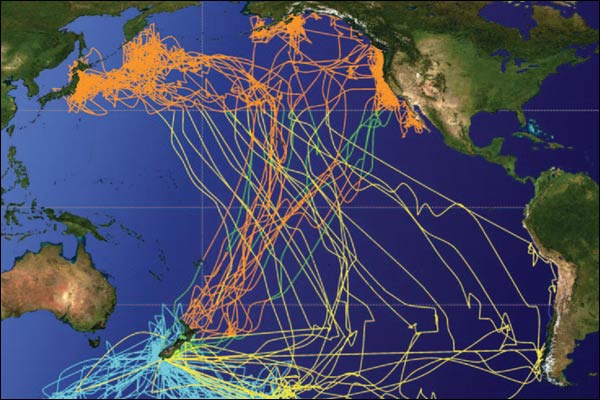
Imagine a 200 day 40,000 mile trip around the Pacific Ocean from California, to Japan, to New Zealand, and back again. Throw in some nice 180 foot deep ocean dives. Lots of good seafood. Now imagine doing that every year of your 30 year life. And you only weigh a pound and a half. Welcome to the world of the Sooty Shearwater. Check out this BBC report on a recent study tracking the migration of these birds. On this map the blue lines are breeding season movements, yellow is the northward journey, and orange lines are winter (our summer) movements and the journey back south. Simply amazing.

Monday, August 07, 2006

Tilting at windmills?

So, somebody wants to put a wind farm in your backyard. Maybe you want it, maybe you don't. Then somebody comes along and says that it might kill lots of birds. So, what do you do? How many birds get killed by windmills, anyway?

Here's what we know: researchers have found that on most modern wind farms, each turbine kills an average of 2.3 birds each year (read the latest NWCC report here).

So if they want to put a monster 500 turbine wind farm in your county, that might kill an estimated (reaching for the calculator...) 1150 birds a year. Still sounds like a lot?

It is estimated that the average house kills around 10 birds a year that smack into its nice picture windows. The average outdoor cat may kill 10 birds each year as well. There are about 100 million homes in the U.S. and maybe that many cats as well. Are you doing the math? We're looking at something like a billion birds killed by windows, and another billion killed by cats, each and every year. With an estimated 20 billion birds in the U.S. each fall, windows and cats may be killing about 10% of all birds every year.

How does that stack up against birds killed by windows. If you crunch the numbers found here, you'll find that there are currently something like 17,800 wind turbines in the U.S. At 2.3 birds per turbine, that's 40,940 birds killed by windmills each year.

Of course, these are estimates. There are some windfarms that kill more birds. Others kill fewer birds. If someone is proposing a windfarm in your area, make sure that they do their environmental studies to show that they're not going to build it in a major migratory pathway, or near too many nesting hawks or eagles. See if you can get them to do ongoing monitoring of the windfarm to make sure that they aren't killing inordinate numbers of birds.

All in all, the habitat destruction that takes place putting in the service roads for the windmills will probably be more damaging than the windmills themselves. Again, if you have a chance, make sure that those impacts are addressed. Maybe there should be some mitigation for habitat destroyed. Its probably going to come down to what you and your county are able to negotiate.

If wind developers do their homework, and do a good job choosing a site, then there shouldn't be too big a problem with a windfarm killing birds. If you want to oppose a windfarm on aesthetic grounds, that's another thing. Just remember that the window you have to look through to see the local windfarm is actually killing at least as many birds as the windmills themselves.

Now, that said, wind power's ability to reduce our need for fossil fuel burning needs for electricity generation is another question entirely...

Friday, August 04, 2006

Champion

Well, I'm not getting much traveling in lately, but my 2006 yard list is currently #2 in the state of Pennsylvania. OK, that's second place in the urban yard category. But, hey...you work with what you got. Latest addition--two Purple Martins seen about a quarter mile away across the creek. As long as I can see it from my yard, its in!

Pretty soon I'll have less time for yard birding. In the next three months I have trips planned for Maine, Colorado, Guatemala, Maine again, Mexico, Houston, San Diego, Austin...stay tuned, should be some bird reports in there somewhere!

The Shorebird Guide redux

OK, after all the great things I said about The Shorebird Guide (and its still a great book), I didn't find it very helpful in working out last month's ABA photo quiz. I had tried to do the quiz at work without all my books, and this book didn't ever get to where I needed to. To be fair, Sibley didn't help much either on this one. There's only so much you can get from a book...and a single online photo. Fortunately, its usually easier to identify birds in the field, as you usually get a better view (and size clues) from several angles. Oh well, better luck with this month's photo quiz!

Friday, July 28, 2006

Hawk with arrow

OK, this is getting rediculous. After last week's story about the ibis with an arrow in it, now comes this news of a Red-tailed Hawk with a similar injury here in Pennsylvania. What kind of poor blighted soul would get enjoyment out of shooting at a big bird with a target arrow? Hope they can catch the bird...if only to get finger prints off that arrow!

Update: The bird has been captured and is doing well in rehab (see story here)

Monday, July 24, 2006

The Shorebird Guide

As a young birder growing up in Oregon, shorebirds were some of my favorites. They migrated through in fair numbers, but mostly through out of the way habitats that most people didn't even know existed. I remember some of my first attempts to observe and identify sandpipers, like the time I walked out through knee-deep mud into Siletz Bay, and was rewarded with my first ever views--very close views--of such gems as Black Turnstone, Ruddy Turnstone, and one of my first "rarities" a Semipalmated Sandpiper. The smell of the mud, the blinding sun, the close connection to exotic arctic-breeding birds...all hooked me on shorebirds for life.

Learning to identify shorebirds was a challenge. Many of them look very similar. After years of puzzling over them, mostly identifying them through trial and error (oh, and the errors there were!), it got easier until now, most of the time, I can identify most shorebirds I see quickly and at great distances.

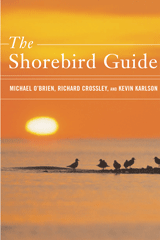
Now, Michael O'Brien, Richard Crossley, and Kevin Karlson have made it easier for most birders to feel comfortable identifying shorebirds in what Houghton Mifflin is billing as The Shorebird Guide (and yes, the italics are in the original title). And you know what, it clearly is the best shorebird guide out there--and there have been some fabulous shorebird titles come out over the past 20 years.

At over 460 pages, its impossible to do a thorough review of this book. It isn't one to be picked up and read through all at once; it is more appropriately a useful tool and study guide. The first section contains almost all of the identification material, with hundreds and hundreds of photos illustrating every shorebird species known to have occurred in North America. The photo captions explain how to identify each species as they change colors throughout their lifetime--which gives the reader the best idea ever of what the birds look like. The second half of the book contains more detailed description of the behavior, migration, molt, and vocalizations of each species--which helps the reader better understand the birds themselves.

Much is made about this book's (along with Pete Dunne's recent book's) attempt to teach the skill of identifying birds by their General Impression of Size and Shape (GISS). While Dunne's book tries to do this through words, this book mostly does this through stunning photographs which--while they do illustrate size and shape very well--also undermine the emphasis on those points by drawing more attention--through their absolute beauty--to the feathers and markings of the birds. Perhaps more "bad" photos of distant birds or silhouettes might have provided more useful here (though there are a fair number of shots such as these to look tantalize the reader). But hey, how often is your harshest criticism of a book that its illustrations that are "too" good?

And now a brief word of caution for the shorebirding tyro heading out to the mudflats with this book. While it contains most of the information you will need to identify these birds, it can't give you the skill and wisdom needed to actually do so. That will take some time and effort. By relying on size and shape, you may make snap decisions that are incorrect. I still mess up sometimes on distant Pectoral and Least Sandpipers when they are far away and I can't get a good size comparison to gauge their true size because these species look very similar to me without looking at plumage details. So, while using size and shape is a good first step in identifying these birds, don't be fooled into thinking that this will always be enough. Most of the time you'll need feather patterns and colors to back up your GISS identification. Especially if you think you are looking at an exciting vagrant shorebird from the Old World. GISS identification, while a skill of advanced birders, can wreck havoc on the intermediate and beginning birders, and can even throw an expert when used carelessly.

GISS is of greatest use in situations where lots of distant birds need to be identified and counted quickly without being able to see nuances of plumage--such as at a hawkwatch or while doing shorebird surveys (and if your going to take the time to find and identify shorebirds, you might as well count and report them so we can better track their movements and populations). But most of the time, wisdom will lead an experienced observer to use both GISS and careful feather inspections to confirm their ID. So, if you live in most of the country away from the coast, don't immediately think that the dowitcher you are looking at is a rare Short-billed because it looks too flat-backed and not round like it swallowed a grapefruit. If the bird gives you that impression, make sure you get confirmatory plumage marks and vocal clues.

That said, I absolutely love this book. Few observers will be so familiar with all shorebird species to not learn something new from this book, while the beginner will encounter an embarrassment of riches. It will still take a lot of field work to really learn to identify these birds out in the elements, but that chore is made much easier with this book. Some of the photos even serve as photo quizzes, which make readers really work out the identification for themselves--a very useful approach. Puzzling over one such photo, I learned more than I ever bothered to learn before about the differences between young and adult Black Oystercatchers. These birds are a cinch to identify most of the time, so the temptation is to pay them little mind, but this book brought me closer to appreciating them than I've felt for a long, long time. So, if you love shorebirds, you'll love this book. If you struggle with identifying shorebirds, this book will help you with that, while instilling a love for them in the very core of your soul.

Friday, July 21, 2006

Gone

Several big trees were cut down yesterday behind our house in the lot across the alley. While I hate to see trees come down (and I think the Carolina Wrens that hang out down there hated it even more than me, they were singing up a storm this morning, probably readjusting their territories), it does open up a wider view of the skyline and the creek down in the park--so maybe it will slightly improve some bird viewing from my back porch.

One of the tricky contradictions between birding and conservation is that many of the best places to see birds are actually not that great as bird habitat, and some of the best bird habitats provide horrible bird viewing. If all you want to do is see lots of birds, there are plenty of places to do that, and many people go birding without thinking much about conservation as long as they have their favorite couple of birding spots to go to regularly.

So...is it more important to provide habitat for birds (like the trees in my alley) or to provide bird viewing opportunities (like my wider view of the creek and skyline)? In the bigger scheme of things, bird habitat has to be more important. Now the trick is to get people to understand the habitat value of land and landscaping. Just because you have a bird feeder and 20 species of birds regularly visit your yard, doesn't mean that you have great bird habitat there. The problem isn't that such yards are a glass half full or empty as bird habitat, its that most people with a couple birds in their yard will think everything is hunky dory and not realize what they are still missing.

As for me, I hope that my wrens are able to remain in my neighborhood now that some of their favorite trees are gone--and I need to make longer-term plans for attracting more species to my own yard.

Tuesday, July 18, 2006

Life in the city

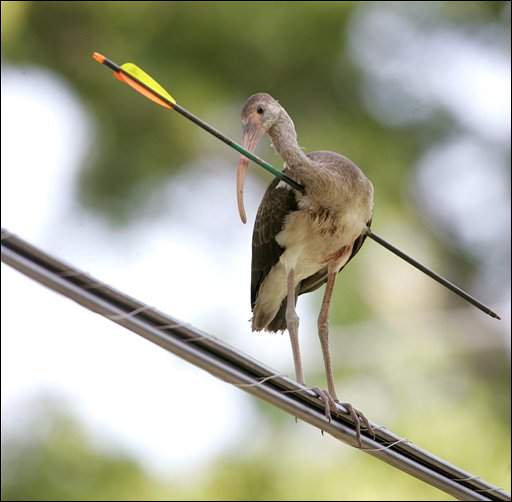
Here's something you don't see every day...an ibis on a power line. Then again, you don't usually see young White Ibis with arrows through their chest either. Apparently, somebody in Florida shot this bird with a practice arrow, and authorities spent two weeks trying to capture the bird to give it medical attention. When those efforts failed, they called off the attempt. Seems the bird is doing OK, hanging out with other birds, and can fly. But what an urban bird horror story!

Besides stray arrows, urban areas pose some of the greatest hazards faced by birds in North America. Fully 10% of all the birds in North America are killed each year by a combination of feral and outdoor house cats (1 billion killed each year) and plate glass windows (another 1 billion killed). That doesn't even count the tens of millions killed by collisions with cars or poisoned by pesticides, or any of the other urban hazards. Is it any wonder that many songbird populations are declining?

So, while bird feeders and handouts from people may encourage some species to hang with their human homies, the hood can be a dangerous place for many birds. One of our biggest challenges of the next century will be to find a way to co-exist with more bird species as the rate of urbanization and exurban residential development continues to escalate. One way to think about this is in terms of win-win or reconciliation ecology.

Can we create cities and suburbs that are as good for birds--even those that usually don't do well in urbanized areas--as they are for people? Can we envision housing developments or commercial districts with Sage Sparrows or Golden-cheeked Warblers living on the roof? Buildings that look more like shrubby or forested hillsides--both to us and to the birds (like the ACROS building in Fukuoka, Japan pictured here)? What is it going to take to start creating habitat, rather than just destroying it, every time we want to "develop" a piece of property? Yeah, baby! That's the kind of progress I'm willing to support.

Ann Coulter, if you really want to be smart...

May I recommend James Downard's excellent review (Part I and Part II) of Ann Coulter's latest anti-evolutionary arguments. The world is a complex place, and it takes some time and effort to wade through the evidence supporting evolutionary theory. In other words, not a task that should be trusted to a political pundit and NY Times best-seller writer without the requisite education.

Friday, July 14, 2006

This is how bird flu will get to the USA

Smuggled poultry products, not wild birds, are probably the greatest threat. Read this story here. Very few wild birds from infected parts of China will ever fly on their own to North America. Meanwhile, thousands of possibly infected geese, ducks, chickens, and pigeons are potentially smuggled into the US each year.

Baby Towhee

On my way into work this morning, I stopped at the bird blind at Peace Valley Nature Center for a little relaxation. 22 species of birds were at the feeders, including something I'd never seen before--a juvenile Eastern Towhee (see photo by Birdfoto). It spent most of its time on the ground in the bushes or grass below a couple feeders, but a few times it flew up onto a feeder or into a pine tree. In flight, huge white patches in the wings and white outter tail feathers might remind one of a mockingbird. Eastern Towhees are a species of conservation concern, as they nest in shrubby understory of forests that are the favorite food of the overabundant White-tailed Deer in the East. The nature center here has a deer exclusion fence around the bird feeding area...good to see that at least one baby towhee made it out of the nest there.

Hummer

Finally, a new yard bird. While eating breakfast this morning, I caught a glimpse of a hummingbird flitting up into a tree on the back end of our lot. I got out the binoculars and was able to watch the immature Ruby-throated Hummingbird get chased around a dead tree by a female House Sparrow. Since our pet goldfish died this week, maybe a new hummingbird feeder is in order to take my kids' mind off the loss of Leoptodon the pet goldfish (named by my kids after the huge prehistoric sea reptile Liopluerodon).

Thursday, July 13, 2006

When birds were gods

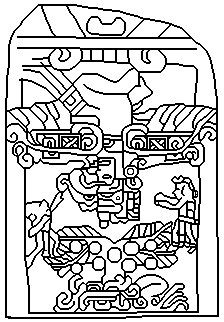
There is a long American tradition of rulers or priests pretending to be birds in their rituals--going back at least to the Izapan culture in southern Mexico before 300 BC. These and similar rituals continued through Mayan and other cultures, including the birdman cult of the Mississippian cultures in Eastern North America up to nearly the time of European contact. Birds, with their ability to fly, seemed to represent many divine powers to these peoples. Some people still believe that the Mesoamerican Principal Bird Diety is important, and that it figures into prophecies concerning cosmic changes to occur in 2012. Apparently, the mystery of living with birds continues, with the bird symbols of the Ancients encouraging additional ways to experience birds beyond the evolutionary ecological paradigm of Western science.

Friday, July 07, 2006

Grassland birds

We've all seen it. A grassy field with a muddy track through it, surveyors tape, and nearby construction equipment. For most people, a grassy field probably looks like a perfect light industrial or residential development site. But many of these apparently empty spaces are actually great bird habitat.

I visited one of these this morning. Three Grasshopper Sparrows were singing their high pitched trills in the grass (listen here), and at least half a dozen Savannah Sparrows were flitting about. Both of these birds are increasingly hard to find here in SE Pennsylvania, as their grassy habitat gets bulldozed to make way for sprawling development. A couple of Killdeer were running along the muddy construction road, with their fluffy babies, and an Eastern Meadowlark (another declining grassland bird) flew over as I was getting ready to leave. (Grasshopper Sparrow photo credit: BLM)

As I walked back to my car, I couldn't help but dream of light industrial development that protected grassland habitat--maybe huge low-slung buildings with grassy habitat actually growing on the roof. For a fleeting moment I envisioned myself as a commercial real estate developer struggling to create awesome bird habitat on the rooftops of my buildings. It sure was a better vision than the impending habitat destruction that was actually in front of me.

Brand new species

The latest edition of the American Ornithologists' Union bird checklist is out, announcing a new species of grouse for North America--the bird formerly known as Blue Grouse is now two species, Dusky Grouse and Sooty Grouse. Actually, these two birds were considered separate species by the AOU in the 1920s, but were lumped together as Blue Grouse in 1944. New DNA evidence suggests that they really are separate species, with the Sooty Grouse living in the coniferous forests of the coastal Pacific Northwest, and the Dusky Grouse living in montane forests of the Rocky Mountains.

So, for a while at least, all the field guides to North American birds will be out of date.

I first heard Sooty Grouse while searching for Spotted Owls near Mount Hood in Oregon as a kid, and saw my first Dusky Grouse sitting in a tree in Memorial Cemetery in Salt Lake City in 1993.

The new checklist supplement also makes a lot of rearrangements and changes to scientific names, based on latest research on relationships between species. So, lots of changes reflecting our growing understanding of the world of birds. Pretty fun stuff!

Thursday, July 06, 2006

Birdchaser on Space Shuttle Poop

You can read it all in the AP story here. For better or worse, my little comment is getting picked up everywhere.

Wednesday, July 05, 2006

Gettysbird

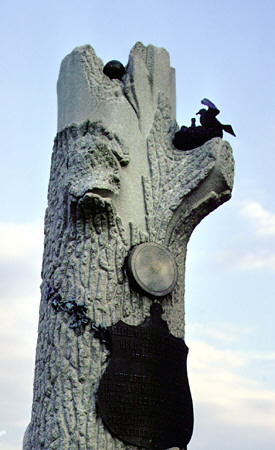
Took the family to Gettysburg this weekend to see the battlefield, and was struck by the Oak Tree monument to the 90th Pennsylvania Volunteer Infantry, featuring a nest with a mother and baby birds on a snag. Apparently, the tree was mostly obliterated and a robin's nest fell down during the battle, and a member of the 90th climbed the tree under heavy fire to replace the nest in the embattled tree. Even during war times, the best of human nature sometimes emerges to help birds placed in harms way by our own actions (photo credit: here).

Friday, June 30, 2006

Lake Nockamixon

Took off from work a bit early to get some fresh air and look for some birds up at Lake Nockamixon, a large lake about 10 minutes from my house. Juvenile Tree Swallows--sporting Bank Swallow-like chest bands--were active around the lake, as were Eastern Kingbirds near the fishing pier. A distant second year Great Black-backed Gull was late (or early). It and the Ring-billed Gull I saw there were flagged as unusual by the eBird filters. Nice to hear Ovenbirds singing in the woods--don't get those here at the Audubon Science Office.

Thursday, June 29, 2006

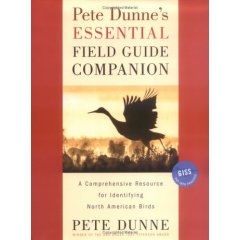
Essentially Dunne

How much would you pay to travel across the country for a year birding with one of America's biggest birding celebrities? While such a trip might set you back tens of thousands of dollars, about $30 can get you the next best thing if you buy Pete Dunne's Essential Field Guide Companion. Reading this new book is like following Pete Dunne on an extended field trip across the continent as he rattles off his own impressions of over 700 bird species--including his own nicknames for the birds, tips on identifying them, their characteristic behaviors, and even unique aspects of the the way each species flies.

While labeling a book as "essential" is a pretty tall claim, what about this book might give someone the idea that they would really, really need it? First off, its important to discuss what this book is and isn't. Basically, this book is an identification guide...but not the traditional bird guide that you might take out into the field and hold up to see which bird picture matches the bird you are looking at through your binoculars. Perhaps the most amazing thing about this book is that it may be the first bird identification book in a hundred years to have no illustrations. That's right. Over 680 pages of how to identify birds, without a single sketch, drawing, painting, or photograph of a bird.

So, how are you supposed to identify birds without pictures? Here's where this book is different. While most bird identification books are designed to be taken into the field, this one is not. It isn't a field guide. As the title indicates, its a companion or supplement to your field guide--something that Dunne might call a Field Guide Helper (and if he was designing his own book cover, pattern if after a box of hamburger helper). Instead of reading it while looking at a bird, this book is designed to be read while looking at another field guide. It doesn't belong in your hand or backpack in the field, it belongs on your desk or table top next to your field guide.

Dunne explains that he wanted to write this book because he felt that the text in modern field guides is just too brief. He got frustrated working on the last edition of the Peterson Field Guide to Eastern Birds, because he wanted to include more text but there wasn't room. Dunne was also inspired by the old Audubon field guides, the ones with paintings by Eckleberry, that had lengthy written descriptions and notes about each bird. The modern Audubon photo guides also have a lot of text, more than the other more recent guides.

So, this book is intended to provide all the text that couldn't be put into a normal field guide, but that could help you better identify the birds you see in the field, but are still puzzling about when you get home. In this way, it is different than Kenn Kaufman's Lives of North American Birds, which is a field guide companion focused on the life history details for each species rather than bird identification issues. The other book which this one needs to be compared with is the new National Geographic Complete Birds of North America. The National Geographic book contains illustrations from their field guide, with expanded text giving additional information on how to identify the birds. So, what might make Pete Dunne's book more "essential" than the National Geographic book?

While it may not be possible to answer that question directly, an exploration of Pete Dunne's Essential Field Guide Companion quickly shows that it makes a unique contribution to the bird identification literature. First of all, instead of focusing on all the details of the plumage of each species, this book is meant to illustrate how GISS is put into practice. If you aren't familiar with GISS, this is your introduction to the Cape May school of birding, where General Impression of Shape and Size (GISS, pronounced jizz--but don't google that spelling!) is of primary importance, and color patterns often secondary. While the use of GISS as a primary identification technique goes back to the early days of birdwatching, Dunne has done as much as anyone to promote its use over the past few decades, beginning with the identification of distant hawks and falcons during migration, as outlined in the classic Dunne, Sutton, and Sibley book Hawks in Flight.

Pete Dunne's Essential Field Guide Companion provides almost a full-page Hawks in Flight style treatment to practically all the regularly occuring birds found in North America. Dunne and his wife traveled across the country to revisit all of these species while writing this book, so he claims that this book is the first bird identification book to be written in the field while watching each species. Reading the species accounts, you do get the feeling that you are there with Dunne as he calls out the identifying features while watching the birds. As I mentioned before, this may be the most engaging and valuable feature of the book, giving the reader a chance to vicariously bird with Dunne as he leads us to see all the birds of North America.

For each species, Dunne begins by offering us his own nickname for each species. Why would he do that? The idea is hardly original to Dunne, though he can be credited for resurrecting an idea first suggested long ago. According to Joseph Hickey in A Guide to Bird Watching (1943),
Not many years ago, Professor Samuel Eliot (perhaps thinking of beginners for the next thousand years) bravely suggested new names for some of the more mistitled species. The northern water-thrush, which isn't a thrush at all, he said could be called 'bogbird'...if one is still distracted with the multiplicity of bird names and often confused by species that look very much alike, a simple solution is to work out a series of private and temporary names for harder species. The two water-thrushes, for instance, could almost pass for twins. One has a yellow line over the eye, the other a white one. Many observers can never remember which has which. Try privately calling one the 'wihte Louisiana' for a while, and the other the 'yellow northern.' In a surprising short time, a once-vexing personal problem will have benn permanently settled. This trick can be extended to many other species..."


So, taking up the challenge, Dunne offers nicknames for all the birds in North America. While this feature is just a small part of his book, it has drawn many comments. Most readers will find some of the names useful, while others may leave them cold. Bronx Petrel (Rock Pigeon) doesn't do anything for me, and I'm puzzled as to why he called the Yellow-rumped Warbler (which already has a well-known moniker of 'butterbut') The Swarm Warbler. So, take them or leave them, perhaps the greatest charm of this attempt is a look into the mind of Dunne. You can see the inner wheels of the mind turning as he tries to come up with over 700 nicknames, and the names often say as much or more about Dunne as they do about the essential qualities of each bird.

For a book meant to be read alongside a modern field guide, the status and distribution sections that start each of the over 700 individual species accounts is perhaps the least helpful. If you have a good map from any of the modern field guides, you can tell at a glance where each species is supposed to be--so in this case, where a picture is worth a thousand words, the dozens of words spent describing the range of each species might have been better used elsewhere.

Sections on habitat are a bit sketchy, though one innovation Dunne employs is to list other birds or animals that each species is often associated with. Sometimes this is useful (maybe you can look for Northern Bobwhites where you hear Field Sparrows), other times not (while Golden-cheeked Warblers and Black-capped Vireos may be found in relative proximity in Central Texas, they usually occupy very different habitats, and you wouldn't necessarily look for both of them in the same locations). Another innovation that doesn't work as well for me is Dunne's classification of species based on their likelihood to wander and turn up outside of their normal range. Again, for a book that is meant to be read with a field guide, the little green circles in the Sibley guide or the lighter shaded range map colors in Kenn Kaufman's guide provide this type of information about vagrancy or species wanderings already.

The second half of each species account is where Dunne's book becomes more useful and interesting to me. His descriptions of each species attempt to be more lyrical and evocative than that usually found in field guides. Again, this isn't a feather by feather description of each bird--that type of info might be more easily found in the new National Geographic book, though even there the descriptions aren't usually that detailed--the best info on sexing and aging most species by feather details is probably Pyle's Identification Guide to North American Birds. What you get from Dunne is a description of his General Impression of Size and Shape (GISS) of each species. These descriptions are best read while looking at an illustration of the bird in a field guide--where a picture may be worth a thousand words, but only if one knows what to look for. Again, in this way its almost like having Pete Dunne in the field showing you what to look at in your field guide as you puzzle out the identification of a bird. If you've birded with a professional guide, you know that they do this all the time. This book allows Dunne to do this for all of us, since together we would make up a larger birding party than would be feasible to manage in the field!

For me, the most interesting sections of the species accounts are those noting the behavior and flight characteristics of each species. While some of this information is gleaned from the comprehensive Birds of North America life history accounts published by Cornell, they also reflect Dunne's experience with the birds in the field. If you are trying to identify birds in flight, Sibley's illustrations of birds on the wing are great, but doubly useful when linked to Dunne's notes about wingbeats and other aspects of the way the birds move or behave. I found these sections to be the most useful, and the most deserving to be called "essential".

Bird songs and calls are difficult for almost everyone to learn. Its easier when you can be in the field with an expert, and have each call and its distinctive features pointed out to you. While most field guides provide some description of bird sounds, Dunne here provides his own interpretation and hints at how to identify them. While a field guide is needed to accompany most sections of this book, the vocalization sections might be most profitably read while listening to a good bird CD collection like the Petersen or Stokes series.

Just like a field guide, this probably isn't a book you are going to sit down and read cover to cover--though most readers would learn a ton if they could. Its more for dipping into here and there. In a final analysis, how well does this book instruct the reader in the GISS school of birding, and how "essential" is it? While I enjoyed Dunne's descriptions and sections on behavior, flight, and vocalizations, its unclear to me that written descriptions are the best way to "illustrate" GISS principles. In the field, GISS are processed by a different part of the brain then language--so the trick here is that Dunne's descriptions require the formation of strong connections between two parts of the brain. To effectively use GISS, you have to be able to identify birds without using the language processing part of your brain. When pushed, the language processing part of your brain should be able to interpret--as Dunne has done here--the GISS that the other part of your brain has cued into. But all this takes practice, and experience with real birds. In some ways, Roger Tory Peterson's simple and almost impressionistic early field guide illustrations were perhaps even more effective at conveying the GISS of each species than any lengthy, jocular, or folksy description might be. I think we have yet to find the ideal way to teach people the GISS method of bird identification, though this book will be useful to most readers.

So, while "essential" might be a bit of an oversell (for which I'm sure we can thank Houghton Mifflin, rather than Dunne himself), this field guide companion will be useful to most birders, as well as a treat. It provides more information than most birders will master in a lifetime, as well as the closest approximation that most birders will get to actually birding with Pete Dunne in the field. As such, this book is valuable and fun to read, as in the final analysis, it provides a window into birds and the joys of birding that is essentially Dunne.

Other reviews of this book in the blogosphere:
Birding Gear Big Board
Living the Scientific Life
Aimophila Adventures

Wednesday, June 28, 2006

Favorite Bird Songs

John over at A DC Birding Blog has challenged us to come up with our 10 favorite bird songs. Along with first entries by Mike and Nuthatch, here's my list:

1) Anna's Hummingbird. Grew up listening to these guys as they colonized western Oregon from the south. They're tiny bodies puff up and it sounds like they need some serious WD-40 and their wheels are coming off. Listen here.
2) Barred Owl. I really like bird sounds at night, when they are almost disembodied from the birds that make them. I love the monkey-hooting of these guys when they really get agitated. Listen here.
3) Yellow-headed Blackbird. How can you resist this otherworldly song? When you are out in the marshes of the Intermountain West, their songs really help you connect to the place. Listen here.
4) Greater Prairie Chicken. In case you need proof that God has a sense of humor. Listen here.
5) Pileated Woodpecker. A big sound from a big bird usually found near big trees. Takes me back to the Douglas-fir forests of my childhood in Oregon. Listen here.
6) Chimney Swift. OK, I hear these almost every day, so they aren't so exotic. But to me, their sound represents the crackling of life as it splits the sky. Listen here.
7) Greater Sage-Grouse. More strange sounds from the Great Basin. You haven't lived until you've heard this coming across the sage flats at dawn. Listen here.
8) Common Loon. There isn't anything common about the calls of this ancient bird. If you've heard it in the summer on a lake surrounded by forest, you know you were hearing the soul of the wild north. Listen here.
9) Plain Chachalaca. What a name, what a sound. My kids are still going around the house trying to sound like this from our time in Texas. Listen here.
10) Upland Sandpiper. Night is falling across Central Texas and these guys are calling as they fly over on their way north. The sound, and the birds, slipping off into the darkness...Listen here.

Looking over my list, I seem to like strange sounds that represent places and times I've shared with birds in wild places. No sweet sounding notes for me. Give me the raw and otherworldly.

Our Bird Cousins

I've previously written about our evolutionary relationship with birds, making us all distantly related cousins. How distantly are we related?

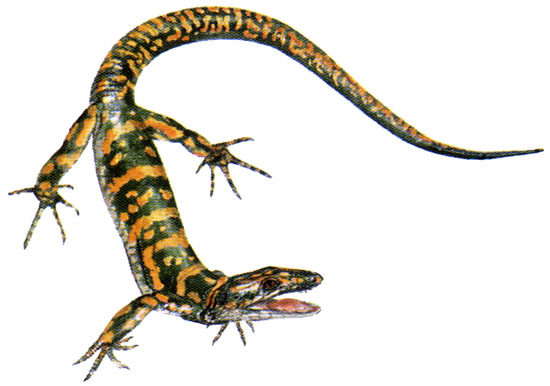
If you go back about 330 million years, there were no birds or people. If you could do your genealogy back that far, you would find that you shared ancestors with birds. These ancestors were four-legged animals similar to the fossils Westlothiana and Casineria. By about 313 million years ago, birds and humans still shared the same ancestors, amniotes similar to Protoclepsydrops and Hylonomus. (Image of Hylonomus from here, more images here)

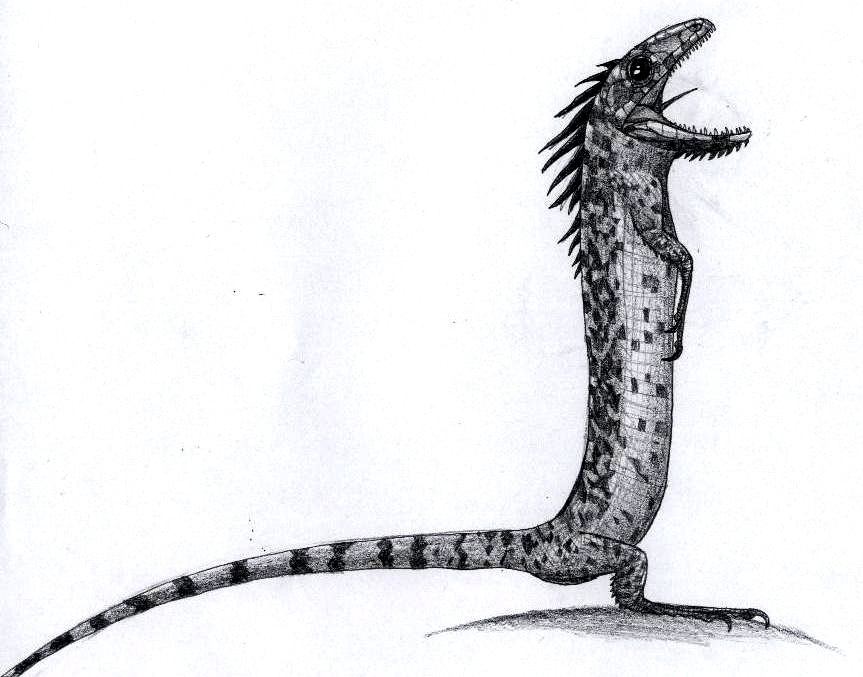
By 309 to 302 million years ago, the ancestors of birds had separated from our ancestors to become a distinct lineage that would include lizards, crocodiles, dinosaurs and birds. These early bird ancestors were similar to Petrolacosaurus, (image from here, more images here) , the oldest known diapsid reptile, which hales from the Rock Lake Shale of the Stanton Formation near Garnett, Kansas (perhaps to the chagrin of people in that state with other views about the origins of birds).

Our own ancestors at this time were more similar to Protoclepsydrops and Archaeothyris (image from here), some of the earliest synapsids. As you can see from these images, the ancestors of both birds and humans were pretty much lizard-people (perhaps another reason I always liked lizards?).


Over the past 300 million years, the descendents of Protolepsydrops and Petrolacosaurus have gone their separate evolutionary ways, though sharing the planet the entire time. Looking back now over perhaps 300 million generations of birds, and perhaps just a few million fewer generations of diapsids, mammals, primates, and humans, its perhaps easier to think that we are very different from each other. While in many ways this is true, part of the joy of living with birds is the quest to determine how much we share with our distant kin, as well as to wonder how our two different lineages could have given rise to so many wonderful creatures after separating from each other back in the Carboniferous. (Owl photo: here)

For more information on the the shared ancestors of birds and people, as well as the evolution of separate bird lineages, see the 2003 Journal of Molecular Evolution paper by Tuinen and Hadley here.

Floods

With all the rain in SE PA the last week, last night the creeks finally flooded. The Perkiomen behind our house is over its bank, blocking my normal way to work. The Neshaminy by my office is still in its banks near the office, but covered the road a couple miles down, forcing me to take an alternate route to get in this morning. On the way in I saw a Green Heron flying high above the Neshaminy, probably displaced from its favorite fishing areas by the high water. So, the bird and I were both a little put out this morning, but as a native Oregonian, I still enjoy a good downpour!

Tuesday, June 27, 2006

Birdchaser on Martha Stewart Radio

Just had a fun half hour with Margaret Roach and Andrew Beckman on their Homegrown show on the Martha Stewart Sirius radio channel. Good discussion on how to make your yard healthy for you, your family, and birds--including how to keep birds safe by keeping your cat indoors and screening your windows. Fun to take a couple calls about birds and talk with the Martha Stewart Living garden editors.

Monday, June 26, 2006

Ticked Off

Well, it finally happened. I suppose it was inevitable with all the time I spend outdoors. Sunday morning I woke up with what felt like a bruise on my thigh. But it wasn't a bruise, but the tell-tale bulls-eye rash where I had been bit by a tick two weeks ago. Yes, ladies and gentlemen, I have Lyme Disease. After a couple hours in the emergency room, I got a perscription for three weeks of Ampicillin and hopefully that will be the end of it. For now I'm a bit tired and achey, and the bulls-eye is spreading and hurts like a bee sting when I bump it.

Lyme Disease is a serious malady, and some folks are afraid to landscape their yards for birds because they are afraid to provide potential tick habitat. While I can empathize with that, the best thing to do is to part of the yard clear of vegetation, and then plant up the edges of the yard or other parts of the yard that you won't be walking through regularly. The deer ticks that carry Lyme Disease can even be in the lawn (though again, some claim that would be rare), so I'm not sure there really is a lot you can do to stop them vegetation-wise, though on Saturday I did hear You Bet Your Garden's Mike McGrath on NPR say you could spray your yard regularly with a garlic spray to drive out ticks and mosquitoes. Not sure how well that would work, (he seems to back away from that suggestion on his website) but I'm almost willing to try it. Other ideas are here.

Unfortunately, you can't spray the whole world, and if you are going to go outside, Lyme Disease is a potential problem in this part of the world. The little baby deer ticks are so hard to see, that you really have to be vigilant and do careful checks every day to make sure you don't have one on you. And even then, they could be easy to miss.

So, be safe out there. Know the signs of Lyme Disease, and get medical attention if you even suspect that you have been bitten by a deer tick or have symptoms. Treated early, it is pretty easy to take care of, but if left untreated, it can really mess up your life!

Peace Valley in the rain

Saturday I took a group of 15 cubscouts and leaders out to find birds at Peace Valley and it poured down rain the entire time. Fortunately, there were still plenty of birds visiting the feeders at the bird blind--so the kids got good close looks at Ruby-throated Hummingbird, Blue Jay, Downy Woodpecker, and a dozen other species. Then, down at the bridge, we saw a dozen more birds, including Great Blue Heron and a moulting and flightless but stunning male Common Merganser. Unfortunately, the Osprey was about a mile away perched in a tree--too far to really even scope it well for the kids, even if I hadn't left my scope in the car due to the rain. All in all, about 25 species and a lot of fun in the rain, with some birds, and a few minutes teaching kids how to pull out invasive exotic garlic mustard!

Friday, June 23, 2006

Animals in Translation

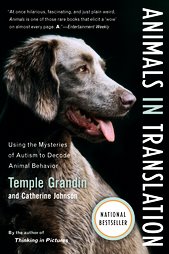
Last night I finished reading Animals in Translation by autistic animal researcher Temple Grandin. I always like Grandin's books, because she makes animal behavior so accessible to the average reader. In this book, she goes farther than she has before to explain just why animals do what they do. In doing so, she draws upon research in many academic fields, as well as her own experience designing humane slaughterhouses for domestic animals.

While most of Grandin's examples of animal behavior are based on studies of mammals, especially domestic livestock and companion animals, she does address birds at several points--including the remarkable case of the Grey Parrot Alex, which Dr. Irene Pepperberg has taught to speak rudimentary English, and which taught himself to spell simple words.

This is a great book for anyone that wants an introduction to what it is like to be an animal, including how much of our emotional and mental life humans share with animals. Humans and animals share much of the same brain chemistry, and Grandin does a good job of explaining what that means while exploring human and animal brain similarities and differences. Grandin is at her best when explaining the behavior of mammals--especially the livestock that she deals with. When she deals with bird migration, she seems to indicate that all birds must learn their migratory pathways--something that is only true for some birds. Most songbirds have their migratory pathways--at least the direction and distances--automatically programmed genetically.

Grandin may be in a unique position to explore the minds of animals, as her autism seems to make her process some information in ways similar to some animals. This allows her (with co-author Catherine Johnson, who is the mother of autistic children) to "translate" animal behavior in ways that the average person can easily understand and appreciate.

I really enjoyed this book, and would especially recommend it to my friends who think that humans occupy a priveledged position in the world based on their linguistic abilities. It was fun to think about music--including birdsong--as being an additional form of language, processed as such by the same area of the brain that handles human language, and to read about Dr. Con Slobodchikoff's findings that prairie dogs use nouns, verbs, and adjectives in their verbal communication, as well as speculation by some researchers that early human interactions with wolfs domesticated both humans and dogs--teaching dogs to be able read human body language as well as teaching humans to work cooperatively and defend territories.

Birding this morning, after reading this book, really had me thinking about the animals I was watching--and who I could see watching me. If you've ever wondered what it is like to be a dog, cat, bird or other animal, this book is an accessible place to start learning how to better translate animal behavior.

Peace Valley

Stopped by Peace Valley on the way to work this morning and picked up 38 species at the bird blind and trails around the nature center. Lots of birds still singing, including Yellow Warbler, Red-eyed Vireo, Indigo Bunting, and House Wren. Baby birds on their own included Carolina Chickadee, Northern Cardinal, and a short-tailed fledgling Gray Catbird begging and being fed by a parent.

Four male Brown-headed Cowbirds were displaying on the ground near the bird feeders at the bird blind--rushing towards each other with wings extended and drooped down, making a liquid sounding "gurgle-oo" call.

Very few water birds on the lake--two Green Herons hunting near the bridge, three Great Blue Herons (including one juvenile bird), eight mostly young Double-crested Cormorants, two female Mallard with young, and a single male Common Merganser.

Thursday, June 22, 2006

Monitoring migrant birds for bird flu

Bird researchers are cooperating to monitor migrant birds for H5N1 bird flu across North America. According to the latest Land Migration Monitoring Network of the Americas newsletter:
LaMMNA has just successfully completed its first season of avian influenza monitoring and we thank all those who participated. A total of 33 member organizations from 21 states participated, representing a wide range of operations from small, single-operator stations to large multi-station observatories. They captured 20,000 birds during their spring operations at 40 stations. Of those, they sampled 1,000 birds with cloacal swabs, pulling tail feathers for DNA analysis. The samples are now on their way to UCLA for analysis.

For more info on the search for H5N1 in Alaska, see the latest USA Today story here. Unfortunately, the story overstates the case for wild birds carrying the virus from Tibet to Europe last year.

In all likelihood, the virus was carried to Tibet and across Asia to Eastern Europe by poultry or poultry products. Mute Swans may have contracted the virus from infected poultry in Eastern Europe, then carried it to Western Europe in mid winter. We still have a lot to learn about how this virus spread last year, and FAO speculations about wild birds carrying the virus across Asia are apparently based on a faulty understanding of the migratory pathways of Asian birds. It is curious that the FAO continues to focus on the role of wild birds, while admitting that "human activities such as poultry production and trade are principally responsible for spreading the disease" (see article here).

Cover-up on date of first H5N1 infection in China in 2003

According to this latest New Scientist article,
A man died of H5N1 flu in Beijing in November 2003 - two full years
before China admitted any human cases of H5N1. The death of the 24-year-old from bird flu came months before China even admitted H5N1 was circulating in its poultry. The man was tested for respiratory illness because of concern in the wake of the SARS epidemic.

It is not clear when the Chinese scientists who reported the finding discovered this, but they tried to withdraw their paper from the New England Journal of Medicine at the last minute on Wednesday. It was too late to prevent publication.

The case suggests that, as has long been suspected, many more people have caught H5N1 flu in China than have been reported, and for a longer time. The more human cases there are, the more chances the virus has to evolve into a human pandemic strain of flu.

There have been other rumors of thousands of human cases in islolated areas of China. Unless we get good numbers on infections and deaths, we can't begin to really understand how widespread or dangerous this bird flu virus may be to people. I suspect that there has been thousands of unconfirmed, undocumented, or unreported cases--indicating that the virus may be slightly easier to contract than previously confirmed, as well as far less lethal than the current official numbers (228 cases, 130 deaths) indicate.

Baby phoebe's wild ride

Yesterday, Steve from work called me just after I got home with a funny story. He was hearing a regular beeping sound as he drove home, and finally realized that one of the baby phoebes from the barn had fledged and ended up inside his car. That will teach him to park in the barn with the windows down! Steve was driving back to work to release the bird when he called me.

This morning, the phoebes were all off the beam near their nest. I guess yesterday was fledge day. Good luck little guys!

Wednesday, June 21, 2006

Ann Coulter--are you kidding me?

Ann Coulter's latest book Godless, has a whole section claiming that evolution is not real science, but all a pack of lies. Are you kidding me? How is it that the #1 selling book in America could be so outrageously wrong? I haven't had a chance to read it yet, but I've been hearing Coulter all over the radio recently. If anyone wants to send me a copy, I'd love to pick that section apart piece by piece. Meanwhile, folks looking for more info on evolution can start with some resources here.

Please, America. Buy whatever books you want. But don't get sucked in to thinking that Coulter is even on the same planet when she starts talking about evolution. Nothing we've learned about the world of living things in the past 150 years makes any sense without an understanding of the evolutionary history of life. Evolution is a fact, not fiction. You can't say the same for Coulter's claims about it.

More Phoebes

Seems like phoebes are the bird du jour right now. Artist and blogging friend Julie Zickefoose is taking care of and painting young pheobe orphans in Ohio, while three baby pheobes in the barn here at work are biding their time sitting on a ledge just outside their nest. They'll be flying off any day now. Its a scary time to be a baby bird. Good thing they don't know what they are in for!

Audubon's Phoebe

In 1803, John James Audubon wrote about his experience with Eastern Phoebes nesting behind his house along Perkiomen Creek west of Philadelphia:
"When they were about to leave the nest, I fixed a light silver thread to the leg of each, loose enough not to hurt the part, but so fastened that no exertions of theirs could remove it. At the next year's season when the Phoebe returns to Pennsylvania I had the satisfaction to observe those [birds nesting in the Perkiomen] cave and about it. Having caught several of these birds on the nest, I had the pleasure of finding two of them had the little ring on the leg."


I live 20 miles upstream from Audubon's house at Mill Grove along the Perkiomen, and this weekend heard several phoebes down at the creek while catching crayfish with my kids. With over 200 generations of phoebes having come and gone since Audubon's time, if any of those phoebes have living descendants, it is statistically almost a certainty that the birds nesting under the bridge behind my house are the direct descendants of the birds that Audubon banded.

We are all connected without knowing exactly how, and its fun to get a glimmer of exactly how that happens. There's only 20 miles and 150-200 phoebe generations between me and the great J.J. Audubon.

Birding by ear in NYC

Another afternoon of Audubon meetings in NYC netted me sightings of crows, starlings, House Sparrows, and pigeons from the windows of 700 Broadway. After the meetings, I was greeted by a familiar sound (listen here) as I stepped out onto the sidewalk--the high rapid chittering of Chimney Swifts. Looking up, I couldn't see the birds initially, but then two swifts cruised across the sky between the rims of the urban canyon. Nice ot see a native bird making its way here in the heart of America's largest city. It was a magic moment standing there looking up, with dozens of passerbys streaming past me oblivious to the aerial dance occuring 150 feet above the street.

Monday, June 19, 2006

Why I blog about birds

While I'm convinced that some sort of addiction is at the root of why I bird, I think other brain chemicals like endogenous opioids may be responsible for why I blog about birds. When I was a kid, a large supportive birding community was one of the reasons I moved on to birds from an interest in reptiles and amphibians. Catching lizards gave me a physical rush, but was rather socially isolating in middle school. Birding, however, gave me a dopamine rush, as well as social support.

I've tried to remain a part of the birding community as I've gotten older, but it has gotten harder, rather than easier. For a long time, I was trying to bird almost every day, which made it hard to regularly bird with others who don't have the same schedule flexibility or intense birding drive. More recently, I've been busy with work and three kids. In some places I've lived, there hasn't been a strong and active birding community. And over the past 10 years, the internet has revolutionized the way that many birders interact. With birding listservs, it is far more common to know other birders by their email address and listserv posts, than by spending time with them in the field.

So, I started blogging about birds back in 2000...back before it was really called blogging. My initial bird blog was to post bird sightings from Hornsby Bend, the best birding spot in Austin, Texas. I was tired of tying up the TEXBIRDS email list with my daily sightings report, so I started up a website where I could write as much as I wanted. This served as something of a local rare bird alert, as well as a way to really talk about local bird distribution without annoying everyone else in Texas who didn't care about Hornsby Bend. Originally I coded these posts in HTML, and eventually started composing them with Netscape Navigator. You can take a look at some of those early proto-blog posts here, here, and here.

So, my initial blog was to help stimulate birding at my local patch, and to help build something of a birding community that I didn't find in Austin when I moved there. We had a local Audubon chapter, but it wasn't the active (some would say hyper-active) birding community that I craved. This first blog was an attempt at community building. And to further that end, eventually I discontinued it as a private blog, and set it up as more of a community bulletin board. It continues in that format today, as the Hornsby Bend Recent Bird Sightings page (see the sidebar there on the left).

I started my second blog--Urban Birdscapes--in January 2004 to promote urban bird conservation--the topic of my PhD research. This blog let me discuss issues I was interested in. It was also a way for me to keep up with media reports related to my research. I kept that blog going until I started working for National Audubon in late 2004. I'm still hoping to start an urban bird conservation blog on the National Audubon website, but that hasn't happened yet. And since I haven't finished the PhD yet, maybe I need to start up that blog again to help me get through the final writing stages.

At any rate, after I discontinued Urban Birdscapes, I started this current blog back in 2004 as I was preparing to make the move from Texas to Pennsylvania. I was finding myself with less time for birding, and really missing the dopamine rush. So, I tried to use this blog as another excuse to go birding. I reasoned that if I had to post something every day or two, then I'd have to go birding to get stuff to post about.

Well, that strategy hasn't always worked as my bird conservation work frequently keeps me busy. But, it has helped somewhat. I've taken more bird walks during the middle of my day, and taken some extra birding efforts here and there along the way. The blog has also given me another way to talk about some of the issues that I think are important. In particular, as avian influenza spread across the old world last year, and with increasing anxiety about it getting to the U.S., I've been able to use this blog to provide commentary on the latest media reports and scientific research related to the bird flu. I've also commented occasionally on the Ivory-billed Woodpecker search in Arkansas. And when there are interesting news articles or research about birds that catch my eye, its fun to talk about them here. Or to just ruminate, as in this post, about the whys behind it all.

I love birding, and when I can't be birding, I like to share my thoughts about birds and birding. It helps me feel like part of the birding community that nourished me as a young birder. And it allows me to explain my birding obsession to my non-birding family and friends.

Many bird bloggers also take photos of birds. I love that, but I have resisted photography for the past 25 years. I haven't wanted anything to take away from the buzz of the search for birds, and photography seemed to slow down the pace of the action. But I'm increasingly wishing I could share the actual birds I see, and their activities, with my blogging friends. S I'm starting to reconsider the time, energy, and money it takes to do some digiscoping or other bird photography. As long as it doesn't stand in the way of my getting a dopamine rush from birding, or cost me a fortune, then maybe I'm up for it. It may turn out that a desire to share bird photographs here become another example of this blog encouraging me to expand the scope of my birding activities.

I'm sure there are brain chemicals that lead us to seek social contact with others. A blog isn't the best way to get that kind of social contact or chemical buzz, but it helps a little. Since we can't all go birding together all the time, at least we can keep up with each other here in the blogosphere.

Why I Bird

I wanted to come up with a Top 10 reasons why I bird post, but could only come up with 5. So, here goes. The Top 5 reasons why I bird:

1) The chase. Going out and looking for birds provides a dopamine rush that satisfies my hunting instinct. There is a lot of recent brain research to suggest that our brains are wired to get a thrill out of anticipating rewards. Some get their kick from shopping, I get it from looking for birds.
2) I like being outdoors. I must get additional brain chemical satisfaction from being outside.
3) Beyond just being outdoors, I like to feel connected to the world around me. By looking for birds, I have to place myself in their world. That makes me feel more connected. Without that connection, I feel incomplete.
4) I think, really, at this point I'm completely addicted. I think I've birded so much, and flooded my brain with so many nice chemicals during birding trips, that its hard to function without them!
5) If I can't be birding, then I can get a dopamine rush just anticipating birding. So, I'm always just one thought away from getting a wanting-to-go-birding high.

I wish there were more intellectual or socially-responsible answers to why I like to bird. But really, when it comes down to it, those answers would really just be me trying to justify my own addiction. So, the bottom line. Q: Why do I bird? A: Dopamine and probably a handful of other nice brain chemicals.

Friday, June 16, 2006

Birds, Evolution, and God

While religion and politics are two subjects that can easily shut down polite conversation, the previous post and the following image (bottom of post) sparked a moment of reflection.

I grew up in a conservative religious household and was taught that evolution was wrong and that God created the world 7,000 years ago. While I'm still an active member of my childhood religion, I've long since moderated my views. I'm now a card carrying evolutionist. I still believe in God, but I believe that the world is very, very old and that all life forms on the planet are related through familial relationships that go back hundreds of millions of years.

To me, that makes the world a richer place. Bigger. Older. More amazing. Rather than believing in a God who waved a magic wand and ushered the creation into being 7,000 years ago, I now see a God working out a plan of eternal progression through the choices and life experiences of billions of creatures over billions of years.

My views about God are personal, but my views about evolution are public. They are based on facts that are readily accessible to anyone. They are based on years of studying those facts. When I graduated from college, with my doubt about evolution intact, I enrolled in another university to study genetics, evolution, and ecology. I studied, and prayed, and tried to open myself up to the facts. And while we still have a lot to learn about how evolution actually happens, there are no facts available to discredit the observable reality that evolution has taken place, and continues to take place, here on earth.

With all due respect to the Bible, its an old book with an ancient understanding of humans and our relationship to the rest of nature. While there is much good to be derived from that book, and I value the depiction of Adam and Eve as stewards of nature, the Bible does not even begin to compare to modern science in its ability to describe, predict, and interpret the origins and continuation of the physical and biological world around us.

I rarely go birding on Sunday. That's my day of rest and I spend it at church and with my family. Sometimes I'll take my kids on a nature walk. And when my nine year old asks me about God, science, and the Bible, I explain that science is a great tool to help us understand the origins and workings of the world and its creatures, but that prayer and the scriptures help us understand how we should relate to that world, other people, and our more distant relatives--all the other creatures on earth. I'm a big genealogy nut (something else I picked up from my religion), and for me, birding is a family reunion with distant cousins. While that may sound strange to my traditional Christian friends (just as my belief in God is a puzzlement to many of my scientific colleagues), that's just part of the joy and mystery that I experience living with birds.


BTW, for more info on keeping discussions about God--which can only be experienced subjectively or from within a religious community--out of science classrooms dedicated to teaching of publicly observable truths, see here.

First Modern Bird

One of the things I love about birds and other animals, are the evolutionary ties that bind us together over hundreds of millions of years. Birds have been flying about since the Mesozoic Era, when our own ancestors were small creatures that looked almost nothing like us. A find published today in Science reveals the earliest known "modern" bird--something that looks like a duck or a loon. Earlier birds belonged to orders that have since died out, but this bird (Gansus yumenensis) appears more closely related to the birds that survived the extinction at the end of the Cretaceous Period about 65 million years ago. See a story about the find here.

Last Child in the Woods

One of the highlights of my trip to Aullwood was getting to spend a little bit of time with Richard Louv, author of Last Child in the Woods. His book is a review of the importance of nature experiences for the development of children, and how Americans are losing those experiences and kids are suffering "nature deficit disorder" because of loss of accessible natural areas and increasingly indoor suburban lifestyles. While playing with some box turtles at the Aullwood center, Richard told a few of us about his experiences with box turtles as a kid.

Before I was a bird guy, I was a ten year old wannabe herpetologist. We didn't really have turtles in Western Oregon, but we had a fair number of frogs, salamanders, and a few lizards and snakes. I spent hours and hours searching for them, dreaming about them, drawing them...basically eating, breathing, and sleeping them for a couple years starting in fourth grade. I eventually moved on to birds (more variety, larger support group, etc.), but still have a fondness for our little cold-blooded neighbors.

Environmental educators speculate about how important it is for kids to have good experiences with nature. I can trace my own career path as an environmental professional) back to those childhood moments, and so can many others. But how many of the other kids that were out catching snakes with me now think twice about animals or the environment? Experiences with nature would seem to be a necessary, but not sufficient, determinant of favorable environmental attitudes.

For me, life without birds, herps, and nature is only a pale shadow of a life. Going day to day without birds is like watching black and white television. Or like eating fat-free salad dressing. Like living in Plato's cave. I've gotta have my bird fix to make it through the day. Recently, my day to day birding has left me feeling a bit malnourished. I need more outside time with birds to cure my own case of nature deficit disorder.

Aullwood

Just got back from a couple days at an Audubon Educators conference at the Aullwood Nature Center near Dayton, Ohio. Nice drive there and back, and some good walks there in the woods. I saw 50 species one morning in the woods including a nice female Yellow-throated Warbler that dropped down to look at us from high in a sycamore. Also, nesting bluebirds and Indigo Buntings. You know you are seriously addicted to birds when you only get the tiniest buzz from two hours and 50 species of Eastern woodland birds. Too many meetings, not enough birds! More cool were the Timber Rattlesnake and Massasauga in the nature center.

Monday, June 05, 2006

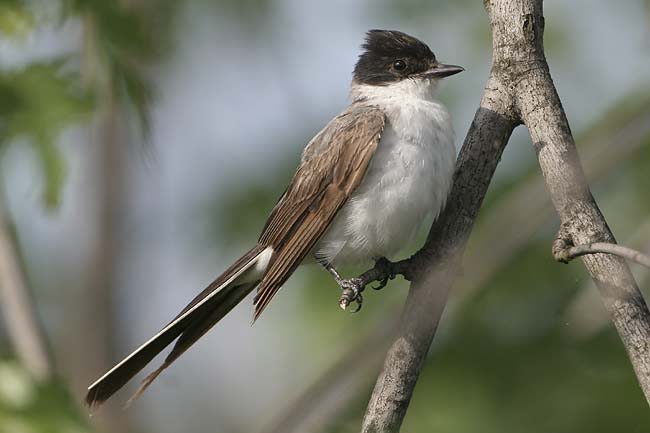
Fork-tailed Flycatcher

I had company all weekend, didn't have email access, and had a funeral to go to this morning--perfect timing for a rare bird to show up! When I got in to work today I found out about a Fork-tailed Flycatcher seen yesterday about half an hour away from my office. Finally, after the funeral, I took off with Paul Green to chase this nemesis bird along the Delaware River in Morrisville (photo: Adrian Binns).

Nine years ago, when my first daughter was a month old, I took her on her first chase...a three hour drive from Dallas to look for two Fork-tailed Flycatchers at Hornsby Bend in Austin. I missed them by a couple hours. Then, last year after I moved from Austin, another Fork-tailed Flycatcher stayed at Hornsby Bend for over a month. These South American birds often don't stay long, and it isn't uncommon to chase, and miss, Fork-tailed Flycatchers when they do show up.

Today was my lucky day. We got to the parking area near the river and could see birders up on the dike. We got there just in time to see it fly off through the trees. Ten minutes later, we found it again and got to watch it for over half an hour as it flew around at eye-level eating bugs off the leaves and branches of several trees. The bird is a first-year bird, with a short-worn tail and brownish flight feathers. A bit ratty looking, but a joy to see after all these years of waiting and missing it in Texas. This bird is apparently the first one to be found in Pennsylvania, so its a really good bird.

Friday, June 02, 2006

Book I wish I had written

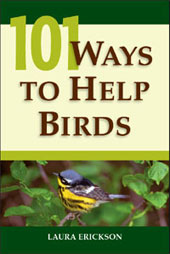
A couple of years ago, I was teaching a class on urban bird conservation at the University of Texas, when I learned that Laura Erickson, who I knew from the Conservationthrougbirding listserv, was writing a book entitled 101 Ways to Help Birds. She shared her 101 ideas with me, and I shared them with my class. I commented on a couple chapter drafts, and have been anxiously awaiting the book in print.

When I finally got the book, I was thrilled. It was everything I had hoped it would be...and more.

Before commenting on the content, let me just say that this is one of the most attractive books I've seen in a long time. I love the greens on the cover (great job, Wendy Reynolds), the stippled illustrations by Roger Hall, the sturdy off-white pages, clear typefont, and simple but very functional layout. In the days of cheap printing and maybe too-easy publishing, this book is everything a book should be and a joy to hold in the hand.

The layout of the book follows the premise of its title, providing 101 suggestions on ways to help birds, broken into 5 parts: helping birds at home, enhancing the natural habitat of your backyard, supplementing backyard habitat, helping birds away from home, and helping birds on a larger scale. These parts are further categorized into 22 sections that cover a wide range of topics from bird feeding and avoiding hitting birds in your car to green consumer tips. Each of the 101 ways to help birds is written clearly and concisely, with specific recommendations on how to help the birds. Each of the ways is backed up with the facts and figures needed to inform the reader of the nature of the threat faced by birds, as well as the best ways to address those threats.

If this book were just a collection of ideas on how to help birds, it would be well worth the cover price of $19.95. But happily, Laura Erickson draws upon her own experiences as a bird rehabilitator and educator to provide personal examples related to many of her tips. These range from the joys of providing food for a wintering Rufous Hummingbird--mealworms mixed in a blender with sugar water, to the heartbreak of dealing with songbirds injured by housecats. The authors experiences and gentle tone make this an easy read, and turns what could easily become a depressing subject (the numerous threats faced by birds) into a hopeful agenda for people wanting to do the right thing for their feathered neighbors.

There are a lot of great bird books out there right now, but this one isn't to be missed. Besides serving as a handbook of how to help birds, it could also serve as great gift for a neighbor, or better yet, a local political leader or civic official. The attractive cover and layout will ensure that the book is picked up, and the great information and delivery will ensure that it is actually read and frequently referred to as you and your neighbors take effective measures to help the birds.

Thursday, June 01, 2006

First case of humans getting H5N1 bird flu from wild birds

A recent outbreak report (here) indicates that several people in Azerbaijan most likely died after contracting bird flu from infected wild swans. These individuals were apparently illegally harvesting feathers from the swans, so they had very close contact with the birds and their body fluids. As with previous human cases, people contracted the virus only through close and prolonged personal contact with infected birds or family members. There still does not appear to be any real threat to humans from casual contact with wild birds. With close contact with birds or their secretions, infection can be avoided with the proper sanitary measures (see here).
Nature Blog Network Fatbirder's Top 1000 Birding Websites