Subscribe

RSS Feed (xml)

Powered By

Skin Design:
Free Blogger Skins

Powered by Blogger

Monday, August 13, 2012

American Dipper


I've just returned from a 7949 mile road trip out to Oregon and back to visit family.  Here's a video of an American Dipper that shared the Wind River with us at Beaver Campground in the southern Washington cascades.  Love these guys, and don't get to see them very often these days.

American Dipper, Wind River, Skamania Co., Washington

Tuesday, July 03, 2012

Review: Bird Sense

I have to admit, I was a bit alarmed when I first saw the announcement for Bird Sense: What It's Like to Be  a Bird, since I've been using that subtitle for public presentations on bird vision since 2001.  Have I waited to long to write my own book on this topic?  Was I totally scooped?

I'm happy to say that Bird Sense is not the book that I would (and still may) write on this topic, but it is a good introduction to how birds see, hear, and otherwise sense and the world around them.  The roughly 225 pages of easily read text is organized into seven chapters addressing bird vision, hearing, touch, taste, smell, magnetic sense, and emotions.  Most of the discussion covers the anatomy of these sensory systems, and how they vary between different birds.  This is a good review or introduction, though I found myself wanting more.  For instance, we know a lot more about ultraviolet vision in birds than was covered here, and I found myself wishing for more discussion of that amazing bird sense.

A highlight of the book is the author's own field experiences with birds around the world.  However, the extended discussion of the sex lives of Buffalo Weavers, while interesting, seemed like a tangent in the chapter on touch, but did make me see that bird sex would be a fun topic and hope that Birkhead will expand upon it in a future book.

Tim Birkhead is a scientist, and a careful one at that, which means that he sticks pretty closely to safe topics that are well studied, and there isn't a lot of speculation in this book.  This is good science, but may not ultimately satisfy folks who really want to know what it's like to be a bird--a question that may only be answered by equal parts science and imagination.  Bird Sense sticks closer to the science, and leaves most of the imagination up to the reader.

So there is still much more to explore and discuss about how birds see, hear, and otherwise experience the world.  That said, Bird Sense is a very well written, entertaining, and informative introduction to the topic, and a good place to start for anyone interested in birds and how they experience their world.

Thursday, June 07, 2012

Juvenile Chipping Sparrow


I caught sight of this brand new young Chipping Sparrow a couple days ago, but he got away before I could grab my camera.  I like how striped and different he is from his parents.  Here it is hopping around under our feeders on my patio.  With all the cowbirds around, good to know at least one Momma and Poppa Chippy got off at least one young in my yard this year.


Wednesday, June 06, 2012

Arrow Goose

This morning I found this unfortunate goose at Spruce Run.  The bird can swim and seems fully mobile, but it's so sad to see.


Friday, June 01, 2012

Cerulean Death March

 Monday morning, while getting ready for a church picnic, I got word that a friend had found a singing Cerulean Warbler in Musconetcong Gorge, a county preserve 20 minutes from my home.  Since this is a very scarce bird in the county, and this was the first (and likely to be the only) one reported in the county this year, I decided to head over to see if I could find it.  My youngest was up for a hike, so we geared up and headed out.

Musconetcong Gorge is a beautiful forest, and we enjoyed the sights and sounds of Ovenbird, Worm-eating Warbler, Indigo Bunting, American Redstart, and dozens of other birds.  Highlight for us was probably catching several toads.


The princess and the toad
But after over an hour of listening, I didn't see the bird, and couldn't be 100% positive that what I thought I heard a couple times in the distance really was the Cerulean Warbler.  So we packed it in and hiked the mile back to the car.
Intrepid Hiker in the Gorge
The next morning, I wasn't able to get away until later in the day, and it was even hotter than ever!  The bird had been relocated earlier in the morning, and I had plenty of water, but it was past 11am and getting really hot by the time I got down to where I hopped to see it.

Male Scarlet Tanager, day two of the Musconetcong Gorge death march.
Long story short, while I got good looks at everything else I heard down along the river (including several beautiful Scarlet Tanagers), in two hours I heard the Cerulean Warbler a couple times, once quite closely, but never got a glimpse!  Sometimes you've gotta just take what you can get--especially when threatened by heat exhaustion!  So I look forward to actually seeing this bird at some point.  In the meantime, its good to know that this bad boy is hanging out in the gorge, keeping hopes for local breeding alive here in Hunterdon County.

Blue Grosbeak Quest

Migration is winding down, and as I continue to explore my new home county in New Jersey, I'm hunting down some of the more scarce breeding species.  Near the top of that list is Blue Grosbeak.  These birds are scarce and local here on the edge of their range.  A few are found each year down in the southern end of our county, and since they've been reported a few times recently, I've been heading down there this week to see what I can find.

Dickcissel, 18 May 2001, Hunterdon County, NJ
The first two attempts, I spent hours looking and listening in vain.  Fortunately, there are plenty of other fun birds around to see in the area--including Dickcissel--another locally rare bird here on the edge of their range.  While watching this one male singing on territory near Clover Hill, I've also enjoyed watching Willow Flycatchers, Grasshopper Sparrows, Savannah Sparrows, Eastern Meadowlarks and Bobolinks in the same fields.  But I've become frustrated looking for my main quarry, the illusive Blue Grosbeak.


Finally, this morning, I had time to just park myself and watch the field.  After about half an hour, a male Blue Grosbeak flew across the field and landed nearby!  But before I could get my camera on it, he flew off to the other end of the field.  Here's the best shot I could get, with the bird in the top of a tree over 100 yards away.  Not a great shot!

Male Blue Grosbeak, hand held CoolPix P500, 36x optical zoom, 100+ yards

Before I could get a good shot, it flew all the way across the large field and landed in the top of a bare tree even farther away.  As I was walking towards it, it dropped back down into the field, where I was finally able to get a more decent shot.

Male Blue Grosbeak, Clover Hill, Hunterdon County, NJ, 1 June 2012
At one point, the Blue Grosbeak was even in the same view with a Dickcissel!  Two locally scarce breeders in one shot!
 
Dickcissel (left) and Blue Grosbeak (right)
I was very happy to see these two birds in Hunterdon County.  But it is a hard life for these grassland breeding birds.  In a nearby field, where a second male Dickcissel had recently started singing, this was all that was left of the habitat this morning.

Recently mowed grassland bird habitat, Hunterdon County, NJ.

It's actually very hard to understand how these grassland birds persist, since their nesting fields are constantly being mowed before they can nest and produce young.  The best way to help these birds is to avoid mowing from late April to late July--which unfortunately is exactly when these fields are usually the most productive as hay fields.  Fortunately several organizations are working to promote grassland stewardship for nesting birds.


Friday, May 25, 2012

Muck Birding

Last night I dreamed I was in a swamp and almost put my hand on a Cottonmouth.  I should have known it was going to be one of those days.

A good day, but a mucky one!  After finding a Semipalmated Plover (2012 County Bird #204) I got a text saying there was a singing Prothonotary Warbler at the other end of the reservoir.  Boots would be required to see the bird.

How bad could the mud be?  How badly did I want this local rarity for my year list?

20 minutes later, I'm in a swamp that looks like my dream, ankle deep in mud.  Fortunately I did hear the bird.  I was even able to photograph it with my Nikon CoolPix P500.


What?  You can't see the bird?  It was 100 yards away, how good a shot did you expect me to get?  Does this help?


 Maybe this will help you out...


OK, the photo stinks.  But at that distance with my handheld camera at maximum 36x zoom, could have been worse!

At one point, for maybe a couple seconds, it was actually closer, but mostly 2012 County Bird #205 was just heard singing and gave me only a quick glimpse. 

Hiking back out of the swamp we ran into this mother giving birth:


Looks painful.  And muddy.


Here you can barely see a couple of her eggs under the mother snapping turtle's hind digging foot.  This was her second hole, about 10 yards away from where she was seen digging a bit earlier.


It's a tough world out there for little turtle eggs.  Here's hoping a few evade the raccoons, and are able to make it out of this newly planted field alive.


Tuesday, May 22, 2012

Hayseed Snow Goose

Snow Goose, Spruce Run, Hunterdon County, NJ, 22 May 2012
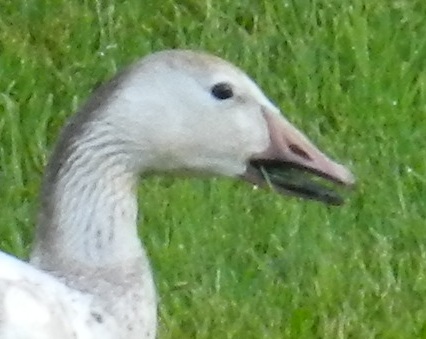
Most Snow Geese left New Jersey months ago, this young bird apparently isn't going to Arctic Canada this year--he's been hanging out with some Canada Geese at Spruce Run.  I think he's a redneck wannabee.  What makes me say that?  He's a real hayseed.  Check out the closeup.


Might as well be auditioning for a spot on Hee Haw!

Monday, May 21, 2012

Color Banded Cormorant

Digiscoped with HTC Incredible phone through Kowa 883 scope.

This morning I found this young Double-crested Cormorant at Spruce Run.  Note the orange color band on the left leg and silver federal band on the right. I submitted the color band code I was able to read (0F9) to the Patuxent Wildlife Research Center Bird Banding Laboratory, and look forward to hearing where this bird comes from.

Wednesday, May 09, 2012

Bobolinks are Back


The Bobolinks are back at Hoffman Park just up the road from my house.  The males are chasing each other and the females across the large fields.  Hard to get close enough for a photo--especially when they seem to fly to the other end of the field whenever I get out my camera!

Thursday, May 03, 2012

Party Wren is in Da House Tonight!

Everybody's gonna have a good time!

I watched this House Wren building a nest in a box at Voorhees State Park in Hunterdon County, NJ today.  Interestingly, he didn't want to use the official nest entrance hole, but insisted on going in and out of the more protected ventilation hole at the top right above the "real" nest hole!


Saturday, March 31, 2012

Rarity in the Fog

It started raining about 11pm last night, so I suspected any migrants passing through might get knocked down and headed out early to Spruce Run Reservoir just down the road.  Here's what I could see when I wasn't wiping the mist from my scope.


This is with my 36x optical zoom.  I could only see a bit better with my scope.  The birds on the left are Buffleheads.  The four on the right are grebes.  Can you tell that one of these grebes is not like the others?

How about now?


I watched the birds for over 10 minutes, and could tell that one was clearly smaller, riding lower in the water, with a thinner neck.  At times it seemed like the bird had a thinner, sharper, slightly upturned bill.  And a pointing headed profile, with a peak above the eye.  While the other three are chunky Horned Grebes, the smaller one is an Eared Grebe--a rarity in New Jersey.  

Did I see it well enough to be sure of the identification?  Or was my old scope and bad lighting and distance playing tricks on me?  

After watching a bit more I couldn't make it into a Horned Grebe, so I made the call and waited for confirming backup to arrive.

The first birder on the scene could tell it was smaller, but wasn't comfortable making the call.  Finally others arrived, and with perhaps better light, and less mist, everyone finally got a good enough look to confirm the ID.  Whew!  Nothing like putting your birding reputation on the line!

Turns out it was a fantastic day at the reservoir, with 10 Long-tailed Ducks, 6 Canvasbacks,5 Greater Scaup, over 150 Buffleheads, 6 Common Loons, and some Red-breasted Mergansers making it the heaviest waterfowl event of the season so far.  The first Greater Yellowlegs of the season flew over, and later 23 Bonaparte's Gulls stopped by, and after I left apparently 29 Red-throated Loons stopped in.  You've just gotta go birding in the rain when you get a storm like this. 


Friday, March 30, 2012

Trash Bird

OK, can you tell what it is?  The bird, not the trash :-)


Here's a better shot.


Here's a slightly fuzzy shot of the bird hopping up and surface gleaning from a bare branch.


All in all a nice walk this morning around the boat launch at Spruce Run.  Relocated the Vesper Sparrow found this morning by Frank Sencher, as well as my first of year Palm Warbler shown here, and first of year Brown Thrasher singing from scrub along access road to the boat launch.


Thursday, March 29, 2012

Belly Up to the Box

This morning on the way to work I watched a female Wood Duck checking out a nest box at Assiscong Marsh in Flemington, NJ.  The action was over 100 yards away on the other side of the marsh, but I was able to capture most of it.


First the duck flew up to the entrance of the nest box.  This is the same box that has had a red morph Eastern Screech-Owl in it for the past week or so.  I wasn't able to see if it was still inside, but as we'll see in a moment, I'm guessing maybe it was.


Most of the time the duck clung to the front of the box below the entrance hole, looking in.


Finally she poked her head entirely in the box to check it out.


A second later she fluttered down, leaving a big wet belly mark on the nest box.  I saw her do this routine twice, but she never seemed to go totally inside the box, making me suspect that our owl friend may have already been in there.  At one point I thought I saw the owl face in the box entrance hole, but it was too quick and through my binoculars so not a great look.

There were at least 8 Wood Ducks at the marsh this morning, and there are at least 3 other duck boxes there, so it will be interesting to see how the Wood Duck breeding season goes.

Wednesday, March 28, 2012

Assiscong Blue-winged Teal

Just one more sign of spring, a drake Blue-winged Teal has spent the last few days at Assiscong Marsh.


Not the greatest shot, but considering it was over 150 yards away, not bad for the Canon P500 at 576 mm (the equivalent of 3270 mm on a 35mm camera).

Also at the marsh were Tree Swallows and an Eastern Screech-Owl (also over 100 yards away) in nest boxes.  Bird love is in the air!


Monday, March 19, 2012

First Chipping Sparrow of the Year

While hanging out at home today I noticed a small pale bird in the bushes, and it soon came in to my patio--my first Chipping Sparrow of the year.  Always fun to keep track of the birds you see each year, so you can celebrate seeing old friends like this after a winter absence.

Chipping Sparrow, Hunterdon Co, NJ, 19 March 2012, Nikon Cool Pix 500, f/5.7, 1/200 second, ISO -160.

Monday, March 12, 2012

Going for 50

I headed out this morning to run some errands and of course I had to get my 20 bird MDR.  After hitting Spruce Run on the way to return a Redbox movie, I had 21 species.  If I turned right I could return the movie.  Turning left I could hit Island Road and Round Valley in order to get a 30 Bird Bonus Day.  Eastern Meadowlarks were singing on Island Road, and my first Tree Swallow of the year was checking out a nest box while a pair of Eastern Bluebirds called loudly.  A good number of ducks at Round Valley had me leaving there with 39 species.  Demott Pond near the Redbox dropoff got me Gadwall and Mallard for 41 species.  Driving past Jutland Lake on the way home I netted a couple of Redhead with the American Wigeon.  That and the Black Vultures on the road gave me 44 birds.  A mile from home I decided to head back to Spruce Run for a couple more birds--Lesser Black-backed Gull, Dark-eyed Junco (finally!) and Downy Woodpecker.

Shoot, I've got more birds than that in my own backyard, so I headed home.  Purple Finch and Eastern Towhee made 49.  Finally a Northern Flicker called off in the woods for 50.  Finally, a 50 Bird Day!  Not bad for a half day in early spring in NJ with no ocean :-)

As I write this up, a White-breasted Nuthatch is calling in the yard for 51.  Let the fun continue!

Tuesday, March 06, 2012

Canada Goose Band Return

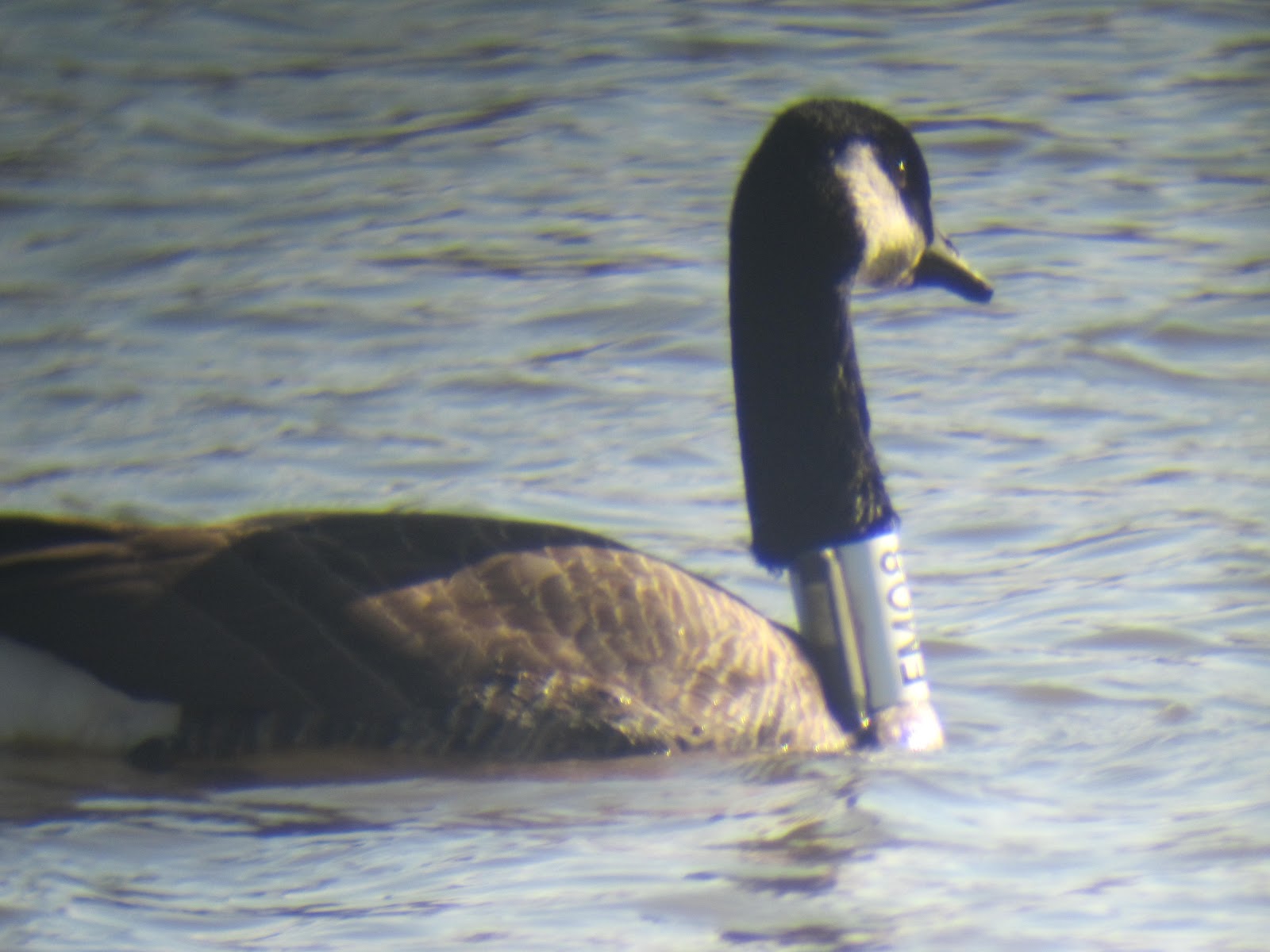
Just got this certificate from the U.S.G.S. Banding Lab with details on a Canada Goose I saw last month.


So this bird was banded two years ago not far from here at another Wildlife Management Area in the county.  Would be fun to know more about where it has been the last two years.  Does it migrate north, or is it one of the local resident geese?  My recollection is that it was probably one of the bigger introduced birds, here are a couple of poor digiscoped shots I got of it by itself.


Nature Blog Network Fatbirder's Top 1000 Birding Websites