Subscribe

RSS Feed (xml)

Powered By

Skin Design:
Free Blogger Skins

Powered by Blogger

Saturday, June 06, 2015

Backyard Big Year Update--May 2015

Least Flycatcher--the only Empid seen in my yard this spring--though a Willow Flycatcher was picked up by my OldBird21c microphone one night.
Usually by the end of May I've seen well over 200 species for the year in my county, and driven almost 10,000 miles looking for birds.  This year I've only birded outside my yard a few times, so my mileage is way down.  And I've found 138 species for the year in my yard.  Not bad considering my overall yard list previous to starting this Backyard Big Year was only 156 species.  But I've still got a long ways to go to reach my Backyard Big Year goals.

I spent a lot of time in my yard in May, trying to get the migrants as they go through.  But it was a slow spring across most of New Jersey, and birds were few and far between.  One indicator of how bad it was--I only saw one Yellow-rumped Warbler in the yard all spring!  This is normally the most common migrant warbler, and a few even winter in the county.

Fortunately, I'm doing a bionic big year, so I can include birds recorded by my OldBird21c microphone at night while I sleep.  It's bitter-sweet to get new birds this way, since they don't count on my personal eBird checklist, but I report them on my NFC station eBird checklist and they count towards the overall Backyard Big Year total.  So far my NFC additions include such hard to get local birds as American Bittern, Black-crowned Night Heron, and Dickcissel (the only ones reported in the county so far this year).  It takes a couple hours or more to review an overnight recording, and there are many calls that I can't ID.  So I've still got a lot of work to do, and hopefully even more goodies tucked away in those recordings.  So stay tuned.

More May 2015 summary including photos at the Backyard Big Year Blog.

Wednesday, April 01, 2015

Backyard Big Year--March 2015 Update

February about killed me with the sub-zero temperatures, and March was also very cold.  But it did start to warm up later in the month and I was able to add 20 new species to the Backyard Big Year list--including new all time yard birds Common Redpoll, Tundra Swan, Mute Swan, Green-winged Teal, American Wigeon, and Northern Pintail.

See a more complete report on the Backyard Big Year blog, as well as photo highlights at Birding is Fun!


As a special early spring bonus, at the Backyard Big Year blog you can also hear audio recordings of American Woodcocks displaying in my yard.

Hunterdon County Thayer's Gull

On March 30, Frank Sencher Jr. sent out a text that he had a probable Thayer's Gull at Spruce Run.  I took a quick break from my Backyard Big Year and was the first additional birder on the scene.  Frank quickly got the bird in my scope and sure enough it looked really good for an adult Thayer's Gull--a bird reported but never confirmed with photos for the county.  So I got out my iPhone 6 and trusty PhoneSkope adapter and started shooting video of the bird.

In these stills you can see the dark eye, bright raspberry pink legs, roundish head, smallish greenish bill, and most importantly the wing pattern--mostly white primaries underneath with small dark tips, and much reduced black on wingtips--mostly just tips and leading edges to the primaries.

Several other birders were able to get to the bird over the next few hours, and it was relocated again on the afternoon of March 31.  There are over 2000 gulls in the area (I counted over 2400 streaming by from my yard this morning), so hopefully it will stay around for a few more days and return in the evenings for more to enjoy.

Underwing with narrowly dark-tipped white primaries.  And doing the Can Can with those amazing raspberry pink feet.

Crucial shot of underwing, note white primaries with dark tips.

Dark eye, rounded head in this profile shot, and smallish greenish bill are all consistent with Thayer's Gull.

This shot makes the bill look heavier, but note the pale reddish gonydal spot, dark eye, and the mostly white primaries with dark tips.  And you gotta love the bright raspberry colored legs and feet.

In this side view the primaries are clearly dark above with large white spots, and the underside of the primaries (on the folded hind wing) is mostly white with a small dark primary tip visible.  Also note greenish small bill with a faint reddish-orange gonydal spot on lower mandible.  

This is a crucial shot of the upper wing pattern--note the reduced black mostly on the tips and leading edge of the primaries.  Also dark iris and bill without much patterning.

Sitting in front of a Herring Gull, unfortunately this view doesn't allow a good comparison of size differences, but the bird consistently looked a bit smaller than a Herring Gull.  Here you can see the brown streaking on the head and dark eye.  And brighter pink legs than the Herring Gull behind it.

In this shot you can see a better size comparison with the adjacent Lesser Black-backed Gull.  Also note smallish bill with small reddish gonydal spot on lower mandible.  And those bright pink legs are pretty obvious!

Tuesday, February 17, 2015

Review: How to Be a Better Birder

Unfortunately books have become like movies.  They appear, make a splash, then largely disappear from the public.  Only a few live on in the active life of most readers or movie watchers.  Books sit on shelves, movies show up in Netflix or on cable.  But many deserve a second look after the buzz has died down.

Derek Lovitch's How to Be a Better Birder (Princeton 2012) is worth a second look.  I had meant to review it when it came out, but somehow life got away from me and the review didn't happen.  But the book has been on my mind a lot, and so now is as good a time as ever to revisit it!

Lovitch grew up in New Jersey, and How to Be a Better Birder is a good introduction to what might be termed the Cape May school of birding.  His first six chapters introduce important concepts that can help birders find and identify more birds, while his final three chapters show how all of these concepts work together in real life birding situations.

The six main topics highlighted in How to Be a Better Birder are:

  • Advanced Field Identification--a review of the "whole bird" school of bird identification, as well as a discussion of taking notes and useful books for a birding library.
  • Birding by Habitat--the importance of learning local plants, and using habitat to help find and identify birds.
  • Birding with Geography--why maps are important for birders, and how to identify and find birds using geography as a tool.
  • Birding and Weather--a brief review of how weather impacts migrating birds, with several case studies including weather grounding shorebirds and weather systems in the Bering Sea driving Asian birds to Alaska ("The Siberian Experess").
  • Birding at Night--tracking migration on RADAR and with nocturnal flight calls.
  • Birding with a Purpose--citizen science programs including the Christmas Bird Count and eBird that allow birders to contribute to our understanding of bird distribution and abundance.
These chapters offer good introductions to all of these themes, with personal examples that help to see how these principles can guide and improve our regular birding--by improve it is understood throughout this book that this means finding and identifying more birds.  Including rarities.  And that's how Lovitch rounds out this moderate (192 pages) tome, with chapters on:
  • Vagrants--how the above principles influence the movement and finding of rare birds.
  • Birding in New Jersey--a review of one of Lovitch's recent birding trips to Cape May and elsewhere in the Garden State, showing how using these principles influenced and improved the birding on that trip.
  • Patch Listing--a plea for birders to pick a local spot using these principles and to bird it regularly.

All of these chapters are worthy of review.  Many of these topics are covered in more detail elsewhere, and Lovitch is quick to provide references and suggestions for those wanting more information.  If you haven't read How to Be a Better Birder yet, you owe it to yourself to take a look. It is informational, but also inspiring.  We can all be better birders, and most birders will probably find something here to spark their imagination or help them take their birding to the next level.

While most of Lovitch's examples are based on his own birding in the Eastern United States, there are references to how these principles play out in other parts of North America, improving the book's usefulness beyond the shadow of Cape May.

And you don't have to be a wide-ranging birder to take advantage of these better birding principles.  In fact, I've been thinking about these themes a lot recently as I undertake my Backyard Big Year.  For more thoughts on how these principles play out for a dedicated yard lister, check out my post on How to Be a Better (Backyard) Birder.

Disclosure: This review is based on a review copy provided by the publisher.


Wednesday, January 28, 2015

Slo-Mo Mourning Dove


I shot this slo-mo video of a Mourning Dove in the snow on my patio. I like how it gives the bird a totally different feel than we are used to seeing.

The funny thing is, this may be more how Mourning Doves experience themselves.  Pigeons and presumably doves have a much faster flicker-fusion rate than we do--the number of discreet moments that they can perceive before they start to blur together.  This probably means that they experience more moments/period of time than we do--or in other words, they probably experience the flow of time differently than we do.  While they may seem all sped up to us normally, this video may show more of how the world is for them.

Watching a Mourning Dove at closer to their own speed, doesn't it look more like a grazing cow.  Or perhaps a distantly related herbivorous dinosaur?

Anyway, the world is a cool place.  Even at dove speed on your patio!

Thursday, January 01, 2015

2015 Backyard Big Year Kickoff

12 hours of birding in the cold got me more than just frozen toes--I was able to find 36 species in the yard, including 3 new for my yard list.  See a more detailed report here.  I'll be posting daily updates on my Backyard Big Year blog and Backyard Big Year Facebook page.

Most of the more unusual yard birds were too far away to get photos, but I did get images of a lot of the more common bird residents.

Carolina Wren on my patio--Day 1 of the 2015 Backyard Big Year

Tuesday, December 30, 2014

2015 Backyard Big Year

Join me in 2015 for a hard-core birding adventure right in my own backyard!

For 2015 I'm bringing hard core birding home in an all-out, high tech blitz to see how many birds I can detecting in my yard during the year.  I'll be watching the sky for flyovers, recording at night with a microphone to catch the birds migrating over the yard, and will have trail cams set up to detect birds trying to sneak a drink out of my water features.

I'm really excited about this Backyard Big Year and have created a Backyard Big Year blog just to keep up with all the birds and birding that will be involved.  I'll post highlights here, but otherwise for 2015 my Birdchaser blog here will focus on my other birding adventures as well as equipment and book reviews.

So look forward to seeing you over at the Backyard Big Year blog or on the Backyard Big Year Facebook page.  We're going to learn a lot about how to see more birds in your yard, so it won't just be about me and my backyard adventure.  I'll be exploring the cutting edge of bird detection, identification, and birding technologies.

It's going to be great!  See you there!

Monday, December 29, 2014

My Top 10 Birds of 2014

So the year isn't quite over, there are still a few days left to find something to add to this list.  But barring a last minute birding surprise, here are my best birds of 2014.

10)  Calliope Hummingbird--a first state record found at my friend's feeders, this bird was a first Hunterdon County record and lingered for a week giving many folks a chance to see it.  One of 7 new birds I added to my county list this year.

1st Hunterdon County Calliope Hummingbird, Holland Twp.


9) Sanderling--After missing this bird in the county for the past two years, I was happy to finally see one at Spruce Run this fall.  One of the 7 birds I added to my Hunterdon County list this past year.

Sanderling, Spruce Run, Hunterdon, NJ


8) White-tailed Wheatear--This bird is a first record for The Netherlands if accepted as a wild bird.  I twitched it on the way to the airport on my way home, and got some distant digiscoped shots (below) of it sitting on an apartment building.  A great rarity and urban bird, and one of the 11 life birds I saw this past year.


7) Arctic Loon--A flyover on a jetty in the North Sea of The Netherlands was one of only 11 life birds I saw this past year.

6) Caspian Gull--I hiked over 8 miles down a beach in the rain and got totally soaked to see this bird, but it was one of the 11 lifers I saw this year.

5) Great Skua--I got a very distant look at this bird during a storm from a jetty in The Netherlands.  One of the 11 life birds I saw this year.

4) Whiskered Tern--I drove down to Cape May, my first trip down there in 19 years, to see this bird that spent a week flying around the hawk watch platform.  One of the 11 lifers I saw this year.

3)  White-tailed Eagle--I've dreamed of seeing this bird for a long time, and finally got to see several of them--if distantly--on my trip to The Netherlands in October.  One of the 11 lifers I saw this year.


A crummy digiscoped shot, but that large-headed, short-tailed blog on the post is an adult White-tailed Eagle :-)

2)  European Golden Plover--found by my local birding friends while I was in New York, I drove through the night to see it and was the first to get video (below) or photos confirming the identification by showing the white underwing.  This is a first state record for New Jersey.


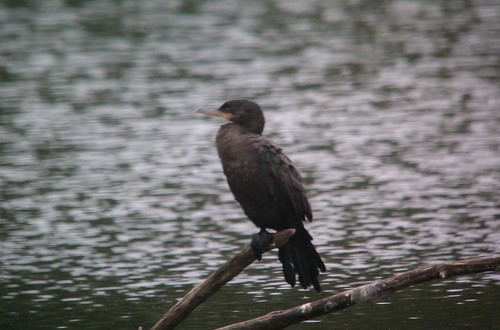
1)  Neotropic Cormorant--I found this bird, a New Jersey first state record, at one of my local patches on the way home from the grocery store back in April.  It lingered until early July, giving hundreds of birders a chance to add this to their state list--and since it is a regional first, folks even came from out of state to enjoy it.

Neotropic Cormorant
First NJ record of Neotropic Cormorant, Clinton, Hunterdon, NJ
 I ended the year within a stone's throw of an ABA milestone, and may take some time out next year to chase a couple more birds for my North America list.  I ended the year with 240 species on my 2014 Hunterdon County list, ending in the top 3 again for the third year I lived here.  I didn't do as good a job of taking my kids birding as I had anticipated back in January, and my Holland trip was the only foreign trip of the year.  So not a big listing year outside of the county, but finding a 3rd third NJ record in 15 months was nothing to complain about!

Hope everyone had a fun time birding in 2014.  Feel free to share your own bests in the comments.

Tuesday, December 23, 2014

North Pole Birding Fail

I spent most of the day playing Santa's helper.  Not a lot of good birding on a drizzly overcast day on the North Pole.  My usual stops on the way to Philipsburg were pretty much dead.  I did have a flock of Snow Geese on the side of I78, but not much else.  I had one 3 minute point count with no birds.  None.  By the time I got home I had only 16 species for the day.  I spent an hour in my yard during the late afternoon trying to get my #20BirdMDR, but ended up with only White-throated Sparrow, Mourning Dove, and Carolina Wren new for the day. So I ended up with a 19 species day, a #BirdingFail.  I could have taken another quick trip into town and picked up a few more species at Demott Pond, but didn't feel like spending gas money just for that. I tried to string a distant calling Song Sparrow, but it just wasn't to be. Oh well. Santa got a lot of work done today :-)

Thursday, December 11, 2014

Best view of bird evolution yet

A series of articles published this week (see overview here) provide the best view of bird evolution yet. Based on the complete gene map of over 40 species from all the recognized bird orders, and taking over 400 years of computer computation time to calculate, this is a real thing of beauty. Here's the tree--


Source Jarvis et al 2014

Interesting evidence that many of the landlords we know of may have descended from the lineage of some sort of raptorial bird that lived through the asteroid impact that destroyed the rest of the dinosaurs--with one group evolving in Africa (Afroaves--woodpeckers, hawks, etc.) and another in Australia (Australaves--falcons, parrots, songbirds, etc.).

There's a lot to digest here, but it's definitely a golden age of bird taxonomy with the technology we have now giving us a much better view than ever before of how our world came to be inhabited by our feathered friends (and everything else, for that matter!).

Tuesday, December 09, 2014

Evening Grosbeaks

This afternoon I was fortunate enough to see a pair of Evening Grosbeaks at a private residence near my home.  I had a couple of birds flyover in 2012, but these were the first I've seen at a feeder since 2007.  Lots of fun!


Wednesday, November 26, 2014

Birdchaser 10th Blogiversary

Today is the tenth anniversary of my first post here on the Birdchaser Blog.  Back on this day in 2004, I had just accepted a job with National Audubon in Pennsylvania, and was getting ready to move my family out from Austin.  I didn't know how much time I was going to have for birding at the new job, so I thought a birding blog would give me an excuse to go birding regularly so I'd have something to post.

Remember the early blogging days when we all had light text on black backgrounds?  And there weren't very many pictures?  Been there, done that!  Here we are ca. 2006.

Turns out there was a lot of birding over the next five years I worked at Audubon.  I was posting a couple times a week during my heyday, and when birding blogs were sparse, Birdchaser was one of the top 10 birding blogs by traffic.

After I left Audubon and started teaching, the blogging started to subside.  The last couple of years my posts have been far less frequent.

Black on white, still just one sidebar, ca. 2008.


So, is there a future for the Birdchaser blog?  Will it make it through its tween years and into a more robust teenage stage of blogging life?

Here's what I have planned:

More posts.

More book reviews.

More photos.

More NFC recordings.

More birding humor.

More fun.

More bad photos of good birds--Juv. Greater White-fronted Goose, Cushetunk Lake, Hunterdon Co, 20 Nov 2014

I've got a birding project coming up in 2015 that will be a lot of fun.  More on that later.  It will have its own dedicated blog, but I'll post highlights here, as well as posts of other travels and the books I'm reading.

I'm also revamping my Urban Birdscapes blog and will have some fun stuff to point to over there soon.  So while I have other projects going, the Birdchaser will be my blog focussed on my own birding trips and bird books.  And who knows what else.

Thanks for sticking around, and I look forward to sharing more adventures in the coming blog tweener years!

Tuesday, November 25, 2014

Review: The New Birder's Guide to Birds of North America

There are a lot of field guides out there.  Including guides aimed at beginners.  Each guide claims its own unique features.  Some are great, some are OK, and some are frustrating.

Bill Thompson III's The New Birder's Guide to Birds of North America may not make this claim for itself, but it may be one of the most fun field guides to come out recently.  It is a publisher's and reader's delight, with a tight and beautiful layout that makes it very fun to peruse.

In short, this is the book form of Bill Thompson III leading beginning birders on an extended cross country trip to see "300 of the most common birds in the United States and Canada."  In doing so, he shares what to look for, listen for, and remember about each bird.  He also shares a nugget of trivia about each bird--just as if we were on a birdwalk together.

In addition to one or two photos of each species, each one page species account features a black and white illustration (by Julie Zickefoose or Michael DiGiorgio) of the bird in action.  A full color range map, and notes on how to find each bird are also included.

Great layout, fun illustrations and facts.  Unfortunately in this case the photos don't show what they say they do, or help very much if you live in the West.

This well-chunked and informative layout makes this book fun and easy to use.  Thompson's prose is light and engaging.  I especially enjoy his descriptions of bird vocalizations--something that isn't easy to do, making it the hardest section to read in most field guides.  Not so here--as when we are told that the Common Moorhen "sounds like someone is torturing a frog" and the Cactus Wren "sounds like someone trying to start a car."

As befitting any guide for beginners, there are plenty of other extra features here to get one started on the road to enjoying birds, including instructions on birding gear, how to use binoculars, info on birding manners, and helpful lists including Five Outside the Box Tips for Improving Your Birding Skills and Be Green: Ten Things You Can Do for Birds.

It's also very cool that Bill Thompson wrote this book in collaboration with his kids and their schoolmates.

So what's not to like about this guide?  It's a delight to read.  A lot of fun.  Beginning birders, and even more seasoned types, will find fun and memorable facts to increase their enjoyment of birds.  But since it has only 300 species featured, it obviously isn't going to help identify every bird--including "red-shafted" Northern Flickers, immature gulls, and the domestic waterfowl that they are most likely to see at their neighborhood park.  There isn't a good way around that limitation.  Readers are even promised in the introduction that they will see birds not found in this book--and that they should have a more comprehensive field guide to help them with those identifications--useful advice for sure, but also begging the question of why such a limited guide might be needed at all.

But since there aren't easy answers to that question--it's best to just enjoy this well written and put together guide for what it is--a fun introduction to North American birds and birding, with text and illustrations almost as lively as the birds themselves.  During this holiday season it would make a good stocking stuffer for the beginning or causal birder, or if you've been birding with Bill Thompson III out on the birding festival circuit, this encapsulation of his birding spirit is a must have as well!

Disclaimer: review based on a library copy.

Additional Reviews:
Birder's Library
Amazon


Friday, November 14, 2014

Review: Field Guide to the Birds of New Jersey

I've only lived in New Jersey for three years, but New Jersey is a great place to bird, with so many birds in such an easily traversed state.  Every where I go, people stop me and seem to want to talk about the birds they see.  Most of these folks probably don't consider themselves birders--though many know quite a bit about the local birds.

These may well be the perfect audience for Rick Wright's new Field Guide to the Birds of New Jersey--the first in what appears to be a long line of state guides to be sponsored by the American Birding Association.  The Field Guide to the Birds of New Jersey (henceforth FGBNJ) is an attractive and well produced book that aspires to spark "a lifetime of enjoyment of birds" in NJ.  I hope it succeeds.

As is obvious from the title, this guide is focused on a small geographic area--just one U.S. state.  Since it is aimed at new or beginning birders, it does not cover every bird found in the Garden State, but does a good job of representing the most common 255 birds that folks are bound to find--including some tough to find birds such as Connecticut Warbler and Northern Saw-Whet Owl that will take some diligent searching to actually observe.

FGBNJ is a photo guide.  I'm not a huge fan of photo guides--usually preferring the synthetic abstraction of an artists rendering to the misplaced concreteness of a photo--but for its purpose, this one does a good job.  The photos--over 600 in all--are almost universally excellent.  Their large format provides good looks at the birds covered.  The photos are beautiful.

With beautiful photos, FGBNJ does a good job of staying out of their way.  The layout is simple, with one species to a page or even a two page spread.  The text for each bird is one big paragraph, written to be actually read rather than skimmed.  Identification tips are usually kept to captions inset into the photos.


My favorite part of bird guides is to hear the voice of the author.  In this case, my friend Rick Wright's polished writing is a joy.  His summary of each species is a good introduction to the bird, and will be very educational for those learning about each species for the first time.  As a clever writer, Rick has tucked away little Easter eggs here and there that will delight.  I've never read about a bank collapse in a field guide before!  And the imagery is often a joy to read, such as an "ocean sprinkled with the silvery dots of roosting and feeding loons."  Such spare but delightful prose hearkens back to the species accounts written by Roger Tory Peterson, the grandfather of all field guide authors.  Wright's prose is a fitting and worthy perpetuator of that grand tradition.

In addition to the species accounts, FGBNJ provides a full checklist to the birds of New Jersey, tips on good birding locations around the state, and the obligatory sections on the parts of a bird and how to identify birds--all geared to the beginner in a clear and concise manner that minimizes jargon--you will find napes, primaries, and secondaries, but as far as I can tell, no tertials.  Perfect for beginners.

There are many challenges to writing and producing a guide for beginners, but FGBNJ and presumably the rest of the American Birding Association series of state guides do provide a good introduction to the birds of the state, and hopefully will provide inspiration to those with casual birding interests to join the ranks of those who start wandering farther and farther afield in their search for avian treasures!

Disclaimer: this review based on a library copy.

Wednesday, November 12, 2014

Quest for 700 ABA Birds

The other 700 club!
It's been a long time since I hit a birding milestone in the ABA area.  In fact, I haven't really hit one since I started graduate school.  Back in 1997 we had just one small baby in the family and during the summer before starting graduate school I made an effort to get a special bird for my #600 ABA species by flying up to Michigan to see a Kirkland's Warbler.  

Since that time we've had two more kids, moved five times, and the birds haven't come as fast as I might have hoped.  I only got 19 new birds while getting my MA and PhD degrees in Austin.  After leaving Austin, I was able to do some traveling for my work with Audubon, and picked up another 53 species in my nearly 5 years there.

In the past few years, the additional new species have come much slower.  There were a couple years were I only got one new bird for the ABA area.  This year so far I've seen three (European Golden Plover--see my video below of first NJ record bird, Bar-tailed Godwit, and Whiskered Tern).  In doing some record-keeping house cleaning today, with all the splits over the last few years and a new listing rule giving me back the African Collared-Dove from Los Angeles that I saw in 1985 (thank you ABA!), my ABA list spreadsheet shows I'm now at 696 species for my North America list--a good handful closer than I anticipated to the 700 ABA milestone.


Once upon a time 700 was considered a very respectable ABA list.  In fact, the first person to reach 700 species sightings in North America was Joe Taylor in 1972.  Before that, birdwatchers who had seen 600+ species in North America were considered elite members of a prestigious 600 Club.  In 1973, Jean Piatt wrote Adventures in Birding, a now classic account of his and his wife's quest to join the 600 Club. Nowadays, dozens of birders report lists over 800 species, and at least one is claiming to have seen over 900 species in North America north of Mexico.

But I'm still poking along slowly as I approach 700.  I'm heading to Florida in December for a family vacation to Orlando, but don't expect any new birds.  Unless I take a few days away from the theme parks and cruise down to south Florida, where a few other possible new birds for me are in the offering, such as the introduced Egyptian Goose (established Florida birds were recently added to the ABA checklist), Red-cheeked Bulbul, Spot-breasted Oriole, and Purple Swamphen.  Now that I realize how close I am to 700, I may have to make some new travel plans here soon!

Since I can't imagine ever spending the kind of money that it takes to get to 800 for North America (multiple Alaska trips, and chasing rare birds wherever they appear across the lower 48), this may be my last ABA milestone.  I'm looking forward to seeing what my next four new birds will be!

Tuesday, November 11, 2014

American Woodcock Wing Sound

I recorded this American Woodcock wing sound yesterday morning when a bird flew over my NFC microphone in my yard.  I usually hear these guys when they are displaying in April, so who knows how often they are actually flying over my yard.  I intend to record all through the winter this year, so who knows what kind of fun stuff I will find.


Wednesday, October 29, 2014

Rare Birds of North America

When I was in high school, one of my favorite books was Don Roberson's Rare Birds of the West Coast.  The only copy available to me was in the Portland Public Library, and I would have to ride the bus downtown to check it out on a special out of county loan.  I would then spend hours looking at all the vagrants recorded in Oregon and nearby states, and dream about what it might be possible to find.  When I got kicked out of my Junior year English class for being obnoxious and had to come up with a self-study unit to pass the time, Rare Birds of the West Coast was my principle source in compiling a paper on which birds were most likely to be added to the official Oregon state list.  Roberson's book, though very dated now, is still one of my favorite bird books of all time.

When I heard that Steve Howell, Ian Lexington, and Will Russell were coming out with Rare Birds of North America (Princeton, 2014), I was very excited to get my hands on the definitive guide to rare birds of the whole continent!

The book has been out for months now, and there have been many excellent reviews (including BirdGuides, Birder's Library, Birdwatch, and ABA).  These reviews are all pretty much glowing, and I recommend going there for more details that I may skip here.  Most reviews come out when a book is released.  Now that I've lived with and used this book for a few months, perhaps I can offer a different perspective.

Rare Birds of North America has a lot going for it.  Let's start with the illustrations.  For me, the gouache paintings by Ian Lewington are the best thing about this book--and blow the socks off the color plates in Rare Birds of the West Coast and they pretty much trump any current field guide illustrations found in North American guides. The illustrations--from the accentor on the cover, to the very last of the 275 color plates--are stunning.  They are clear, large, and a joy to behold.  They've got my mouth watering for the future publication of a field guide to North American birds that will feature Lewington's work.  These illustrations have made this book my second stop (after my trusty Sibley) when considering the identity of a possible vagrant bird.  I even carried it around in my car for awhile.  I expect I'll be using and enjoying these illustrations for a long time.

Sample plate from Rare Birds of North America


The text of Rare Birds of North America is exhaustively researched and documented and the format and layout is fantastic, with great introductory sections on vagrancy as well as molt and topography of bird plumage (but what else would you expect from the author of Peterson Reference Guide to Molt in North American Birds?).  The species accounts are also well thought out, with information on occurrence, possible patterns of vagrancy, and identification and habits of each species covered.    In summary here's what works best for me:

  • Discussion of vagrancy--good review of literature and speculations
  • Molt and topography section--concise review
  • Species accounts organization and layout, especially the--
  • Comments section--where we get the clearest access to the authors's thoughts on these birds and their occurrence, including fun speculations about how, why, and where these birds might possibly turn up next.
In living with the text of this book, there's a few things that have been a little irritating for me:
  • Division of the species accounts based on geographic origin of vagrants.  For each taxonomic group of birds, birds of New World and Old World origin are split from each other, sometimes them harder to find in the text.
  • Field Identification section--generally good information, but sometimes vague and frustrating.  Many times I'm left wondering what field marks are really diagnostic, or if I would be able to really identify one of these vagrants based on the information provided.  A case in point from an actual frustrating ID I faced here is Yellow-legged Gull.  This is a real possible vagrant where I live (and I had a candidate bird last year), but one that might be impossible to distinguish from a hybrid Herring x Lesser Black-backed Gull.  The text mentions this challenge without really providing a good discussion of how to actually make the distinction.  Granted this may be a frontier of bird identification, but I was hoping for some more clarity here from the founder of the Bird ID Frontiers listserv!  Likewise, when a possible New Jersey first European Golden Plover showed up in a sod farm field a few miles from my house, the ID text offered some hints (underwing pattern and body structure), but left me hanging in describing the plumage.  In fact there aren't detailed plumage descriptions here--just comparisons between the vagrant birds and more familiar North American species, or between the ages and sexes of the vagrant species.  So where I would hope a book like this would provide the definitive descriptions and field identification discussions, after using this book a few times I feel like it is a good reference, but not the final word, and that more research in other references will often be needed to actually identify a vagrant.
  • Summaries of vagrant records are generally good, but when I found that the 1996 Common Crane record from Nebraska that I and many other North American listers twitched (this was the first twitchable Common Crane in 20 years) was not included, it made me wonder how exhaustive these summaries actually are.  I suspect they are pretty thorough, but you hate for there to be a doubt.
That said, and my petty quibbles aside, Rare Birds of North America is an impressive book.  While I may not actually work as the best source of ID info on some of these birds, it will still be helpful, the illustrations will be very useful, and the summary of bird records will still inspire the imagination.  If it helps birders find and recognize more of these mega vagrants, than it will have fulfilled its purpose and provided a lot of enjoyment to twitchers across North America.  I personally look forward to spending additional time with this book, and using it to help me when I'm birding on my own or twitching somebody else's good find.

As I mentioned, most bird books arrive with much aplomb and online reviews, then you don't hear much about them later.  I'd be curious to hear how Rare Birds of North America has lived up to its initial reviews, or what other thoughts folks have about it after living with it for half a year?

(Review based on a review copy provided by Princeton University Press).


Tuesday, September 30, 2014

Pre Dawn Thrush Flight 30 September 2014

I recorded over 310 thrush calls between 5am and 6:35am at my home in Hunterdon County, NJ this morning.  Here's the eBird checklist.

As always, there are many calls that I'm still puzzling over.  Here's a spectrogram of a call sequence from 6:09am:

You can download the audio of this clip, and follow any possible discussion of it from my post on the Nocturnal Flight Call Facebook group.

Wednesday, September 24, 2014

Back in the NFC Saddle

This past spring I crashed the laptop I was recording night flight calls on, and I didn't get my MacBook Pro set up to record until last night.  But I'm back in business now thanks to my Griffin iMic adapter and Audacity software.  Still recording using the Oldbird 21c mic.  Since the Oldbird detectors aren't set up for the Mac, for now I'm just recording then browsing the spectrogram by hand to find and ID the calls.

Here's my eBird checklist from early this morning.


Wednesday, June 11, 2014

Neotropical Cormorant

Neotropic Cormorant, Clinton, NJ, 11 June 2014

After not seeing any reports of the Neotropic Cormorant I found in Clinton back in April, I stopped by the Red Mill pond downtown and quickly found the bird sitting on branches in the middle of the pond.  This will be the 1st New Jersey record pending acceptance by the NJBRC.  When I first found the bird, I guessed it would stay the summer (where else would it go?), so we'll see how long it hangs out.  It's got a nice river to fish in, and unless it gets lonely and wants to go off and look for a mate, I don't know why it won't just hang out here along the river.

eBird checklist
Nature Blog Network Fatbirder's Top 1000 Birding Websites