Subscribe

RSS Feed (xml)

Powered By

Skin Design:
Free Blogger Skins

Powered by Blogger

Wednesday, January 18, 2006

Carolina Parakeet Video

Not everyday you get to see an extinct species on film. But thanks to digital technology, we'll all get to see Carolina Parakeets (view clip here) in The New World, the latest film from New Line Cinema, opening Friday. Haven't been keeping up with movie previews lately, so hat tip to Bill of the Birds for this one.

Tuesday, January 17, 2006

The Gaze

This morning after a brutal three hours of work on the dissertation, I headed off into the woods at work to try and recoup my sanity. I didn’t see anything too unusual--mostly because of the rather odd gentleman I ran into down near the creek. He appeared to be in his late 60s and had some kind of European accent. I was trying to pish up some sparrows when I noticed him sitting on the ground maybe thirty feet away.
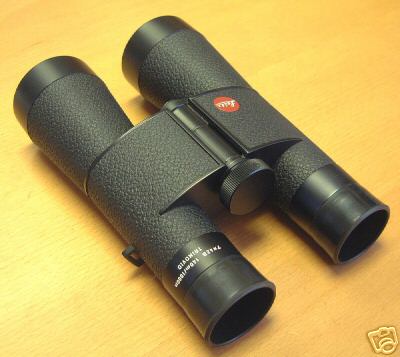
At first I was a little startled. The only folks I usually see in the woods are hunters in blaze orange vests, but this guy was obviously not a hunter. I quickly noticed he had some old Leitz (remember those?) binoculars, so I figured he might be a birder and asked him if he'd seen anything good. He kind of looked at me funny and asked me what I meant--which immediately tipped me off to him not being a regular birder. I asked him if he'd seen anything out of the ordinary, and he replied that it was his first time on the property so he wasn't quite sure what was ordinary.
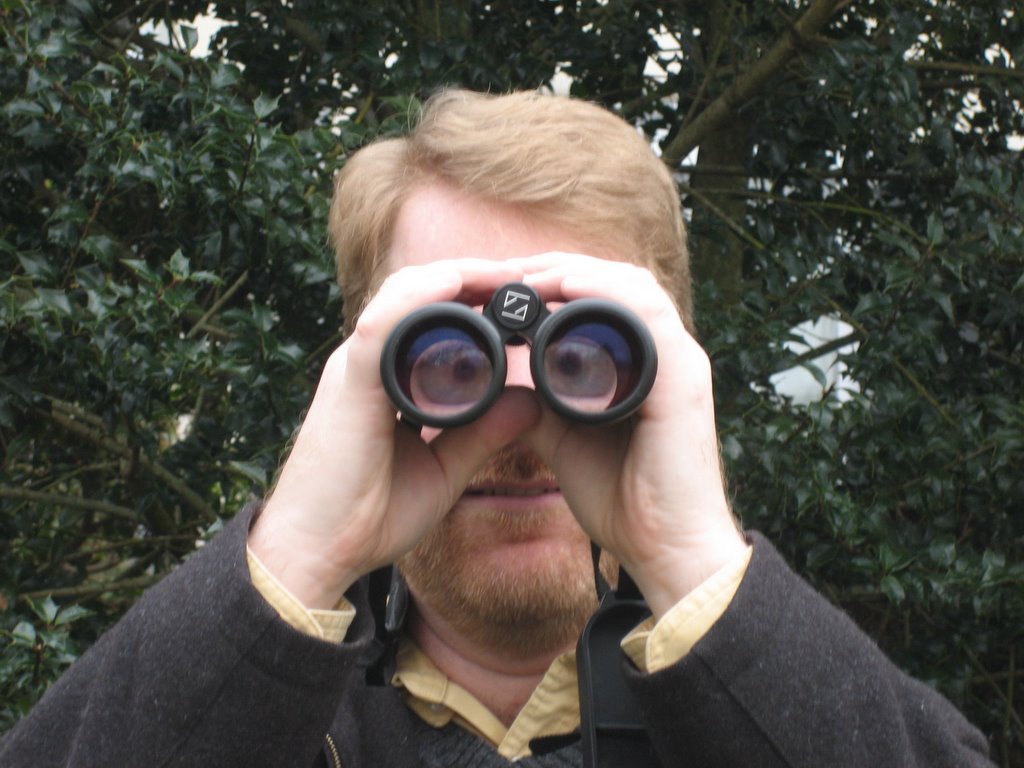
Anyway, I introduced myself and he told me his name was Sartre. "Like the philosopher?" I asked, to which he replied in the affirmative. I thought he was a little confused, because actually, when I said "like the philosopher?" what he really said was, "Yep, that's me."

Well, I really didn't think much of it because I noticed a couple of sparrows back in the brush, but then I noticed that this Sartre guy was kind of looking at me funny, so I felt like I had to make conversation with him. I muttered something about sparrows, and he started asking me about bird watching.

Now, I've only recently embraced the term "bird watching," it just wasn't cool to be a teenage bird watcher. Growing up, I had tried very hard to make a case for it being cool to be a birder. I was explaining this to him when he interrupted me--

"But you are watching the birds, aren't you?" he asked.
"Uh, I guess so," I replied. "Really I'm just trying to identify them, to see what they are."
"And what do you think the birds make of you watching them?" he asked.

Now, I thought this was getting a little weird, but whatever. Then he asked me if I'd ever felt like birds would "just happen" to take off as soon as I got them in the scope or binoculars. "Sure," I responded, "especially grebes."

Then he asked me if I wanted to know why they fly as soon as you look at them. I told him I thought it was just coincidence that the birds would fly when I looked at them, but then he did something that really kind of freaked me out. He said, "here's what you look like to a bird when you look at it..." He lifted his 7X35s to is eyes, and all of a sudden his eyes got HUGE! The binoculars magnified his eyes so all of a sudden it looked like he had giant monster eyes.

He took down his bins and said, "those birds are watching you, and when you look at them through the binoculars, they know that you have spotted them, you've captured them in the gaze, you've objectified them, put them at your visual mercy. It's like you've caught them, like the way you feel when you realize someone has been staring at you.

Birds don't like this, because usually they only experience this feeling when a predator has locked on them. When your eyes get huge through the bins, or you all of a sudden sprout a big giant eye in your spotting scope, it freaks them out and they fly away. You've caught them in the gaze."

Now, this was all very startling to realize. Birds may be watching us watch them, and our big, huge, magnified eyes might appear threatening to them. Yikes! Next time you are birding with someone, have them look at you with their binoculars or scope and you'll see what I mean. It's rather amazing.

Anyway, I kind of stood there puzzled for a minute, looking at my binoculars. I wanted to ask this guy more about this insight, but he was shuffling off towards the creek. He just said I could check it out in his book. "The Gaze," he said, "just remember the gaze."

Of course, this couldn't have been the real nobel prize-winning existentialist philosopher Jean-Paul Sartre (he's dead), but I have to tell you, this whole experience was kind of puzzling. Maybe even shocking. Maybe I've just been spending too much time writing my dissertation, or watching grackles at the feeder outside my window at work. Maybe none of this makes sense, but then again, maybe there's something to it. Maybe dead philosophers really do go birding in Southeastern Pennsylvania.

This afternoon I’ll go back out to the woods to see what’s around. I'll try not to "gaze" at the birds, but I'm still going to want look for those sparrows.

Monday, January 16, 2006

All Work and No Play...

...makes me a dull birder, but there it is! I spent the day at the office working on my PhD dissertation with only occasional glimpses at birds out the window. I was able to see a couple new 2006 office yard birds (Purple Finch, Common Grackle, Red-winged Blackbird, and Brown-headed Cowbird), but nothing out of the ordinary. The Purple Finch was the first I've seen since late last Fall. It was a beautiful wine-colored male, a real stunner. I was a bit amazed to see a Downy Woodpecker feeding on the ground beneath a feeder--don't recall ever seeing one of those on the ground before. And it was fun to watch the Blue Jays pick up a sunflower seed with their beaks, place the seed between their feet, and holding it there while they peck it open and extract the meat.
Saturday, January 14, 2006

Birds on Google Video


Did you know you could get free videos on Google Video? You can even place the video on your blog or website. This one is of baby House Wrens being fed by their parent. Not quite the same as watching it in real life, but kind of fun anyway.

Here's another one of hikers walking right past one of the reintroduced California Condors in Arizona. Makes you wonder how long this bird is for the world!


According to the Peregrine Fund, this individual is Condor 241, a female bird hatched at the World Center for Birds of Prey on April 13, 2001, raised by puppets to keep it from becoming imprinted on people, and released at Vermillion Cliffs in Arizona on December 9, 2002. According to the latest info, it is alive and well in the wild. Lets hope the bird is usually a bit more wary of people and this video just shows it having an off moment!

And finally, if you have an hour and a half to kill, here's a long video with Diane Porter of birdwatching.com that will teach you how to start watching birds. Enjoy!

Bullock's in Bethlehem


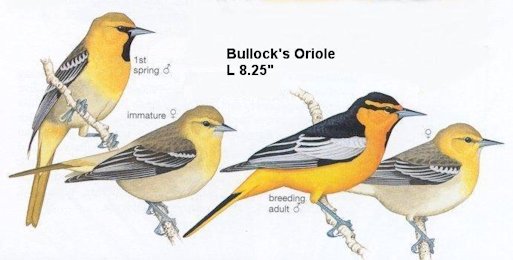
This morning I drove an hour and a half out of my way to see a young Bullock's Oriole in Bethlehem. The bird is coming to a feeder behind a house, and when I got there this morning, it was pouring rain. Fortunately, within ten minutes, the bird appeared at the feeder, where it seemed to eat some grape jelly spread out for it on the platform feeder. Then after about 45 seconds, it flew off around the back side of the house.

While this is only the third time this species has been seen in Pennsylvania, I grew up with them out west and have seen dozens, if not hundreds, of them. So why would I drive an hour and a half out of my way and stand in the rain for ten minutes--just to see this orange and gray bird for less than a minute? Especially when I should be spending the full day working on my PhD dissertation on urban bird conservation? Probably because I'm insane. Its just what birders do!

Now, there's a Northern Hawk Owl I'd love to see just six hours away up in New York. What are the chances I can get my family to make a day trip of it?

Friday, January 13, 2006

Helping Folks With Their Owls

The first weekend in February I'll be down in Austin, Texas to teach an owl workshop at the Hornsby Bend Bird Observatory. I'm pretty excited to get back down there and see old friends, lead some folks on an owl walk, and help them figure out how to get more owls on their property or in their yards. Check out the workshop details here, and if you're in Texas that weekend, stop on by for owls and a great Texas BBQ lunch!

Saving Birds is Hard Work!

Usually when I tell people that I'm a bird conservationist, that I get paid to help save birds, they think I must have it pretty easy. But hey, bird conservation is hard work! Even Einstein agrees!


Of course, he'll write just about anything if you visit Hetemeel.com!

Thursday, January 12, 2006

Bird Eats Boy

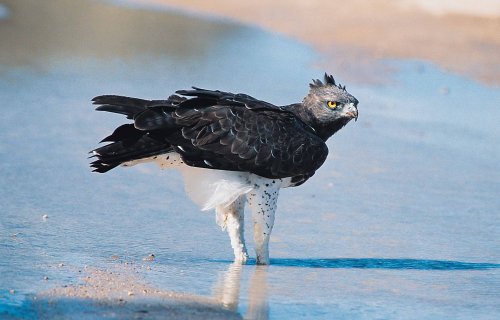
OK, it was 2 million years ago, and the boy--well, maybe it was a girl--was a young Australopithecene, related to our early ancestors. But still, quite an interesting story. Eagles in Africa were more than an awesome sight to our early, early forebearers. Apparently, at least every once in a while, an eagle would swoop down, grab a youngster by the skull, hover with it in the air until it died, then fly off to feast on it. Sometimes, we watch the birds. Sometimes the birds watch us!

Sunny Day

After a day of miserable cold and mist, today dawned bright and sunny, with 18 bird species in the woods at work, including a Hairy Woodpecker, which is new for the year. I first heard it call high in a tree, then saw the larger-than-a-cardinal woodpecker briefly before it flew off through the woods. Birding is often like that. Of the 146 individual birds I saw or heard this morning, many were just brief looks--often obstructed by trees or bushes. While it is common to get killer magazine-cover-type looks at birds, most of the birds you see are far away, partially hidden, or don't stay put for very long. But that's part of the challenge and fun--to be able to find and identify these little gems as they go about their own business.

Wednesday, January 11, 2006

Ivory-billed Woodpecker on NOVA

Check out the seven minute story that aired last night on NOVA about the recent rediscovery of the Ivory-billed Woodpecker. Controversy continues to swirl around these Arkansas sightings. My friend Laura Erickson is down in Arkansas looking for it right now (read her reports here). I've had other friends go down to help look for it. Half the time I wish I was down there searching as well. But according to Tom Nelson, one of the leading skeptics, it may be all for naught--the video, sightings, and sound recordings do not reveal the presence of ivory-billed woodpeckers, but merely the wishful thinking of the searchers. It's a damning argument, and one that is ruffling more than a few feathers. Here's hoping this is all resolved soon!

Tuesday, January 10, 2006

Sleeper Creeper

This morning while walking the woods at work, I watched a Brown Creeper for about five minutes as it worked its way from tree to tree. Then it flew down to the base of a tree and did something I hadn't seen a creeper do--it just stayed put. There was a White-throated Sparrow perched a couple feet away from the creeper, and it was looking up into the sky, so I wondered if the birds were just watching a hawk or something up there, but I couldn't see anything. Then I got closer and the creeper stayed put, clinging motionless to the side of the tree. I'd never seena motionless creeper, so I wondered if something was wrong. Finally, when I was 15 feet away, I could see that its little eye was closed. Was it alive? After about five minutes, it perked up, stretched its wings, squirted out a little dropping, and started hitching itself back up the tree. It was just taking a nap! A sleeping creeper is not something you see every day, so it was fun to witness this little episode in the life of a backyard bird.
On the way to the bank this afternoon I had a Snow Goose in a large flock of Canada Goose in Richboro. Turkey Vultures and a couple singing Carolina Wrens bring the 2006 office yard list up to 27 species.

Ancient Birds, Stone Age Music

Mark Brazil has an interesting article about his visit to see the oldest known flute, a 35,000 year old instrument made from a swan bone found in Germany's Geissenklosterlen Cave. We've all heard birds sing, and speculated about how human music may have been initially inspired by the sounds of birds. This ancient flute not only shows Paleolithic humans to have made bird-like notes with a flute, but to have crafted that flute from the body of a bird. Next time you're listening to your iPod, you can thank your prehistoric ancestors for creating music by literally taking a note from their bird neighbors.

Monday, January 09, 2006

H5N1 Bird Flu in Turkey

While public officials are quick to blame wild birds for the latest spread of H5N1 avian influenza throughout 10 of Turkey's 81 provinces, there is yet little evidence to support the claim, while trade in poultry is still the most likely carrier of the virus. In recent weeks, evidence has been mounting that use of chicken manure as food for farmed fish is another likely spread of H5N1 viruses to both domestic and wild birds. Wild birds are still more than likely the victims, rather than common carriers, of H5N1 avian influenza.

2006 Office Yard List

Since its a new year, its time to start a new yard list at work...after a nice morning walk today with Black-capped Chickadee (out of range, but regular this year in the area), Red-breasted Nuthatch, and Brown Creeper, the office list is up to 25 species. The office is located on 160 acres along Neshaminy Creek where it crosses Almshouse Rd. The land is owned by a the Heritage Conservancy, and my office is in a 200 year old three-storey farm house. With only the creek for water, we don't get many ducks or shorebirds, and the corn field hasn't attracted many grassland species, so its mainly woodland birds with the occasional flyovers. This year, we'll try to see if we can see more than the 109 species we found here last year. Its a great place to work, and take those 15 minute breaks!

Saturday, January 07, 2006

Mr. Nature Mom

Took all three kids this morning up to the Green Lane Nature Center. We all got great close looks at a Brown Creeper from the bird blind, and the kids enjoyed the activities at the center. Then we drove around the lake--not a lot of different birds on the lake, but several thousand Canada Goose. On the way home, the four year old said his favorite part of the morning was seeing the large flock of geese.

Rule #1 for nature viewing with kids--keep it short.
Rule #2--focus on showing them the spectacular, either spectacular creatures, or spectacular numbers.
Rule #3--don't push it, when they're done, you're done. As long as they enjoy it, they'll want more. If you push it too much, they may resist.

Friday, January 06, 2006

Birdchaser in Birder's World

My review of John Faaborg's book Saving Migrant Birds has just come out in the latest issue of Birder's World Magazine. Just got my two complimentary copies in the mail, which was a boost to my day, which has been otherwise slow birdwise--170 Common Mergansers at Peace Valley were nice, but action at the bird feeders here at work has been very light. One cool thing today was a young White-breasted Nuthatch that kept winking at me as it sat just outside the window on the feeder. OK, maybe it was just blinking repeatedly. But then again, maybe it likes me!
Thursday, January 05, 2006

Flybys

One of the joys of birding is experiencing regular flybys. This morning, two of the neighbor crows zipped past my car as I was heading out to work. During my afternoon walk, several Mourning Doves flew across the field and through the trees.

The great thing about flybys, is that you don't know where the birds are coming from, or where they are going. It is just a few short shared moments in the otherwise discontinuous lives of the bird and the observer. Like art, a bird flyby is reality frozen in a moment. The coming from and going to is a mystery, and stands for all the other comings and goings in our lives.

Usually, if we think about it, we want to know more. More about where the bird is coming from, where it is going, how it spends the rest of its time. But that is only when we think about it. For most of us, the flyby is just a flash. Just a brief moment that may or may not even register. Like the passing of clouds, or a thought. Birds come and go. Like the feathered winds that they are.

Wednesday, January 04, 2006

Bluebirds

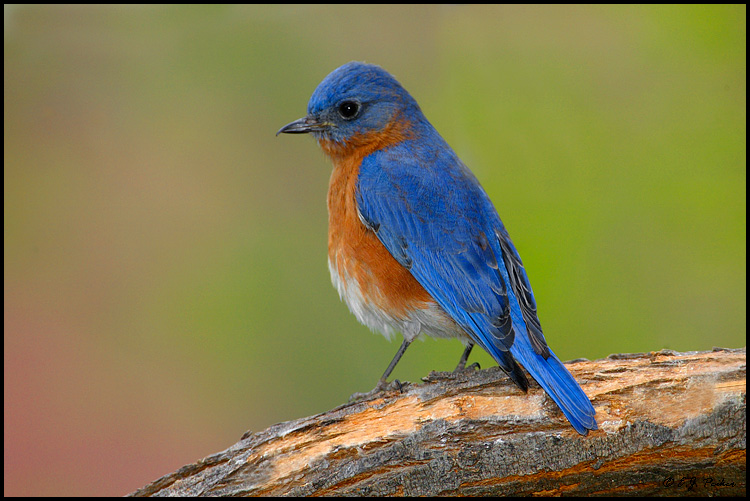
This afternoon, the woods at work were very quiet, but there were four Eastern Bluebirds calling and foraging along the edge of the mowed corn field. While Eastern Bluebirds can be fairly common (I had one on the roof of my neighbor's house when I pulled out of the driveway this morning), they sure are beautiful, and its easy to see why they are so popular.

And, as if to join me in initiating my Year of the Redtail, a nice adult Red-tailed Hawk soared over the field most of the time I was birding during my break this afternoon.

Tuesday, January 03, 2006

Spying on the Neighbors

There were plumbing problems at work this morning, so I got to work from home. While eating lunch, I noticed that my crow neighbors were out on the basketball court behind our townhome, so I grabbed my Zeiss 7x42s and went up to the upstairs windows to see what they were up to.

The first thing that I noticed was that there were six, not five, crows together in the group--so the family may be a bit larger than I originally thought. When I first saw them, the birds were sitting more or less together on a split-rail fence surrounding the play area. Then they all flew out to the basketball court. They were all there for only a few moments when one of the birds flew up to the top of a basketball backstop. A couple seconds later, that bird was joined by another, while the remaining four birds continued to walk around on the ground. I didn't see them eat anything, but they seemed to pick up some small rocks and sticks.


The second crow on the basketball backstop seemed to want to get closer to the other one. It sidled up to it and started grabbing the other birds wing feathers with its beak. After maybe 30 seconds, the first bird flew 50 years away and landed on the top of a townhouse. Soon, three of the other birds followed suit and landed on nearby rooftops. I didn't see where the other two birds went. Soon, even the rooftop birds were gone.

Not much to gossip about. I really have more questions than information about these neighbors of mine, and not sure when I'll actually meet them. Maybe I should get some cracked corn for them. If we don't end up moving to Perkasie, maybe I'll be able to find this pair's nest when the nesting season gets started here in a few months.

Meanwhile, some interesting reading on the secret lives of crows from Crow expert Kevin McGowan can be found here. A good old-fashioned life history of crows is online here. In addition, a biography of the crow leader Silverspot, by Ernest Thompson Seton, while perhaps slightly conjectural, has been on my mind a lot lately. I enjoyed it as a kid, and it still serves as a bit of an inspiration for my new fascination with crows.

There is still a lot to learn about these small black neighbors of ours. For folks interested in helping us all learn more about crows, check out Crows.net to see how you can submit your own valuable crow sightings.

Monday, January 02, 2006

Unless You Believe

This morning I took our friends from Maryland to see some of the sights here in the Philadelphia area. At one point while we were walking, we came to a wooded area with a lot of leaves on the ground. A group of doves were feeding there in the leaves and my friend said, "you don't usually see a lot of doves in the forest."

Its true. Sometimes you do. I've seen small flocks of Mourning Doves in the woods, but more often they feed on the ground in more open areas. But there was something else different about these doves. They were larger than Mourning Doves. More purplish. We were only a few feet away from them, and in perfect light, I could see that they weren't Mourning Doves at all. There, right in front of me and my friends was a small group of Passenger Pigeons.

I know Passenger Pigeons are extinct, but that's what they were. Not five feet away. Six or seven of them on the ground. In perfect light. The scene will be engraven in my memory forever.

Then, hearing something behind me, I turned and saw a large pair of woodpeckers behind me. On most days, a sighting of a pair of Pileated Woodpeckers would be the highlight of any morning birdwalk here in Southeastern Pennsylvania. But not today. Just as the doves weren't Mourning Doves, the woodpeckers in front of me weren't Pileateds. They looked to be about the same size as Pileateds, but they had large white patches on their back, and horn-colored bills. One, the female, had a recurved black crest. The other, the male, had a red crest. Again, I was very close to these birds. In perfect light. In fact, squatting down very still, I was able to get within inches of this pair of birds clinging to an old stump. The viewing conditions were perfect, and I studied the birds at length. There can be no doubt as to their identification. There, not 15 feet away from the Passenger Pigeons was a pair of Ivory-billed Woodpeckers.

Anyone reading this would have to think that I'm either kidding around, or completely whacked, but let me assure you that this is an entirely accurate account of my experience. I really did see Passenger Pigeons and Ivorybills at 11:45 AM. Anyone who wants to can check out my story. I can provide excellent directions to these birds.

From where I live in Bucks County, Pennsylvania, head south towards Philadelphia on the Northeast Extension. Take I-76 east towards central Philly, then take the left exit onto I-676. Immediately take the first exit on the right--that's the Ben Franklin Parkway. At the bottom of the ramp, continue straight for a couple blocks. That will take you to Logan Circle. Go 1/4 of the way around the circle and you'll see a large brick building on the right on the corner of Logan Circle and 19th Street. The birds were on the third floor of this building, here on display at The Academy of Natural Sciences.

While you can't exactly add these mounted museum specimens to your life list, you can see them at extremely close range. And right next to these birds, are three mounted Eskimo Curlews, a Great Auk, and a couple of Labrador Ducks.

How is one to feel at seeing the bodies of so many extinct birds? While I don't get to see Passenger Pigeons and Great Auks every day, even as museum skins, it was hard to get excited about seeing them. It was neat, but not a happy sighting. Instead of marveling at the sight of so many rare birds, the experience left me feeling hollow and empty. Their presence was a blunt reminder of their absence.

For those who care about birds, there are many such reminders. Too many. Small flocks of spring warblers reminding one of the many more birds that one could find in the past. Sightings of birds, now rare, that were once common. Rumors of ghost birds, hard to verify, in distant bottomlands of the Mississippi Delta.

These sightings and experiences are hard to take, unless you believe. Unless you feel in your heart of hearts that the Cornell researchers and Audubon volunteers will find the Ivory-bills this winter in Arkansas. Or maybe on the Atchafalaya. Or you can imagine somebody spending $100K to set up a private Attwater's Prairie Chicken breeding facility, and raising another $30 million to buy 5,000 acres of Blackland Prairie Farmland to restore prairie chickens to Central Texas. Or you can envision neighbors banding together to manage their property for the birds of conservation concern in their area. Or that we can rewild the American west by bringing back the megafauna that we lost during the human colonization of the Americas 11,000 years ago at the end of the Pleistocene.

Unless you believe, your heart must necessarily ache. Or you must numb yourself to the pain of loss. Unless you can envision a world teaming with wildlife. Unless you can see in your mind's eye flocks and herds to rival those reported by our ancestors, and see a way to bring that vision to life.

I believe. Can you? Can you see it?

For a $10 museum admission I can take my children to see Ivorybills and Passenger Pigeons any day of the week. Someday, I hope to be able to take them to see real live ivorybills. And Bachman's Warblers. And hundreds of prairie chickens. And thousands of Whooping Cranes. And maybe even Eskimo Curlews. I can see an America echoing with their wingbeats, where flocks of wild birds are more common than strip malls. Its a future I want to invest in. Its a future I want to leave for my kids. But its a future we may never see, unless we believe.

Year of the Redtail

I was busy with houseguests this weekend, and couldn't get away for an early morning birdwalk to start the year. Then, driving to church, an adult Red-tailed Hawk flying across the road in front of me was my first bird of 2006. Since I'm writing about Pale Male in the first chapter of my dissertation on urban bird conservation (which I'm trying to complete it this year), I'm more than happy to see this sighting as an omen, and look forward to a happy and productive Year of the Red-tailed Hawk.

After church, I took the kids and our friends to Peace Valley Park. As we approached the bird blind, one of our friends' kids said that he hated birds. I said, "you don't hate birds, you just don't know you like them yet".

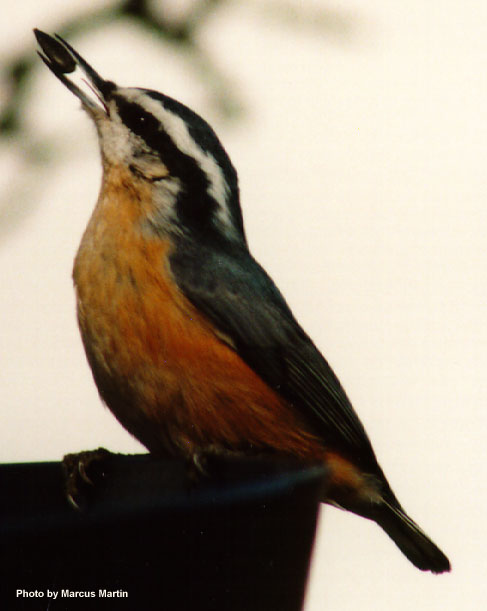
Sure enough, in ten minutes we saw over a dozen species at close range, including a lifer Red-breasted Nuthatch for my kids. As we left the blind, that same kid who hated birds was gushing about the bird blind and how cool it was to see those birds.

Nobody hates birds. Some people just don't know how much they like them yet.

Friday, December 30, 2005

Birds as Individuals

Julie's Hummingbirds have me thinking a lot more about birds as individuals. Check out photographer Harri Vainola's meditation and photos on this theme, as well as the classic Len Howard book Birds as Individuals (scroll down for discussion here). Makes me wonder, who exactly was that Carolina Wren tossing leaves on the ground behind my new house this morning?

Thursday, December 29, 2005

Julie's Hummingbirds

If you haven't heard the story of my friend Julie Zickefoose's hummingbirds, check it out at NPR. First, listen to the story of how she raised three baby hummingbirds here. Then, listen here to find out how they came back to her yard again the next spring. These are great stories illustrating just how close of a connection some people are able to make with some birds. After listening to Julie's stories, you may have a lot more questions about the birds in your backyard!

New Yard Birds

Over the past year, the birds that I've called new yard birds have been those sighted for the first time at my office on 160 acres of field and forest near Ivyland, Pennyslvania. Today, I my 14 new yard birds are actually my first sightings of birds at my new yard, a tiny lot behind a townhome that we are going to buy in Perkasie, Pennsylvania.

While getting the townhome ready for an appraisal tomorrow, I noted over 70 American Robins coming to a holly tree in the backyard. They were joined by a couple dozen Cedar Waxwings. When I stepped out onto the porch to see them, I noted several other species, including a Song Sparrow, Downy Woodpecker, Carolina Chickadee, Tufted Titmouse, Northern Cardinal, and Mourning Dove. Its a tiny yard, but this new yard is adjacent to a wooded alley and a park on Perkiomen Creek. Lets hope these new yard birds are the first of many, many more to stop by our new home.

Wednesday, December 28, 2005

Five Crows

What kind of day is a five crow day? Today, five crows were the only birds I saw. They flew past this morning as I said goodbye to my inlaws outside in the driveway. The rest of the day I spent inside with the kids, recovering from the overstimulation of the holidays.

Most "real" birders probably wouldn't consider five crows a notable sighting. Crows are common. You could see five crows without even trying (like I did today). There is nothing sporty about finding five crows. Nothing worth noting at all.

Except when you start to wonder about those crows. Most likely, a group of five crows is a family group--probably two parents and their young. This time of year, the family group may consist of young from this year as well as a couple older young birds from last year--birds spending their last few months with the family before heading out to find their own territories.

Whether I know it or not, there is something going on with those five crows...they have a history, one that continues each day when they awake. The adults will probably spend the rest of their lives in short flying distance of my driveway. I may see them from time to time and just note two crows, three crows, or even five crows. My life may intersect with them at odd points in time as I happen to be in the yard as they fly by.

For most of us, these five crows could well symbolize our relationship with birds. Distant. Impersonal. We see them, and note them. Or not. But we really don't know them.

The sighting of five crows is an indictment. An admission that I don't know my local crows. A friend at work knows her crows. She can call them and they will come. She feeds them. Talks to them. Knows where they go and where they spend the night.

But for me, I merely note that five crows flew across the road and through the trees behind the row of townhomes on the other side of the street. They called...or at least one of them called...but I don't know what it was calling for.

Five crows. Living an ancient crow lifestyle amidst 21st Century humans and their technology. Knowing their business perhaps better than we know theirs. And for all I know, we may be less anonymous to them, than they are to me. Perhaps they know me as the guy who leaves early each morning in the red Mazda Protege, often returning after the sun has gone down.

Many of us barely know our human neighbors, let alone our neighborhood crows. But I, for one, vow to do better. To know my crows. And to be known by them as more than a passing figure in their life.

Tuesday, December 27, 2005

Holiday This and That

With family here for the holidays, birding has been spotty the last few days. Yesterday I did take off for an hour and hit Peace Valley. Over 7,000 Canada Goose and two dozen Lesser Black-backed Gulls were the highlight in the cold windy afternoon.

I went back there this morning with my brother-in-law from Dallas to show him his lifer American Black Duck. We dipped on the owls near the nature center, and didn't have enough time to pin down an American Tree Sparrow. Birding with time limits is a drag!

This afternoon, we caravaned down to Valley Forge and Amish country. At Washington's Headquarters, a nice Brown Creeper was working the lower trunk of a sycamore tree. While their habit of creeping up a tree and flying down to start over again has been much noted, the thing that struck me today was how insect-like the flitting flight was--almost like a moth as it flicked itself down the trunk and along a few branches. It's been a long time since Brown Creepers have been a regular part of my birding fare--they were hard to come by in Central Texas--so it was nice to watch one for a few minutes today before it moved on to another part of the park.

Thursday, December 22, 2005

One More to Go

This afternoon, as I took my bird walk at work, I saw a long-tailed rufous-brown bird fly low across an open space and land in a low tangle. Not much of a look, but good enough to identify it as a Brown Thrasher--a bird that should have migrated south earlier in the fall, and a new yard bird that I had just about given up on. That makes 109 for the year...with just one more work day left in 2005, can I find another new bird to reach 110?

A Two Owl Morning

Took the four year old and one year old birding this morning for a couple hours before work. At the bird blind at Peace Valley, a grey-phase Eastern Screech-Owl was sunning itself in the entrance of a wood duck box back by the pond. The four year old was able to get spectacular looks through the scope. The one year old...again, hard to tell!

Then we went for a walk to look for Long-eared Owls at a traditional roost site near the lake. Unfortunately, wasn't able to see the birds before two of them flushed from the pine trees and flew off, giving only fleeting glimpses as they winged off to another grove of trees. Not wanting to stress the owls anymore, and getting tired from carrying both a scope and the one year old, we moved on. The kids loved the dozens of birds at the feeders. Besides the owls, my favorite birds of the morning were two Horned Grebes diving in the distance at Lake Nockamixon.

Wednesday, December 21, 2005

Cold Morning

This morning I stood around waiting for a White-winged Dove to show up at a feeder here in Bucks County. For the last ten days, it has shown up at dawn to feed in someone's backyard. Today was the first day that local birders came to look for it (after the initial small party of confirming viewers), and the first day that it didn't come in for its morning feeding. Hard to know if it has moved on (its far, far away from its usual Texas and southwestern US range), shifted its routine, or succumbed to either the Cooper's Hawk or Sharp-shinned Hawk that we saw patrolling the yard this morning. A Red-breasted Nuthatch was working the trees in the yard, along with the more common juncos, cardinals, sparrows, chickadees, and finches. I wasn't ready to spend 2 hours in the cold, so got a bit more chilled than I was prepared for. Oh well. Sometimes you eat the bear, and sometimes the bear eats you.

Tuesday, December 20, 2005

Arctic Ghost

This morning I kept my kids "home" from school to go searching for a Snowy Owl (that's Hedwig for all you Harry Potter fans) first found on Sunday about an hour away in Berks County (important for parents to instill a proper sense of priorities!). After driving around snow-covered fields for a couple hours, my four year old was getting hungry, pulled out a clump of my one-year-old's hair, and the subsequent screaming almost bagged the search right then.

After threatening to cancel our Burger King lunch plans if they didn't start behaving, we drove around some more. The four year old was really suffering, but he did suggest that God might be able to help us find the owl. So he said a little prayer, and we drove back to the place where the bird was last seen. Another searcher who had been there before us decided to call it a day and head back to Lancaster County. I scanned the fields one last time, then took a look at my map and noticed an area we hadn't covered yet on the way back to the main highway, and told the kids we were heading home.

Just as I was losing hope and looking for a place to turn around and head back up to the highway, I spotted the young Snowy Owl on the ground about 75 yards off the road. The eight year old and four year old were able to get great scope views of the bird. The one year old may or may not have seen the bird. Hard to tell with toddlers.
All in all a great morning with the kids, who can add Snowy Owl and Horned Lark to their life lists. That and the Burger King chicken strips make three good birds for the day!

Monday, December 19, 2005

Yard Bird #108

My friend Steve sighted a Red-breasted Nuthatch at one of the feeders here at work this morning. That makes it yard bird #108 for 2005. Interesting to note, is a cosmic kind of way, that yard bird #108 is the topic of birdchaser blog post #108. Freaky!

Wednesday, December 14, 2005

WatchList Bird

Audubon has a WatchList, a list of birds that are of greatest conservation concern. This morning, while driving over the bridge on the edge of our land at work, I saw what looked like a duck in the creek. After I pulled into the parking lot, I walked back down there and found four American Black Duck and two Mallard swimming with two Canada Goose in the unfrozen section of the creek. American Black Ducks are native to the Eastern United States, and have been declining in numbers for decades. Nice to see them this morning as 2005 yard bird #107.

Tuesday, December 13, 2005

New Yard Bird

At the office this morning, my friend and associate Steve called up from downstairs that an American Tree Sparrow was at the feeders. I ran downstairs with my binoculars and got excellent close looks at an adult sparrow feeding on the ground in the snow and at the feeder. This is yard bird #106 for the year--and a beautiful rufous and brown bird that I don't get to see all the time. A good way to start the morning.

Saturday, December 10, 2005

Bird-Witched!

Started driving up to Ithaca, New York in the dark on unplowed roads yesterday morning. Quite a harrowing experience! Eventually, the roads cleared up some. About 20 minutes out of Ithaca, a snow covered corn field held a flock of 45 crows, a couple dozen Rock Doves, and as they took off, I noticed a pair of Horned Larks in with them. Sapsucker Woods around the Cornell Laboratory of Ornithology building were pretty quiet in the snow. Did see a couple nuthatches, chickadees, and a Sharp-shinned Hawk.

When I got home, I had a copy of Marjorie Adams' new book Bird-Witched waiting for me in the mail. Marjorie is a grand old lady birder down in Texas. I had reviewed her manuscript for UT Press, and she very graciously thanked me in her acknowledgement section. Glad to see your book finally in print, Marjorie. It was worth all your hard work!

Wednesday, December 07, 2005

Bird Flu and Chicken Manure

Latest buzz in the bird conservation community monitoring bird flu is the possibility that the H5N1 virus is being spread to wild birds through the practice of feeding farmed fish on chicken manure. Apparently, this "integrated fish farming" is a fairly common practice promoted by the UN FAO, and could be a significant risk-factor in spreading viruses from poultry to wild waterfowl. There is a large state-owned fish farm on the south shore of Qinghai Lake in China, where there was a large bar-headed goose and other bird die-off due to H5N1 avian influenza this year. Researchers are trying to find out more about the aquaculture practices there to see if there might be a link between the farming operation and the local bird flu outbreak.

Monday, November 28, 2005

Merlin Monday

While taking my stroll through the woods and fields at work this morning, a nice dark Merlin came cruising in along the tree line, broke up a flock of Mourning Doves, and then perched on the top of a distant tree for 20 minutes to preen. A very nice welcome back to work present for a Monday.

Tree Sparrows with H5N1

According to a new paper in the Journal of Virology, H5N1 avian influenza viruses may be widespread in Tree Sparrow populations in Asia. Just goes to show that we should be testing more than just waterfowl for the presence of avian influenza viruses. There are thousands of different variants of the hundreds of different HN subtypes in thousands of different bird species. If we are to ever really understand these viruses, we'll need widespread testing of as many species as possible.

Anyway, the Tree Sparrow article is:

"New Genotype of Avian Influenza H5N1 Viruses Isolated from Tree Sparrows in China" by Z. Kou, F.M.Lai et al, published in the Journal of Virology, December 2005, p. 15460-
15466, Vol. 79, No. 24.

Abstract:
The 2004 outbreaks of highly pathogenic avian influenza H5N1 disease in China led to a great poultry loss and society attention. A survey of avian influenza viruses was conducted on tree sparrows (Passer montanus) collected in China in 2004. Four viruses were isolated from free-living tree sparrows. The results of the whole-genome analysis indicated that an H5N1 virus with a new genotype is circulating among tree sparrows. The hemagglutinin and neuraminidase genes of the new genotype were derived from Gs/Gd/96-like viruses and the nuclear protein gene descended from the 2001 genotype A H5N1 viruses, while the other inner genes originated from an unknown influenza virus. In experimental infection, all four viruses were highly pathogenic to chickens but not pathogenic to ducks or mice. The four tree sparrow viruses were different from the 2003 tree sparrow strain (genotype Z) in Hong Kong. The results suggested that H5N1 viruses might be distributed widely in tree sparrows.

Thursday, November 24, 2005

Turkeyless Turkey Day

Last year for Thanksgiving, I took my kids out to see wild turkeys west of Austin. This year, we're visiting family in Lexington, Virginia. We took a drive in the long-shot chance that we could find a turkey (its open season on wild turkey here in VA, so the birds should be pretty much hunkered down). We drove up to the Goshen Wildlife Management Area and there were hunters all over so we didn't do much more than drive around. Dropped back down to the Douthat State Park, where we did get out and we all got pretty good looks at a pair of Pileated Woodpeckers working the trees near the lake. Not exactly a wild turkey day, but a nice sighting to be thankful for on this Thanksgiving.

Tuesday, November 22, 2005

Global Bird Flu Tracking?

A new system was announced by the UN Convention on Migratory Species this week, but details so far seem to indicate that it is really just tracking migratory birds, not the viruses that they carry. We still need a solid plan for global monitoring of avian influenza viruses. The announcement this week that some of the ducks in Canada do have a low pathogenic variant of the H5N1 virus is more evidence that we have a lot to learn about the distribution and potential for spread of all of these avian influenza strains.

Meanwhile, there are also reports that live birds are regularly smuggled out of China into the United States. Smuggled domestic birds are probably a greater risk for spreading the highly pathogenic form of H5N1 than wild birds, both here in the United States as well as in Asia and Europe.

Great Office Bird Rush

On Friday, I took my normal bird walk a little later than usual...but as I got down to the corner of teh corn field, a small flock of blackbirds flew up. I followed them to their perch in a nearby tree, and noticed that there were three Rusty Blackbirds in among the Red-wings. Several folks at work had never seen Rusty's before, so for the first time since I got it last month, I found a good use for my cell phone!

Half the office were able to come down to the field and see the birds before they flew off. A couple other folks were on a conference call and couldn't make it out until later. Sometimes there just isn't enough time in a day of bird conservation planning to actually go out and see a good bird!

Don't Fear the Creeper...

So for the past month I've been looking to add Brown Creeper to my yard list at work, but these little guys can be hard to find. Yesterday, I went out to get something from my car, and on the way back to the house, a small bird flew onto the trunk of a nearby tree. It moved up the trunk in characteristic creeper fashion, and I got close enough to see that, yes, it was the little brown bird I had been seeking. Birds are great, often showing up at just the right moment!

Tuesday, November 15, 2005

Birding Slow

Migration of land birds has really tapered off at work...morning walk today came up with 25 species, but nothing unusual. A Fox Sparrow was nice, and there are lots of chickadees and nuthatches using the feeders. Yesterday there were dozens of Bufflehead on Lake Galena at Peace Valley, so waterbirds are moving in. All the leaves are brown, skies are gray, and birds are moving on...

UK bird flu testing SNAFU

According to the BBC, last month's report of a parrot in the UK with H5N1 virus was a mistake. The positive bird flu virus test came from a mixed sample of tissue from a South American blue-headed pionus and a mesia from Taiwan. Apparently the mesia had the virus, not the parrot. More mesias from the same shipment ended up dying of bird flu in quarantine.

We've really got to do a better job of being careful with testing for H5N1 and other avian influenza viruses. Standard protocol right now is to mix samples from several birds--which can help identify if the virus is present, but doesn't give a precise (or in this case accurate) picture of virus in the bird population. If we are to figure out exactly which species has a particular bird flu virus, and how common infection is in a population, we can't be using pooled samples this way.

Monday, November 14, 2005

More H5N1 news from Kuwait

I've seen a private report out of Kuwait that the flamingo found there with H5N1 was one of several flamingos being held at a farm, and that the birds were imported ornamental birds rather than free-flying wild individuals. I'll report more on the origin of this bird if more news comes in...in the meantime another reminder to be careful with media reports--in this case, hard to make a direct implication of wild birds in the transmission of H5N1 avian influenza to Kuwait.

Sunday, November 13, 2005

Caution About Bird Flu from Korea

Birds Korea, the main bird conservation organization in Korea, is a source of interesting commentary on the current bird flu situation in Asia. Basically, there is just a lot that we don't know about the spread of H5N1 avian influenza, and these statements by Birds Korea highlight some of what we know and don't know about the virus--and makes the point that there are many other ways that the virus may be spread than through the migration of wild birds.

LPAI H5N1 in Italy

A report to the ProMed email list indicates that the wild duck that tested positive for H5N1 in Italy was carrying a low pathogenic variety of the virus, apparently not closely related to the highly pathogenic strains found to be killing domestic and wild birds in Asia. The duck was a young wild Mallard, killed and eaten by a hunter in the municipality of Mirandola, province of Modena, in the Emilia-Romagna Region.

This may indicate that low pathogenic (LPAI) versions of H5N1 are circulating in wild birds without causing illness in either wild or domestic birds. Widespread global testing of birds is needed to help determine the range of viruses and their effects in wild birds.

Friday, November 11, 2005

Lieberman's plan to monitor wild birds for avian influenza

Senator Lieberman has a proposed bill to create a Global Network for Avian Influenza Surveillance. It was included in the Harkin-Specter amendment aimed at combating the growing threat of bird flu to Americans. The Senate passed the amendment, and if it makes it through the conference committee, the bill will:

• Increase the efficiency with which we can detect, verify, and report on the presence of deadly viruses and other infectious diseases in migratory birds,

• Create a database that identifies the avian flu and other viruses of interest in migratory birds so that they can be shared in as close to real time as possible.

• Track mutations or changes in the virus in wild birds,

• Utilize virus tracking information to guide domestic and global preparedness.

This looks like just the kind of start we need to be able to monitor avian influenza and other viruses that may impact the health of people and birds.

H5N1 bird flu strain confirmed in Kuwait

CTV.ca Canadian Television is reporting that a wild flamingo found on a Kuwait beach has tested positive for H5N1--the first confirmed case of H5N1 avian influenza in the Persian Gulf.

Thursday, November 10, 2005

Bigger Avian Influenza Threat?

The widespread practice of reusing chicken manure as a fertilizer for fish farms, a practice promoted by aquaculturalists, may be responsible for transmitting H5N1 virus from infected poultry to wild birds. While we don't know enough yet about how widespread this practice is, and have mostly circumstantial evidence to support the case of viral transmission this way (the Mute Swan that died of H5N1 avian influenza in Croatia was found at a fish farm), there does seem to be a viable risk here to wild birds.

Again, there is a lot we need to learn about this virus and how it is transmitted. For now, transmission from wild birds seems to be the least of our worries (there haven't been repeated huge die-offs of wild birds in Asia, and no confirmed cases of domestic birds getting the virus from wild birds). Meanwhile, several outbreaks in wild birds may be caused by exposure to infected poultry, so poultry raising and marketing practices need to be more closely studied so we can get a better idea of what is really going on.

Monday, November 07, 2005

Sentries in U.S. Seek Early Signs of the Avian Flu - New York Times

A New York Times story from yesterday discusses plans to monitor wild birds for avian flu in the United States. We still don't have the full plan yet, but the article has a photo of researchers in California taking a sample from a Yellow-billed Magpie. Also mentions thousands of birds sampled in Alaska, including species not previously mentioned as test subjects, including owls.

Bald Eagle at Green Lane

This morning I went in to work late after accompanying my son on a nursery school field trip to Green Lane Nature Center in Montgomery County outside of Philadelphia. Lots of fun walking around in the woods, learning about traditional Lenape native culture. Mostly just the common forest birds in the area, but I did get to see one of the lake's breeding Bald Eagles fly overhead at one point. Its always a good day when you get to see an adult Bald Eagle.

H5 Wild Bird Flu In the United States?

The Recombinomics website reviews the latest info on the Canadian H5 avian influenza detections in wild birds, and speculates that H5N1 may be in the U.S. already. The crippling final line of the status report is:

"Based on the data from Canada, it seems likely that H5 is well represented in the wild bird population in the US. It is unclear why such infections have not been detected and reported."

While it is probably more likely that the H5 influenza found in Canadian birds is H5N2, which is a fairly common LPAI H5 virus in Minnesota.

The answer is probably...um, because we're not really looking that hard for avian influenza viruses. If we were taking thousands of samples from birds all across the country, who knows what we'd find. The question really is, how badly do we want to really know how widespread these viruses are in wild birds? Is it enough to just wait for sick or dead birds to start turning up in parks and golf courses?

While we wait for the U.S. national surveillance plan, we can only hope that we will be offered a long-term, widespread system to detect and track all avian influenza viruses in wild birds--not just a short-term H5N1 detection sytem that will only tell us, too late, that the a dangerous virus has already arrived.

Friday, November 04, 2005

New H5N1 monitoring suggestions from Israel

Dr. Reuven Yosef, Director of the International Birding & Research Centre in Eilat, Israel posted a note yesterday to the Pro-Med email list, with commentary on proscribed schemes for avian influenza virus monitoring in wild birds. The article reviews the migration pattern of bird species that may bring H5N1 bird flu to the Middle East from Central Asia. Most importantly, it recommends more widespread testing of apparently healthy wild birds:

"Further sampling should not be restricted to birds found dead or freshly hunted as suggested by existing action plans [WHO, EMPRES, EU surveillance guidelines, etc.], but instead be performed on a daily basis, from a wide range of species."

Amen!

Thursday, November 03, 2005

Late Birds

This morning there were 25 species in the woods near my office--including a late Palm Warbler and Eastern Phoebe. The warbler was feeding on the ground in the short mowed grass near the corn field, bobbing its tail up and down in characteristic fashion. Little guy should be headed for the West Indies, I'd think.

More wild bird monitoring...

...to be started in Indonesia after a pigeon tested positive for H5N1.

Wednesday, November 02, 2005

Hawk Induced Silence

This morning it was very quiet in the woods outside my office, probably because a beautiful adult female Sharp-shinned Hawk was on patrol, cruising up and down the tree line and over the fields. On most mornings lately, I've been seeing over 20 species of birds. This morning, only a dozen or so were out, and the woods were almost completely silent--only a couple of Golden-crowned Kinglets were calling and one Winter Wren was singing deep in a tangled thicket.

More H5 Bird flu in British Columbia

Yesterday, news reports indicated that officials in British Columbia had found H5 viruses in 24% of 704 samples from wild ducks. Further testing will be conducted to find out if these viruses are the HPAI H5N1 virus, or some other H5 virus. Since these samples were taken from healthy birds, it underscores the importance of monitoring healthy birds for flu viruses, and we have to remember that without testing, we have no idea of the true situtation in respect to the circulation of avian influenza viruses.

The San Diego Union-Tribune has a good news story on this, with more details about the testing of young ducks in Merritt, BC.

Tuesday, November 01, 2005

President Bush on Monitoring Birds for Bird Flu

Today President Bush held a press conference to announce the National Strategy for Pandemic Influenza.

The plan states that the government will "expand our domestic livestock and wildlife surveillance activities to ensure early warning of the spread of an outbreak to our shores" (p.7).

To do this, President Bush announced in his speech that "to strengthen domestic surveillance, my administration is launching the National Bio-surveillance Initiative. This initiative will help us rapidly detect, quantify and respond to outbreaks of disease in humans and animals, and deliver information quickly to state, and local, and national and international health officials. By creating systems that provide continuous situational awareness, we're more likely to be able to stop, slow, or limit the spread of the pandemic and save American lives."

Hopefully, this will be a long-term plan to monitor birds for more than just the current H5N1 strain of avian influenza, and will become a system for tracking the spread and evolution of all avian influenza viruses. But it probably won't.

In fact, this National Biosurveillance Initiative has been announced before (see overview here), but as part of the War on Terror. So, it remains to be seen how serious, comprehensive, and long-term this monitoring scheme will be. So far, no details about The Department of the Interior - H5N1 National Surveillance Efforts have been released.

Bird Flu Monitoring efforts in Africa

The Financial Express today has a story on African efforts to monitor for H5N1 bird flu virus--including efforts in South Africa and Egypt.

In South Africa, the paper reports that "agriculture officials have been conducting random sampling of wild birds along the country's coastline and monitoring the health of domestic poultry."

In Egypt, "George Majid, Egypt's environment minister, said the government had been taking measures in co-operation with the American Navy Research Centre (Namro), based in Cairo, to take samples from migrating birds and conduct laboratory checks to ensure Egypt was free of the H5N1 virus."

News services are claiming that H5N1 may already be in Africa (something I pointed out here earlier). The most recent statement to this effect is in this Financial Express article and comes from Bernard Vallat, director general of the World Organisation for Animal Health.

Of birds and memories

This morning, while taking a bird walk break at work, there were over a dozen White-throated Sparrows in the woods. Where I grew up in Oregon, White-throated Sparrows are rare winter visitors; most people would be lucky to see one at all, and active birders may see only a few each winter.

While watching the birds this morning, and listening to them sing their whistled song, I got thinking about the first one I ever saw. It was the day that my grandfather died. He had been in the hospital for a few weeks after suffering a heart attack, when he died on my grandmother's birthday. It was the middle of October, and the family gathered at my grandmother's house to celebrate her birthday and mourn the passing of my grandfather.

At some point, the whole scene was a bit too much for a teenager, so I went for a walk down to the creek with my grandparent's dog Poco. Some sparrows in the brush caught my eye, and I quickly saw that it was a White-throated Sparrow. Up until that time, it was one of the rarest birds I'd found on my own--a bitter-sweet moment on a day of tender emotions.

I don't think of that day every time I see a White-throated Sparrow, but it is always there, just beneath the surface. Every bird that we come to know has a wealth of associations attached to it...just waiting for us to enjoy if we take the time to remember. Just another way that birds enrich our lives, by connecting us to the important people, places, and events of our personal histories.

Bird Flu in Canada

A recent report out of Canada found 33 cases of H5 avian influenza in a national survey of wild ducks. Further tests will be conducted to identify the exact strain. Since the birds were healthy, researchers reported that they do not think the birds are carrying the highly pathogenic strain of H5N1. However, it is a misconception that ducks carrying H5N1 will appear sick.

While we will have to wait for further testing to see if the birds are carrying H5N1 for sure, H5 viruses of any type were previously thought to be rare in Canada. According to the Recombinomics website, "In Canada, there have been about 120 deposits at GenBank and only two are H5. One (H5N2) was detected in 1980 and the other (H5N9) was detected in 1966. Thus, there have been no H5 isolates reported in the past 25 years, although that is when most of the deposits from Canada were collected."

This nation-wide survey found 28 infected ducks in Quebec and 5 in Manitoba, and "will serve as a benchmark in future years". More information about the Canadian monitoring scheme can be found online here. . According to the operational proposal, so far the testing is just of Mallards and other wild ducks. Hopefully, future testing will include a wider range of wild bird species.

Monday, October 31, 2005

Wild Bird Monitoring Schemes for Europe

The October 21 issue of Science has a good news article highlighting continued debate about the role of wild birds in carrying and transmitting H5N1 avian influenza virus. The article refers to a proposal by Erasmus University of Rotterdam virologist Albert Osterhaus to create networks in Europe and elsewhere to test wild birds for the virus.

A related story in the same issue (subscription required) describes the work of virologists monitoring birds in the Netherlands, including Vincent Munster at the Erasmus Medical Center and Ron Fouchier. The story reports that the researchers have "applied for European Union funds to expand the network across Europe."

These researchers published an outline of this approach earlier this year in the journal Nature. They argue that,

"To obtain a better global picture of the threat posed by avian flu, it is imperative to investigate the virus in wild bird populations. Wild birds, particularly migratory ducks, geese and shorebirds, are the natural reservoir of influenza A viruses, which can infect other avian and mammalian species7. But information about flu in wild birds is still limited. A widespread and integrated approach is needed to understand the dynamics, epidemiology and pathogenesis of these virus infections in wild birds, and the potential routes of virus transmission."

They propose that
"the immediate duties of our proposed task force are fourfold. First, to gain insight into the global picture of flu, taking into account temporal and geographical variation of the virus, in the different species involved (wild birds, poultry, humans, other domestic animals such as pigs, horses and cats, and other wild animals such as seals, cetaceans and tigers). Second, to prioritize research and integrate knowledge of different disciplines on influenza virus infections. Third, to advance intervention strategies for animal outbreaks and human cases. And fourth, to translate knowledge into policy advice, emphasizing the integration of human and animal health strategies."

The also argue that surveillance and monitoring can help reduce not only the threat of an avian influenza pandemic, but also save millions of dollars, with an estimated cost of $1.5 million/year to establish and run the network, as opposed to the hundreds of millions of dollars spent each year to combat the spread of H5N1 in several Asian countries.

Wild Bird Monitoring In Singapore

According to the Gulf Times, agencies in Singapore are monitoring wild birds for H5N1 bird flu viruses. The story reports that the state-run Agri-Food and Veterinary Authority (AVA), as well as the National Parks Board "have an ongoing surveillance programme to test for avian flu in wild birds at reserves. Nets are set about at various locations in the early morning and late evenings. The AVA said it then collects blood and stool samples from the birds and tests them for the deadly H5N1 strain.
The tests have turned up negative to date."

According to the Wild Singapore Website, the AVA "now tests migrating birds twice a month instead of once during the migratory season of September to March."

The reports do not indicate which species are being monitored.

Africa Bird Flu in Financial Times

University of London Professor E.G. Nisbet commented in the Financial Times this weekend about the likelihood of waterfowl carrying H5N1 avian influenza to Africa. He mentioned Garganey as a possible carrier and transmitter of the virus, a possibility I mentioned here last week.

Friday, October 28, 2005

H5N1 High Risk birds in Europe

An EU press release from last month suggests that member states should enhance surveillance for avian influenza viruses in wild birds this winter. States are requested to identify species of wild birds presenting higher risk based on--
a) origin and migratory flyways,
b) numbers in the EU, and
c) likelihood of contact with domestic poultry

A provisional list of higher risk birds included the following 15 species: White-fronted Goose, Bean Goose, Mallard, Gadwall, Northern Pintail, Northern Shoveler, Eurasian Wigeon, Common Teal, Garganey, Common Pochard, Tufted Duck, Northern Lapwing, Ruff, Black-headed Gull, and Common Gull.

As many of these birds are occasional vagrants to Eastern North America from Europe, if H5N1 becomes endemic in the European population of any of these species, there is a remote chance that one of these birds could carry the virus to North America during fall migration.

However, if H5N1 is to be carried to North America by wild birds, it is still more likely to arrive via Alaska, where populations of many more Asian birds cross over to nest in Western Alaska, and where populations of a few North American species (such as Sandhill Crane) cross over into Siberia during the breeding season.

Additional monitoring of live and apparently healthy birds is needed, and though this provisional list of higher risk European birds is a good initial guide for testing, the announcement today of H5N1 in a heron in Romania underscores the need to test additional wetland birds for the virus.

Mallards and Avian Influenza Viruses in Northern Europe

A study recently published by the CDC examines H5 and H7 influenza strains found in Mallards in the Netherlands and Sweden. Since many of the strains they found in Mallards were closely related to more pathogenic strains that caused outbreaks in Europe, the authors claim that "the minor genetic and antigenic diversity between the viruses recovered from wild birds and those causing HPAI outbreaks indicates that influenza A virus surveillance studies in wild birds can help generate prototypic vaccine candidates and design and evaluate diagnostic tests, before outbreaks occur in animals and humans."

Since low pathogenic avian influenza (LPAI) strains can become precursors to more dangerous HPAI strains, a proactive approach to avian influenza management would involve widespread testing of birds for all avian influenza A viruses, not just testing of sick birds for H5N1.

Monitoring for H5N1 in Israel

A USA Today story from yesterday has Yossi Leshem, an ornithologist and director of the International Center for the Study of Bird Migration at Latrun, claiming that their six banding stations are not enough to effectively carry out surveillance for avian influenza H5N1 virus in Israel. According to the article, Leshem stated that "at least a dozen additional banding stations are necessary."

If at least 18 banding stations are needed to keep an eye out for H5N1 in the small state of Israel (20,840 square miles), how many stations would be needed to find and track the virus in the United States (3,537,441 square miles)?

The pressing need for widespread and extensive monitoring of avian influenza (and other zoonotic viruses) is a challenge and opportunity. Will we build a one-time wind-gauge to find and identify H5N1 when it comes to North America, or will we create a system of continual, long-term monitoring that will help us track emerging viral storms for years to come?

Avian influenza stories

I've recently been quoted in a couple avian influenza stories, the latest on the National Geographic website.

That article slightly overstates the risk of H5N1 transmission from wild birds in Africa by stating that "many" birds that may carry H5N1 are now arriving in Africa. More correctly, "some" birds that may carry H5N1 are now arriving in Africa. While many birds "may" have the virus (we need more testing), only a few birds nesting in central Asia (where the virus was found in wild birds this summer) make it all the way to sub-Saharan Africa. Of the species found infected in Asia that make it to Africa, the most likely candidate for virus transmission may be Garganey (see my post below)--though still no direct evidence that this species is carrying the virus out of Asia.

At the end of this article, Gary Allport did a good job describing the migration and potential threat of transmission from wild Mallards.

The second article is a press release put out by the Wild Bird Feeding Industry. Lots of interesting info there for people worried about getting bird flu from bird feeders or birds in their backyards. The skinny on that is: no real threat right now, but wash up after potentially coming into contact with bird droppings.

Bird Flu test results from Alaskan wild birds

According to the latest report, no H5N1 found in Alaska. But only 290 of 4,500 samples have been screened so far. Lets keep our fingers crossed.

Wednesday, October 26, 2005

H5N1 bird flu already in Africa?

An interesting report from last year found that ostriches in South Africa were testing positive for antibodies to H5 virus. However, apparently the virus they had been infected with was H5N2, not the H5N1 virus that we are currently worried about birds carrying to Africa. How many other birds in Africa have already experienced H5N2 infections, and how will that impact their ability to withstand potential future H5N1 infections? Have birds with H5N1 already reached Africa in past years? Unfortunately, we know very little about the extent and distribution of H5 infections in birds. Since the first H5 virus to be detected (H5N3) was from a tern in South Africa in 1961, some forms of H5 virus have apparently been in Africa for as long as we've known about them.

With media speculation about H5N1 being carried to Africa by migratory birds, there has been little discussion of the exact mechanism for this to take place. Mallards, which have been shown in the lab to be able to harbor and transmit some H5N1 genotypes without showing signs of infection, are found in marshlands in North Africa, but are not as common throughout the continent. Most Mallards in Africa are also probably from Western Europe, where the virus is not yet thought to be widespread.

Garganey, a small Asian teal, may be a more likely candidate to carry H5N1 to Africa. While the virus has been found in a Garganey in Russia, it is not known how extensive the virus is in Garganey populations, or how well these birds are able to withstand, carry, and transmit H5N1. If these ducks are able to carry and transmit the virus along their migratory route, they may carry it to Africa, where large flocks spend the day on large lakes and move into rice fields to feed at night. Garganey in Africa reportedly stay well clear of human settlements, so they may not pose an immediate health risk to people, but if they can transmit H5N1 to other local birds, there may be a greater risk of the virus spreading to other birds and even humans.

These are a lot of ifs, but in order to gauge the possibility of H5N1 spreading in Africa, monitoring of Garganey flocks might be a good place to start.

But for real effective virus monitoring, we need a global commitment to widespread surveillance of all wild birds.

Goose and Gulls

Last night I stopped by a pond near my home to see a Greenland race Greater White-fronted Goose in a flock of 60 Canada Goose. This is a fairly rare bird in this part of the world, and has arrived a bit earlier than most reports. The bird is smaller than a Canada Goose, with bright orange legs and beak. Fun to see something walking around your neighborhood that spent this past summer in Greenland.

At work this morning, I finally found 2005 yard bird #103--three Herring Gulls flying over with a flock of 86 Ring-billed Gulls. Still hoping to have a Lesser Black-backed Gull fly through sometime this year. The best place in North America to see Lesser Black-backed Gulls, an uncommon bird in most of the Northeastern United States is Peace Valley Park a few miles from here.

Tuesday, October 25, 2005

US Plan for Bird Flu Testing

Bloomberg has a story about the U.S. plans to monitor birds for the arrival of H5N1 in North America. The article reports that ten species have been tested in Alaska--Pacific Black Brant; Emperor Goose; Northern Pintail; Steller's Eider; Rock, Dunlin, Western and Sharp-tailed Sandpipers; Black Turnstone, and Bar-tailed Godwit. Birds considered for testing in the Eastern United States include Canada Goose and Snow Goose.

While its good that a range of birds are being tested, the testing may not be wide enough to find other avian influenza strains in other species--a concern since the virulent strain of H5N1 probably developed in the bird markets of Hong Kong when genetic material from a quail virus combined with material from a duck virus. If other bird species carrying other virus strains become infected with the current H5N1 virus, further mutations may arrise that prove deadly to additional species.

The UN Convention on the Conservation of Migratory Species of Wild Animals (Bonn Convention) has called for
--global surveillance of avian influenza in wild birds,
--regulation of animal markets--
--suspension or restriction of the global wild bird trade
--improved standards in poultry farms
--identification of precise migratory routes of waterbirds and the highest risk locations along different flyways

Saturday, October 22, 2005

Bird Flu in Wild Birds

I've been working overtime trying to keep up with the latest news about H5N1 bird flu in Asia and Europe. The latest updated statement from National Audubon is here.

More and more evidence is coming in of wild birds being found infected with H5N1, increasing the possibility that wild birds may be spreading it from Central Asia to Europe. However, since domestic ducks can also transmit the virus without showing signs of infection (see abstract of latest study here), legal and illegal movement of domestic ducks is another potential source of virus transmission that we may not have a good handle on.

Latest reports of wild birds with H5N1 include Mallard, Garganey, Great-creasted Grebe, Green Sandpiper, and Coot in Russia, Bar-headed Goose and Whooper Swan at Erhal Lake in Mongolia, and a boat intercepted off the coast of Taiwan held an illegal shipment of cage birds out of China that included mynahs, a black-naped orioles, and Chinese nightingales infected with H5N1. Whooper Swans have also tested positive for H5N1 in Croatia and Romania. Right now, most testing for H5N1 occurs when sick birds are found. That's a good way to help confirm H5N1 outbreaks, but does little to help understand where the virus is, the full range of species it is infecting, and the risks of transmission to other domestic and wild birds.

What we really need is a comprehensive, systematic, and long-term program to survey avian viruses in multiple species across the globe. Checking for viruses only when we find sick birds is like taking a wind speed reading during a hurricane--valuable info, but not as valuable as the ability to track, predict, and prepare for a hurricane when it is still at a distance. Right now, there is a potential hurricane of avian influenza--but we don't have a good idea of when and where it might strike. We don't know how many bird already have H5N1, where those birds are, and what other avian influenza strains are out there that it might swap genes with.

Imagine hurricane predictions without doppler radar. That's just about where we are at with avian influenza tracking right now. Researchers in Alaska are testing waterfowl for the virus, including Steller's Eider, Emperor Goose, and Northern Pintail. Canada has started a system to survey mallard flocks for avian influenza viruses--but what about other waterfowl and shorebirds species? With more reports of Passerines (song birds) testing positive for H5N1, maybe we should be testing more widely? A United States Interagency Working Group is working on a plan to test for H5N1 across the United States in response the the current threat--but what is needed is a longer-term plan to not only test for H5N1, but to track all avian influenza strains. We don't just need a way to track this influenza storm, but future storms as well.

More New Yard Birds

A Palm Warbler, an Orange-crowned Warbler, and a White-crowned Sparrow were new yard birds at work on Thursday. Lots of migrants were found in the region, with heavy movements caught on radar each night this week. Rain this weekend is keeping me in, but should be good time to look for migrant ducks--including scoters--on local lakes. Winter is coming, but lots of birds on the move.

Friday, October 14, 2005

Bird Flu

One of the fun things about living with birds is that sometimes we even share the same germs. In the case of avian influenza, this has become somewhat of a problem, with millions of people around the world starting to wonder, in some sort of Hitchcockian fashion, if birds are going to kill them.

The good news is that so far, most people are at very little risk from avian influenza or "bird flu". While the virus is spreading towards Europe, there is little evidence that wild birds are spreading the virus. And the virus is not easy to catch from birds, and is even harder to catch from other humans.

For a statement on the relationship between wild birds and avian influenza, with some good links, see this statement by the National Audubon Society.

New Yard Birds

After a week of rain, it let up a little this morning so I took a walk around the office (160 acre farm) and found a couple new birds for my 2005 yard list. The most expected was a Great Blue Heron. These are common in the area, and we even have a creek on the property, but so far this is the first one I've seen here this year. It was merely flying overhead and didn't stop.

I also found a Winter Wren down in a tangle of multiflora rose, but the best bird was a single Rusty Blackbird. These birds are becoming much more rare, they're population has plummeted. According to recent analysis of Christmas Bird Count records, Rusty Blackbirds have experienced a 5.2% annual decline, a total decline of 86% over 39 years, a loss of nearly 13 million Rusty Blackbirds since 1965/66. They breed in the boreal forests up north, and winter in the SE United States. This one was probably just moving through. Nice way to start the day.

Rusty Blackbirds have a variable plumage depending on age, sex, and time of year. A photo of a bird that looks like the one I saw this morning is online here.

Thursday, October 06, 2005

Pine Run

Stopped by Pine Run on the way to work this morning. 23 species, including a nice juvenile Bald Eagle. Otherwise just the common local stuff, though Canada Goose numbers are increasing as we get closer to winter (over 500 there this morning). Still 11 Pectoral Sandpipers on the mudflats. For gull fans, 2 Lesser Black-backed Gulls were joined there this morning by 9 Ring-billed Gulls.

Tuesday, October 04, 2005

Honey Hollow

This past weekend I took my three kids for a morning of salamander catching in the creek at Honey Hollow Education Center here in Bucks County, PA. The kids enjoyed turning over rocks and catching larval red-backed salamanders and small crayfish--as well as the green frog I caught. For me, I also enjoyed my first Pileated Woodpecker I've seen in Pennsylvania, as well as a furtive Winter Wren. The woodpecker let out with its insanely wild call (listen here) from nearby as we were playing in the creek, and I got a fleeting look as it disappeared through the trees. Not a great sighting, but a neat wild experience nonetheless.
Nature Blog Network Fatbirder's Top 1000 Birding Websites