Subscribe

RSS Feed (xml)

Powered By

Skin Design:
Free Blogger Skins

Powered by Blogger

Friday, December 29, 2006

My Local Patches in Birder's World

Birder's World this month has guides to two of my local birding patches--Hornsby Bend near Austin where I wrote my master's thesis on the birds and sewage ponds, and Peace Valley Park five miles from my house here in Pennsylvania. These are two hot spots where I've spent a lot of time. Does that make me hot?

The Other Guys

Birder's World has just published The Other Guys, Auburn University ornithologist Geoffrey Hill's report of his Florida Ivory-billed Woodpecker search. I heard Hill and Mennill give their presentation about the search at the North American Ornithological Conference in Veracruz this past October.

A couple of notes on this article:
Hill reports on the Arkansas search started when "a kayaker spots a woodpecker in Arkansas in the inter of 2004." While this has become the official story, others have noted that Gene Sparling, the kayaker, was aware of an earlier report of Ivory-bills in the area by 1999 Pearl River IBWO searcher Mary Scott. So, the Arkansas report is not an independent report out of the blue by an anonymous kayaker, but the continuation of a crusade to find IBWOs that started in the Pearl River.

It's also clear that Hill was looking for IBWOs in Florida because he had just heard a few weeks earlier about the Arkansas sightings and he was "longing for an Ivory-bill search" of his own. So again, the Florida sightings are not independent, but rather came from a search inspired by reports from Arkansas, that fueled expectations that IBWOs were in Arkansas and perhaps elsewhere, just waiting to be found.

Their first sighting was of a flying bird by "novice birder" Brian Rolek. An hour later, Hill alone heard a double-knock. While Hill writes that "I left the area that weekend intrigued but a long way from convinced that we had found Ivory-bills." OK, that may be the official story, but as a birder, I wonder if there was more going on. We've all had the experience of missing a rare bird seen by others. This is frustrating, but never so frustrating as when someone you are with sees the bird and you don't. When that happens, your brain gets a little crazy. You really, really want to see the bird. Does that impact your judgement? Fuel your expectations? Did that impact this search in Florida? Hard to tell, but you have to wonder.

At the very least, Hill and Hicks were back the next weekend. What were they expecting to find? How anxious were they? Did they have cold clammy palms? Having chased lots of rare birds, I can only imagine how keyed up I would be if I really thought there was a bird as rare as the IBWO out there, and that I had almost seen it the week before. I would be very, very determined to get the bird!

So Hill and Hicks are out looking for the woodpecker that their associate saw the week before, and Hill thinks he may have heard. Hicks sees a bird fly. He describes it as a picture perfect IBWO--except he didn't see the bill. Its perfect. Is it too perfect? It sounds good. But brief view, with high expectations, can be a recipe for disaster when looking for a rare bird.

At this point, the whole team is surely convinced that IBWOs are there on the Choctawhatchee. Everything now becomes a search for evidence to support their claim. All doubt seems to have vanished. Was enough critical judgement expended to judge those two quick sightings?

The rest of the article goes on to detail their continued search for evidence of the woodpeckers. Not really a search for evidence, because they already think the birds are there, but a search for proof that the birds are there. We all know what they came up with...some interesting sound recordings, a couple more quick glimpses of birds that look like IBWOs, some large holes in trees, and bark scaled from trees. Lots of trees have large holes in them, and Pileated Woodpeckers are known to scale trees. The sound recordings? Who knows what are making those? But its impossible to prove that they were made by IBWOs. The thirteen sightings are all brief glimpses of flying birds--a tough sell to birders critical of brief rare bird sightings.

"The Other Guys" are out there again this year, with help from Cornell. Hill is "confident that we will succeed" in finding the IBWOs. It won't be long before the whole world will be able to judge that confidence for themselves.

Saturday, December 23, 2006

Rarest bird I've seen all year

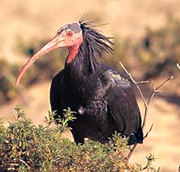
Today I was able to see a bird that has a wild population of less than 300 birds, a pair of Waldrapp or Northern Bald Ibis. This isn't a North American bird, its a North African bird. Today I saw a pair when I took my kids to the Philadelphia Zoo. According to BirdLife International, there are an estimated 227 individuals in the wild, though there are over 1,000 in captivity.
This species has undergone a long-term decline and now has an extremely small range and population. Numbers are currently increasing, partly due to management actions and consequent improved breeding success. However, this improvement in its status in Morocco is very recent and the species may still be undergoing a continuing decline; in Syria its population appears to have declined dramatically in the past 20 years. The species is therefore retained as Critically Endangered because of its extremely small population undergoing continuing decline.
(Photo:RSPB).

While I prefer birding to looking at birds in the zoo, zoo's are great to get you close to some very unusual birds and other animals. Today we got to hear the howl of a Humboldt Penguin. My kids got to race back and forth with five giant otters. We watched an American Crocodile slowly exhale bubbles through its nose underwater, a very active beaded lizard stretch and display, and have a king cobra follow our moves through the glass of its cage, and interact with dozens of other species. I've never been so close to a two-toed sloth (two feet, with no intervening glass, I could have touched it!)

The Philadelphia Zoo is great in that it has displays that allow you to get very close to many animals, including within inches of great cats. A small group of us were gathered around a Mountain Lion today when all of a sudden it perked up and totally fixated on something outside of its cage. We turned around to see what it was looking at, and there was my two year old playing in the bushes twenty feet away. Wow! We'll have to watch her when we go camping out west!

Tuesday, December 19, 2006

Keeping hummingbird feeders from freezing

The following tip comes from David Tracy, posted to the OBOL email list. David has a rare Costa's Hummingbird coming to a feeder in freezing cold Bend, Oregon. So, if you live where it gets cold, but want to keep a hummingbird feeder out (because who knows what kind of rare hummer you could get in the winter), here you go:

If you want to keep your feeder defrosted like one of the pros, go to
the local plumbing supply store. Not Lowes or Home Depot, they will only give you a blank stare. Here in Bend try Searing's on N.E. 2nd street. Invest the $8-10 for a clamp-on light fixture that looks like this (photo here).

Plug in a 125 Watt Infra-red light bulb, but don't get the red-glass type. Get an I.R. bulb with clear envelope, it casts a more natural light. Hang it using the adjustable, integrated clamp so it points at the feeder from one or two feet away. This is the way plumbers defrost frozen pipes. I plug mine up to a timer so it comes on an hour before sunrise and clicks off an hour after sunset.
Monday, December 18, 2006

Christmas Bird Count

Yesterday was the Upper Bucks Christmas Bird Count. I had a challenging area to cover--basically 5 miles of a major road between Quakertown and Coopersburg, with a mile of farm roads, commercial development, and subdivisions on either side. It was a beautiful day, sweater weather, but the birding was slow. I ended up with only 36 species after driving 82 miles and hiking about 2 miles. With no really accessible public land in this area, it was mostly roadside birding. Highlight was probably a Marsh Wren in a small cattail marsh behind a movie theatre, and American Tree Sparrows and Swamp Sparrows in an abandoned field/stormwater detention basin next to a Kmart. Not exactly a day in the wilds, but fun to explore birdlife on the urban fringe.

Postscript: I just got an email from Bill Etter, the count compiler. Turns out this is only the second Marsh Wren to be reported on this count since it started in 1968, the only other sighting was in 1992. So, looks like my strip mall birding really paid off this time!

Saturday, December 16, 2006

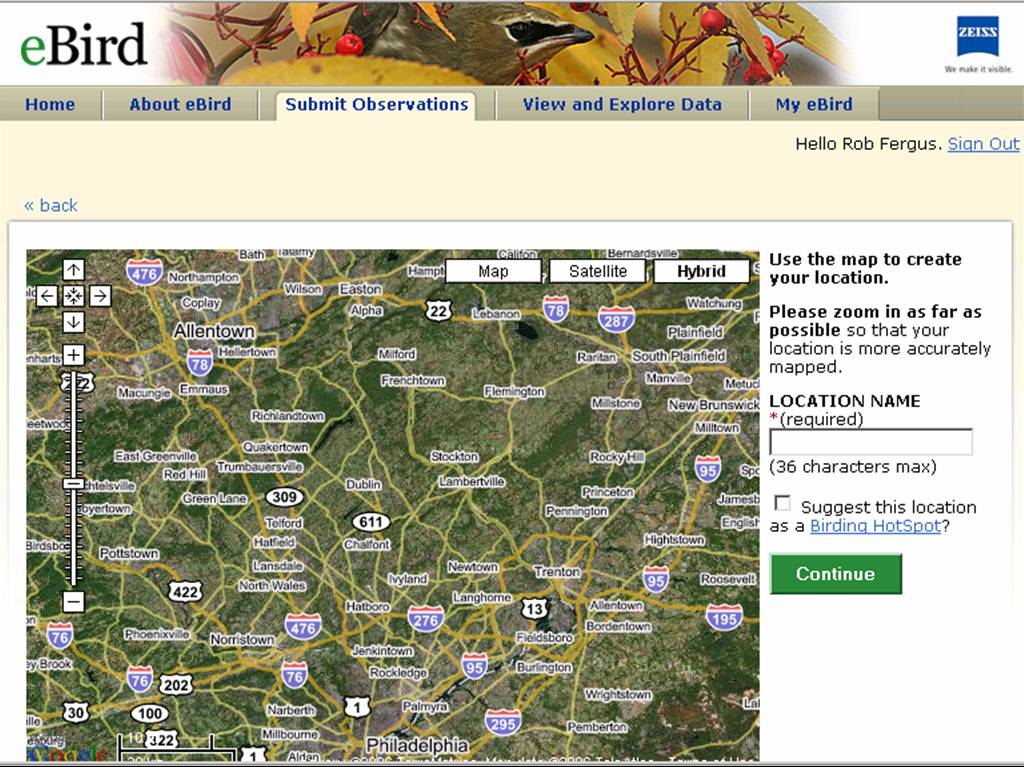
New eBird mapping tool rocks!

If you haven't seen the new Google mapping tool in eBird, its time to give eBird another look.

In the past, it was fairly easy, but still a bit cumbersome in eBird to add new sightings from new locations. Either you had to use the slow mapping tool, or open up something like Google Earth and toggle back and forth to add latitude and longitude readings from Google Earth into eBird.

No more. Now you can add new sighting locations very quickly using the new Google mapping tool directly in eBird.

The other day I had a Yellow-bellied Sapsucker fly up onto a tree while I was in my car sitting at a light. I never reported it to eBird, even though it was my first of season sighting, because it was just a little bit inconvenient to go through the three minute process to set up a new sighting location in eBird.

But yesterday, with the new mapping tool, I was able to add the new location and report my sighting in less than a minute.

So, if you've struggled with adding new locations in eBird in the past, give it another look. Its fantastic and easier to use than ever.

Friday, December 15, 2006

Conservation Through Birding

I've recently taken on the ownership/moderation of the Conservation Through Birding email group. There have been a lot of good discussions there over the last few years about how to get folks interested in conservation through their interest in watching birds. Check out the archives for lots of good ideas from some of the best birders and bird conservationists in the country, and join us for future discussions.

Has it really come to this?

Junkscience.com has declared the Ivory-billed Woodpecker "rediscovery" in Arkansas as one of its Top Ten Junk Science Moments for 2006. CBS has picked up on the theme, listing the Ivory-billed debate in its story on feuds and frauds in recent science. Perhaps this isn't the best day for my friends at the Cornell Lab of Ornithology.

Tuesday, December 05, 2006

NPR on Bird Flu

An NPR story today reviews the latest paper indicating that poultry may pose the greatest risk of transmitting H5N1 avian influenza to the United States. While NPR usually does a decent job of reporting, this bit had me in stitches:
If the avian flu did reach the United States through wild birds, some say the virus wouldn't necessarily devastate the poultry industry, because chickens are usually raised in sealed barns. But growing numbers of chickens are now raised as free-range poultry. By law, free-range birds must spend part of their lives outside, where they can mingle with wild chickens.
Wild chickens. Now that's scary!

Birdchaser on Audubon Website

Links to my blog posts about the Hog Island Audubon Leadership Camp are online here. I'm planning on another great week in Maine this summer. Great food, great birds, great place! If you are an Audubon chapter leader, why don't you join us?

Thursday, November 30, 2006

I and the Bird #37

For the latest best posts in the world of bird blogging, I and the Bird #37 is online here.

Tuesday, November 28, 2006

To Bird, or Not to Bird

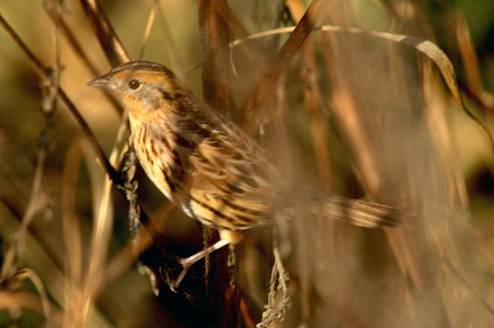
This weekend, birders found a LeConte's Sparrow in a weedy field near my house. Dozens of birders have been there each day since then. Everyone has seen it. Except for me. So far, I have chosen not to chase it (photo:Howard Eskin).

Moment of full disclosure. I've seen hundreds of LeConte's Sparrows in Texas--so I do not need to see this as a life bird. Also, though I've lived in Pennsylvania for almost two years now, I am not actively pursuing a Pennsylvania State List. And though I do keep a Bucks County list, I haven't had a desire to really given it as much attention as it would need to be taken seriously. So, my bird listing interests are not as high as they have been at other times and places in my life. Given that, any other reasons I may give for not chasing this LeConte's Sparrow may be suspect to anyone who has other birding priorities.

That said, my biggest concern about chasing this bird is that it is a small shy bird that feeds on the ground in tall grass. The only way to see it is to stomp around in its habitat until it flies, and hopefully lands where you can see it. If it flies and lands on the ground again, you have to keep chasing it and making it fly until it lands up on top of a weed or somewhere else where you can get a good look at it. While I don't have a problem with doing this to a bird once and a while, with dozens of people chasing this bird every day, I have to wonder about the negative impacts that chasing this bird might have.

According to the American Birding Association code of ethics, the primary concern of birders should be the promotion of birds and their environment. Birders are to "avoid stressing birds or exposing them to danger" (1b). Birders are also supposed to "stay on roads, trails, and paths where they exist; otherwise keep habitat disturbance to a minimum" (1d). While it isn't my job to be the birding ethics police, I do not think that it is possible to see this bird without violating these two parts of the birding code of ethics.

Some have told me that, what the heck, the damage is already done. Others are already stomping around in the grass. The bird is already being chased. We might as well all get in on the fun. This is the tragedy of the commons, the idea that as long as a resource is being exploited, we might as well get our due share. The "everyone is doing it" defense doesn't make me feel very good.

Others are claiming that the bird isn't being disturbed too much. Maybe just for a few minutes at a time over the course of the day. While the bird is only being seen that often, I'm not so sure that that it isn't being disturbed more often.

After the furor dies down, I'll probably wander over to this place to see if the bird is still around. I'll be interested to see how much habitat damage has been done, and will continue to puzzle over the ABA birding code of ethics. While its not easy to sit out a bird chase in your own neighborhood, its a bit easier to do when you aren't too worried about missing a bird for a precious list. Would I be so hesitant to chase a bird and join in a group habitat trampling exercise if the bird were an Arctic Warbler or Painted Crake, rather than a bird I've seen hundreds of times?

Saturday, November 25, 2006

Turkey Day with the kids

Thanksgiving morning we were busy getting ready to have company over, so we had to postpone our annual Wild Turkey search until Friday. Last year we dipped on Wild Turkeys near Lexington, Virginia, but this year, with some local knowledge, we did much better, finally coming across fourteen Wild Turkeys foraging in the woods off 3 Mile Run near Lake Nockamixon. We also found a Gray Fox out in another field. The three kids all got good looks, so it was another satisfying Turkey Day. (photo:Michigan DNR)

Thursday, November 23, 2006

Extinct Bird Rediscovered

It isn't the Ivory-billed Woodpecker. Its a duck, the Madagascar Pochard. Pretty exciting news if you're into rare birds.

Bird is the Word

When you say "bird", does it sound rhyme with "word" or does it have another sound? You can take a nifty quiz to distinguish what kind of American accent you have. I took it and the results came out spot on for this native Oregonian:

What American accent do you have?
Your Result: The West

Your accent is the lowest common denominator of American speech. Unless you're a SoCal surfer, no one thinks you have an accent. And really, you may not even be from the West at all, you could easily be from Florida or one of those big Southern cities like Dallas or Atlanta.

The Midland
Boston
North Central
The South
The Inland North
Philadelphia
The Northeast
What American accent do you have?
Take More Quizzes


Funny how we can pick up our favorite actor's voice on television from two rooms away in the house, but sometimes we still struggle with the voices of common birds. More on how to become a better bird listener later. Meanwhile, what kind of American accent do you have?

Monday, November 20, 2006

Craneberries

We're coming up on one of my favorite holidays--Thanksgiving, or better yet Turkey Day. I love that we have a holiday that features a bird as a central feature. I'm not a big fan of domesticated turkeys, but really love to watch Wild Turkeys. I haven't seen any for several months, so maybe its time to go on a turkey search.

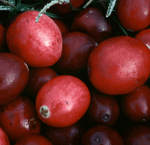
Meanwhile, not many people know that cranberries were originally called craneberries, because their flowers look like cranes and early English settlers to North America also saw cranes feeding on the berries. We really ought to make more of these bird connections to Thanksgiving--a national day of thanks, and birding!
(photo:David Foster)

Thursday, November 16, 2006

Brant at Peace Valley Park

On my way to work this morning, I finally saw the Brant goose that has been hanging out at Peace Valley Park for at least the past week or so. This coastal goose is a rare but pretty much annual visitor to this part of Pennsylvania--not easy to find, but something to look for each fall and winter. The bird at Peace Valley was all by itself swimming in the water off one of the boat launches at the park. Smaller than the abundant Canada Geese that spend the winter here in huge flocks, this sharp little goose is a lot of fun to see. A small goose I saw in a very distant flock of flying Canada Geese at Peace Valley about a month ago was very probably this individual. (photo:Dave Saunders)

Project Feeder Watch

Its that time of year again, time to start counting the birds at your feeders for fame and fortune...or at least for science. Brought to you by Cornell Laboratory of Ornithology, Audubon, Bird Studies Canada, and Nature Canada, Project Feeder Watch has helped us gain a better understanding of birds at feeders across the country, and gives everyone a chance to contribute meaningful observations towards creating this larger picture of how birds respond to our efforts to help and attract them. I started out the morning with just a Carolina Chickadee, Blue Jay, and two House Finches at the feeders. I'll watch the feeders off and on today and tomorrow, finally reporting the highest number of each species seen at one time. I'll do this every other week until April, reporting the numbers to the online database, and having a blast at the same time. Join Project Feeder Watch, and help us keep track of the birds that we all enjoy.

Wednesday, November 15, 2006

Did I ever mention my book?

I'm fascinated by the relationships that people have with birds. Purple Martin landlords, folks that put up and maintain those Purple Martin houses across the country, have some of the most interesting experiences and relationships with their birds. A couple years back, I wrote a book about these birds and the people who care for them with Robin Doughty, my graduate work advisor at the University of Texas at Austin. Its a fun little book. See if your local library has a copy, or get one for yourself (and other copies for your friends!). You can read a review by Ro Wauer here.

Sonic Bird Telescope

How about a way to identify birds by sound as they pass high overhead? New Scientist reports that researchers are experimenting with this technology to help them identify distant flying birds that might pose a threat to aircraft. Sounds like another good tool for bird observatories. Can I get one for my yard?
Nature Blog Network Fatbirder's Top 1000 Birding Websites