Subscribe

RSS Feed (xml)

Powered By

Skin Design:
Free Blogger Skins

Powered by Blogger

Wednesday, June 27, 2007

Steve Kress's Guide to Attracting Birds

Even if you didn't win a copy of Steve Kress's The Audubon Society Guide to Attracting Birds playing the IATB Sweepstakes, here's why you should get yourself a copy--its an absolutely amazing resource put together by a legend in the field of bird conservation. While there are literally hundreds of books out there on how to attact birds to your yard--this is one of the very best. Steve Kress has written several other books along this line, but this is the one where he had the freedom to put in all of the extra stuff that wouldn't fit in some of the other books.

As Steve writes in the introduction, "Improving the quality of land for wildlife is the single most constructive step that anyone can take to assist wild bird populations." If you want to help birds, the best place to start is in and around your own home--the bird habitat you have the most control over. As indicated by the subtitle, this book focuses on Creating Natural Habitats for Properties Large and Small. Steve Kress, a Vice-President at the National Audubon Society with a Ph.D. from Cornell, has spent his life researching and practicing the techniques and secrets he shares in this lavishly illustrated 466 page volume dripping with information.

As mentioned, this guide covers a full range of habitats and property sizes, from large rural grasslands or forested tracts, to suburban yards and urban patios. Its more than just a guide to attracting birds, its really a user-friendly guide to bird habitat management--with detailed instructions on how to manage grasslands, forests, and shrublands, as well as over 130 pages on various trees, shrubs, and other bird-friendly plants. If you want to build a pond or small pool for wildlife, its all here. Nest boxes, gott'em, for birds of all kinds. And not just nest boxes, but nesting structures for other birds as well, including owls, geese, loons, and terns. Everything you wanted to know about bird feeders, but were afraid to ask? All right here under one cover.

But, you say, you've seen it all before? Think again! How about detailed illustrations showing exactly how a bird opens a seed? Or how to provide live food for secretive towhees? Or make a nest cone for Mourning Doves? Unless you've been poking around in the scientific journals, you're not likely to have seen a lot of the information in this book before.

So, whether you own a farm, ranch, suburban yard, or apartment balcony, this book contains the best-researched and most useful information you're going to find about how to make your property better for birds--and will teach you a lot about birds in the process. Unfortunately, we all can't spend time individually with Dr. Kress as he works to bring puffins and other seabirds back to abandoned islands off the coast of Maine, but through this book, we can work shoulder-to-shoulder with him to bring more birds back to the yards and properties that make up our own mini-Edens.

And the winner is...

Thanks to the drawing facilitated by a random number generator, I'm happy to announce that the winner of the IATB Sweepstakes is Liza of The Egret's Nest. Her copy of Steve Kress's The Audubon Society Guide to Attracting Birds will ship out shortly. Thanks to everyone for playing, and enjoy the latest IATB over at The Wandering Tattler.

Friday, June 15, 2007

Bird Flu Hits NYC

Not for the faint of heart...


More footage, again, pretty rough...

Thursday, June 14, 2007

Common US Birds in Decline

Some of my colleagues at Audubon have recently conducted an analysis of over 40 years worth of Christmas Bird Count and Breeding Bird Survey data to identify common birds that have experienced large declines. These birds are not endangered, but have declined by more than 50% over that time period. A new website gives more info on these birds and what can be done to help them.

A press conference today attracted a lot of media attention to this issue, with over 160 stories posted by newspapers so far.

Wednesday, June 13, 2007

I and the Bird Sweepstakes

Welcome to I and the Bird #51. You love IATB, but admit it, you don't always read all the posts, right? But this time you will, because this time you'll have to in order to enter the I and the Bird Sweepstakes!

How to Enter

To enter the sweepstakes, just email your answers to the following questions to me at birdchaser AT hotmail DOT com by Tuesday, June 26. I'll draw a name at random from all of the correct completed answer sheets on June 27 and announce the winner here at my blog.

The Prize
The winner will receive a copy of The Audubon Society Guide to Attracting Birds, signed by the author, Steve Kress. This book has mountains of information on how to help birds thrive in your yard or on your larger rural property, brought to you from the guy who has spent his life bringing birds back to abandoned habitats--most notably bringing puffins back to abandoned islands in the Gulf of Maine. Just think of your yard as a miniature island of potential habitat just waiting for you to improve for waiting birds.

The Questions
1) Bird conservationists have reintroduced Aplomado Falcons to their former range in arid grasslands near the Mexican border of the United States. According to Carel at Rigorvitae, how many Aplomado Falcons successfully fledged in South Texas last year?

2) Ski areas and conservation partners have made great strides in the last couple years to protect the montane habitat of the rare Bicknell's Thrush. Name the blogs of the four intrepid bloggers (Mike, Patrick, Corey, and Will) who recently traipsed up Wakely Mountain to see this threatened songbird.

3) Invasive exotic vegetation can play havoc with bird habitat restoration efforts, though some native birds may utilize them for food or cover. Name the invasive plant plaguing the Birdman, but providing habitat for Spotted Morning Thrushes.

4) Conservationists seeking to restore native bird populations should take into account the predator avoidance strategies of the birds they want to help. That's all well and good, but what the heck is aposematism?

5) Rails are hard to protect since they can be tough to find in their wetland haunts. Which rail finally showed up for Tai?

6) Migratory birds have many ways to orient themselves during their seasonal movements. According to Gulf Crossings, which species recently helped researchers figure out how some birds may use polarized light to help them find their way?

7) In suburbia, large parks with good habitat can be important refuges for resident birds, and can attract locally rare species. What locally uncommon bird did John find at a DC area park and only see once, though he could hear the bird singing nearby?

8) When you're trying to help birds, and need local landowner help, communication can be a problem. Many people know birds by names other than those by which they are labled in the field guides. Birdfreak revels in bird nicknames. What is his own nickname for the American Robin?

9) Even more troubling than confusing local nicknames, other bird terms can cause problems for bird conservationists. What bird term noted at Words & Pictures recently caused a stir when it triggered internet filters in the UK?

10) On the other side of the pond from Steve Kress's puffin islands, Craig visited an important seabird sanctuary on the Farne Islands. What type of cormorant was he able to photograph there?

11) In addition to managing for rare birds, bird conservationists have to manage for abundant species that can become pests. While some folks may not like these, I'm kind of partial to this species from my days in Austin--what's the name of the species that the Wrenaissance Woman was able to photograph in San Antonio?

12) Even abandoned housing projects can be important bird habitat for some species, as noted by Sarala at Blogaway. What kinds of birds did she see, that were also enjoyed by K T Cat at The Scratching Post, but not filmed by Shinie in Northern Idaho?

13) Habitat loss is the greatest threat to most bird species, including the Northern Spotted Owl (which is under threat again). What threat to Canada's boreal forests (described at the Stokes Birding Blog) is also the greatest threat to the Northern Spotted Owl, as noted by GrrlScientist?

14) Helping birds isn't always as difficult as fighting the government. In a backyard, even a little pond or birdbath can help local birds. What species did Summer note taking a bath?

15) Bird atlas projects help us keep track of bird distribution as populations fluctuate through time. Pennsylvania is conducting its second statewide atlas. How many species has Vern confirmed breeding in his atlas block?

16) Just down the road from Vern, Drew was doing his part for bird conservation by conducting point counts. What bird did he see and hear in the same place where he found a clump of thirty or forty butterflies?

17) Other birders have been using eBird to track bird sightings, including the unusual influx of Horned Puffins along the California coast this spring. Where did Liza of The Egret's Nest find her lifer Horned Puffin?

18) Farther afield, researchers have determined descovered some interesting, some might say disturbing, behavior in Oriental Pied Hornbills. While many hornbill species are critically endangered, this one is still fairly common in some areas--which is a good thing based on the behavior described by YC at the Bird Ecology Study Group blog. What behavior did these researchers document?

19) The African nation of Cameroon is home to at least 15 globally endangered bird species. David at Search and Serendipity shows us video of some more common Cameroonian birds. Which bird does he describe as "little bits of sky that have fallen to the ground"?

20) And last, but not least, Duncan at Ben Cruachan Blog reminds us that birds are part of a larger ecosystem that includes many other organisms that we should stop and enjoy while we're out trying to make the world better for birds. While you might want to stop to smell the roses, you probably don't need to stop and smell what he found on top of an ant mound. What did he find there?

The Payoff
OK, that wasn't so hard was it? Just 20 short questions. Email your answers to me by June 26 and you'll have a chance to win Steve Kress's book. Thanks for playing. Now that you've been inspired by these posts, head out and do something good for the birds we all love! Then share your bird experiences with us on the next edition of I and the Bird, and come back here after the next I and the Bird comes out to see who won the book.

Submit your next I and the Bird post links by June 26 to Paul at The Wandering Tattler (pjollig AT gmail DOT com) or Mike at 10,000 Birds.

Special thanks to Steve Kress for donating the prize for the I and the Bird Sweepstakes. Show your thanks by supporting Project Puffin.

Saturday, June 09, 2007

Tuesday, June 05, 2007

Where JJ Walked

Yesterday I visited Mill Grove, where John James Audubon began his journey of discovering American birds, and where as a young adult he met and married his longsuffering wife Lucy. A lot has changed in the past 200 years. The landscape is now one of mature trees and highways, rather than agricultural fields. The Perkiomen Creek still flows past down below the house, and many birds enjoy the environs of this county park and Audubon Center.

During a walk through the woods, we saw Scarlet Tanager singing high in a tree, and heard baby Downy Woodpeckers calling from within a nest cavity. Eastern Bluebirds, Tree Swallows, and House Wrens are nesting in boxes on the property, and a colony of Barn Swallows inhabits the bottom floor of the old barn. A Baltimore Oriole was hanging out near the house, and a pair of Chimney Swifts were nesting in Audubon's old home. Indigo Buntings, Common Yellowthroats, and Great Crested Flycatchers were among the more than three dozen birds we saw in a couple hours, walking where JJ Audubon walked, along a wooded Perkiomen Creek that he might barely recognize now for all the trees.

Tuesday, May 29, 2007

Audubon Bird Clock

Here's the dirty little secret in the bird marketing world--real birders HATE the Audubon Singing Bird Clock. You know, the one with a different bird picture marking each hour and that gives that bird's call when the clock strikes that bird's hour. At $19.95 its a not an expensive gift, and its an all time best-seller in the bird merchandizing world. And maybe that's the problem with the clock--many birders just find too many incongruities between the worlds of birds and marketing. No offense to the clock people, many birders feel the same way about bird mugs, dishrags, or pillowcases. There's a wide divide between bird people and bird mug people.

But maybe there's a way beyond this impasse. What I propose is a new singing bird clock. Instead of featuring real birds at each hour, it should have beloved pop culture birds in their place. Since they aren't real birds, they won't annoy real birders. And since most cartoon birds are more popular than real birds, this clock would be a guaranteed best seller. Here's your million dollar idea for the day!

The new "oughta been" singing bird clock could feature the following birds and their calls:

1--Donald Duck saying "Mickey Mouse" from the Mickey Mouse Club song.
2--Big Bird saying "Snuffy, Snuffy...where are you?"
3--Tweety Bird saying "I tot I taw a putty tat!"
4--Foghorn Leghorn saying "I do say..."
5--Daffy Duck saying "Despicable"
6--The Roadrunner saying "bbbbbbbppppttt"
7--Heckle and Jeckle (for the old-timers) saying "Hey, Old Featherhead"
8--Iago (from Disney's Aladdin, for the younger kids) saying "Look at this. I'm so ticked off that I'm molting"
9--Alan-a-dale the rooster from Disney's Robin Hood singing "dododododododododo, dodododododo"
10--Zazu from Disney's The Lion King saying "Not so fast!"
11--Toucan Sam saying "Follow your nose, it always knows!"
12--Woody Woodpecker and his famous laugh

C'mon, it made you laugh, right? You even followed a link or two. You'd buy this clock for someone, right? And its totally inoffensive. Who can get upset at the marketing of pop icons? No real nature to despoil or prostitute there! Even hard-core birders have a soft spot for some of these beloved characters. I'm telling you its a winner. Look for it in stores by Christmas!

Hummer Nest

There must be a Ruby-throated Hummingbird nest near the office at work, as this morning as I came in I saw a female fly down to the foundation to pick spider webs--which they use as nesting material--from the basement window wells. Very cool to see these tiny birds doing their thing.

Field Birds

This weekend I took a walk at Pine Run, going another half mile or more farther than I usually do there, and finally found a pair of Eastern Meadowlarks that were rumored to be there. These may be the only meadowlarks for several miles around. Also had Yellow-billed Cuckoo calling in the woods, as well as several Willow Flycatchers. Summer is pretty much here, and we had to break out the window AC units this weekend.

Tuesday, May 22, 2007

Lee Creek sanctuaries

Sunday afternoon we got a tour of the Lee Creek area on the south shore of the Great Salt Lake. Fun to see some more old friends, including Burrowing Owl, Sage Thrasher, Prairie Falcon, and a pronghorn antelope. But the stars of the show were a family of four baby Long-billed Curlews with their parent in the tall grass. These are perhaps the cutest little birds I've ever seen. Its amazing to think how much those bills have to grow in the next few months as the birds mature! I couldn't find a good photo of these guys online. If anyone has a good photo of baby curlews, let me know!

Park City

On Saturday, I woke up early and hiked up the mountain behind The Canyons at Park City. Lots of old friends up there--Virginia's Warbler, MacGillivray's Warbler, Dusky Flycatcher, and my favorite of the morning, four booming Ruffed Grouse. I love how you almost feel the low wingbeating of the grouse before you actually hear them. Its been probably ten years since I've heard these guys, so a real treat. (grouse photo credit: Utah DNR)

Farmington Bay

Friday I flew to Salt Lake City to take part in some Global Warming meetings at Park City. On my way to the meetings I stopped by some of my old stomping grounds, including Farmington Bay. Fun to see American Avocets, Black-necked Stilts, and Cinnamon Teal--old friends that I don't get to see too much of out here in Pennsylvania. (photo credit:Sandra Bray/Great Salt Lake Audubon)

I was a little surprised to see a Northern Mockingbird in Davis County, something I never would have expected when I lived in Utah during the early 1990s. Seems like there are more sightings of these guys away from Southern Utah or the West Desert where they were more likely to be seen back then. Is it Global Warming? Increased shrubbery in suburbia? Something else happening? Its always hard to tell what causes these kinds of distributional changes.

Thursday, May 17, 2007

Birdchaser at IATB Wordchaser

Dave Bonta has the latest I and the Bird #49 up at his blog, and gives me a kind nod with the title of his poetic version of this blog carnival--The Wordchaser.

Tuesday, May 15, 2007

Bobolink Odyssey

Some birds are old friends that you only see now and again. This morning, on my way to work, I stopped by Pine Run to look for shorebirds. Walking back to my car, a Bobolink flew up out of the field and circled me while singing. This past weekend, I’d seen three Bobolinks in a horse pasture in Ambler, where I always see them on my birdathon, but this was my first one for Bucks County. (photo credit: USFWS)

I did not grow up with Bobolinks, as they are almost unheard of in Western Oregon. There are a few scattered colonies of Bobolinks in Eastern Oregon, and I saw my first ones at the P-Ranch near Malhuer National Wildlife Refuge on May 26, 1984. The next year I saw them on June 1, during the traditional late May or Early June trip to Malhuer to search for eastern vagrants.

The next year I graduated from high school, and missed Bobolinks. For the next couple of years, I didn’t live in Bobolink country. Finally, on June 26, 1993, I was married, finishing up my degree at BYU, had a car, and was able to drive up to see Utah’s most accessible Bobolinks in some wet pastures near Heber.

In 1994, we moved from Utah before the Bobolinks returned for the summer, but I was able to see some on May 20 west of Helena while doing field work in Montana. In 1995, we moved to Texas. Bobolinks are only extremely rare migrants in Central Texas, and I never did see them near Austin where I lived for almost ten years. Bobolinks are uncommon but regular during migration on the Upper Texas Coast, and I finally saw some at Bolivar while leading trips for the April 2001 American Birding Association conference in Beaumont.

For the past three years, I’ve been able to see Bobolinks here in Pennsylvania each spring during my birdathon. I love to hear their raspy songs, and their stunning display flights. And every time I see them, it brings back memories of all the times and places where my life has intersected with these charming black, brown, white, and butter-colored blackbirds. While I’m not sure I’ve spent enough time with them to actually call them old friends, they are familiar acquaintances, favorite guest stars when they show up on my birding exploits and help weave together over twenty years of my birding odyssey.

Monday, May 14, 2007

Birdathon

On Friday and Saturday I birded with a couple of friends to raise money for the Wissahickon Valley Watershed Association birdathon. Our birding was restricted to sites within the watershed, which does not include any good waterbird or shorebird habitat, so we're always struggling to get to 100 species. This year was no different, we ended up with only 96 birds.

Highlights on Friday were a Black-crowned Night Heron at the Ambler Waterfowl Preserve--an old abandoned asbestos pit filled with water--and a Wild Turkey, which are easy to get this year at Four Mills, but a bird we've missed in the past.

Friday night I ended up camping at Fort Washington on Militia Hill, one of our best birding spots, for a father/son campout with my church group, so I got an early start on the dawn chorus there. It was a much better day for migrants on Saturday, and we ended up with 20 warbler species, including Cape May, Blackpoll, Wilson's, Hooded, and Nashville--some not-to-easy to get birds in our area. But the highlight for me was my best-ever look at Black-billed Cuckoo, a bird that has elluded me many times in the past.

So, a good weekend of birding, for fun and nonprofit. And congrats to my eBird friends at Cornell who won the big-league World Series of Birding in NJ this weekend.

Thursday, May 10, 2007

Not so wetland

The detention basin that hosted 17 Solitary Sandpipers earlier in the week is almost dry, and only had two Least Sandpipers and two Killdeer this morning. Another detention basin near the Quakertown Lowes had a single Least Sandpiper and two Solitary Sandpipers. We're forcast for some rain tonight and tomorrow, which should be good for my birdathon as well as refresh some of this shorebird stopover habitat.

Tuesday, May 08, 2007

More migrants

On my way to work this morning I stopped at the drainage basin with all the shorebirds in Quakertown--there were only 8 Solitary Sandpipers that I could see, along with the other shorebirds there yesterday, and a Greater Yellowlegs was new there.

Then I stopped by Nockamixon and saw Orchard Oriole, Baltimore Oriole, Yellow Warbler, and heard lots of Ovenbirds.

At State Game Land 157 there were over 20 Ovenbirds singing, Yellow-rumped Warblers, Black-and-white Warblers, Baltimore Orioles, and plenty of Gray Catbirds. Best birds were a Pileated Woodpecker and a fly over Broad-winged Hawk.

Monday, May 07, 2007

Unsolitary Sandpipers

This evening while running errands, I stopped by a detention basin in Quakertown and found two Solitary Sandpipers with a Spotted Sandpiper. At another detention basin, there were an eye-popping 17 Solitary Sandpipers, 8 Least Sandpipers, 1 Wilson's Snipe, 3 Killdeer, and 1 American Pipit. With the warm water, not sure how long the water is going to last in these detention basins, but worth taking a look over the next few days. It's a far cry from the coast, but I'll take what shorebirds I can get!

Spring colors

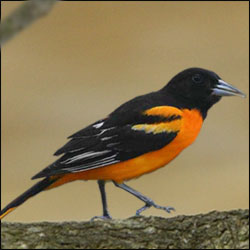
A colorful assemblage of migrants at work this morning, including brilliant blue male Indigo Bunting and everyone's favorite orange and black Baltimore Oriole. Not much singing in the woods, Warbling Vireo, Northern Parula. A male Eastern Bluebird was defending a nest box from four dive-bombing Tree Swallows in the field by the barn. Common Yellowthroats were singing in the brush below the power lines. (photo: National Park Service)

Dunlin on the run

On the way to work this morning I found a nice breeding plumage Dunlin at Pine Run. This sandpiper, formerly known as Red-backed Sandpiper or Black-bellied Sandpiper, is a rare migrant in Bucks County, seen only a couple times a year if that, so a nice way to start the week. Also saw my first Solitary Sandpiper of the year at Pine Run, and a lingering Bonaparte's Gull at Peace Valley. (photo: USFWS)

Saturday, May 05, 2007

megaloony

I was in DC yesterday, and busy this morning, so didn't check my email until 3pm--when I learned that yesterday Cameron Rutt had discovered a Yellow-billed Loon about 100 miles away near Harrisburg. It was still there this morning, so within an hour my 4th grader and I were in the car cruising west on I-78. By 5:30 we arrived, a few birders were still there, and the bird was in view. We watched it and followed it as it dove just offshore in the Susquehanna River. This is another bird that I had chased and missed several times as a kid growing up in Oregon, so it was sweet to finally see this bird. Its almost in complete alternate (breeding) plumage, which is another treat, since most birds that wander down to the Lower 48 from Alaska and Canada are in basic (nonbreeding/winter) plumage and not nearly as classy looking as this beauty! What a great bird to end the day! (photo: Cameron Rutt)

Update: More photos of this bird are online here--
Tom Johnson's photos
Tim Lenz's photos
Geoff Malosh photos
Dustin Welch photos

Watch a local TV news story about the bird at WHTM.

Tuesday, May 01, 2007

Rose-breasted Fun

Sitting at my desk the fun continued at work today, when a brilliant male Rose-breasted Grosbeak flew to the seed feeder a few feet from my window. It spent several hours there, off and on, munching on seeds. Each year I get dozens of emails at work from folks seeing these birds for the first time--they're always blown away and think they've found something totally rare and unusual. They are spectacular birds. Ah, Spring! (photo: Bedford Audubon).

Warblers Arrive

Finally had a good flock of warblers at work this morning in the drizzle, with birds singing everywhere. Highlight was 1 Blackburnian Warbler high in the tree. Most numerous were 55 Yellow-rumped Warblers. Also singing--5 Black-throated Green Warblers, 3 Palm Warbler, and 3 Yellow Warblers.

Shorebirds on the move

On the way to work this morning there were 8 Spotted Sandpiper, 9 Least Sandpiper, 8 Lesser Yellowlegs, and 1 Wilson's Snipe at Pine Run. Not a huge number of shorebirds, but good to see them on the move. In the woods near the shore, were my first Yellow Warbler of the year, as well as several Yellow-rumped Warblers and a Palm Warbler. Migration is underway!

Monday, April 30, 2007

Sandhill Crane surprise

I drove past Quakertown Swamp, a local wetland area with an active Great Blue Heron rookery (birds were on at least eight nests this evening), with my two kids this evening. At about 6pm, I saw what I thought were two Great Blue Herons flying over the swamp--but one had its neck extended. I thought it might be doing some kind of display to the other bird, but my five year old said it didn't look right for a Great Blue Heron--too light. Sure enough, in binoculars I could see it was a Sandhill Crane--a rare migrant through these parts. I watched it circle down towards the swamp, then circle higher, and moving off to the east. After a few minutes I turned around and parked, but by then the bird was gone. I'm used to seeing these guys in huge flocks in Texas--or in pairs on their mating ground. I don't know if I've ever just seen one lone crane by itself. A surprise all around! (photo: kentuckyawake.org)

Word from Cornell--No Ivory-billed Woodpeckers

The mobile search team from Cornell was unable to find any Ivory-billed Woodpeckers during the search the past five months. More here.

Friday, April 27, 2007

PA State Game Land 157

This morning in the rain before work I walked up Haycock Mountain (don't get too excited, its only a couple hundred feet high) on Pennsylvania State Game Land 157, in search of warblers and other migrants. Not a whole lot around, and heard more than I saw, but did have 6 Black-and-white Warblers, 1 Palm Warbler, 1 Ovenbird, 1 Wood Thrush, 1 Hermit Thrush, 1 Eastern Towhee, and 1 Brown Trasher--all First of Season birds for me. Nice to finally bird somewhere in Bucks County where you can't see any houses or really hear any traffic!

Thursday, April 26, 2007

Junkin's Warbler


This is a very cool mystery story brought to you by our friends at the Cornell Lab of Ornithology. Can you identify the parents of this bird--"Junkin's Warbler"--a hybrid between two warbler species? Learn all about it here.

Green Day

OK, not the band, but a Green Heron--the only bird of note (my first one of the Spring) during a quick stop at Peace Valley this morning. Still not finding warblers, and getting a bit frustrated since everyone else in PA seems to be having lots of birds.

Wednesday, April 25, 2007

Singing Rusty Blackbird

Despite two days of searching in the woods near my office, no migrant warblers appear to be here yet, despite numerous warbler sightings all over the county and surrounding areas. But this morning I did find two Rusty Blackbirds in a flock of Red-winged Blackbirds--including a singing male. These birds should all be north of here by now, so it was a treat to see one, and hear it sing.

Monday, April 23, 2007

Chimney Swifts arrive

This afternoon I heard and then spotted my first Chimney Swifts of the Spring circling over the spires of a church in Sellersville. I love to hear the chatter of these aerial insectivores--a sure sign that Spring is in the air!

Spring is in the air

It's 85 degrees today in SE Pennsylvania. Leaves are starting to pop out on the trees, and people are starting to report migratory songbirds. On my morning walk this morning a Yellow-rumped Warbler was singing, a Northern Flicker was calling and drumming loudly, and Song Sparrows were singing from their song posts. I didn't see any northbound migrants, but a little exploring tomorrow should show me some new arrivals. Its Spring, when every day can bring new surprises!

Friday, April 20, 2007

Ruff Jinx Nixed

Finally, after over 25 years of scoping out hundreds of thousands of yellowlegs, I finally got my first North American sighting of a Ruff. This morning I joined two other PA at 9:45am just across the border in NJ to look for a blonde Ruff found last weekend in the marsh/mutflats off the railroad tracks at High Hill Rd. Within half an hour, we had the bird in the scope, but it was over 100 yards out. We watched it for over 20 minutes before the birds flew and we lost it. About 11:15 we saw it again, a bit farther out. After a few minutes it disappeared again. Finally, about 11:30 I briefly saw it land and immediately take off again with a flock of yellowlegs, and all the shorebirds in the marsh took off heading east and landing over a mile away, way out of sight.

Most birders have a jinx bird or two, birds that they should have seen long ago, but for some inexplicable reason, they just haven't run into. Growing up in Oregon, I'd missed Ruff a couple times by a few hours. Living in Texas, no Ruffs showed up at Hornsby Bend in all my years birding there, though three had been seen there during the previous ten years, and I never managed to chase one on the Texas coast.

The Mid Atlantic states used to be Ruff central for the Lower 48, though in recent years, there don't seem to have been as many reported as in decades past. At any rate, at long last, I've connected with a Ruff on this side of the Atlantic. Below is a picture of the bird we saw today, taken by the bird's original finder, Dave Magpiong. Check out his great website, Fledgingbirders.org dedicated to getting new folks interested in birds and birding. Take a moment to check out Winged Wonders, his birding and nature blog at the Courier Post Online, including a post about finding the Ruff.

.

Thursday, April 19, 2007

Going, going, gone

By the time I got back to Nockamixon with my youngest kids to show them the oystercatcher, everyone was still standing around, but the bird was gone. Apparently fifteen minutes before I arrived, the bird started calling, then flew off circling and gaining altitude before heading out.

I did get to see two Horned Grebes, a Pied-billed Grebe, and an Iceland Gull that had been hanging around this week--so all in all another good stop at the lake.

Spring is in the air and I'm getting frisky. Wish me luck for tomorrow's chase!

Oystercatcher Redux

After work I picked up my fourth grader from school and we cruised back up to Lake Nockamixon to see the American Oystercatcher. There were still half a dozen birders standing around, and we got good looks at it standing on the bank of the lake with some Canada Geese. At one point it dropped down and stood belly-deep in the water, splashing and bathing itself for a few minutes. It has flown about two miles from where I initially found it, to another boat launch area. This is apparently the 5th Pennsylvania record of this species. It seems to be a young bird, as it still has some black on about half of the bill, and dark reddish eyes.

Rare Bird Chase

Today it was my turn to start a rare bird chase. Driving back from errands in Quakertown, I stopped by Lake Nockamixon to see if there were any birds blown in from the recent storms. When I got to the end of the fishing pier, there was a stunning American Oystercatcher sitting on a rock just off the pier. This is a bird of the seashore, considered Accidental here in PA, and only the second county record. I was so excited I didn't watch it for more than 30 or 40 seconds since all I could think of was that I needed to get to a phone to let others know about the bird. I managed to get another birder on my cell phone, and get the word out, and within an hour at least four others had seen the bird. Very cool.

Elsewhere I saw five Wild Turkeys in Pennsburg, another five at Peace Valley where the Bonaparte's Gulls seen the last few days have apparently moved on, leaving behind hundreds of Tree Swallows and an Osprey.

Tuesday, April 17, 2007

Birdchaser at Delmarva Ornithological Society

Tomorrow night (April 18) I'll be presenting a talk on how birds see the world at the Delmarva Ornithological Society meeting at the Ashland Nature Center in Hockessin, DE. If you are around, come join us at 7pm for refreshments (always good) and the talk.

Monday, April 16, 2007

Loony Weather

Howling winds, sleet, and snow all night--but only a small change in birds at Peace Valley on my way into work this morning. The Snow Goose that has been there for months was at the flooded boat ramp (water is very high right now). Other than that, seven Common Loons, three Double-crested Cormorants, two Common Mergansers, and one Ruddy Duck were all that I could see out on the lake from the south side. Lots of Tree and Northern Rough-winged Swallows flying low over the lake.

Thursday, April 12, 2007

Scoter Surprise

Always a treat to see inland away from their off-shore haunts, six White-winged Scoters were floating in the middle of the lake at Peace Valley park this morning when I stopped by in the rain on the way to work. Always worth checking out lakes and ponds when it rains, as you never know what the weather will bring down (Photo Dave Menke/USFWS)

Wednesday, April 11, 2007

Hither and Yon

On the way to work this morning, I stopped by Peace Valley, as usual. Most of the waterfowl have moved through, but there was a nice breeding plumage Common Loon near the south shore of the lake.

At work, eight Wild Turkeys wandered up to the feeder right outside my window. Very cool to be within a couple feet of these birds.

Took a walk down to the creek during my lunch break. A male Wood Duck flushed off the creek, then I saw another male swim out from behind a downed tree--followed by two female Green-winged Teal--the first of this species I've ever seen on the property. A bit downstream were two more teal, a male and female.

So some nice birds I don't get to see every day, and a yard bird for the office. Not too bad for a day at work.

Wednesday, April 04, 2007

Couple quick birds on the fly

Yesterday while I was on the phone, my first Osprey of the year circled over the creek outside my window at work. This morning on my way to a meeting in Princeton, the neighborhood flock of over a dozen Wild Turkeys was working through an old corn field on the neighbor's property.

Tuesday, April 03, 2007

Red-necked Grebe

A single Red-necked Grebe, a rare migrant here in SE Pennsylvania, was found at Peace Valley last week and was still present this morning when I stopped by on my way to work, floating in the middle of the lake with three Ruddy Duck and two Bufflehead. There are so many white-tailed deer in the park that they have really hammered the understory of the forest--making it easy for me to see three Wild Turkeys running through the woods as I drove out of the park this morning. I love to see turkeys run--its a wild spectacle that sends a chill down my spine!

Thursday, March 29, 2007

Birds out my window

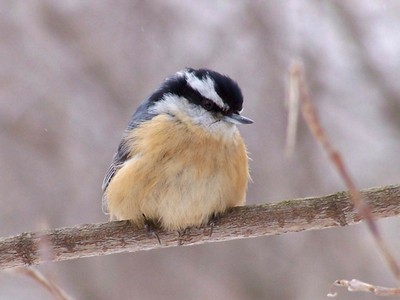
This week I moved to a larger downstairs office at work, with a fireplace, some nice plush chairs and more space for my books. But the best amenity is the birdfeeder right out side the window where I watch a steady stream of White-breasted Nuthatches, Carolina Chickadees, Dark-eyed Juncos, White-throated Sparrows, and Downy Woodpeckers and a dozen other species jostle for seeds all day. Right now, early spring has brought roaming Brown-headed Cowbirds, and a pair is gobbling up seeds at the feeder and keeping the smaller birds from getting much more than the spilled seeds on the ground. Cowbirds have a bad reputation amongst descriminating nature lovers--since they leave their eggs in the nests of other birds, sometimes outcompeting and hastening the demise of native nestlings. But these birds are still striking--males with shiny black bodies and coffee-colored heads. The females have subtle brown feathers with delicate paler feather edges. This morning I'm enjoying seeing something I haven't seen a lot of--head-on views of the cowbirds. Their eyes seem remarkably close-together and forward-facing for a bird, giving it a stern or intent look. Who needs television with this kind of spectacle going on mere feet away. I may have to close the curtains if I want to get some work done!

Turkey Walk

This morning a friend saw 14 Wild Turkeys crossing the driveway when he pulled into work. When I arrived a half hour later, I decided to take a stroll down into the woods to see if the birds might still be around. Moving slowly, I was able to find at least 11 hens and 2 tom turkeys walking single-file through the trees. Then the males stopped to display, puffing up their feathers and fanning their tails. I didn't grow up with turkeys, so its always fun for me to see this. For a moment, the woods at work were a primordial forest, with a troop of ancient lifeforms moving through a parallel universe that I was priviledged to visit. I love that.

Tuesday, March 27, 2007

What happened to Birderblog?

So, you tried to go to Laura Erickson's Birderblog.com and it was gone? Thanks to Google caching, you can still read why its gone, even though Laura took down her original post about why she quit her dream job of blogging for Binoculars.com. Google caching is a great tool to help you find stuff that people have taken off the web, but it really can work against you if you are the person trying to retrieve something you've sent out into cyberspace! So, bloggers beware!

Thursday, March 22, 2007

Merganser copulation display

Yesterday and today there was no sign of the Long-tailed Duck at Peace Valley, but I did get a chance to watch a pair of Common Mergansers in their copulation display. The female was prone on the water with her neck outstretched and her chin touching the water. She faced the male as he circled, dipping his bill in the water then raising it up pointed to the sky in a ceremonial drinking display, mixed with occasional brief preening of the back feathers. This went on for more than ten minutes as I watched yesterday before I had to leave. Never did see if they actually did the deed. I couldn't find any photos of this behavior online, though it is described briefly in the Birds of North America account online (subscription required). I sure need to get that camera!

Tuesday, March 20, 2007

Long-tailed Duck

This morning I stopped by Peace Valley Park on my way to work and was greeted by a stunning winter-plumaged male Long-tailed Duck floating in the middle of the lake with the large Common Merganser flock. This is mostly a coastal bird, so not one you see very often here inland. Also present were three Northern Pintail, and half dozen Ruddy Ducks and Ring-necked Ducks, also a lone male Bufflehead. Birds are on the move! (photo: Indiana Audubon Society)

Thursday, March 15, 2007

More bad news for Ivory-billed Woodpecker searchers

A new study with more evidence that the famed video of a bird in Arkansas is probably not an Ivory-billed Woodpecker (read it here).

Here's the abstract:
Background: The apparent rediscovery of the Ivory-billed Woodpecker Campephilus principalis in Arkansas, USA, previously feared extinct, was supported by video evidence of a single bird in flight (Fitzpatrick et al, Science 2005, 308:1460-1462). Plumage patterns and wingbeat frequency of the putative Ivory-billed Woodpecker were said to be incompatible with the only possible confusion species native to the area, the Pileated Woodpecker Dryocopus pileatus.

Results: New video analysis of Pileated Woodpeckers in escape flights comparable to that of the putative Ivory-billed Woodpecker filmed in Arkansas shows that Pileated Woodpeckers can display a wingbeat frequency equivalent to that of the Arkansas bird during escape flight. The critical frames from the Arkansas video that were used to identify the bird as an Ivory-billed Woodpecker are shown to be equally, or more, compatible with the Pileated Woodpecker.

Conclusions: The identification of the bird filmed in Arkansas in April 2004 as an Ivory-billed Woodpecker is best regarded as unsafe. The similarities between the Arkansas bird and known Pileated Woodpeckers suggest that it was most likely a Pileated Woodpecker.

Tuesday, March 13, 2007

Timberdoodles with the kids

This evening I took my family to Sailor Point at Peace Valley Park at dusk to see the American Woodcocks (Timberdoodles) come out for their evening display flights. When we got there, we heard a half dozen woodcocks making their "pzeeeent" calls off in the woods and in the brushy field near the boat launch parking lot. Then, a couple bird zipped close by overhead. As it was getting harder to see, the birds started flying high overhead making their squeaky conveyor belt noises in the dark. The kids were tired, and it was a little chilly out there, but still lots of fun.

Getting inside the bird's head

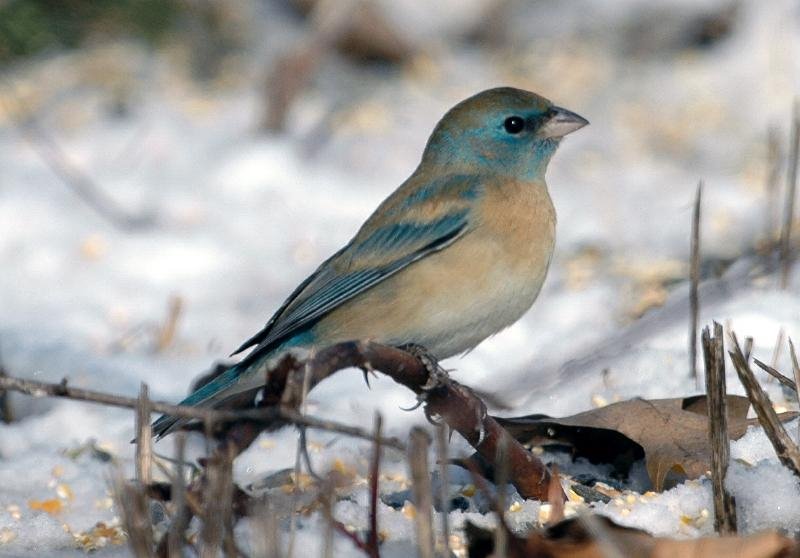
This past weekend, while waiting for the Lazuli Bunting to show up, I was entertained by numerous observers offering conjectures about the hidden habits and activities of the wary bird. One man who had seen it briefly two days earlier, elaborated at length about how it always hung out with White-crowned Sparrows, hid behind a certain bush, and always came in between 9 and 10 am. Another speculated that the bird roosted nearby, but then disappeared to spend the rest of the day living in luxury eating seeds from a backyard feeder somewhere. In a total absence of real information, people were stringing together all kinds of speculative ideas based on the tiny bits of information gleaned from the past sightings of others.

I spent a lot of Friday morning engaging in this myself, wondering where I would go if I were a lone bunting, and wandering the neighborhood in search of the bird, and an explanation for its behavior. Saturday morning, as I recounted all of the available information to a newcomer, another birder quipped, "you're never going to get inside the f%*#in bird's head--it's either here, or it isn't."

In chasing birds, it is interesting to see how speculation goes wild when people are trying to find a bird but it isn't making itself available. The last few years of Ivory-billed Woodpecker searching are full of this kind of speculation. Lacking any real solid evidence, many wild and fantastic stories have been put forward about Ivory-billed Woodpecker ecology and behavior. But when you really get down to it, the bird is either there or it isn't. So far, there isn't convincing evidence that it's still there.

But that's just a side note--an interesting example--of this general practice of creating wild speculative stories about the comings and goings of rare birds. We try to find meaning, even when we don't have real information to do so. And when we finally see a bird we've been seeking, we like to think that somehow we've mind-melded with it, that we've somehow put ourselves into its world in order to connect with it on its own terms. Maybe we have, or maybe we haven't. How far do we really ever get into the bird's head?

Saturday, March 10, 2007

Good things come to those who wait

I woke up before 5am and drove over to the Lazuli Bunting spot before dawn. The sun wasn't even up and I was still not the first birder there. Others started to roll in and we all stood on the side of the road waiting and hoping for the bird to reappear. While we waited, I walked over to the creek and was excited to see a pair of Mink loping across the ice along the far bank. Its been over 10 years since I've seen Mink, so that was pretty cool.

Finally, after almost two hours of standing in the cold, I glanced at my watch. 7:49 am. I turned to some of the guys I was with and said, "this is about when the bird showed up yesterday, so its about time." Just then, the bird appeared behind us and we all got good looks as it sat in a tree for a few moments, then flew across the road, scuffled with a few other birds, and after a few more moments flew off and disappeared down along the creek. Perfect.

Except for one guy who was just walking up as the bird disappeared and a couple more birders who arrived in the next fifteen minutes. Since the bird is only seen briefly in the morning as it makes its rounds, and disappears for the rest of the day, things didn't look good for those who arrived late.


However, luckily a couple of kids fishing down along the creek spooked up the bird and at 8:15 it flew up and perched for several minutes in the top of a bare tree. Almost everyone got decent looks, especially those with scopes. The bird is freshly molted, with buffy tips to the feathers that are gradually wearing off to reveal the striking red, white, and lazuli plumage. Since these birds are supposed to be in Western Mexico this time of year, it isn't a plumage that most of us get to see. After a few minutes in the top of the tree, the bird buzzed off with its rapid bunting flight and disappeared back into the cedars and bushes behind us. (photo: Howard Eskin)

The bird didn't show up again before I had to leave about 9:15, to the chagrin of those who arrived after it disappeared. If it holds true to form, it won't appear again until tomorrow morning. Those who show up late will have to be satisfied with some of the other birds in the area--Hooded Mergansers, Sharp-shinned Hawk, and a host of sparrows including White-crowned, Field, American Tree, White-throated, Song, Swamp, and at least one roaming Fox Sparrow.

Friday, March 09, 2007

Lazuli Dip

For most folks, dip is a tasty concoction you eat with chips. For birdchasers, a dip is when you chase a bird but don't find it. This morning, I dipped on Lazuli Bunting twenty minutes from my house.

Lazuli Buntings should be in Mexico right now. But apparently one is in the next county over (see photos here).

I got there at 8:30 after taking my kids to school. The bird had shown up for a mere 2 minutes at 7:45. Apprently, it is only seen in the morning, and disappears for the rest of the day. Nobody knows where it goes.

I wandered around the area hoping to discover its hidden daytime haunts, but no luck. However, it wasn't a completely wasted morning, as I was able to get some really close looks at two American Woodcocks--including a great look at one bird on the ground. These secretive nocturnal sandpipers are usually only seen in the dim light of evening when they fly around displaying over open brushy areas in the woods. Today it was great to get up close and personal with a couple of these amazing birds.

Since I've seen dozens of Lazuli Buntings before, but had very few good looks at woodcocks, I think I got the better end of the bargain. Of course, that won't stop me from making another trip to look for Pennsylvania's third-ever-reported Lazuli again this weekend!

Thursday, March 08, 2007

Latest I and the Bird

I and the Bird #44 is up at The Greenbelt. Check it out for the latest best thoughts on birds from the blogosphere.

Tuesday, March 06, 2007

GBBC Wrapping Up

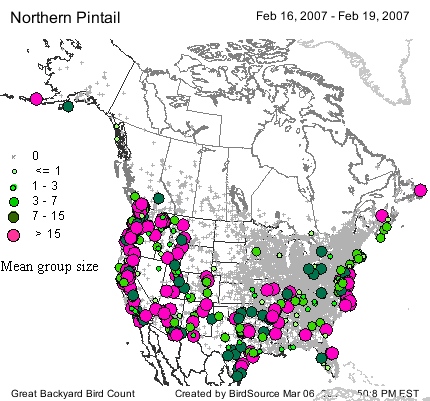
Public data entry for the Great Backyard Bird Count ended last week, but behind the scenes there is still a lot of work to do. We have over 90 regional reviewers sifting through the unusual records and trying to clean up the data. We are still missing reports of many species, especially in Hawaii--so we're contacting observers there who might have additional species to report. We're also starting to look at the results from this year--including some interesting trends. Northern Pintail numbers are down, which may be further evidence that this species is continuing its precipitous population decline. Hooded Merganser numbers are way up this year, so there might be something intersting going on there. American Crow numbers are down a bit on a per checklist basis, perhaps indicating continued problems with West Nile Virus mortality.

The GBBC is an imperfect instrument, but by creating a snapshot of bird populations during mid February each year, it gives us a first look at how birds are doing across the continent. Sometimes, as in the cases mentioned above, we see things that make us look more closely at how some species are doing to see if we can otherwise verify trends that show up on the count, and perhaps identify the causes of the trends.

The fun thing is, anyone can take a look at the maps and the data for all of the past GBBCs. By exploring the maps, or the yearly counts, maybe you can spot an interesting trend that nobody has noticed yet!

Friday, March 02, 2007

Ducks on the move

As the ice melts off the lake at Peace Valley Park, small flocks of ducks are dropping in as they make their way north. Yesterday I saw 12 Ring-necked Ducks, 10 Northern Pintail, a dozen Green-winged Teal, and 1 American Wigeon with the more regular Black Ducks, Mallards, and hundreds of Common Mergansers. Today, there was only one Northern Pintail, but six American Wigeon, two Bufflehead, and several hundred more Common Mergansers.

Yesterday I also saw my first Fox Sparrow of the spring, and others are reporting Tree Swallows arriving in the state. Spring is in the air!

Thursday, March 01, 2007

Owl Love...or Lust

This morning at 3:30 a pair of Great Horned Owls apparently hooked up for a duet in my neighborhood. While I've previously seen and heard the one owl, there are definitely two now. Its prime breeding season for these guys here in Pennsylvania, so love is in the air. Or at least the hormonal and social activities that we associate with love in our human world. Bird love may be different in many ways, but to the extent that human couples and bird couples share hormonal sexual responses to each other, birds and humans may have a lot in common. So if it ain't love, maybe its at least lust.

We still have a lot to learn about bird feelings and emotions.

Wednesday, February 28, 2007

Birds before Work

This morning during my early morning walk, the friendly neighborhood Great Horned Owl was calling from the top of a pine tree at the end of my block. As I watched it, the bird flew across the street into a neighbor's backyard. A nice way to start the day.

On my walk along Perkiomen Creek, I was startled by a large bird fly away low along the creek, then climb steeply to clear the trees. It was beating its wings quickly and in the early morning light mostly showed dark wings with a white-trailing edge to the wing. Common Merganser.

Arriving at work this morning, a tom Wild Turkey was displaying out in the open near the edge of the woods. Three hen turkeys were shuffling around just inside the woods.

All in all not a bad way to start the day.

Monday, February 26, 2007

Ivory Gull Twitch

I woke up this morning to news that an Ivory Gull was being seen in New York, about two and a half hours from my home. Having daydreamed about seeing this rare Arctic gull for years, there was nothing to do but to jump in the car with my nine-year old (if they can open school late for snow, I can cancel it for a day to show my 4th grader an all-white gull that eats dead seal carcasses left by Polar Bears!). We arrived at the designated spot and followed a half dozen birders on foot for about half a mile. And there it was, a beautiful white bird, sitting on top of a telephone pole, with 40 birders standing around below it. After 20 minutes, it flew off, circled around, and came back a couple times--landing on a piling, picking up part of a dead fish, and flying off again. Amazing. I wasn't ready for the colors on the bill--red, orange, yellow, green, blue. If you live on the East Coast, this is a good bird to chase. Since these birds are declining, possibly due to melting of Polar ice caps due to global climate change, and possibly due to mercury poisoning, there's no telling how many opportunities we'll have to see these birds. They almost never get this far south. (Photo: Phil Jeffrey)

Also in the area, and at one point in the same binocular field, a wintering Snowy Owl. As one birder commented, its not very often that you see a bird that makes a Snowy Owl look off-white--but an adult Ivory Gull sure does that. Some birders have seen this Ivory Gull pick at scraps of a duck killed by this owl, so its quite a scene there on the banks of the Hudson River 20 miles north of NYC.

My 4th grader was happy to see the gull, as well as her second Snowy Owl, and to play in the snow for a little while. She read her autographed Kaufman guide half way home. Hopefully she'll remember this twitch, and feel a connection to the Arctic wildlife that need our protection.

More on this bird:
Phil Jeffrey
The City Birder
Jersey Birder
Edallbirds

Saturday, February 24, 2007

False Advertising?

Originally this post was a criticism of the ad copy for Ivorybill Hunters, Geoff Hill's new Oxford Press book about looking for Ivory-billed Woodpeckers. However, upon further reflection, I've decided its time for me to follow Rule #2, a Fergus Family rule my parents came up with after watching Walt Disney's Bambi--ie, if you can't say anything nice, don't say anything at all.

In the spirit of that rule, I think I'm done commenting on the whole Ivory-billed Woodpecker saga--and I want to apologize to anyone who I have disagreed with about this issue. The lines seem to be drawn, I don't see too many people changing each other's minds about this, and resulting conversations seem to mostly generate ill feelings. To the degree that I've contributed to that, I apologize. While I believe in always searching for and standing up for the truth as it can be best determined, I do not believe in using truth as a weapon to attack others. To the degree that I have done that, or have made others feel attacked, I apologize. We may disagree, but I apologize for doing so disagreably. I aspire to be better than that.

Wednesday, February 21, 2007

New Species for the GBBC

So far we've added three new species to the Great Backyard Bird Count for the first time this year. I've wanted to get Lesser Prairie Chicken on the count for the past three years, and we finally got a sighting reported this year from Oklahoma. This year we were finally able to update state checklists, which allowed us to (finally!) record the Falcated Duck that has been returning to Oregon each of the last few winters. Also, this year we were able to add the two Pink-footed Geese that have been hanging out near Newport, Rhode Island.

Hopefully there will be more new additions as we continue to sift through the records and drum up reports of birds still not submitted yet to the count. We are accepting reports from last weekend through February 28, so there is still time to submit your bird sightings online (here).

Winter Wren

I've been practically living with my computer surgically attached to my body for the last week, while working on the GBBC. Besides the birds at Peace Valley Park on my way to work, and the birds at the feeders at work, I haven't been having enough bird encounters lately.

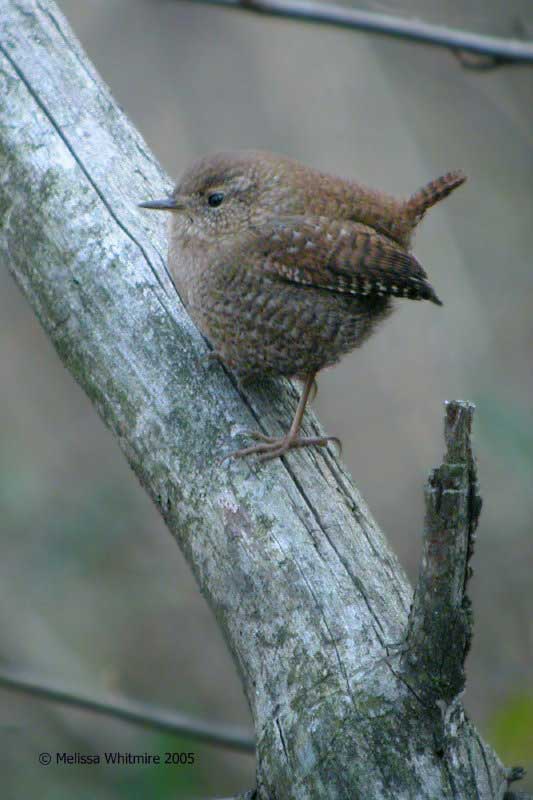
Today, on my morning walk, a pair of Winter Wrens caught my attention as they called back and forth to each other as them moved along the woods between the hike and bike path and Perkiomen creek near my house. These little brown puffballs are a joy to watch as they flit about. And they may have helped keep me from harm. By stopping to watch them, I narrowly avoided a very slippery patch of black ice on the path, that would have almost certainly caused me to tumble had I been marching along at full speed!
(photo:Melissa Whitmire)

Tuesday, February 20, 2007

GBBC Photo Gallery


Two years ago we started a Great Backyard Bird Count photo contest as a way for people to share pictures of their favorite birds seen during the count. If you got some nice bird photos this past weekend, consider sharing them here. Otherwise, just drop by to see what others are sharing at the GBBC photo gallery. (photo: Margaret Heslin).

New GBBC Records

The Great Backyard Bird Count is setting all new records for participation this year. As of 2:00pm EST today, we have a new record of 61,678 checklists submitted--breaking the previous 2000 record of 60,999 checklists. We also have a new record for the number of individual birds counted, currently over 8.6 million birds.

Many states, provinces, and territories have already submitted record numbers of checklists. As of this afternoon, they include Arizona, British Columbia, Florida, Georgia, Iowa, Kansas, Kentucky, Missouri, New Brunswick, North Carolina, Nunavut, Quebec, South Carolina, South Dakota, Utah, Wisconsin, and Wyoming. Several other states are close to breaking their checklist records.

It's still early, and a lot of unusual sightings are still under review, so it would be too early to declare that any state has broken their historic all time species counts, but it looks like that will happen for a good number of states as well.

Thanks to everyone for submitting their counts. While the count is now over, observers have until February 28 to submit their counts online.

Post script (2/22)
--As of this morning, 29 states, provinces, and territories have broken their records for checklist submissions. For a comparison, last year only 19 were able to do so.

Monday, February 19, 2007

GBBC Update--Feb 19

As of 1pm this afternoon, we have 41,072 checklists submitted to the Great Backyard Bird Count, up 40% from last year at this time. Still a long ways to go. We're also showing reports of 567 species (though some of those are actually species pairs or other non-species). Some of the more interesting reports--a huge flock of blackbirds and grackles reported in DE has raised eyebrows. Also 450,000 robins in Florida, where there is a huge winter roost this year.

And my very own favorite, after two years of trying, we've finally got a report of Lesser Prairie Chicken for the very first time on the count.

There are still a lot of species missing from the count. If you have seen a species not already reported for 2007 on this list, then make sure to report it online!

A few more hours to get out and count some birds. Have fun!

Saturday, February 17, 2007

GBBC Update--Feb 17, 2007

The 10th Great Backyard Bird Count is rolling along nicely. As of 9pm EST this evening, birders had submitted 17,210 checklists and reported over 500 bird species--up over 50% from the number of submissions last year at this time in the count.

New York leads the pack with numbers of checklists submitted (1115), followed by Georgia (987), and North Carolina (961). Cities reporting the most birds are Charlotte, NC (133), Durham, NC (100), and Tallahassee, FL (98).

There are still over 100 species reported last year that haven't been reported yet this year. You can see which species are still missing by looking through the species list here. Species with an asterisk have been reported this year. Birds without an asterisk (sort of like Plain-bellied Sneetches) are still missing from the count. If you've seen one of these missing birds this weekend, make sure to report it. Or if you know where one of these missing birds is, head out and see it tomorrow or Monday, then report it!

Whatever you do, please report any and all birds seen each day this Friday-Monday to www.birdsource.org/gbbc.

International GBBC

I've had several people email with desires to participate in the Great Backyard Bird Count from outside of the U.S. and Canada. While the official GBBC website and database can only handle sightings from the U.S. and Canada at this point, feel free to post your International GBBC counts here as a comment! Hopefully in future years, we can get a more official way to share International GBBC counts.

A U.S. serviceman from Iraq sent me this list from CSC Scania:
European Collared Dove--19
House Sparrow--73
White-cheeked Bulbul--4
Black-winged Stilt--1
Carrion Crow--1
Rock Dove--1
Hooded Crow--1
Magpie--1
Crested Lark--1
Unidentified bird of prey--1
Unidentified wren-like bird--1

Lets hear it for our International GBBC participants!

GBBC--record setting pace

Just over a day into the Great Backyard Bird Count, we're on a record setting pace for numbers of checklists submitted. At 10am EST on Saturday, we had 8491 checklists submitted. Last year at this time, we only had 5130 checklists in by now. In 2000 we had 6804 checklists in by this point. So keep it up, head outside, see some birds, and report them online here.

This morning from my back porch I was able to count more species than yesterday--including a flyby Lesser Black-backed Gull and the wintering Northern Mockingbird defending the holly tree. Since every day is different, submit a checklist for your yard each day this weekend so we can get an average count that more accurately depicts bird abundance in your area.

Friday, February 16, 2007

GBBC Help--Counting Flocks of Birds

eBird has a great online guide to counting flocks of birds (Bird Counting 101)--worth taking a look at if you are concerned about accurately counting large flocks of birds for the Great Backyard Bird Count.

GBBC Help--Finding Zip Codes

To enter bird sightings for the Great Backyard Bird Count, you need to know your zip code. While you are sure to know the zip code of your home, what about the zip code of your favorite birding area? How do you find that?

Its as easy as can be. Just head to the zip code search tool online here, and zoom in to find your favorite birding area. Each zip code is colored to make it easy to see exactly what zip code your favorite birding area is in.

GBBC Starts Today!!!

It's finally here, the Great Backyard Bird Count. I started the morning looking out my window at a frozen wasteland of an urban backyard. Only birds present: 10 European Starlings and 8 House Sparrows. The Northern Mockingbird that has been defending our holly tree, nowhere to be seen. No Mourning Doves on the lines. No House Finches or Dark-eyed Juncos at the feeder. Oh well, I did a count, and submitted it online.

On the way to work, I stopped by Peace Valley Park. I thought the lake would be entirely frozen, but no, there is still a small patch of open water. Best birds were a pair of Redheads floating out with the Common Mergansers and a pair of Hooded Mergansers. There was another small dark diving duck too far away to see for sure what it was. I'll have to go back again later. Meanwhile, when I got to work, I submitted another checklist for the park.

Here at work, I'm watching the feeders. Once I've got the high count for each species, I'll submit another checklist from here.

I love the GBBC! Tomorrow I'll take my kids out for a little bit before heading back here to the office to run GBBC support all day. The ground is covered with snow. Its bitter cold. But there are still birds out there to count!

Thursday, February 15, 2007

Better than TV--Backyard Wild Kingdom

With snow covering the ground, our feeders at work are loaded with birds--dozens of juncos and white-throated sparrows at a time on the ground. Yesterday there were over 20 cardinals at once in the snow. Today, while I was watching the action, a young Cooper's Hawk swooped in and scattered all the birds. It landed in a bare tree and preened for a few minutes. Finally, a young white-throated sparrow took off out of a nearby holly tree, and the hawk bolted after it. The sparrow hit an upstairs window, and before it could hit the ground, the Cooper's Hawk had grabbed it in mid-air not five feet from me just outside my window, and landed in the snow with the sparrow in its talons. We considered each other for a moment, and the hawk flew off carrying the hapless sparrow. Amazing!

Tuesday, February 13, 2007

GBBC in the Blogosphere

Lots of bloggers are getting in on the GBBC action. Look for more posts as we get closer to the count, and enjoy the GBBC experiences of these folks as they post throughout the weekend. I look forward to reading about everyone's GBBC fun! Meanwhile, check out these GBBC posts:

Bootstrap Analysis
Birds Etcetera
Got Serenity
Sox Fan Zone
A DC Birding Blog
Arcol-o-gist
AnimalBytes
The House & Other Arctic Musings
10,000 Birds
Journey was the Destination
All About Home Schooling
Blog de Purée
Doc's Sunrise Rants

There are over 433 posts currently listed at Blogsearch. While you're composing your own GBBC blog post, cruise on over to hear the latest NPR story about the count (here).

Great Backyard Bird Count this weekend

This weekend is the Great Backyard Bird Count! We've been busy the last couple weeks at work lining things up, and we're almost ready to go. For the first time ever we have regional reviewers to check up on unusual reports of birds in every single state and Canadian province and territory. Today I've been blitzing state birding email lists with information about how their states did last year, and urging folks to get out and see more birds this year. More birders+more birds=more fun! That's the equation for GBBC success!

So, whatever else you do this weekend, head out to your favorite birding area, check out the birds in your yard, and report the birds from both places each day at the GBBC website. Then spend some time on the website checking out the nifty maps and up-to-date reports on the birds being seen in your area and across the country. Take your friends and family out and have some fun!

Friday, February 09, 2007

Drawing Birds

Drawing the Motmot has a great recent post about how to draw birds. Don't you wish you could draw birds too? Turn of the computer, grab some paper, head outside (or to a window), and get started!

Birding is for lovers

National Audubon has a Valentines Day page dedicated to bird love, and to human couples who met through birding. While birding can be a source of discord in a relationship, in the best of worlds it can also bring people together. They don't call enfatuated couples love birds for nothing!

Thursday, February 08, 2007

Bird Killer Granny

Birders across the country are disgusted by a Newsweek article about a grandmother who buys a gun and kills a cardinal that has been attacking her glass windows. Some have even wondered if this is a spoof--since it seems clearly to be in bad taste and an over-the-top response to a minor nuisance. Others are determined that the U.S. Fish and Wildlife Service should fine the granny for willfully violating the Migratory Bird Treaty Act that protects all native birds.

I wanted to look into this a bit, so I started looking for this granny--Walda Cameron of Goshen, New York. I did find her address at an online campaign contributions site for a Democratic judge (here). She also wrote a NIMBY letter to the editor of a local paper against a proposed asphalt plant. She also donates to charity. Finally I found her phone number. Other than that, not a lot more about her online.

Of course, before phoning or sending a note to the bird-killing granny, we should all take a deep breath. While this granny clearly lives in a glass house, and admittedly does cast stones, at least at birds, we don't want to create a tempest in a teapot and wouldn't want our own responses to be as over-the-top as her original misguided shooting and ill-begotten celebratory article. Walda made a couple big mistakes, and I'm sure she isn't getting the response she thought she would get to her article. And bloggers are Googling her personal information. Public shame is a more powerful punishment than anything the U.S. Fish and Wildlife Service can dish out. I'll bet it isn't fun to be her this week.

Tuesday, February 06, 2007

Googling the Ivory-billed Woodpecker?

John over at Birds Etcetera is using Google to determine the importance of various terms and people in the Ivory-billed Woodpecker debate. Unfortunately, this approach probably doesn't mean very much. For instance, by Googling the terms Ivory bill Texas he gets 199,00 Google hits, while Googling Ivory bill Arkansas only gets 147,000 hits. Likewise, Googling Ivory bill Sibley gets 76,900 hits, Ivory bill Audubon gets 124,000 hits.

Unfortunately, this probably has more to do with the overall significance of the search terms in general use, rather than how they are related to the Ivory-billed Woodpecker. As an example, Ivory Bill Tomato gets 144,00 hits, Ivory Bill Dishwasher gets 58,000 hits, and Ivory bill porn gets 288,000 Google hits. Are these results more likely to tell you that the IBWO is obscene, or that the Google hits results don't mean much?

Saturday, February 03, 2007

Whooping Crane deaths in Florida

The recent storms killed all of the young birds in the experimental flock that had recently arrived from Wisconsin. It is entirely possible that severe storms associated with global climate change may increasingly threaten the Florida birds, as well as the wild flock that winters on the Central Texas coast. You can spend millions of dollars trying to save these birds, but with small populations, chance storms and other events like this are a huge threat. That's why it is important to keep populations of birds from getting to small, and a the real reason that we should be concerned about Cerulean Warblers, Greater Sage Grouse, Rusty Blackbirds, and other species that are seriously declining. Its a travesty that the Bush Administration refuses to list some of these species. Once their populations get even smaller, they will be harder to save, and even more threatened by freak storms or other events.

In managing endangered species, the question shouldn't be "how small can the population get" before we have to step in to help it, but "how can we get even more birds than we think we need, so they can make it through freak events like this?" Its like when you learned to drive a car--you shouldn't be seeing how close you can drive to the edge of the cliff, but how far away from the cliff you can get.

H5N1 in England

This is the first time HPAI H5N1 has been found in poultry in England, infecting turkeys on a farm in Suffolk. We'll have to see if it is found in wild birds in the area. Still a lot we don't know about how this might be transmitted across Europe. Earlier this winter there was an outbreak in Russia and Hungary.

Friday, February 02, 2007

Scattering the flock

Today at work I took a few minutes to help with our office Project Feeder Watch count, and suddenly all the Mourning Doves and juncos bolted from the ground around the feeders. I knew something was in the area, and a few moments later a young Cooper's Hawk swooped up into the tree above the feeders. It perched there for several minutes, glancing all around, as the Blue Jays called loudly from other nearby trees. Its great to see these impressive bird-eating hawks scatter a flock...kind of like a T-rex scattering a heard of hadrosaurs, but on a smaller scale. Very fun way to start the morning.
Nature Blog Network Fatbirder's Top 1000 Birding Websites