


 RSS Feed (xml)

What is the connection between recent finding of avian influenza in France, Egypt, and the Dick Cheney quail hunting accident? Maybe nothing...but I can't wait until after the GBBC to blog about it!
Bird flu will be found in most Western European countries by Spring. Many will blame migratory birds, but without a thorough investigation, we won't really know what is happening there, how long the virus has been present, or how it arrived.
As for Dick Cheney, the local authorities wrapped up their investigation just about as soon as it happened, so again, for all we know, there isn't much transparency there either--and we may never know exactly what happened there.
So, in both cases, apparently light investigatory work may keep us from knowing all the details. But more importantly, all the media attention to both of these stories may be keeping us from what may be more important--in Cheney's case, well, this isn't a political blog, so I'll leave any comments about Cheney's expansive view of executive power for another time. But for bird flu, the media hype about migratory birds carrying avian influenza is keeping us from seeing some larger problems--such as the role of China in the global poultry trade--including the growing and shipping abroad of potentially H5N1 infected baby chicks. The parent company of one major breeding facility in Lanzhou, which is probably responsible for the H5N1 outbreak in Tibet this summer, also according to information on its corporate website, controls 30-40 percent of the commercial poultry industry in Turkey.
More later on this, but don't get distracted by bird hunting accidents or hand-waving about wild birds. Yes, there may be something there. But pay close attention to what's happening off-stage. In this case, poultry trade out of infected countries--especially China.
Sunday, February 19, 2006


In the Belly of the GBBC Beast #5
Usually, I don't work or bird on Sundays, which for me are dedicated to family and church. However, during the GBBC, someone has to be on hand to answer emails and help things keep moving along...so I came in to work after church and am now firmly esconced once again in the belly of the GBBC beast!
I just spent two hours answering emails from last night and this morning. Good news is, that we finally learned from the 2000 Florida Butterfly Ballot fiasco, and changed our online reporting checklist this year to have only one column of birds, rather than three. This has really reduced the data entry errors--so most of the errors I'm hearing about now are people changing their identifications, rather than reporting data entry mistakes.
I've gotten a few emails from people who see some strange or clearly erroneous bird reports, and then question or belittle the whole GBBC process. Others have graciously offered their assistance to help review sightings. Here's basically my take on the whole "there are some big errors in GBBC reports" idea:
1) First of all, the GBBC encourages reports from birders of all levels--including some who may be trying to identify birds for the first time. Thats good, but we need to be patient and understanding. So, having data quality issues is a good sign, a sign of growth.
2) It also highlights the educational aspects of GBBC--this gives us a chance to help people improve their identification skills. When we spot something really strange, we email the person and then help them review their own identification. Its a lot of work sometimes, but worth it if it helps people out and teaches them something.
3) This issue also highlights the importance of having local reviewers to go through the records in a timely fashion and spot the errors. We're better off this year than last...with only a couple Canadian provinces and Maine without local reviewers of their own. So, as we grow our network of reviewers, the data quality will get better and better.
4) And finally, it emphasizes how much we really need skilled birders to go out and count the birds, so that well-identified birds are included, reducing the statistical weight of problematic identifications.
But, really, its mostly just a lot of fun to see the strange things that sometimes get reported, and to see what common identification challenges are out there. Its very educational to see how people identify birds they are unfamiliar with, and personally, it helps me better understand the challenges that new birders face. Its been almost three decades since I first started identifying birds...and while it is still a challenge when I visit far-off places with lots of new birds, my day-to-day birding provides very few identification challenges. So, its fun to see people struggling and to be able to enter the process from their perspective.
The flip side, is that once you see just how easy it is for people to misidentify birds, it is tempting to question the value of this whole GBBC endevour. But I choose to take the perspective that it is a learning process for all...and that as we go along, we'll find better ways to improve the quality of the reports, and ways to analyze the results.
So, its all good! Just go out and count some birds, and help others do the same. Then, come inside, get warm, and enter your sightings online!
Saturday, February 18, 2006
In the Belly of the GBBC Beast #4
OK, you can go to www.birdsource.org/gbbc to see how we are doing half way through the Great Backyard Bird Count. But what you can't find is right here--the top 5 states reporting by percent of expected species. And the winners, so far, are:
1. West Virginia (57/65) --88%
2. Tennessee (103/120) --86%
3. Pennsylvania (96/123) --78%
4. Mississippi (103/134) --77%
5. Texas (275/358) --77%
There's still lots of time to head out and find more birds, or to just count them in your yard. So far, we've counted over 1 million individuals of 489 species.
As of 7pm tonight, here are the states that have submitted the most checklists:
1. New York --584
2. Pennsylvania --502
3. North Carolina --501
4. Virginia --470
5. Texas --469
Most of the technical problems seem to have been cleared up today, and I didn't get m any complaints.
One thing that has been amazing this year, has been all the bird photos submitted to the GBBC. Literally thousands are pouring in...more than we can use, but we've selected some great ones to look at here.
So, get a good night's sleep, and if the weather permits (don't hurt yourself), go out and help us find more birds tomorrow.
In the Belly of the GBBC Beast #3
After a morning of stripping floors in my new house, I'm back on the job...answering GBBC emails and keeping my finger on the pulse of the continent's bird life. Its pretty heady stuff!
Cornell folks worked hard yesterday to fix the server caching problems that were giving us trouble, so everything seems to be working better now on the GBBC website. As of an hour ago, we had 6413 checklists submitted--up 6% from this time last year, but only 78% of the number reported by this time in 2000. So, we're doing OK, but would love to see more checklists coming in.
Getting reports of bad weather across the country. Texans are complaining about a little cold and rain. Good thing they aren't in Wisconsin, where temperatures are below zero and people are being urged to stay indoors. Good thing temperatures in the Upper Midwest are supposed to climb up above zero tomorrow!
As of 3pm today, here are the states and provinces submitting the most checklists:
1 New York --397
2 North Carolina --365
3 Pennsylvania --354
3 Texas --354
5 Virginia --346
Here are the states reporting the most species:
1 Texas --269
2 California --219
3 Florida --189
4 Arizona --166
5 Georgia --153
And here are the localities reporting the most checklists:
1 Charlotte, North Carolina --46
2 Richmond, Virginia --34
3 Raleigh, North Carolina --33
4 Ithaca, New York --24
5 Santa Fe, New Mexico --23
But you don't have to be in the Belly of the GBBC to get this info, just check out the current status reports online here.
Now that I'm caught up on answering emails, its about time to start crunching some numbers, and to start rounding up reports of species not reported yet. We've got a long way to go to get all the species we need, and the number of checklists we want. So, go out and see some birds, and report them to the GBBC here!
Friday, February 17, 2006
In the Belly of the GBBC Beast #2
A couple hours later and things are getting interesting here at GBBC Central. Numbers of submissions seem way down from last year. Some people are reporting problems viewing the site with AOL and other browsers. A few emails have suggested that the server is slow. We're waiting to hear from our tech folks. Its been a quiet day. Maybe too quiet. Hopefully, any potential IT problems will be worked out tonight, and tomorrow will dawn bright with lots of people out birding and reporting their sightings online.
Meanwhile, here is an
Unofficial GBBC FAQ
Dealing with some of the most common concerns people have (besides browser problems)
What do I do if I make a mistake on my checklist submission?
While we can delete an erroneous sighting, we can't add anything to your original count. If you want to add the correct species, you can just enter a new record. You don't have to submit your whole list again, just submit a checklist with the correct info. Then send us an email telling us which species to delete from your record. Make sure you tell us which state you are in, and give us the submission number if at all possible. We'll then be able to go in and delete the mistake.
How come the GBBC didn't accept my great sighting of (name of cool bird here)?
Out of range species or large flocks of some species are flagged by our database for review by a local reviewer before the sighting is added to the database. If the reviewer has any questions about your sighting, he or she will contact you. This is how we try to ensure the highest possible accuracy in the database.
I think you the GBBC is counting the same birds twice. I reported the same bird two times, and now it says there are two of them in my town.
Its OK. This count helps us know how common birds are in each area, and we figure that out by dividing the number of birds seen by the number of checklists submitted for the area. So, your two reports of fabulous bird X, divided by your two checklists, still just equals one fabulous bird X. The report for your area may appear a little bit misleading if you take it to indicate the actual number of birds present--but now that you know this little GBBC secret, it isn't too confusing, right?
In the Belly of the GBBC Beast #1
The first morning of the GBBC has come and gone with minimal difficulty. When the sightings submission form went live, we took down the links to the downloadable checklists for each state, so that caused a bit of a flurry from observers looking for the checklists. So we had to get links up on the site to those checklists again.
Other than that, just the typical questions we get all the time. Tonight I'll put up an unofficial GBBC FAQ page--that will give details on the most frequent questions I'm getting from out there.
So, at 1pm EST on Friday, the GBBC is up to 249 species reported across North America. Its only just begun, but we're off to the races.
Thursday, February 16, 2006
Twas the Night Before the GBBC
Tomorrow is the big day. We've got our team of regional reviewers ready to verify unusual sightings in each state and province before they are added to the database. Last minute emails are answered, and hopefully, everyone is getting to bed early and anxiously waiting for the stroke of midnight, so they can run out and start counting birds!
OK, its not Super Bowl Sunday or New Years, but it is pretty exciting. I'll be at the office all weekend, answering emails and phone calls, mostly trying to help out the computer and bird ID challenged. Even more than a bird census, the GBBC is an educational tool! And I love helping people figure out what birds are actually in their yard.
Make sure to check out the GBBC website for the latest real-time species totals for your state and hometown. And make sure to add your own bird sightings this weekend. Even if its only a few birds coming to your backyard feeder. Every sighting counts, and helps us better understand the distribution of birds across the continent.
Yes, its going to be a busy weekend for me. And as if it wasn't going to be busy enough, I closed on a house this afternoon, and have friends and family coming into town to start getting it ready for us to move into later next week! Nothing like painting and home repairs to keep you from going insane after a long day at the office.
Stay tuned here for daily reports from the Belly of the GBBC Beast, and go out and count some birds!
Wednesday, February 15, 2006
Cold Duck
This morning I noticed some Common Mergansers on the creek as I drove to work, so paid particular attention as I crossed the bridge at the edge of our property at work. Sure enough, a couple ducks were down there, so I walked back down after parking the car and found 15 Black Ducks and 5 Mallard--firsts for the office list this year. After days of trying to keep up with the latest avian influenza news online and elsewhere, good to spend a few moments with some real ducks.
Tuesday, February 14, 2006
H5N1 Bird Flu in Germany
Tests on infected swans in Germany just announced here. Tests to be released tomorrow are also likely to confirm H5N1 avian influenza in Austria. It is probably just a matter of time before this bird flu strain becomes widespread in the EU. Swans are more likely victims than carriers of this virus--it is quite probable that by the time we see Mute Swans dying of the disease, it has already been present in local poultry flocks long enough to infect the swans.
Genius

Calvin and Hobbes saved my life as an undergrad. This one here is my favorite bird strip, from February 16, 1987 (Do you remember where you were that day, I do!). Thanks to the Calvin and Hobbes Searchable Database, we can all enjoy these classics and easily search for our favorites. Bill Watterson, you're my hero!
Here's another bird classic, from Valentines Day 1987.

Monday, February 13, 2006
Snow Birds
 Nothing like a good snowstorm to bring the birds flocking to the feeders. Today at work, when I finally got in there after they plowed the parking lot, there was a nice Field Sparrow feeding with the more common White-throated Sparrows and Dark-eyed Juncos. There are usually a few of these guys around, but they've been scarce lately, and this is the first one I've seen this year--making it 2006 yard bird #38.
Great Backyard Bird Count
One of the fun things about my job at Audubon is that I get to help with the Great Backyard Bird Count every February. The count is geared towards birders and birdwatchers of all levels. All you have to do, is count the birds you see any day between February 17-20, and report them online here. Despite its name, you don't have to limit yourself to counting birds in your yard. If you are a birder, you can go anywhere in North America and report the birds you see.
In fact, one of my missions is to try and drum up reports of every bird found in North America this weekend. I'm hitting the state email lists, and emailing contacts around the country to encourage them to go find and report the less commonly observed species. Last year we got reports of 612 species--including, at the last minute, a Greater Sage Grouse sighting by a researcher in Wyoming that took me a long time to scrounge up. There were some very rare birds reported last year, including quite a few Mexican species that had wandered north into the Rio Grande Valley of Texas. This year, we'll see if we can top our total species number, and increase the number of people reporting.
So, by all means, report your birds this weekend! Especially if you see the Pink-footed Geese in CT, the Slaty-backed Gull in NY, or a Lesser Prairie Chicken, or Gunnison Sage Grouse, or any other local and hard-to see species. But perhaps even more important than finding good birds, is to have a good time. Take a friend birding, especially someone new to the adventure. Then, go online, report your sightings, and see how they fit into the larger picture of bird sightings all across the country--in real time.
And when you're out birding, think of me holed up in my office, answering emails, reviewing unusual sightings, and keeping my finger on the pulse of bird populations across the country. Check in here, and I'll have daily postings with behind the scenes details from the belly of the bird count. Its going to be a lot of fun this weekend, so see you there!

Birdchaser at the Lady Bird Johnson Wildflower Center
On Saturday, February 25, I'll be giving a presentation on urban birds and bird habitats at the Lady Bird Johnson Wildflower Center. The talk will be part of their annual Native Plant Spring Symposium. The Wildflower Center has fantastic programs, and is in a beautiful setting on the edge of the Texas Hill Country in sw Austin. So, if you're in Austin that weekend...stop on by.
Geese in the Snow
 We got 13 inches of snow overnight on Saturday. Sunday afternoon as I was digging out the driveway, I heard high-pitched honking and looked up to see a couple flocks of 1500+ Snow Goose going over high, heading south. With so much snow, the fields these birds had been feeding on must have been covered, so they were probably heading out to find open foraging areas. Since it snowed all the way to the coast, who knows how far these birds would have to go to find open fields.
Sunday, February 12, 2006
Latest Ivory-billed Woodpecker Sightings
Cornell is reporting that there have been possibly six brief ivory-billed sightings this year by searchers in Arkansas, but none have been more than brief glimpses revealing only one possible field mark--so not considered confirmatory. They are hopeful that there will be more sightings as the season progresses, but it is frustrating that there haven't been any confirmed sightings yet this year.
Saturday, February 11, 2006
H5N1 Bird Flu Spreads to EU
This week Greece, Italy, and Azerbaijan join the list of nations with incidents of H5N1 avian influenza in wild birds. Mute Swans continue to be the wild birds most impacted in Europe so far. We still don't know where these birds are coming from, or how they are contracting the virus. In many areas, Mute Swans associate with feral or free-ranging domestic waterfowl--perhaps picking up the virus from these birds, which have been shown to be able to carry and spread H5N1 without showing signs of infection. We need more testing of both wild waterfowl, and especially of otherwise healthy-looking domestic ducks. If we just wait until we see dead swans or poultry, we may well miss the spread of this virus in shipments or movements of the main bird shown to carry the virus without showing signs of infection--domestic ducks.
Friday, February 10, 2006
Accipiters
 Today I had a Sharp-shinned Hawk wing through the trees as I walked the woods at work. Then this afternoon, a nice adult Cooper's Hawk came and sat for a long time on the platform feeder at the office. Great to see these amazing bird-eating hawks up close. Some people don't like them to come to their bird feeders, because they eat their favorite birds. But its all part of nature. This morning I saw a House Finch that was pretty much blind from eye disease, and thought it was just a matter of time before it gets snagged by a hawk. Maybe today is the day.
The Skinny on the Latest PNAS Bird Flu Article
OK, I was finally able to get a copy of the PNAS bird flu article that has been reported on here and in the media this week. It isn't available online yet, but apparently only as a proof distributed to the media. Here's the basics:
Establishment of multiple sublineages of H5N1 influenza virus in Asia: Implications for pandemic control
H. Chen, G. J. D. Smith, K. S. Li, J. Wang, X. F. Fan, J. M. Rayner, D. Vijaykrishna, J. X. Zhang, L. J. Zhang, C. T. Guo, C. L. Cheung, K. M. Xu, L. Duan, K. Huang, K. Qin, Y. H. C. Leung, W. L. Wu, H. R. Lu, Y. Chen, N. S. Xia, T. S. P. Naipospos, K. Y. Yuen, S. S. Hassan, S. Bahri, T. D. Nguyen, R. G. Webster, J. S. M. Peiris,and Y. Guan
Abstract: Preparedness for a possible influenza pandemic caused by highly pathogenic avian influenza A subtype H5N1 has become a global priority. The spread of the virus to Europe and continued human infection in Southeast Asia have heightened pandemic concern. It remains unknown from where the pandemic strain may emerge; current attention is directed at Vietnam, Thailand, and, more recently, Indonesia and China. Here, we report that genetically and antigenically distinct sublineages of H5N1 virus have become established in poultry in different geographical regions of Southeast Asia, indicating the long-term endemicity of the virus and the isolation of H5N1 virus from apparently healthy migratory birds in southern China. Our data show that H5N1 influenza virus has continued to spread from its established source in southern China to other regions through transport of poultry and bird migration. The identification of regionally distinct sublineages contributes to the understanding of the mechanism for the perpetuation and spread of H5N1, providing information that is directly relevant to control of the source of infection in poultry. It points to the necessity of surveillance that is geographically broader than previously supposed and that includes H5N1 viruses of greater genetic and antigenic diversity.
www.pnas.org/cgi/doi/10.1073/pnas.0511120103
OK so far...but here's where it gets tricky. This article is getting cited as evidence that wild birds are spreading H5N1 avian influenza from southern China, to Qinghai Lake in western China, Russia, and then this fall to Turkey and eastern Europe. Here's the new evidence given here:
1) Six wild ducks, apparently healthy Mallards, Spot-billed Ducks, and Falcated Teal, were found to have H5N1 in the wild in southern China in January and March 2005--indicating that some wild ducks may have the virus and appear healthy.
2) The exact strain of H5N1 that these ducks had is very similar to the strain found at Qinghai Lake and in Turkey.
That's it. Some wild birds have it (actually, we already knew this from reports in Russia this summer), but only very few individuals (six of 4,674 samples in this study). And the kind they have is similar to that found later in the year in Qinhai and eastern Europe.
It is slightly troubling that this article would seek to implicate wild birds in the recent outbreaks, even though it states that "the likely source of [the Qinghai] infection was thought to be from poultry in southern China" and that "the source of infection for these new outbreaks, including the initial Qinghai outbreak, has not been fully determined. Whether or not migratory birds could survive infection and carry H5N1 over long distances also remains unanswered."
As the only support for the wild bird transmission hypothesis, the paper cites a World Animal Health Organization report of Russian H5N1 viruses similar to those at Qinghai in several domestic ducks and geese and one wild duck last summer, and a Food and Agriculture Organization of the United Nations bulletin that only suggests in passing that wild birds may be transmitting the virus. None of this constitutes real evidence of wild birds spreading H5N1 during migration, and it seems irresponsible for the authors of this paper to base their claim of wild bird transmission of H5N1 on these weak sources.
So, while it remains possible that wild ducks may be able to spread H5N1 during migration, the case is far from proven and should remain a hypothesis for further testing. Meanwhile, there is lots of negative evidence showing that H5N1 must be rare in wild birds--even in this paper's study sites in southern China where the disease is thought to have originated and remained in poultry for the past 10 years.
Eagle Antics
 Yesterday on the way to work, I stopped by Peace Valley and scoped out the flocks of Canada Geese and Common Mergansers. But most of the time I spent watching a young Bald Eagle (photo source here) circle, swoop, and dive on the merganser flock. For over 10 minutes it harried the ducks, causing them to dive as it swooped low. Once a Canada Goose even dove under the water as the eagle swooped low. The whole time, the eagle was being chased and dive-bombed by Lesser Black-backed Gulls and Herring Gulls. While magestic to watch, it seemed obvious why eagles spend more time feasting on carrion than hunting ducks--with those huge wings, the bird wasn't the fastest or most agile aerial hunter. Quite a spectacle to take in before a day at the office.
Garganeys and Nigerian Bird Flu
While I've highlighted the possibility of Garganey potentially carrying H5N1 bird flu to Africa, both here and in this National Geographic News article, this possibility remains mostly hypothetical. A recent article in the New Scientist seeks to tie the recent bird flu outbreak in Nigeria to wintering Garganey and Northern Pintail. However, no wild ducks with H5N1 have yet been found anywhere in Africa, so linking the current Nigerian outbreak to migratory waterfowl is premature. We also don't know exactly where the waterfowl wintering in West Africa spend the breeding season, so it is premature to claim that they have brought HPAI H5N1 to Africa from Russia. African countries also import poultry from many countries in Asia, so it is even more likely that the Nigerian outbreak can be linked to either legal or illicit trade in poultry or other birds. Nigerian Agriculture Minister Adamu Bello has suggested illegal poultry imports may be behind the outbreak.
Wednesday, February 08, 2006
H5N1 Bird Flu in Nigeria
Latest news accounts describe an H5N1 avian influenza outbreak in poultry in Nigeria--a first for Africa. Despite predictions that wild birds could carry the virus to Africa this year, these news accounts are quick to blame wild birds for bringing the virus to West Africa without direct evidence actually confirming this possibility. The official OIE account of this outbreak is here.
Tuesday, February 07, 2006
Response to Latest Wild Birds and Bird Flu News
I don't normally have long posts here, but wanted to share the latest thoughts on wild birds and avian influenza from Nial Moores of Birds Korea. This was posted to BirdLife's aiwatch email list this morning, and is a good summary of what we know, and don't know, about the relationship between wild birds and the spread of avian influenza:
It is increasingly apparent that H5N1 avian influenza has now become one of the most immediate threats to wild birds and their conservation in Eurasia. This is not because wild birds yet threaten human health (apparently there is still no case where a wild bird has even been suggested to infect a human with the disease, and more surprisingly it seems there is still not yet a single case where wild birds have even been proven unambiguously to have infected poultry...?). It is rather because of all of the suspicion and villification of wild birds, and because wild birds can be killed by Highly Pathogenic Avian Influenza H5N1: both directly, and through culls.
Very recent so-called response strategies to claims that wild birds are spreading HPAI H5N1 include calls for a massive cull of wild bird in parts of Siberia (including the destruction of nesting habitat), and the callous slaughter of some wild birds left exhausted by severe cold in Romania (they were, according to a January 31st Reuters report, beheaded or used as live footballs by a gang of local men). This in addition to the extraordinarily cruel treatment of poultry in many areas, bagged and burnt to protect our health.
The role of wild birds in the active long-range spread of HPAI H5N1 has been sensationalised and stated as fact ad nauseam for a number of years now it seems, and although the New Scientist article is yet another to suggest such a so-called revelation, it seems appropriate to note its use of the word CAN (rather than the word DO) when suggesting long range spread by wild birds.
Note too, quote:
The researchers analysed samples taken from 13,000 migratory birds and 50,000 market poultry in southeast China between January 2004 and June 2005, when the Chinese government banned independent sampling. In the markets, they found H5N1 in about 2% of apparently healthy ducks and geese, and some chickens, in all but two of the months in the sampling period.
End of quote
The 2% level of infection of apparently healthy poultry was found in markets. Only 6 apparently healthy wild birds out of 13 000 were found infected with H5N1 (though even here the details are left very sparse: which species of waterbird, and at what stage of infection they were at). The short New Scientist article then appears to take two huge leaps in logic, the first in assuming that infected wild birds can migrate long distances just because infected captive juvenile mallards (freed from other stresses) can recover and fly, and second in suggesting that just because the genetic make-up of the virus is similar between infected ducks in Poyang, birds at Qinghai and chickens in Turkey, that this somehow proves the method of spread. This seems especially important when the thrust of the research reveals how widespread the virus has become in poultry in China, and even more significantly how many asymptomatic infected poultry can carry and shed the virus.
Omitted from this and many other similar articles too is a still huge amount of negative data, and numerous unanswered questions, re the spread of HPAI H5N1 by wild birds.
The listserver group AI Watch (orginally set up by some staff in Birdlife, an excellent initiative for which they are to be warmly congratulated) contains as its members many bird conservationists (including those working in areas with outbreaks), and a range of others with H5N1 relevant expertise. Its members have been trying honestly and openly to look at the available evidence - through researching background information to areas with outbreaks, and through applying existing understanding of wild birds and their migrations to the discussion (something by and large sorely lacking so far: really, which wild bird species have a migration route that takes them from southeast China to Qinghai and then onto Europe?).
The following is a personalised summary of a few of the causes so-far suggested by members of the AI watch group as potential/already implicated in the spread of HPAI H5N1 (what a very few of us still stubbornly call Poultry Flu!):
1) Spread by the legal and illegal caged bird trade. Known examples of diseased captive birds with HPAI H5N1 include the parrot in the UK, Hawk-eagles found in baggage in Belgium, mesias in Taiwan, and a captive Flamingo in Kuwait. The first three were detected in customs, preventing further spread of the disease. The last, like several others, was immediately identified by some media as carried by a migratory wild bird - despite overwhelming evidence to the contrary (the flamingo was in a collection on private property apparently). The recent discovery of infected falcons at a falcon centre in Saudi Arabia is yet one more example of this form of spread.
2) The related Merit Release: the purposeful release of once-captive birds into the wild in order to gain spiritual merit. Any increase in reports of infected wild birds after such ceremonies?
3) The movement of poultry and eggs, legal and illegal, and the movement of vehicles and personnel that might also have been contaminated by virus (infected excrement carried on shoes, tires or crates etc). The poultry industry is an enormous industry, legal and illegal, that rears billions of birds annually, moving them both within and beyond national borders: across the width of China, from Thailand to Russia etc. This poultry is of course used for human consumption, and in some cases (as in western China) for control of locust outbreaks, with the potential to infect natural wild bird habitats. Note that this virus can be maintained in the environment for significant periods: apparently for up to two or three weeks in cold water or in droppings.
H5N1 outbreaks in South Korea and Japan a couple of years back were traced back to infected poultry meat imported from China. The outbreaks in both countries were stamped out quickly by controls on imports and culls of infected poultry. Testing of wild birds in both countries at that time and subsequently revealed none (apart from a few dead ones: see below) were infected with H5N1. How could this have been so if large numbers of healthy yet infected wild birds were carrying the virus around, infecting poultry as they went, as apparently suggested by the New Scientist note below?
4) Secondary spread to wild birds by infected poultry, including contamination by such poultry of local environments. The HPAI H5N1 virus killed several non-migratory species like Large-billed Crows in Japan and Eurasian Magpie in Korea - species that scavenge around poultry farms (among other places). This, as well as point 5 below, also seems relevant to discoveries of dead H5N1-infected waterbirds like Chinese Pond Heron, Little Egret and Grey Heron, that often feed in polluted fish-rich waterways (e.g as found in many areas near poultry farms, where waterbodies can be enriched by agricultural run-off).
5) Spread though use of poultry manure as fertiliser in fish-farms. Requiring further investigation, is it not striking that fish-farms using poultry manure enrichment were apparently set up in Qinghai shortly before the massive outbreak there that wiped out several thousand Bar-headed Geese in spring 2005? That species like the Mute Swan, migrating from countries without H5N1 outbreaks, have been found infected at fish-farms in countries with outbreaks?
6) Spread by infected wild birds. The limited, perhaps inter-connected, outbreaks in wild birds in Mongolia in the summer of 2005 seem to suggest that such medium-range spread by wild birds is possible. Considering the rapid spread of outbreaks of H5N1 in poultry in southern Siberia just before, it seems at least possible that a few ducks infected by sick poultry (or their environs) would be able to fly several hundred kms south to Mongolian wetlands where they could then infect a small number of local nesting waterbirds like Whooper Swans before succumbing to the disease. What is equally or even more important (and too rarely mentioned) is that such outbreaks appear to be extremely rare indeed; that in Mongolia they were very limited in scale; and that they petered out quickly. The virus was not maintained in a highly pathogenic state in wild birds in Mongolia; the outbreaks did not lead to known outbreaks in wild birds in neighboring countries; and they did not involve known infection of poultry or humans by wild birds.
While considering the above points, the need to review more of the negative data becomes even clearer:
1) Why have there never been HPAI H5N1 outbreaks in several countries in East Asia that maintain very strict import controls (on poultry and caged birds), even though the same countries receive many wild migrant birds from infected regions annually?
2) IF wild birds are responsible for spreading the virus from Qinghai to Russia and eastern Europe, why have the same species been unable even to reinfect poultry or wild birds in South Korea and Japan (we have well over a million waterbirds coming from Siberia and China to Korea in winter, yet no outbreaks of HPAI H5N1 here for a couple of years)?
3) Why have many species of geese and other waterbird species that breed in genuinely remote areas of northern Siberia etc to winter in infected regions (where they mix with species like Mallard and Pochard, both implicated by some as H5N1 carriers), not yet been infected?
4) Why has the disease not yet spread though Siberian-nesting waterbirds from Asia into the Americas or into Australia or New Zealand (it has now had 10 years in which to do so, while it apparently managed to move from China or SE Asia to western Asia and eastern Europe in only the past 8 months)?
5) Why no outbreaks in India this winter (it was after all infected Bar-headed Geese, that winter in India, that were for a while blamed for spreading the disease north from Qinghai last summer)?
6) Why too do the infected wild bird species seem to keep falling into the same several categories, namely: (a) scavengers around human habitations and poultry farms (crows etc), (b) species popular in capivity (from falcons, to laughing thrushes and Oriental Magpie Robins), and (c) waterbirds that need to use human-modified wetlands?
The pattern of outbreaks, to me at least, seems to vary little. Typically, it involves sick poultry and quick accusations that wild birds infected them; it includes calls for controls on wildlife reservoirs by either media, decision-makers or the general public; and each time it includes papers, notes or skewed media articles revealing that finally there is now overwhelming evidence that wild birds and not people and their poultry are really to blame.
It would be really wonderful if more such questions were asked repeatedly to media and certain leading organisations (like FAO) that have been always been so quick to blame wild birds for outbreaks of the disease.
Contrary to widespread reports, it is not bird conservationists that are burying their heads in the sand...
Many questions (and sadly still far too few people asking them).
With best wishes and birding,
Nial Moores
Birds Korea, South Korea
Bird Flu and Wild Birds
A recent paper in the Proceedings of the National Academy of Sciences is linking transmission of H5N1 avian influenza to the migration of wild birds wintering in China. According to a story about the study in the New Scientist,
"The team found H5N1 in six apparently-healthy migratory ducks at Poyang Lake in Jiangxi province, which borders Guangdong and Hunan, in January and March 2005, before the northward migration. The isolates had all the genes, and certain specific mutations, later found in geese at Qinghai Lake, 1700 kilometres northwest. And this virus, notes Peiris, is very like H5N1 in Turkey.
The team also tested whether the Poyang viruses would make ducks too sick to fly by infecting young mallards. “Most got a bit sick then recovered,” says Webster, and all shed virus for up to a week. “The evidence is now overwhelming that migrating birds can move H5N1 over long distances,” says Peiris. “But they are not the scapegoats for maintaining H5N1 within poultry. There the cause and solution lies within the poultry industry."
The Canadian Press also carries this story. Curiously, the PNAS study that these articles discuss is not found on the PNAS website, so I can't comment on it directly. But these news articles do seem to indicate that the authors, while noting that wild birds may carry the virus, claim that the bigger problem is containing its spread once it gets into the poultry population.
Monday, February 06, 2006
Bird Flu in Perspective
While there is a potential risk that the current H5N1 bird flu could become pandemic, the reality is that according to the latest report by the World Health Organization, only 88 people have died from this illness since 203. In comparison, each year 35,000-50,000 people are killed by snake bites in India. And lighting kills 73 people each year in the United States alone. With millions shelled out to lottery winners in the U.S. each week, you have a better chance of winning the lottery than you do of contracting avian influenza. So, while pandemic flu is a threat worth watching and preparing for, automobiles are currently a much bigger threat than avian influenza (killing 42,443 people in the US in 2001).
Bobby Harrison--No 2006 Ivory-billed Sightings
Ivory-billed Woodpecker searcher Bobby Harrison has posted that he hasn't found any Ivory-billed Woodpeckers yet this year, despite some heavy searching in Arkansas. The next couple months will be crucial for the search teams, as tensions mount.
Texas Owl Prowl
 This weekend I gave an owl workshop at the Hornsby Bend Bird Observatory in Austin. Friday night, we discussed the ecology of the local owls, and then we went on an owl prowl. We were able to get close looks at a couple of Barred Owls that came in and landed nearby in response to our owl calls. Its always a treat to see these birds. In addition to the 40 workshop participants, we were joined on the prowl by 11 teenage girls who work for the Austin Youth River Watch Program--a program that employs at-risk kids in monitoring water quality in the local creeks and river. This was their first owling adventure, and it was great to see them get excited. Sometimes I forget how incredible it is that owls will call back and come in to check you out if you call to them--but for these girls, it was as if a whole new world had opened up. Very cool. (photo credit: Friends of Sherwood Island)
Saturday morning I led another owl prowl at 5:30 am and the birds replied again. Unfortunately, we weren't able to locate any of the Great Horned Owls that nest on the property--but at one point I did hear a distant Barn Owl call. Hornsby Bend is a magic place during the day, and perhaps even more enchanted at night. Nothing beats an owl prowl for mystery and birding excitement. People came from as far away as Houston and the Rio Grande Valley for this workshop, and besides the great Texas BBQ lunch, these responsive Barred Owls made the workshop a great success, and I look forward to running the workshop again next winter.
Next month I'll be down in Austin again for a Purple Martin workshop--another fun exploration of the world we share with birds. And more Texas BBQ!
Back In Austin
 A couple days in Austin, Texas last week were good for the soul. Sitting at a light on Airport Blvd, a Red-shouldered Hawk scared up a flock of grackles sitting in a tree behind a fast-food restaurant. Flying around in the flock were two Monk Parakeets (see photo). These green gems are all over Austin, nesting in huge nests on power poles and business signs, and may well be the most popular birds in the city. Monk Parakeets were first found in Austin during the early 1980s, and have bred here for over 20 years. They are originally from Argentina and Brazil, and were introduced into Austin, and other cities across the country, probably by pet owners who tired of caring for the loud and long-lived green and gray birds. Now, they are a part of the local scene, giving a tropical air to Austin as they fly over the city.
 At a small pond in front of the Walnut Creek Wastewater Treatment Facility on MLK Blvd in East Austin, I was surprised to find 235 Black-bellied Whistling Ducks. These birds are regular breeders in Austin, but I've never seen more than maybe 50 of them in one place before, so it was quite a shock to see this many standing together on the edge of a small pond just off the road. Whistling Ducks (see USFWS photo) used to be rare in the Austin area, but have expanded their range over the last few decades, and are now--as indicated by this sighting--fairly common in some areas, and a couple years ago we decided to feature one on the logo of the Hornsby Bend Bird Observatory.
At a Bend in a Texas River
 Spent a couple of days last week at Hornsby Bend in Austin, Texas. Hornsby Bend is a biosolids management facility run by the City of Austin, where they compost the sewage waste from Austin. The property includes 200 acres of wastewater ponds and 1200 acres of fields and riparian forest along the Colorado River. In just a couple hours of birding over a couple days there, I found 76 species, including some South Texas specialties including Ringed Kingfisher (see TPWD photo) and Least Grebe--two species that probably nest on the property. Over almost 50 years of birding here, people have found over 370 bird species on the property (see a slighly outdated checklist I compiled here)--including Black Scoter and Rock Wren found here for the first time this fall.
Hornsby Bend is the best birding spot in the Austin area, and home to the Hornsby Bend Bird Observatory, which conducts bird counts and citizen science bird workshops. I started the bird observatory with other members of the Austin birding community after finishing my masters research on the birds there in 1999. I've spent many, many days wondering around the property there, and it was nice to be back. Like a migratory bird, I may not have any one place to call home, but I do feel at home whenever I can be at Hornsby Bend.
Tuesday, January 31, 2006
Have You Seen A Wawa?
 When I first visited southeastern Pennsylvania in October 2004, one of the first things I noticed were the Wawa chain stores and gas stations. I had no idea what a Wawa was--but I did note the goose in the Wawa logo.
After I moved here a couple months later, I learned that Wawa is the Lenni Lenape Indian name for the Canada Goose (UPDATE: See note below).
I also quickly found that the Canada Goose is perhaps the most abundant winter bird in this area. Every day I see hundreds--if not tens of thousands--of these geese flying in formation, feeding in fields, or loafing on local lakes.
 So, I live in the wawaland. I gas up at Wawa. I see wawas flying overhead as I drive home from work every day. Wawa music accompanies me frequently when I'm birding. I have spent many hours looking through huge flocks of wawas, hoping to find a more rare Blue Goose, Barnacle Goose, White-fronted Goose, or Brant. For birders looking for rarities, wawas are just birds to be looked through, not at.
But wawas, despite their abundance, are fascinating in and of themselves. Researchers have studied many aspects of wawa social and breeding behavior, so we know more about wawas than we do about most bird species. We know that they identify each other by voice. Researchers have even described how they may fake each other out. A search for other articles on Canada Goose behavior on the Searchable Ornithological Research Archive, brings up 417 articles.
With so much written about how they live, and the ease with which they can be observed, wawas are ideal birds to watch and learn from. Anyone over three years old can probably identify a Canada Goose. But how many of us really know them? I, for one, have much to learn about these wild neighbors of mine--and look forward to spending more time with them over the next few weeks before they head north again.
UPDATE (Nov 2022): I have been unable to confirm this word in Lenape. Apparently it is Ojibwe. According to Brinton, the Lenape name for wild goose is kaak.
Monday, January 30, 2006
No Ivory-billed Woodpeckers So Far
Latest news from the Cornell search teams: despite internet rumors, and brief glimpses reported by a few birders, no confirmed Ivory-billed Woodpecker sightings in Arkansas so far this year. The birding world waits.
Too Close
This afternoon, after I walked the woods at work, I was coming back in when I noticed a House Finch that didn't fly off as I approached the feeder. When I was about 8 feet away from it, I could see that it had House Finch eye disease (conjunctivitis). I was able to get within 12 inches of the bird as it picked up sunflower seeds from the feeder. It didn't see me. I could see that both of its eyes were swollen, red, and watery. While it is great to get close looks at birds, this was too close, and made me sad. Some birds with this condition can recover on their own, but many will die. If this bird couldn't see a 6 foot tall human 12 inches away, its hard to imagine that it can persist much longer in the wild.
Friday, January 27, 2006
Bird Flu Viruses
There is a new study in Science magazine that provides much more detail on the genetics of avian influenza viruses, and the authors think they may have found one gene that may make the virus more deadly to humans. An abstract of the article is here, and a news story in The Scientist about it is here. We still have a lot to learn about these viruses, but most of us will never see chicken sneezes the same way again!
Birds At The Feeder
 Thursdays and Fridays are days we count birds at our feeder for Project Feeder Watch--a joint research project of the Cornell Laboratory of Ornithology, Audubon, Bird Studies Canada, and Nature Canada. Basically, we have to report the highest number of individuals of each species that we are able to see at our feeders at one time during the two day count period. Just now, my 10 minutes at the window netted me a birder's dozen:
Mourning Dove 4
Blue Jay 4
House Finch 6
White-crowned Sparrow 10
Dark-eyed Junco 8
Red-bellied Woodpecker 1
Downy Woodpecker 1
Carolina Chickadee 2
Tufted Titmouse 1
White-breasted Nuthatch 1
Northern Cardinal 3
American Goldfinch 1
The goal during periodic visits to the window the rest of the day will be to see if I can see a higher number of each of these species, or find additional species. Its kind of a game, but the results from thousands of such sightings, across the country, for many years, is helping us better understand the winter ecology of our winter birds. A good book that came out a few years ago, based on Project Feeder Watch data, is Birds At Your Feeder, by Erica Dunn et al. If you aren't a Project Feeder Watch participant, check it out and give it a try. Its a lot of fun!
Tuesday, January 24, 2006
Bird Flu on Oprah
Oprah did a whole episode today about bird flu (see highlights here). Oprah seems to have done a good job reviewing the fundamentals of bird flu with Dr. Michael Osterholm of the University of Minnesota. Some good ideas about how to prepare for pandemic flu. Oprah Winfrey Show watchers wanting to find out more about bird flu should check out the information pages at www.pandemicflu.gov for info on human health issues, and ProMed emails for the latest news about bird flu outbreaks around the world. And just to be sure everyone is on the same page--if there is a pandemic flu, it will be spread by people, not wild birds. Right now, the outbreaks in Asia and Europe appear to be tied to the movement of infected ducks, chickens, and their wastes.
Saturday, January 21, 2006
Watcher in the Woods
 This afternoon I took a break from dissertating to walk the woods along the western edge of the field behind the office. Very few birds around, I was begining to wonder if Sartre had scared them all away, when I discovered that he had, in the form of an immature female Sharp-shinned Hawk, sitting in a tree. Those sparrows and chickadees don't like being out in the open with one of these birds around. First they catch them in their gaze, then they catch them! After I got too close, the hawk flew away, and all the little birds came out and started foraging in the open again. An amazing little chain of events.
The only other real birds I saw today were 1085 Common Mergansers, along with two Ruddy Ducks, thousands of Canada Goose, and a couple dozen gulls of several species at Peace Valley Park on my way to the office this morning. Fun to see huge rafts of mergansers moving in the same direction and diving for fish in the lake. I'm used to seeing hundreds of Ruddy Ducks during winter in Texas, but here the are harder to come by--the pair of Ruddy's today were the first I've seen all winter.
Friday, January 20, 2006
Pressure is On
 In the latest issue of the Auk, ornithologist, Federal Ivory-billed Woodpecker recovery team member, veteran Ivory-billed Woodpecker searcher, and author of In Search of the Ivory-billed Woodpecker, Jerome Jackson has a commentary critical of the recent Ivory-billed Woodpecker reports in Arkansas. Pressure is really mounting for the Cornell researchers to provide more conclusive evidence for the presence of these birds in the Big Woods of Arkansas. I wish my friends at Cornell all the luck in the world. I hope the birds are really there. But as Jackson says at the end of his commentary, "hope is not truth. It is only the fire that incites us to seek the truth."
Fish Farming and Bird Flu
 BirdLife International has come out with a new statement and info about farming practices and the spread of H5N1 avian influenza. This photo, from the BirdLife website, shows how duck farms are established in conjunction with fish farming, so that bird manure can be washed into the water to provide nutrients to feed the fish. If infected duck manure is used, this can spread the infection to wild birds and other poultry, as the virus remains viable for a long time in water--especially at lower winter temperatures. There is concern that shipments of infected bird manure for use in distant fish farms may be spreading the virus outward from centers of infection. It is possible that public health officials continue to blame the spread of bird flu on migratory wild birds (when there isn't much evidence to support that claim) in order to avoid dealing with these popular agricultural practices.
Wednesday, January 18, 2006
Carolina Parakeet Video
Not everyday you get to see an extinct species on film. But thanks to digital technology, we'll all get to see Carolina Parakeets (view clip here) in The New World, the latest film from New Line Cinema, opening Friday. Haven't been keeping up with movie previews lately, so hat tip to Bill of the Birds for this one.
Tuesday, January 17, 2006
The Gaze
 This morning after a brutal three hours of work on the dissertation, I headed off into the woods at work to try and recoup my sanity. I didn’t see anything too unusual--mostly because of the rather odd gentleman I ran into down near the creek. He appeared to be in his late 60s and had some kind of European accent. I was trying to pish up some sparrows when I noticed him sitting on the ground maybe thirty feet away.
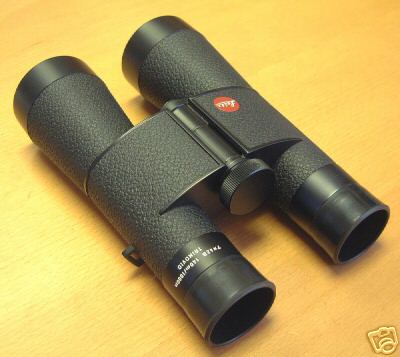 At first I was a little startled. The only folks I usually see in the woods are hunters in blaze orange vests, but this guy was obviously not a hunter. I quickly noticed he had some old Leitz (remember those?) binoculars, so I figured he might be a birder and asked him if he'd seen anything good. He kind of looked at me funny and asked me what I meant--which immediately tipped me off to him not being a regular birder. I asked him if he'd seen anything out of the ordinary, and he replied that it was his first time on the property so he wasn't quite sure what was ordinary.
Anyway, I introduced myself and he told me his name was Sartre. "Like the philosopher?" I asked, to which he replied in the affirmative. I thought he was a little confused, because actually, when I said "like the philosopher?" what he really said was, "Yep, that's me."
Well, I really didn't think much of it because I noticed a couple of sparrows back in the brush, but then I noticed that this Sartre guy was kind of looking at me funny, so I felt like I had to make conversation with him. I muttered something about sparrows, and he started asking me about bird watching.
Now, I've only recently embraced the term "bird watching," it just wasn't cool to be a teenage bird watcher. Growing up, I had tried very hard to make a case for it being cool to be a birder. I was explaining this to him when he interrupted me--
"But you are watching the birds, aren't you?" he asked.
"Uh, I guess so," I replied. "Really I'm just trying to identify them, to see what they are."
"And what do you think the birds make of you watching them?" he asked.
Now, I thought this was getting a little weird, but whatever. Then he asked me if I'd ever felt like birds would "just happen" to take off as soon as I got them in the scope or binoculars. "Sure," I responded, "especially grebes."
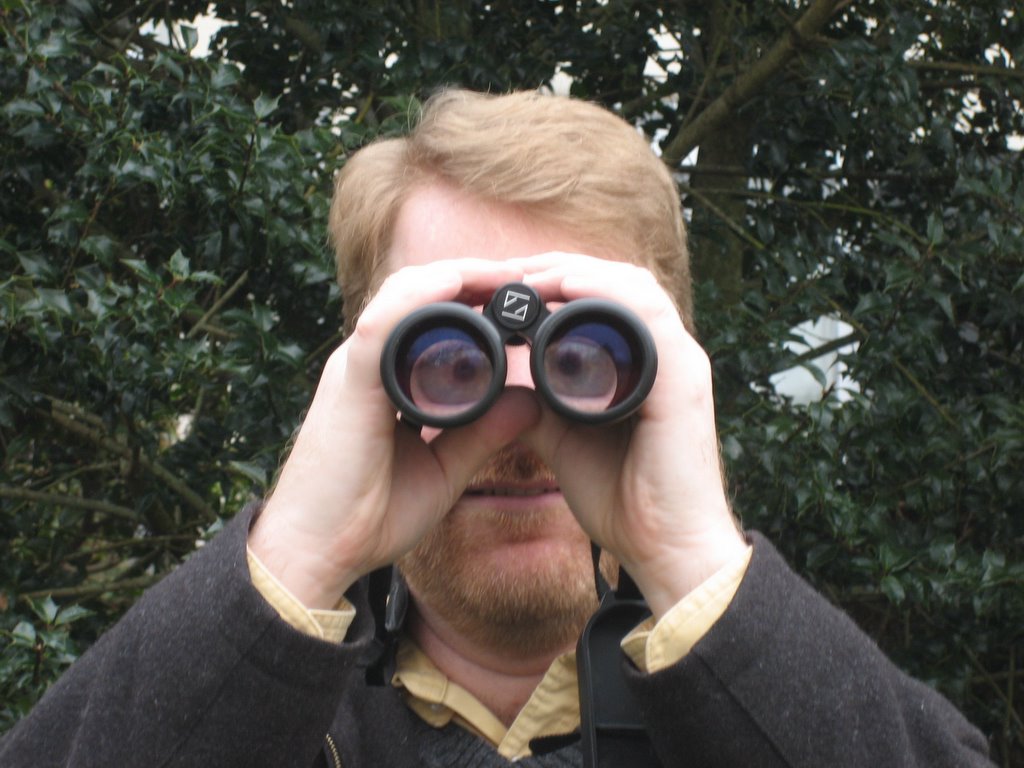 Then he asked me if I wanted to know why they fly as soon as you look at them. I told him I thought it was just coincidence that the birds would fly when I looked at them, but then he did something that really kind of freaked me out. He said, "here's what you look like to a bird when you look at it..." He lifted his 7X35s to is eyes, and all of a sudden his eyes got HUGE! The binoculars magnified his eyes so all of a sudden it looked like he had giant monster eyes.
He took down his bins and said, "those birds are watching you, and when you look at them through the binoculars, they know that you have spotted them, you've captured them in the gaze, you've objectified them, put them at your visual mercy. It's like you've caught them, like the way you feel when you realize someone has been staring at you.
 Birds don't like this, because usually they only experience this feeling when a predator has locked on them. When your eyes get huge through the bins, or you all of a sudden sprout a big giant eye in your spotting scope, it freaks them out and they fly away. You've caught them in the gaze."
 Now, this was all very startling to realize. Birds may be watching us watch them, and our big, huge, magnified eyes might appear threatening to them. Yikes! Next time you are birding with someone, have them look at you with their binoculars or scope and you'll see what I mean. It's rather amazing.
Anyway, I kind of stood there puzzled for a minute, looking at my binoculars. I wanted to ask this guy more about this insight, but he was shuffling off towards the creek. He just said I could check it out in his book. "The Gaze," he said, "just remember the gaze."
Of course, this couldn't have been the real nobel prize-winning existentialist philosopher Jean-Paul Sartre (he's dead), but I have to tell you, this whole experience was kind of puzzling. Maybe even shocking. Maybe I've just been spending too much time writing my dissertation, or watching grackles at the feeder outside my window at work. Maybe none of this makes sense, but then again, maybe there's something to it. Maybe dead philosophers really do go birding in Southeastern Pennsylvania.
This afternoon I’ll go back out to the woods to see what’s around. I'll try not to "gaze" at the birds, but I'm still going to want look for those sparrows.
Monday, January 16, 2006
All Work and No Play...
 ...makes me a dull birder, but there it is! I spent the day at the office working on my PhD dissertation with only occasional glimpses at birds out the window. I was able to see a couple new 2006 office yard birds (Purple Finch, Common Grackle, Red-winged Blackbird, and Brown-headed Cowbird), but nothing out of the ordinary. The Purple Finch was the first I've seen since late last Fall. It was a beautiful wine-colored male, a real stunner. I was a bit amazed to see a Downy Woodpecker feeding on the ground beneath a feeder--don't recall ever seeing one of those on the ground before. And it was fun to watch the Blue Jays pick up a sunflower seed with their beaks, place the seed between their feet, and holding it there while they peck it open and extract the meat.
Saturday, January 14, 2006
Birds on Google Video
Did you know you could get free videos on Google Video? You can even place the video on your blog or website. This one is of baby House Wrens being fed by their parent. Not quite the same as watching it in real life, but kind of fun anyway.
Here's another one of hikers walking right past one of the reintroduced California Condors in Arizona. Makes you wonder how long this bird is for the world!
According to the Peregrine Fund, this individual is Condor 241, a female bird hatched at the World Center for Birds of Prey on April 13, 2001, raised by puppets to keep it from becoming imprinted on people, and released at Vermillion Cliffs in Arizona on December 9, 2002. According to the latest info, it is alive and well in the wild. Lets hope the bird is usually a bit more wary of people and this video just shows it having an off moment!
And finally, if you have an hour and a half to kill, here's a long video with Diane Porter of birdwatching.com that will teach you how to start watching birds. Enjoy!
Bullock's in Bethlehem
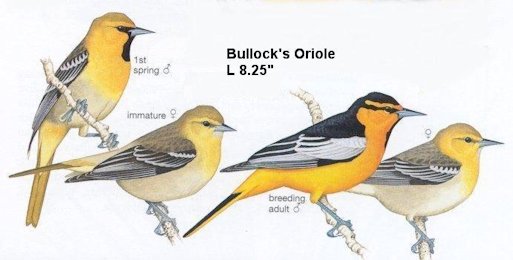
This morning I drove an hour and a half out of my way to see a young Bullock's Oriole in Bethlehem. The bird is coming to a feeder behind a house, and when I got there this morning, it was pouring rain. Fortunately, within ten minutes, the bird appeared at the feeder, where it seemed to eat some grape jelly spread out for it on the platform feeder. Then after about 45 seconds, it flew off around the back side of the house.
While this is only the third time this species has been seen in Pennsylvania, I grew up with them out west and have seen dozens, if not hundreds, of them. So why would I drive an hour and a half out of my way and stand in the rain for ten minutes--just to see this orange and gray bird for less than a minute? Especially when I should be spending the full day working on my PhD dissertation on urban bird conservation? Probably because I'm insane. Its just what birders do!
Now, there's a Northern Hawk Owl I'd love to see just six hours away up in New York. What are the chances I can get my family to make a day trip of it?
Friday, January 13, 2006
Helping Folks With Their Owls
 The first weekend in February I'll be down in Austin, Texas to teach an owl workshop at the Hornsby Bend Bird Observatory. I'm pretty excited to get back down there and see old friends, lead some folks on an owl walk, and help them figure out how to get more owls on their property or in their yards. Check out the workshop details here, and if you're in Texas that weekend, stop on by for owls and a great Texas BBQ lunch!
Saving Birds is Hard Work!
Usually when I tell people that I'm a bird conservationist, that I get paid to help save birds, they think I must have it pretty easy. But hey, bird conservation is hard work! Even Einstein agrees!

Of course, he'll write just about anything if you visit Hetemeel.com!
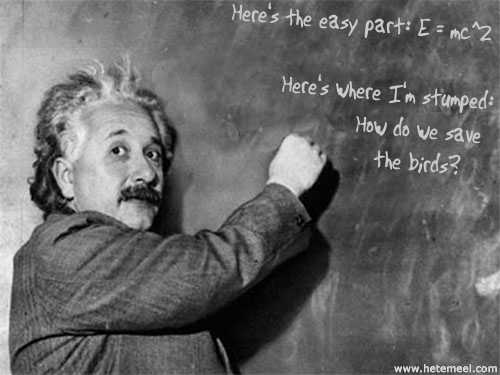
Of course, he'll write just about anything if you visit Hetemeel.com!
Thursday, January 12, 2006
Bird Eats Boy
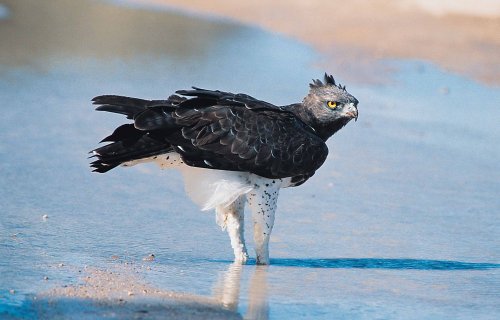
 OK, it was 2 million years ago, and the boy--well, maybe it was a girl--was a young Australopithecene, related to our early ancestors. But still, quite an interesting story. Eagles in Africa were more than an awesome sight to our early, early forebearers. Apparently, at least every once in a while, an eagle would swoop down, grab a youngster by the skull, hover with it in the air until it died, then fly off to feast on it. Sometimes, we watch the birds. Sometimes the birds watch us!
Sunny Day
After a day of miserable cold and mist, today dawned bright and sunny, with 18 bird species in the woods at work, including a Hairy Woodpecker, which is new for the year. I first heard it call high in a tree, then saw the larger-than-a-cardinal woodpecker briefly before it flew off through the woods. Birding is often like that. Of the 146 individual birds I saw or heard this morning, many were just brief looks--often obstructed by trees or bushes. While it is common to get killer magazine-cover-type looks at birds, most of the birds you see are far away, partially hidden, or don't stay put for very long. But that's part of the challenge and fun--to be able to find and identify these little gems as they go about their own business.

Wednesday, January 11, 2006
Ivory-billed Woodpecker on NOVA
 Check out the seven minute story that aired last night on NOVA about the recent rediscovery of the Ivory-billed Woodpecker. Controversy continues to swirl around these Arkansas sightings. My friend Laura Erickson is down in Arkansas looking for it right now (read her reports here). I've had other friends go down to help look for it. Half the time I wish I was down there searching as well. But according to Tom Nelson, one of the leading skeptics, it may be all for naught--the video, sightings, and sound recordings do not reveal the presence of ivory-billed woodpeckers, but merely the wishful thinking of the searchers. It's a damning argument, and one that is ruffling more than a few feathers. Here's hoping this is all resolved soon!
Tuesday, January 10, 2006
Sleeper Creeper
 This morning while walking the woods at work, I watched a Brown Creeper for about five minutes as it worked its way from tree to tree. Then it flew down to the base of a tree and did something I hadn't seen a creeper do--it just stayed put. There was a White-throated Sparrow perched a couple feet away from the creeper, and it was looking up into the sky, so I wondered if the birds were just watching a hawk or something up there, but I couldn't see anything. Then I got closer and the creeper stayed put, clinging motionless to the side of the tree. I'd never seena motionless creeper, so I wondered if something was wrong. Finally, when I was 15 feet away, I could see that its little eye was closed. Was it alive? After about five minutes, it perked up, stretched its wings, squirted out a little dropping, and started hitching itself back up the tree. It was just taking a nap! A sleeping creeper is not something you see every day, so it was fun to witness this little episode in the life of a backyard bird.
On the way to the bank this afternoon I had a Snow Goose in a large flock of Canada Goose in Richboro. Turkey Vultures and a couple singing Carolina Wrens bring the 2006 office yard list up to 27 species.
Ancient Birds, Stone Age Music
Mark Brazil has an interesting article about his visit to see the oldest known flute, a 35,000 year old instrument made from a swan bone found in Germany's Geissenklosterlen Cave. We've all heard birds sing, and speculated about how human music may have been initially inspired by the sounds of birds. This ancient flute not only shows Paleolithic humans to have made bird-like notes with a flute, but to have crafted that flute from the body of a bird. Next time you're listening to your iPod, you can thank your prehistoric ancestors for creating music by literally taking a note from their bird neighbors.
Monday, January 09, 2006
H5N1 Bird Flu in Turkey
While public officials are quick to blame wild birds for the latest spread of H5N1 avian influenza throughout 10 of Turkey's 81 provinces, there is yet little evidence to support the claim, while trade in poultry is still the most likely carrier of the virus. In recent weeks, evidence has been mounting that use of chicken manure as food for farmed fish is another likely spread of H5N1 viruses to both domestic and wild birds. Wild birds are still more than likely the victims, rather than common carriers, of H5N1 avian influenza.
2006 Office Yard List
Since its a new year, its time to start a new yard list at work...after a nice morning walk today with Black-capped Chickadee (out of range, but regular this year in the area), Red-breasted Nuthatch, and Brown Creeper, the office list is up to 25 species. The office is located on 160 acres along Neshaminy Creek where it crosses Almshouse Rd. The land is owned by a the Heritage Conservancy, and my office is in a 200 year old three-storey farm house. With only the creek for water, we don't get many ducks or shorebirds, and the corn field hasn't attracted many grassland species, so its mainly woodland birds with the occasional flyovers. This year, we'll try to see if we can see more than the 109 species we found here last year. Its a great place to work, and take those 15 minute breaks!
Saturday, January 07, 2006
Mr. Nature Mom
Took all three kids this morning up to the Green Lane Nature Center. We all got great close looks at a Brown Creeper from the bird blind, and the kids enjoyed the activities at the center. Then we drove around the lake--not a lot of different birds on the lake, but several thousand Canada Goose. On the way home, the four year old said his favorite part of the morning was seeing the large flock of geese.
Rule #1 for nature viewing with kids--keep it short.
Rule #2--focus on showing them the spectacular, either spectacular creatures, or spectacular numbers.
Rule #3--don't push it, when they're done, you're done. As long as they enjoy it, they'll want more. If you push it too much, they may resist.
Rule #1 for nature viewing with kids--keep it short.
Rule #2--focus on showing them the spectacular, either spectacular creatures, or spectacular numbers.
Rule #3--don't push it, when they're done, you're done. As long as they enjoy it, they'll want more. If you push it too much, they may resist.
Friday, January 06, 2006
Birdchaser in Birder's World
 My review of John Faaborg's book Saving Migrant Birds has just come out in the latest issue of Birder's World Magazine. Just got my two complimentary copies in the mail, which was a boost to my day, which has been otherwise slow birdwise--170 Common Mergansers at Peace Valley were nice, but action at the bird feeders here at work has been very light. One cool thing today was a young White-breasted Nuthatch that kept winking at me as it sat just outside the window on the feeder. OK, maybe it was just blinking repeatedly. But then again, maybe it likes me!
Thursday, January 05, 2006
Flybys
One of the joys of birding is experiencing regular flybys. This morning, two of the neighbor crows zipped past my car as I was heading out to work. During my afternoon walk, several Mourning Doves flew across the field and through the trees.
The great thing about flybys, is that you don't know where the birds are coming from, or where they are going. It is just a few short shared moments in the otherwise discontinuous lives of the bird and the observer. Like art, a bird flyby is reality frozen in a moment. The coming from and going to is a mystery, and stands for all the other comings and goings in our lives.
Usually, if we think about it, we want to know more. More about where the bird is coming from, where it is going, how it spends the rest of its time. But that is only when we think about it. For most of us, the flyby is just a flash. Just a brief moment that may or may not even register. Like the passing of clouds, or a thought. Birds come and go. Like the feathered winds that they are.
Wednesday, January 04, 2006
Bluebirds
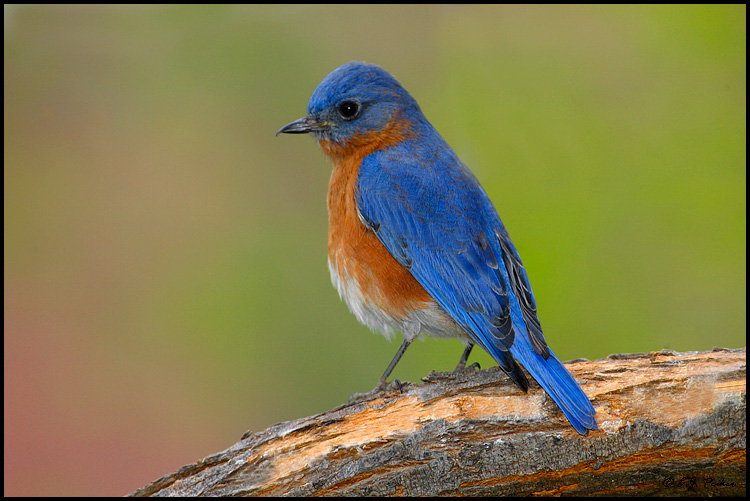 This afternoon, the woods at work were very quiet, but there were four Eastern Bluebirds calling and foraging along the edge of the mowed corn field. While Eastern Bluebirds can be fairly common (I had one on the roof of my neighbor's house when I pulled out of the driveway this morning), they sure are beautiful, and its easy to see why they are so popular.
And, as if to join me in initiating my Year of the Redtail, a nice adult Red-tailed Hawk soared over the field most of the time I was birding during my break this afternoon.
Tuesday, January 03, 2006
Spying on the Neighbors
There were plumbing problems at work this morning, so I got to work from home. While eating lunch, I noticed that my crow neighbors were out on the basketball court behind our townhome, so I grabbed my Zeiss 7x42s and went up to the upstairs windows to see what they were up to.
The first thing that I noticed was that there were six, not five, crows together in the group--so the family may be a bit larger than I originally thought. When I first saw them, the birds were sitting more or less together on a split-rail fence surrounding the play area. Then they all flew out to the basketball court. They were all there for only a few moments when one of the birds flew up to the top of a basketball backstop. A couple seconds later, that bird was joined by another, while the remaining four birds continued to walk around on the ground. I didn't see them eat anything, but they seemed to pick up some small rocks and sticks.
 The second crow on the basketball backstop seemed to want to get closer to the other one. It sidled up to it and started grabbing the other birds wing feathers with its beak. After maybe 30 seconds, the first bird flew 50 years away and landed on the top of a townhouse. Soon, three of the other birds followed suit and landed on nearby rooftops. I didn't see where the other two birds went. Soon, even the rooftop birds were gone.
Not much to gossip about. I really have more questions than information about these neighbors of mine, and not sure when I'll actually meet them. Maybe I should get some cracked corn for them. If we don't end up moving to Perkasie, maybe I'll be able to find this pair's nest when the nesting season gets started here in a few months.
Meanwhile, some interesting reading on the secret lives of crows from Crow expert Kevin McGowan can be found here. A good old-fashioned life history of crows is online here. In addition, a biography of the crow leader Silverspot, by Ernest Thompson Seton, while perhaps slightly conjectural, has been on my mind a lot lately. I enjoyed it as a kid, and it still serves as a bit of an inspiration for my new fascination with crows.
There is still a lot to learn about these small black neighbors of ours. For folks interested in helping us all learn more about crows, check out Crows.net to see how you can submit your own valuable crow sightings.
The first thing that I noticed was that there were six, not five, crows together in the group--so the family may be a bit larger than I originally thought. When I first saw them, the birds were sitting more or less together on a split-rail fence surrounding the play area. Then they all flew out to the basketball court. They were all there for only a few moments when one of the birds flew up to the top of a basketball backstop. A couple seconds later, that bird was joined by another, while the remaining four birds continued to walk around on the ground. I didn't see them eat anything, but they seemed to pick up some small rocks and sticks.
The second crow on the basketball backstop seemed to want to get closer to the other one. It sidled up to it and started grabbing the other birds wing feathers with its beak. After maybe 30 seconds, the first bird flew 50 years away and landed on the top of a townhouse. Soon, three of the other birds followed suit and landed on nearby rooftops. I didn't see where the other two birds went. Soon, even the rooftop birds were gone.Not much to gossip about. I really have more questions than information about these neighbors of mine, and not sure when I'll actually meet them. Maybe I should get some cracked corn for them. If we don't end up moving to Perkasie, maybe I'll be able to find this pair's nest when the nesting season gets started here in a few months.
Meanwhile, some interesting reading on the secret lives of crows from Crow expert Kevin McGowan can be found here. A good old-fashioned life history of crows is online here. In addition, a biography of the crow leader Silverspot, by Ernest Thompson Seton, while perhaps slightly conjectural, has been on my mind a lot lately. I enjoyed it as a kid, and it still serves as a bit of an inspiration for my new fascination with crows.
There is still a lot to learn about these small black neighbors of ours. For folks interested in helping us all learn more about crows, check out Crows.net to see how you can submit your own valuable crow sightings.
Monday, January 02, 2006
Unless You Believe
This morning I took our friends from Maryland to see some of the sights here in the Philadelphia area. At one point while we were walking, we came to a wooded area with a lot of leaves on the ground. A group of doves were feeding there in the leaves and my friend said, "you don't usually see a lot of doves in the forest."
Its true. Sometimes you do. I've seen small flocks of Mourning Doves in the woods, but more often they feed on the ground in more open areas. But there was something else different about these doves. They were larger than Mourning Doves. More purplish. We were only a few feet away from them, and in perfect light, I could see that they weren't Mourning Doves at all. There, right in front of me and my friends was a small group of Passenger Pigeons.
 I know Passenger Pigeons are extinct, but that's what they were. Not five feet away. Six or seven of them on the ground. In perfect light. The scene will be engraven in my memory forever.
Then, hearing something behind me, I turned and saw a large pair of woodpeckers behind me. On most days, a sighting of a pair of Pileated Woodpeckers would be the highlight of any morning birdwalk here in Southeastern Pennsylvania. But not today. Just as the doves weren't Mourning Doves, the woodpeckers in front of me weren't Pileateds. They looked to be about the same size as Pileateds, but they had large white patches on their back, and horn-colored bills. One, the female, had a recurved black crest. The other, the male, had a red crest. Again, I was very close to these birds. In perfect light. In fact, squatting down very still, I was able to get within inches of this pair of birds clinging to an old stump. The viewing conditions were perfect, and I studied the birds at length. There can be no doubt as to their identification. There, not 15 feet away from the Passenger Pigeons was a pair of Ivory-billed Woodpeckers.
 Anyone reading this would have to think that I'm either kidding around, or completely whacked, but let me assure you that this is an entirely accurate account of my experience. I really did see Passenger Pigeons and Ivorybills at 11:45 AM. Anyone who wants to can check out my story. I can provide excellent directions to these birds.
From where I live in Bucks County, Pennsylvania, head south towards Philadelphia on the Northeast Extension. Take I-76 east towards central Philly, then take the left exit onto I-676. Immediately take the first exit on the right--that's the Ben Franklin Parkway. At the bottom of the ramp, continue straight for a couple blocks. That will take you to Logan Circle. Go 1/4 of the way around the circle and you'll see a large brick building on the right on the corner of Logan Circle and 19th Street. The birds were on the third floor of this building, here on display at The Academy of Natural Sciences.
While you can't exactly add these mounted museum specimens to your life list, you can see them at extremely close range. And right next to these birds, are three mounted Eskimo Curlews, a Great Auk, and a couple of Labrador Ducks.
How is one to feel at seeing the bodies of so many extinct birds? While I don't get to see Passenger Pigeons and Great Auks every day, even as museum skins, it was hard to get excited about seeing them. It was neat, but not a happy sighting. Instead of marveling at the sight of so many rare birds, the experience left me feeling hollow and empty. Their presence was a blunt reminder of their absence.
For those who care about birds, there are many such reminders. Too many. Small flocks of spring warblers reminding one of the many more birds that one could find in the past. Sightings of birds, now rare, that were once common. Rumors of ghost birds, hard to verify, in distant bottomlands of the Mississippi Delta.
These sightings and experiences are hard to take, unless you believe. Unless you feel in your heart of hearts that the Cornell researchers and Audubon volunteers will find the Ivory-bills this winter in Arkansas. Or maybe on the Atchafalaya. Or you can imagine somebody spending $100K to set up a private Attwater's Prairie Chicken breeding facility, and raising another $30 million to buy 5,000 acres of Blackland Prairie Farmland to restore prairie chickens to Central Texas. Or you can envision neighbors banding together to manage their property for the birds of conservation concern in their area. Or that we can rewild the American west by bringing back the megafauna that we lost during the human colonization of the Americas 11,000 years ago at the end of the Pleistocene.
 Unless you believe, your heart must necessarily ache. Or you must numb yourself to the pain of loss. Unless you can envision a world teaming with wildlife. Unless you can see in your mind's eye flocks and herds to rival those reported by our ancestors, and see a way to bring that vision to life.
I believe. Can you? Can you see it?
 For a $10 museum admission I can take my children to see Ivorybills and Passenger Pigeons any day of the week. Someday, I hope to be able to take them to see real live ivorybills. And Bachman's Warblers. And hundreds of prairie chickens. And thousands of Whooping Cranes. And maybe even Eskimo Curlews. I can see an America echoing with their wingbeats, where flocks of wild birds are more common than strip malls. Its a future I want to invest in. Its a future I want to leave for my kids. But its a future we may never see, unless we believe.
Its true. Sometimes you do. I've seen small flocks of Mourning Doves in the woods, but more often they feed on the ground in more open areas. But there was something else different about these doves. They were larger than Mourning Doves. More purplish. We were only a few feet away from them, and in perfect light, I could see that they weren't Mourning Doves at all. There, right in front of me and my friends was a small group of Passenger Pigeons.
I know Passenger Pigeons are extinct, but that's what they were. Not five feet away. Six or seven of them on the ground. In perfect light. The scene will be engraven in my memory forever. Then, hearing something behind me, I turned and saw a large pair of woodpeckers behind me. On most days, a sighting of a pair of Pileated Woodpeckers would be the highlight of any morning birdwalk here in Southeastern Pennsylvania. But not today. Just as the doves weren't Mourning Doves, the woodpeckers in front of me weren't Pileateds. They looked to be about the same size as Pileateds, but they had large white patches on their back, and horn-colored bills. One, the female, had a recurved black crest. The other, the male, had a red crest. Again, I was very close to these birds. In perfect light. In fact, squatting down very still, I was able to get within inches of this pair of birds clinging to an old stump. The viewing conditions were perfect, and I studied the birds at length. There can be no doubt as to their identification. There, not 15 feet away from the Passenger Pigeons was a pair of Ivory-billed Woodpeckers.
Anyone reading this would have to think that I'm either kidding around, or completely whacked, but let me assure you that this is an entirely accurate account of my experience. I really did see Passenger Pigeons and Ivorybills at 11:45 AM. Anyone who wants to can check out my story. I can provide excellent directions to these birds. From where I live in Bucks County, Pennsylvania, head south towards Philadelphia on the Northeast Extension. Take I-76 east towards central Philly, then take the left exit onto I-676. Immediately take the first exit on the right--that's the Ben Franklin Parkway. At the bottom of the ramp, continue straight for a couple blocks. That will take you to Logan Circle. Go 1/4 of the way around the circle and you'll see a large brick building on the right on the corner of Logan Circle and 19th Street. The birds were on the third floor of this building, here on display at The Academy of Natural Sciences.
While you can't exactly add these mounted museum specimens to your life list, you can see them at extremely close range. And right next to these birds, are three mounted Eskimo Curlews, a Great Auk, and a couple of Labrador Ducks.
How is one to feel at seeing the bodies of so many extinct birds? While I don't get to see Passenger Pigeons and Great Auks every day, even as museum skins, it was hard to get excited about seeing them. It was neat, but not a happy sighting. Instead of marveling at the sight of so many rare birds, the experience left me feeling hollow and empty. Their presence was a blunt reminder of their absence.
For those who care about birds, there are many such reminders. Too many. Small flocks of spring warblers reminding one of the many more birds that one could find in the past. Sightings of birds, now rare, that were once common. Rumors of ghost birds, hard to verify, in distant bottomlands of the Mississippi Delta.
These sightings and experiences are hard to take, unless you believe. Unless you feel in your heart of hearts that the Cornell researchers and Audubon volunteers will find the Ivory-bills this winter in Arkansas. Or maybe on the Atchafalaya. Or you can imagine somebody spending $100K to set up a private Attwater's Prairie Chicken breeding facility, and raising another $30 million to buy 5,000 acres of Blackland Prairie Farmland to restore prairie chickens to Central Texas. Or you can envision neighbors banding together to manage their property for the birds of conservation concern in their area. Or that we can rewild the American west by bringing back the megafauna that we lost during the human colonization of the Americas 11,000 years ago at the end of the Pleistocene.
Unless you believe, your heart must necessarily ache. Or you must numb yourself to the pain of loss. Unless you can envision a world teaming with wildlife. Unless you can see in your mind's eye flocks and herds to rival those reported by our ancestors, and see a way to bring that vision to life.I believe. Can you? Can you see it?
For a $10 museum admission I can take my children to see Ivorybills and Passenger Pigeons any day of the week. Someday, I hope to be able to take them to see real live ivorybills. And Bachman's Warblers. And hundreds of prairie chickens. And thousands of Whooping Cranes. And maybe even Eskimo Curlews. I can see an America echoing with their wingbeats, where flocks of wild birds are more common than strip malls. Its a future I want to invest in. Its a future I want to leave for my kids. But its a future we may never see, unless we believe.
Year of the Redtail
I was busy with houseguests this weekend, and couldn't get away for an early morning birdwalk to start the year. Then, driving to church, an adult Red-tailed Hawk flying across the road in front of me was my first bird of 2006. Since I'm writing about Pale Male in the first chapter of my dissertation on urban bird conservation (which I'm trying to complete it this year), I'm more than happy to see this sighting as an omen, and look forward to a happy and productive Year of the Red-tailed Hawk.
After church, I took the kids and our friends to Peace Valley Park. As we approached the bird blind, one of our friends' kids said that he hated birds. I said, "you don't hate birds, you just don't know you like them yet".
Sure enough, in ten minutes we saw over a dozen species at close range, including a lifer Red-breasted Nuthatch for my kids. As we left the blind, that same kid who hated birds was gushing about the bird blind and how cool it was to see those birds.
Nobody hates birds. Some people just don't know how much they like them yet.
Subscribe to:
Posts (Atom)


