This fall I am teaching a Diversity of Life course at Rosemont College in Philadelphia. My students will each be required to create a Nature Observation Blog, where they will post their observations of at least 15 animals, 15 plants, and 10 other organisms that they can find, identify, and observe during September. I will post links to my student's pages once they are up. Here is a sample of the type of posts they will be creating for each observation:
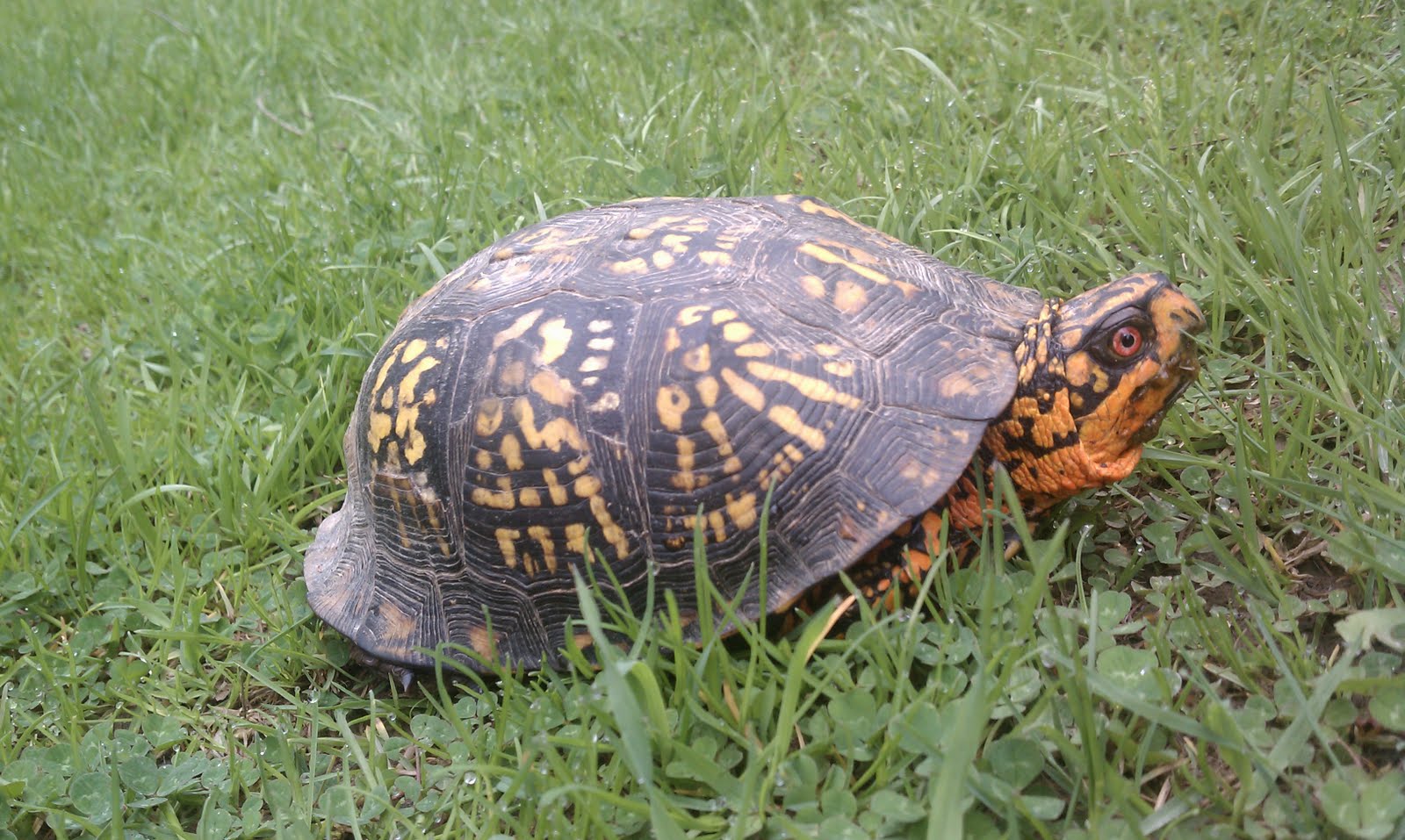
Eastern Box Turtle (Terrapene carolina carolina)
Observations
I found this turtle while birding at Peace Valley Park, Bucks County, PA on 27 April 2011. It was in the middle of a grassy trail through the woods--about 3 yards from the closest bushes on either side of the trail. When I first observed it, the turtle seemed alert, raised up high on its legs with its neck extended up high. I watched it for a few minutes through my binoculars, at about 15 yards away. As I got closer, it slowly pulled into its shell. It remained tightly pulled back into its shell as I picked it up. After I put it down, I walked off about 10 yards and continued to watch it for a few minutes, but it didn't come back out while I was still there.
Questions
What was the turtle doing out in the open? Why was it alert--had it already seen me before I had seen it? When do box turtles assume this alert position? What sensory methods (sight, vibration, etc.) are most important for box turtles? How do they use those methods to detect and interact with their environment? How old and what sex is this turtle? How does box turtle coloration vary by age and sex?
Stickel found that the average home range for a male turtle was 330 feet in diameter, while that of a female was 370 feet, so looks like this turtle isn't going to be going very far--though she found that turtles do sometimes make extended trips outside of their home range. The ranges of turtles overlapped, so perhaps there are other turtles nearby, and they like to have a nice open spot for sunning themselves in their home range, so perhaps this turtle was sunning itself when I found it there in the open.
This morning while watching my House Sparrow nursery out back, I noticed the young out in the open on my patio. They are sort of watching the sky, but not really. More focused on their own little activities--crushing seeds, pecking at stuff, chasing each other, etc. Made me wonder how well these little guys survive.
The answer--not so well. According to Lowther & Cink (2006) only 20% of young House Sparrows survive their first year. So, if those young sparrows don't look like they are all that careful, guess what, they probably aren't! If they can make it through their first year, adult sparrows have a 57% chance of making it through the next year.
It's tough being a baby sparrow, though they don't look too worried about it!
I made a more valiant effort today to get to know my bird of the week and actually spent some time out on the porch watching sparrows. I saw some quick indirect scratching, bill wiping, and other behaviors. But the more I watched, the more puzzled I became. It was clear that I had no idea what these birds are doing out there. At one point there was a male up in the top of a holly tree, calling fairly consistently with some type of a "cheep" call, while a female hoped around in a slightly lower branch making some kind of a lower pitched "churr" call. When I got a better look at the female it was clear she had something in her beak, so I thought she might be carrying food to young in a nest. But she stayed up there churrping and moving about repeatedly for over 15 minutes. Eventually the male flew off to land on the ground in a neighbor's yard. I never did figure out what the female was up to.
As I listened to the sparrow calls, I could tell that there were many different types of subtle differences in the calls, but it was tough to focus on them. Afterwards, I went to xeno-canto.org to listen to House Sparrow calls and the mystery deepened. Paul Driver's bird calls website gave me more samples to listen to, but I am still left scratching my head. I guess I've known forever that House Sparrows make a lot of different sounds, but I never paid them any attention. And now that I'm trying to sort them out, it is a bit bewildering. So much to learn, so much I don't know about these common little neighbors in my yard!
Somehow I got all the way through the day without attending to my bird of the week, so after dinner I went out on the porch to see what I could find out about my local House Sparrows.
According to Lowther & Cink 2006, House Sparrows congregate for 30-60 minutes before heading to their roost, arriving at their roost 30-15 minutes before sunset. My local sunset tonight is 20:05 EDT, so I was out about an hour before that. There were a half dozen young House Sparrows on the utility lines behind my house and another couple birds chirping in the bushes. After about 5 minutes they had all dropped down out of sight except for one lone bird on top of a power pole. And the birds were quiet. After a few more minutes, as I was watching the last bird on the pole, it too dropped down. As I lowered my binocular I saw a Sharp-shinned Hawk swoop lazily past the pole. Had the other birds seen the bird approaching minutes earlier, or was it just a coincidence?
A few minutes after the hawk had left, 14 House Sparrows took off out of my neighbors bushes flying to the southwest fast and direct, about 50 feet up, down the alley and out of sight. Were they heading off to a congregations site in the neighborhood? Might be fun to see if I can find a local roost.
So I wouldn't say I was that diligent in my House Sparrow appreciation so far, but I'm getting better. I'll see how much better I can do tomorrow!
Other birds flying over my house this evening: Barn Swallow, Chimney Swift, Fish Crow, Canada Goose.
Thirty years ago today I became a birder! While I had been a casual birdwatcher for awhile, it was the junior high school trip to Malheur National Wildlife Refuge thirty years ago that, depending on our perspective, either came to define or ruin the rest of my life!
Who knew when the two vans full of kids and teachers pulled out from Oregon City for the five day field trip to Malheur National Wildlife Refuge and Steens Mountain that thirty years later one of those kids would still look back on that day with such importance!
We stopped off at a cave near Bend on the way over, and by evening we were at the refuge field station. I still remember we had spaghetti with zucchini in it for dinner that night. Common Nighthawks were roosting on the utility lines as we waited for dinner to be ready. I still can't smell sagebrush without being whisked back there. Since this was the first day that I started keeping a real bird list, I can actually look back to see what birds we saw that day!
Killdeer
American Crow
American Robin
Western Scrub-Jay
European Starling
House Sparrow
Black-capped Chickadee
Turkey Vulture
Rock Pigeon
Violet-green Swallow
Western Grebe
Yellow-headed Blackbird
American Coot
American Kestrel
Barn Swallow
Black-billed Magpie
Burrowing Owl
California Quail
Canada Goose
Clark's Nutcracker
Common Nighthawk
Evening Grosbeak
Great Blue Heron
Great Horned Owl
Mallard
Mourning Dove
Red-tailed Hawk
Red-winged Blackbird
Ring-necked Pheasant
Song Sparrow
It's been a wild and crazy ride since then! As a new birder, it wasn't easy to keep a mental picuture of all the new birds I saw that week. But some like the Burrowing Owl and the nighthawk are still fresh in my mind. Others like my first Western Grebe and Evening Grosbeak are way back in the musty recesses where they aren't readily available. I wish I could still remember my first coot, but I don't. It's like those first childhood memories--hard to really say why some stick and others don't. But even if I don't remember them, I have them written down, so I know they were there for my very first day or real birding.
So it was a rainy day and I only had a few moments to watch for House Sparrows in my back yard. Not wanting to slight my chosen bird of the week, I dove into the best online sparrow reference out there:
Lowther, Peter E. and Calvin L. Cink. 2006. House Sparrow (Passer domesticus), The Birds of North America Online (A. Poole, Ed.). Ithaca: Cornell Lab of Ornithology; Retrieved from the Birds of North America Online: http://bna.birds.cornell.edu/bna/species/012
I was all set to learn some fascinating things to help me better appreciate House Sparrows when I came upon this little tidbit about sparrow diet:
Nestling diet almost all invertebrate prey, especially Diptera larvae
For those of you not up on your insect classification, Diptera are flies. Fly larvae are...maggots!
Baby sparrows are maggot eaters! Ugh!
House Sparrow Appreciation FAIL! Back to the article, and I vow to spend more time outside watching the birds tomorrow!
I was looking out my window this morning and noticed I have a regular sparrow nursery in my backyard.
I live in an urban row home in Bucks County, PA so I only have a tiny backyard. But this morning there was a lot of activity. House Sparrows adults and juveniles were on the patio and in the grass, a juvenile Song Sparrow came through, a juvenile Chipping Sparrow was up on a utility line near the alley, and House Finches came through with young as well. As a birder, I'm a bit ashamed to admit that I don't really know House Sparrows very well. They aren't a bird that most of us spend much time getting to know, even though we may see them every single day. So join me this week as I explore the world of the House Sparrow. I'll be reading up on them, but more importantly spending some time with them in my yard and elsewhere. If you are like me, you may want to take a moment to reconnect--or perhaps connect for the first time, with these birds as well.
So this morning I finally had some free time to chase the Gray-hooded Gull on Coney Island, first found July 24 and relocated this past weekend (see this NY Times article). By the time I got the kids in the car, it was already late, but two hours later we rolled across the Verrazano Bridge and down to Coney Island. We walked out onto the boardwalk and spotted the crowd of birders down near the Wonder Wheel at the end of 12th Street. And there was the bird. Sitting on a pole. Calm as can be, with people standing 40 feet away. I didn't have a good camera, so all I could get were these few pics through my Android phone.
After 10 minutes of enjoying the bird, the kids were ready for something else, and since we were already at the beach...
On the way back to the car later the gull was on top of the restrooms at the end of 12th Street.
One last pic just to get the feel for the day.
This is only the second Gray-hooded Gull reported from North America. Normally found in South America and Africa, the first North American record came from Florida in 1998 (pdf). If you aren't satisfied with my photos of this current rarity, there are plenty of better shots online from folks with real cameras :-)
I just found out from Bill Etter that our 2010 Upper Bucks Christmas Bird Count set a new record for the most Eastern Screech-Owls reported on a count. Our 237 owls beats the old record of 220 Eastern Screech-Owls found on the Lynchburg, VA CBC in 1976. 17 of those 237 Eastern Screech-Owls were mine, found on my portion of the count circle near my home in Perkasie, PA. I guess it's official, I live in the middle of the Eastern Screech-Owl capital of the world!
I've added an article on what to do when singing mockingbirds keep you up all night over at AbsoluteBirdControl.com. I get several emails a month about this during the breeding season, which lasts from maybe Jan-Feb in the south to at least Aug-Sep. Happy to hear any other suggestions folks have about how to live with, or otherwise address this problem (don't say shotgun!).
I live in a row home in a small town outside of Philadelphia. My yard, including the house, is less than .1 acre. There is a creek and park a block away, so there are a good number of birds in the area, but I've done pretty good to find 64 species from this tiny spot. Last night as I was sitting on my back porch, a Green Heron flew past at dusk--number 65 for the yard. Since the house is up for sale and we are moving to New Jersey soon, will this be my last new bird for this yard?
Back in February 1994 I had just started a Utah state big year. I had set a record for the number of species seen in the state during the month of January (Utah birders keep track of that kind of stuff!) and was having a great time chasing around the state. That month I read the following in Paul Baicich's sidebar entitled "A Road Not Taken" in the February 1994 Birding magazine (BTW, RTP is Roger Tory Peterson).
17 years later, how many of us sill don't know Joseph Hickey's 1943 classic A Guide to Birdwatching, in which Hickey outlines how any bird enthusiast can make real ornithological discoveries by carefully studying local birds? If it isn't strictly a road not taken, amateur ornithology is at the very least birding's road less traveled. While the hobby of birding Birding has grown immensely since 1943, it is still mostly about identifying and finding birds, rather than about scientifically studying them.
Before Hickey, Aldo Leopold the patron saint of conservation and wildlife management had recommended avocational natural history study as a worthy pursuit in his classic Sand County Almanac. In fact there is a direct connection between Leopold and Hickey--A Guide to Birdwatching was Hickey's master's thesis written under Leopold at the University of Wisconsin.
We have come a long way since 1943 and since Baicich reminded us of this road less traveled in 1994. But perhaps there is still a long way to go. We have eBird, the Great Backyard Bird Count, and many other formal citizen science projects we can join in. But as Hickey urged, what birders really need is a question--something that isn't known about local birds or bird biology but that can be discovered with some careful study in their free time.
Along these lines I love my work with Purple Martin landlords. The most active martin landlords are always tinkering--trying to figure out new ways to help their birds. From a conservation standpoint I love this approach, and I teach workshops where I encourage people to take a similar approach with other local birds they want to help. What does it take to create a Texas suburban neighborhood that Painted Buntings can thrive in? How can you attract and create habitat for Eastern Towhees in your yard? What are the preferred habitat features for migrant warblers in your local parks? There are lots of things we don't know out there. If conservation biology questions don't float your boat, pick something else you don't know. Read all you can find about it. Pick up a copy of Hickey's classic for inspiration, and then learn whatever skills and how to use the tools you will need to answer your chosen question. Be a field ornithologist, not just a birder.
Will you take the birding road less traveled? Do you have a question?
Looks like my days as a Pennsylvania birder may be coming to a close. Since my wife has taken a new position in New Jersey, we've been house hunting and getting ready to sell our place here in suburban Philadelphia. Looks like our new home will be somewhere in The Garden State. We have an offer pending on a home on over 2 wooded acres that will offer a different set of yard birds from our current row home. For now, we're dealing with appraisals, home inspections, repairs, and all that other good stuff that comes with uprooting your life, but hope to be back birding and posting regularly soon.
Meanwhile, I've been enjoying the Chimney Swifts soaring over my house here, as well as the mockingbirds and other local nesters in my yard. Need.more.birds!
For the past two weeks I've been in Texas, where I got to lead a 2,200 mile whirlwind tour of urban birds and birding sites from Houston to Beaumont to Galveston to Rockport to Harlingen to McAllen to Laredo to San Antonio to Austin. We found over 260 birds including some favorites like Green Parakeet, Monk Parakeet, Red-crowned Parrot, Audubon's Oriole, Scaled Quail, White-collared Seedeater, Clay-colored Thrush, Red-cockaded Woodpecker, Golden-cheeked Warbler, and Plain Chachalaca. Great to see how much birding infrastructure has been built along the Texas coast in recent years, and I was very happy with the birding opportunities in Laredo. It was great to see how projects that I had a small part in working on as the acting chair of the Audubon Texas board in the early 2000s have come to fruition (Mitchell Lake Audubon Center in San Antonio and Blucher Park in Corpus Christi) and great to visit with Paul and Georgean Kyle at the Travis Audubon Chaetura Canyon Preserve in Austin (see photo). Four days of the tour were spent at the International Urban Wildlife Planning and Management Conference in Austin, so great to visit with lots of fellow urban bird folks as well as visit old friends in Austin. Of course we spent some time out at Hornsby Bend, my birding home. Great trip, great birds, and great friends--to say nothing of the great TexMex and BBQ!
Had a good hour or so at Peace Valley this morning. Ruby-throated Hummingbird, Rose-breasted Grosbeak, Blue-winged Warbler, Great Crested Flycatcher and lots of Gray Catbirds are back. Was hoping for more warblers, but the trees are still aren't really in leaf yet, so any day now! On the lake an adult Bald Eagle soared overhead and a female Hooded Merganser swam by the bridge near the nature center.
Had a very enjoyable hike to see the 21 gorgeous waterfalls at Rickett's Glen State Park yesterday with my kids and some friends. Hard to hear birds on most of the trail due to water noise. On the Highland Trail heading back it was nice to hear some Brown Creepers singing--something I don't get to hear to often. Also had Red-eyed Vireo and Yellow-throated Vireo back from migration, as well as a Black-throated Blue Warbler. Spring is springing!
Finally, at long last, Audubon has published online a neighborhood bird conservation workbook that I wrote for them more than two years ago when I was their senior scientist for urban bird conservation. The idea was to provide a resource to get people started thinking and working together to make their neighborhood or community more sustainable for birds and people. So check it out, let me know what you think. Now that I'm no longer with Audubon, someday I'll be able to come up with a better and updated version of this based on everyone's input and field trials!
Tree Swallows were reported last week at Peace Valley and elsewhere in SE PA but I hadn't seen one yet this spring until I was driving back from the gas station today and had one on a power line north of Perkasie. Spring is here more and more each day!
So here's a fun email I got today. Any thoughts on what you would say if your neighbor had a complaint like this?
I have a Chuck Will's Widow that is nesting about 50 ft from my backyard in a wooded area. He sings ALL night long and even with the doors and windows closed he can be heard which is affecting our sleep. The neighbors are also complaining. Can anything be done?
Yesterday I stopped by Peace Valley and was able to find all three mergansers, though there were less than a dozen ducks on the whole lake. A female Red-breasted Merganser (uncommon here) was close by the shore, but by the time I got my scope up it dove and I wasn't able to get a shot of it until it was way out in the lake. Ugh! I got 15 seconds of blurry video, but it rivals the 2005 Arkansas Ivory-billed Woodpecker footage!
The front yard of our house slopes gently down to a small pond. Every year around this time we get three or four nesting pairs of Canada geese, then later another 40 to 60 geese show up to party for the summer. We don't mind seeing them on water or on the other three sides of the pond -- we just don't want to them on our lawn because they chew the sod and poo all over our driveway. We have two giant poodles that are trained to drive them back into the pond whenever they see them, but then they eat the goose poo which caused them to vomit. I'd like to find an inexpensive way to encourage the little vandals to stay on their side of the shoreline without interfering with mowing of our grass.
Canada geese problems are nothing new. But poo eating poodles. That's a new one for me!
With several high profile bird guides being released this year, one deserving new guide may not be getting as much attention as it deserves--the new National Geographic Guide to the Backyard Birds of North America by Jonathan Alderfer and Paul Hess. Scheduled for release later this week, this attractive guide is a great book to give to those backyard birdwatchers in your life--or any friend or neighbor who might appreciate the birds in their yard.
This 256 page resource is attractively designed and chock-full of useful and interesting information--including two major sections, the first on backyard bird basics (by Paul Hess) and the second larger section (by Jonathan Alderfer) with species accounts for 150 of the most likely birds to be encountered in backyards across the United States and southern Canada. Most of the bird illustrations are from the larger original National Geographic guide, so they will be familiar to long-time birders, but the still do the trick. There are also many additional high-quality photos to round out the visual appeal of this guide.
I really like how this guide provides many ways to approach, identify, and enjoy birds. Each section includes noteworthy features that make it not only beautiful but useful.
Visual Indices: This NGS guide provides six different ways to find and identify birds, beginning with the inside and back covers. The covers fold out to reveal a visual index, showing each of the birds in the guide. This is takes advantage of the key innovation of several brands of laminated pocket guides (such as Local Guides and Pocket Guides) that have become popular over the past decade or so, allowing anyone to quickly see and compare many birds in order to find the one that most looks like whatever bird they are watching.
In addition to this visual index, there is a Color Index showing head shots of all the birds included in the guide, organized by overall color. This feature goes back to the original National Audubon Society guides. While this schema doesn't necessarily work as the only way to finding birds (which was a handicap for the original National Audubon Society guides), it may be useful here as four pages of indices, and is a great innovation.
There is also a quick index inside the front cover, allowing people to look up popular birds alphabetically. For those counting, the other ways to find birds quickly in the guide are the table of contents, index, and just flipping through the 150 species accounts.
Species Accounts: I have to admit that when I first looked at the species accounts I was a little put off by the layout. Each species is given its own page (some have up to two pages), with large illustrations from the original National Geographic guide, as well as a large map. The maps are large, well designed, and beautiful. The large size of the maps makes them especially attractive and is exactly what one would hope for from our friends at National Geographic! What put me off initially was the layout of the text into two columns, separated by a line, along with various icons and several different colors and styles of font. On first view the pages look overly busy. But with time, this became less bothersome as I became more aware of how the various icons and font colors organize what is a huge amount of useful and interesting text.
Each species account provides an Identification section, which is very thorough and includes a similar species section--something that is especially useful for beginning birders, and something that is often missing in recent field guides. There is also a section on range, which more than just describes the range shown on the map, butt also includes information on habitat. A food section describes the favorite foods of each species, as well as feeding notes on how to provide these foods in your backyard. Finally, a nesting section summarizes the location and type of nest, as well as number of eggs and information on incubation and fledging--perfect for people curious about the birds they are watching nest in their yard.
Overall these species accounts are well done and will be very useful for people curious about the birds in their backyard. Additional information is provided in sidebars--actually full-page accounts dedicated to special questions or topics of interest, including bird sex, sleeping birds, attracting bluebirds, and how birds stay warm. A section on bird age provides a table including the longest-lived wild birds of sixteen species included in the guide. These mini-essays are great additions that will be very interesting to backyard birders and sure to increase their appreciation of the birds in their yard.
Backyard Basics: While it is easy to focus on the species accounts since they make up the largest portion of the book, it would be criminal to only lightly mention Paul Hess's great initial Backyard Basics section, which includes 34 attractive and useful pages designed to educate and increase people's awareness and enjoyment of birds in their yard. This includes pages with tips on bird feeding, bird housing, landscaping for birds, how to find birds, how to identify birds, and how to connect with birders and additional resources. I was happy to see a nice Citizen Science section introducing readers to projects including the Christmas Bird Count, Project Feeder Watch, the Great Backyard Bird Count, and eBird. Sidebars include links to other organizations and useful websites.
This whole section is attractively illustrated with photographs and loaded with succinct but useful information. The How to Identify birds section is very basic, just a single page describing eight features or criteria for identifying birds--with another page showing how these features can be used to distinguish between several similar species (Downy vs. Hairy Woodpecker, Gambel's vs. California Quail, and Black-capped vs. Carolina Chickadee). While there is an illustration showing the parts of the bird (inside the back cover), it is very basic so backyard birdwatchers won't be overwhelmed with unusual plumage terms (though there is a glossary included in the back as well so they can learn what a patagium is if they really want to!).
In addition, National Geographic has set up a backyard birding website where readers of the book can hear the vocalizations of the birds covered in the guide, as well as find more information and help identifying the birds they see in their yard (Backyard Bird Identifier). So readers of this guide can easily plug into great online resources and the online birding community if they desire.
Final Notes: Overall I found this to be an attractive and well thought out book, and would highly recommend it for backyard birdwatchers. Since it only focuses on backyard birds, it might be a bit frustrating if it is the only bird book owned by someone who also wants to go birding in local parks or wildlife refuges--as soon as they show up at a wetland they won't be able to find any waterbirds in this guide besides Mallards, Canada Goose, Killdeer, and some gulls. So beginning birders who range away from home will need an additional guide. But if you have someone who has feeders in their backyard, this is a great and informative book that they will be sure to enjoy.
Disclaimer: This review is based on a complimentary review copy provided by the publisher.
Angry Birds is Evil. With an uppercase E! According to Wikipedia, over 50 million people have downloaded this game, and globally people are spending 1 million hours a day playing it! That's a lot of time that could be better spent birding! Or saving starving children! Or something!
While I'm all for promoting birds, this is a bit crazy. If you don't know what Angry Birds is, just walk away now. Don't Google it. Don't download it onto your phone. If you want bird entertainment, put the phone down and go outside to look at real birds. Angry Birds is Evil I say! Evil!
(Yes, I did download it onto my Android phone. No, I will not play it an hour a day. But it's seriously calling my name!)
While I was scanning the lake at Peace Valley, 13 Tundra Swans flew in and landed across the lake. I watched them hop out of the water up onto some of the last of the ice on the lake. By the time I had driven around to the other side, they were all up on the ice and napping.
Last weekend was the Great Backyard Bird Count, but the GBBC fat lady hasn't sung yet. If you saw birds last weekend, you have until March 1 to submit your sightings to the GBBC website. So make sure to get last weekend's bird sightings reported to the GBBC website this weekend. As they say, it ain't over 'til it's over, and the fat lady won't sing until after March 1.
At 11:30 this morning Paul Guris sent out an alert on the Delaware Valley Ornithological Club email list that Anita Guris and Marty Dellwo were looking at a Barnacle Goose in a flock of Canada Geese across from the high school in Red Hill, Pennsylvania near the north shore of Green Lane Reservoir. I was able to get there by noon and shoot 15 minutes of video through my scope and HTC Incredible phone over the next hour. Frustrating shooting again through the camera phone, I've got to figure out what I did with my Canon PowerShot camera! But at least the goose is identifiable. Nice to spend an hour with this bird since the only other ones I've had in PA was a flyby at Peace Valley after hours and hours of searching, and a clearly banded and escaped aviary bird at a roadside pond several years ago.
This afternoon I abjectly failed to get an identifiable photo of a Eurasian Wigeon on Green Lane Reservoir, Montgomery County,Pennsylvania. The bird has been on the water and ice there for the past two days, but I waited until the Junior Birdchasers got home from school so I could take them to see this bird which was a lifer for them (state bird for me). The light was harsh, the bird was far away. We all got to see it, but the best I could do digiscoping with my Android phone on video was this crummy shot showing (if you trust me) the reddish head of the drake Eurasian Wigeon. For most of the video I had trouble keeping the image in the camera or the bird wasn't visible. So--Lifer (yeah!), Lifer (yeah!), State Bird (yeah!), photo (fail!).
Again, note how Crossley ID stacks up to the others.
103 Big Sibley
84 Crossley ID
54 Stokes
37 National Geographic
33 NWF
31 Smithsonian
26 Kaufman
Again, note how well Big Sibley does in comparison. Book jacket claims 6,600 in Big Sibley, compared to 10,000 images claimed for Crossley ID (and 3400 photos in Stokes). As a direct comparison, many of the Crossley ID images are small and distant birds, especially distant flocks of birds--which is useful in itself, but not always the same way as illustrations showing additional variations.
I'm also impressed with how well Kaufman stands up, compared to the others in the middle of the pack--very respectable for such a trim guide (and he manages to show a juvenile Saw-whet Owl, which even Crossley ID doesn't pull off)!
So that's how the numbers stand in this comparison. But there are probably even more than 10,000 birds in Crossley ID--just check out his shot of the Black-legged Kittiwake colony, and it's anyone's guess how many birds are in there! For the record, here's the number of illustrations claimed for these guides:
10,000 Crossley ID (combined photos--who knows how many birds that really is!)
6,600+ Big Sibley (illustrations)
4,000+ National Geographic (paintings)
3,400 Stokes (photos--some are of more than one bird)
2,100 NWF
2,000+ Kaufman (photos)
2,000 Smithsonian
The Great Backyard Bird Count is here! I took my kids out birding this morning, we checked out the duck migration at Peace Valley for 20 minutes or so. Lots of turnover from yesterday, and the highlight was 350 Snow Geese flying north in formation. Temps are in the 60s today, snow continues to melt. Spring is in the air! In addition to the geese, we had a large (for here) group of 27 American Wigeon, and 3 Hooded Mergansers with the more regular ducks. Also good looks at a Lesser Black-backed Gull eating a fish on the ice. Lots of fun, and the kids enjoyed posing for their birding photos!
Nothing like a good case of scope eye to cure the late winter blahs!
So in my initial review of the Crossley ID Guide, I mentioned that the text for each species account seems shorter than found in most field guides. But the more I read, the more I wondered. There seemed to be a lot more there than I had originally thought. So I had to break out some other guides and do a comparison. As I suspected, there was a lot more in the Crossley ID Guide than I had originally given it credit for. Here's a comparison word count for each species account in Crossley ID and several recent field guides, including the new Stokes guide, the original Big Sibley, Kaufman's guide, the Smithsonian guide, NWF guide, and 5th edition National Geographic Society guide.
As this comparison should make it clear, the Crossley ID guide holds its own against the other guides, with only the Stokes guide coming in with a consistently higher word count per species, and Kaufman coming in almost always below Crossley ID in word count.
Here are the rankings by total word count for these hopefully representative species accounts:
Stokes 2811 Big Sibley 1591 NWF 1191 Nat Geo 1141 Smithsonian 1093 Crossley ID 1014 Kaufman 611
So while Crossley ID does come in below most of the other guides, the text isn't that much shorter. And since Crossley ID spends almost no words on descriptions of vocalizations, the amount of words spent describing the behavior and plumage of each birds is very similar to that found in most of the other guides. Note that though this count is skewed by the Red-tailed Hawk account, which is probably the longest in the Stokes guide, even without it the rankings remain about the same.
One finding of this quick comparison that shocked me was how much text is actually in Big Sibley--which I've also thought in the past was a bit spare on text. Turns out it has more text per species than almost all the other guides. Of course, the new Stokes guide is the most wordy. And I have to say, actually counting the words in the Kaufman guide made me like that guide even more--nothing like a spare, beautifully executed format and design to warm the heart--at least the part of my heart that I inherited from several Danish ancestral lines :-)
Ice is starting to melt here in SE Pennsylvania and ducks are on the move! Spring is in the air! I spent a half hour at Peace Valley this morning, and saw several groups of Northern Pintail arrive or take off heading north. Most of the Lake Galena is still frozen, but the area near the dam has several acres of open water that had a lot of ducks:
Common Merganser 80
Northern Pintail 64
Ring-necked Duck 58
Mallard 25
American Wigeon 7
Black Duck 5
Greater Scaup 1
Bufflehead 1
Also lots of gulls--mostly Lesser Black-backed Gull (45) and Herring Gull (30) but a few Ring-billed Gull and a couple of Greater Black-backed Gulls in the mix, out on the ice itself.
(Photos shot with HTC Incredible phone, close up through my old Balsch & Lomb Discoverer scope)
It's that time of the year again, time to head out and count the birds in your yard or your favorite birding spot. Or spots. You can bird as much or as little as you like. Just make sure whatever you do that you report all the birds you find this Friday-Monday. It's easy as pie, just head over to the GBBC website to enter your bird sightings. Shout out to everyone who is working behind the scenes reviewing submissions, promoting the count, and especially teachers and parents who are taking kids out this weekend. Never leave a kid behind! It's the Great Backyard Bird Count!
At long last The Crossley ID Guide is here! I'm not sure we've waited for this as long as we waited for the Sibley guide, but once word got out about Richard Crossley's project, we've been looking at his sample guide images online and wondering what the final book would look like. Well, it is finally here and there is a lot to talk about!
If you haven't already, you might want to watch Crossley's own intro video, where he explains what this book is all about.
So where to begin? Best to just jump in!
Size Matters: This is the largest "field guide" format yet. In fact it is closer to Audubon's Birds of America than it is to the old Peterson or Golden field guides in size. At 9.8 x 5.9 x 4.5 inches it is bigger than Big Sibley. Crossley ID seems almost designed to be impossible to carry into the field. In fact, it was. As Crossley notes in his Introduction, he "grew up in a British birding culture where you didn't take a guide into the field--only a notebook. You focused on the bird and wrote notes. This was the 'law' and, if you wanted to be taken seriously as a birder, you simply didn't carry a guide." Crossley's not about to encourage breaking that law. So this is an ID guide, not a field guide. Don't even think about putting it in your day pack. Leave it at home where it belongs. OK, maybe you can carry it in your car.
Format: As shown in the video, Crossley ID utilizes a different format than past field guides. Perhaps the best way to sum it up is in the Crossley's first statement in the Introduction: "I DON'T LIKE TEXT." In fact, the Crossly guide probably has less text per species than many other recent field guides (see how it stacks up in an actual comparison here). In this way it is the Anti-Stokes guide. Where the new Stokes guide has so much text that my eyes tended to roll back in my head, the species accounts in Crossley ID are so brief as to be almost sparse. But again, this is by design. This is an ID guide--a resource to teach birders how to see and identify birds themselves, rather than a compilation of field ID tips. This may be the most frustrating thing to some birders, but there is a method to the madness.
According to Crossley, what we all need is to become more adept at looking at birds. Not just memorizing or looking up field marks on birds after we've seen them, or as mentioned above, even worse, in the field. So what Crossley ID does is present the birds themselves. Lots of images of the birds--close up, far away, in good light, in bad light, sitting, flying, in all kinds of positions and in their native habitat. Then you, dear reader, are encouraged to explore the images on your own. Look closely and compare the photos, and become so familiar with the birds that you can identify them no matter where or how you see them. The ID approach isn't about field marks so much as it is about familiarization. You don't need field marks to identify a cow or a horse. Likewise, if you spend enough time looking at birds, you will be able to identify most of them just as easily. In fact, the plates in the book are set up to encourage you to spend time with the book, and it is probably more useful to do this before you go birding than it is using Crossley ID as a reference to look something up after you've been out birding.
I love this aspect of the book. I'll admit my bias here and say I'm not one to spend a lot of time reading field guides. Field guides are good for looking stuff up, but not necessarily great for studying. I especially don't like most photo guides for this--as the format of multitudinous and disparately colored background boxes with birds in them just puts me off. And long written descriptions just put me to sleep. Just get me the field marks and get me out of there, as clearly and quickly as possible!
But with the Crossley ID guide we can linger on each picture, read the brief captions which make up most of the text, and really get to know the birds.
In many ways, the Crossley ID guide is a throwback to the days when birders learned to identify birds by studying museum skins. But in this case, instead of rows of specimens to look at, what Crossley had presented are more like 2D versions of old museum dioramas, with each species getting its own diorama chock full of individual birds. If perusing the Crossley ID guide is by design more like birding than reading a book, it is even more like visiting a museum and checking out the dioramas. But instead of creepy looking stuffed birds, we get great images of living birds. Crossley has revolutionized museum dioramas as much as he has ID guide plates!
Most species get their own full page--but for less common birds, or birds that don't s how as much variation (or maybe birds Crossley doesn't have as many photos of?), several species share a page--but each with their own species box or diorama and accompanying photo caption. For the most part this works well, and is orders of magnitude more attractive than photo field guides that offer rows and rows of boxy pictures.
Photos: OK, so how are the photos? Amazingly, Crossley took over 99% of these photos himself (and we can all be jealous for how much time in the field that represents)! So there are more than 10,000 photos of over 640 species in the guide. Most of them are good to great. A few are only so-so. At least by conventional bird photo standards. But the brilliant Crossley has pulled a jujitsu move on us! Even the "bad photos" are illuminating! I was especially struck by some of the alcids and other water birds that appeared underexposed. The photos of Eastern Whip-poor-will are also so dark as to be almost ridiculous. But that is the beauty of it! How well are you really going to see that Whip-poor-will in real life? And how do you ID seabirds in bad light? Especially if you are like me and you use a vintage spotting scope rather than a newer scope that costs more than a used birding mobile?
So this is a book that has to be judged by a completely different standard. Instead of how beautiful are the photos (a standard the Stokes guide explicitly adopted), how useful are they? Since the Crossley ID format allows for so many more images, the sheer number of images makes this guide much more useful than a standard photo field guide. Since the photoshopped images allow the birds to be seen in closer proximity to each other, and in one continuous scene rather than in chopped and vignetted scenes from separately cropped photos, the eye and mind can much more quickly and easily and pleasurably examine all the birds. This makes the Crossley guide something completely different--a photo guide that is fun to look at for long periods of time. The Crossley guide is to old photo field guides what a top of the line roof prism binocular is to an old out of alignment pair of Tasco brand binoculars. You can use one of these all day, but the other one will eventually give you headaches!
One of the limitations of past photo guides is that there just isn't enough room to have enough photos to show birds in all different plumages or poses. Crossley ID goes a long ways towards rectifying that, though there are still some serious limitations based on space or, probably, the number of photos Crossley had available. For instance Crossley ID is just the latest photo guide to not show a young Northern Saw-Whet Owl, and we can never get enough shots of songbirds in flight. Hopefully future editions of this guide will get even better as Crossley gets more photos to fill in the missing shots we might want included.
Finally, it has to be said, that the habitat shots in these photos/dioramas are unique and deserving of comment. Most are fantastic (waterfowl, shorebirds, seabirds). Some seem strange (hummingbirds look like they are in miniature Victorian glass cabinets for sure!). Only a few seem to not work at all for me (not a fan of the Anhinga plate). Most are beautiful. Birds are tucked away everywhere, making an exploration of Crossley ID a birding version of Where's Waldo? Or wait, makes it actually a lot like birding! And there are so many crazy things tucked into the backgrounds. This has to be the first bird ID guide with habitat shots that feature girls in bikinis, fisherman, and grumpy old men! It would be fun to see how many of the actual landscape shots are identifiable by knowledgeable birders--especially those shots that don't feature the Cape May lighthouse (anyone count how many times that shows up in Crossley ID?).
Text: As I mentioned before, the text here is pretty spare. Not as spare as the Kaufman guide--but probably more spare than many birders may be used to. And there is almost no mention of bird vocalizations--which may frustrate some birders, but I found it refreshing for a field guide author to admit that written descriptions of bird vocalizations are almost worthless in most cases. There also aren't a lot of distracting bolded words in the photo captions--just a bold "ID" to separate the intro portion that discusses mostly behavior notes from the text focusing on plumage marks.
Did I say that Crossley hates text? He's not just saying that for effect. Even the ID portions of the species accounts are spare. Very spare. No list of field marks. Only the briefest of description. No going into inordinate depths about aging or geographic variation. This is not the book to get if you want to try and identify every bird you see down to the subspecies level (a tricky and usually not even feasible goal in most cases). But that said, the ID sections of each species often have more jewels per word count than many other guides.
The writing itself is fun. I really appreciate a guide that allows me to vicariously bird with the author. I've only seen Crossley in action once, back in the mid-1990s on Higbee Dike at Cape May. But reading Crossley ID is like joining him for an extended romp through the field. At random, I open Crossley ID to the Carolina Wren page where I read this--
Common and would be very familiar if it allowed itself to be seen. Usually found in dense tangled vegetation and trees, particularly near homes, but also more extensive woodlands. It's amazing how something so small can make so much noise you are sure to have heard it. A large repertoire of songs, calls, and scolds, cheery, cheery, cheery perhaps the best known. If you are not sure of a sound, it's probably this species. Skulks around, on or near the ground, tail nearly always cocked (straight when singing). Climbs trees nuthatch-like, often hanging pside down and entering holes. Inquisitive, it goes to odd places--garages, through the open window, under the car, in plant pots, and just about any nook it can get into: perhaps you have found one stuck somewhere. Sometimes bobs up and down. Hops rather than walks. Very aggressive, the yard boss.
How's that for character? This is just the first part of the species account, not the ID section. It is fun writing, but it also gives you a good feel for the bird itself--and for Crossley, behavior and personality are as much of a field mark as anything. So don't skip the text, even if you don't get a long list of field marks. If you get a sense of what the bird is like, that may be as useful as anything (just like Pete Dunne's species nicknames and descriptions of how each bird flies may have been the most valuable part of his Essential Field Guide Companion).
Parting Thoughts: There is a lot more to say about this guide, so I will have additional posts here for sure. In the meantime, a few random comments:
--Paper: I'm not a book engineer, but the pages seemed overly stiff in my copy, making it a little bit awkward to open and thumb through the guide. Not sure how much of this is paper vs. binding issues. Maybe something for the publisher to look at in future printings.
--"The Line Up": Inside the front cover there are small images of birds lined up in groups to help birders find them in the book. I like the idea, but somehow these birds look like they were cut out and pasted in rows by a school kid. I like how Kaufman has his intro birds visually grouped into different colored backgrounds--perhaps something like that could help out here as well. The 16 page visual index in the Introduction is similarly challenged--not as visually interesting or even useful as the old Golden guide sparrows or confusing fall warblers plates. Perhaps a redesign could make these pages more useful and interesting--though that is probably tougher to do with photos than paintings where birds can be posed more similarly.
--Maps: The maps seemed to be accurate and are another Paul Lehman production, so they are mostly pretty good. They use the old Golden guide color scheme, though the red for summer distribution is a bit too red for my taste--too ketchupy! Some of the maps seemed small or cramped (they are literally thumbnails), and visually I don't think anyone has surpassed the map scheme in the Kaufman guide. I particularly miss seeing migratory routes, as well as areas where each bird is more common or uncommon.
In conclusion, I think all birders would benefit from making a regular study of Crossley ID. Get a copy and start having fun with it. I'll have more to say about that later!
If you read birding magazines you've seen this image before in Nikon optics advertisements. It's an iconic representation of Birder as Cosmic Hero. Hoisting his trusty optics as if mighty weapons, striding confidently on the edge of The Deep, The Bird Man--in this case Richard Crossley--might just well have come from slaying Leviathan.
It's an inspiring image for those of us who grew up in an age when birding wasn't cool, when we had to hide our bins when we went to the beach. But that's neither here nor there! As this image has been showing us in Nikon ads for a while, better times are here.
The Bird Man Cometh!
In this case, we are hailing the arrival of Richard Crossley's long awaited new field guide--The Crossley ID Guide. Crossley has been offering us glimpses of this work for over a year, and we've all been waiting expectantly. My review copy arrived in the mail today. So I anticipate having plenty to say over the next few days. Stay tuned. It's going to be fun. If you haven't ordered your own copy yet, you're going to want to for sure. There's a lot of field guides out there. I don't always say this, but this is one you aren't going to want to miss.
Hold onto your optics boys and girls. The Bird Man Cometh!
Do you remember back to before you were a birder? To before you were even a birdwatcher? Here I am with my sister on my way to grandma's house, feeding ducks at the city park in Bend, Oregon. I'm three years old. Not a birder. Not a birdwatcher. Let's call me a bird person. There might still have been hope for me back then. I probably liked my box of animal crackers as much as I liked the ducks--I actually probably thought more of the cookies!
Were you ever just a bird person? Did you like birds, but maybe didn't even think about them in any special way? You didn't try to identify them. You didn't make great efforts to watch them. But you liked them?
Did you go down to the local park to feed ducks?
If you did, you were a bird person. Actually, some folks would already call you a birder. When the 2001 U.S. Fish and Wildlife report on birding came out, it found 18 million Americans that year who had traveled a mile or more away from home to see birds and labeled them birders. What kinds of birds where they watching?
That's right, most of them were watching ducks and geese. Probably feeding them old bread, too!
But rather than call these folks birders, lets call them what they are. Regular folks who like to play with ducks. If they ever do more with birds, we might call that phase their protobirding phase. Someday. Meanwhile, we might call them bird people.
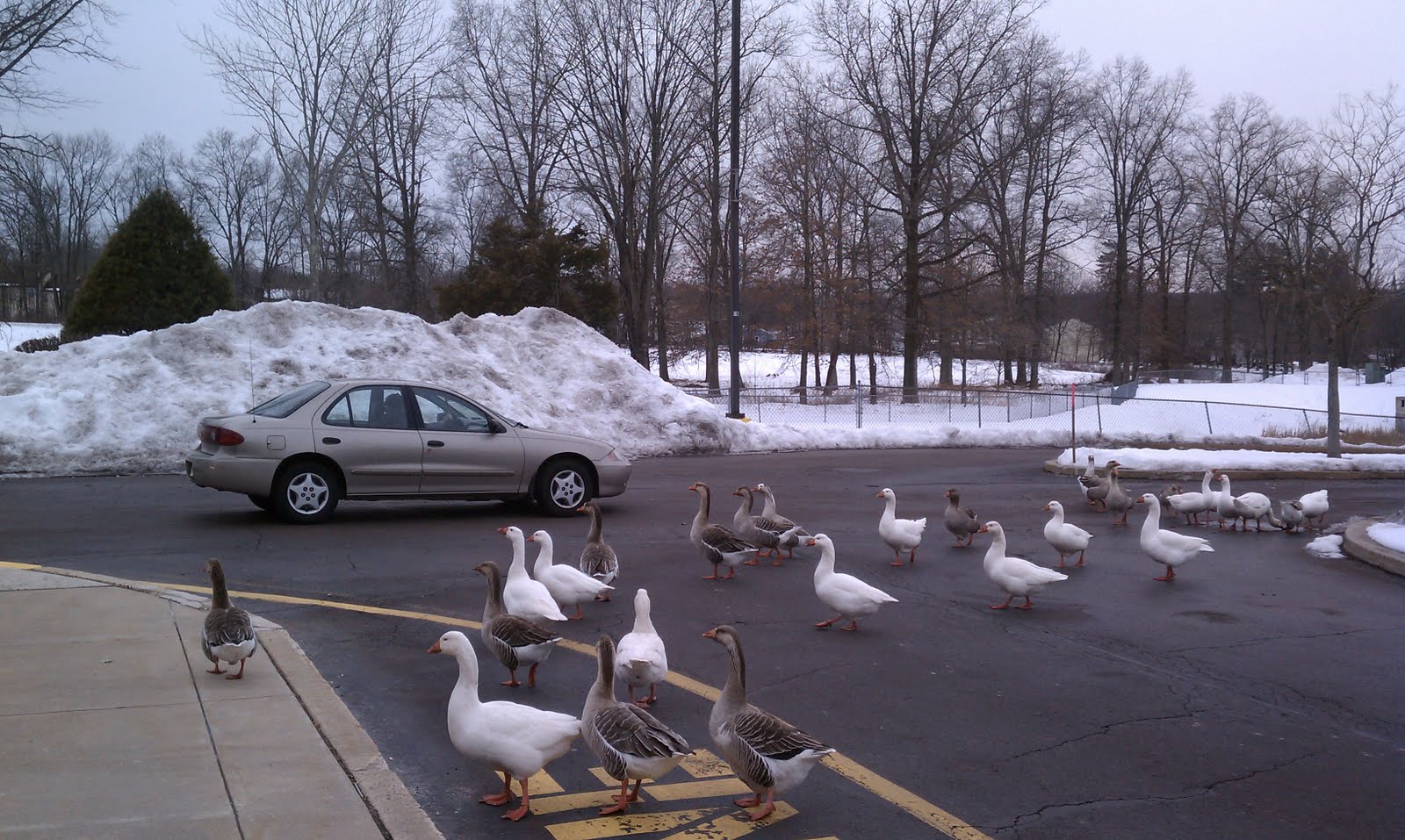
So when you see a line of geese headed through your neighborhood supermarket parking lot, like I did this afternoon, what do you think? Which of these are you?
Not a Bird Person: "Look at all those geese, somebody oughta get rid of them" Bird Person: "I should run home and get your old bread" Birdwatcher: "What are those geese doing?" Birder: "Look at those #$%!@ feral geese. Stupid trash birds"
Now ask yourself--of these four folks, who's enjoying birds the most?
Ah to be a regular bird person or at least a protobirder again!
NASA image S13-01480 (original above, colorized below)
Some people see this as a giant geoglyph--a carving of a parrot--on the surface of the Argyre Planitia area of Mars. Proof of previous life on Mars, or just wishful thinking? Before dismissing their hypothesis outright, check out the serious work of the Cydonia Institute which is exploring this formation as well as other similar ones on Mars.
Check out these bird head profiles on a building at the Late Classic Mayan city of Uxmal (about 850-1100 AD). You can see the long beaks (looks like trunks), as well as the eyes and mouthes (below the beaks). There are a lot of speculations about these birds, but we still struggle to know exactly what they are or what they represent. Scholars call this bird the Mayan Principal Bird Deity. Which just mostly means we are still trying to figure it out.
For the next little while I'm going to be a featured guest blogger over at WeLoveBirds.org--a birding social media site hosted by the Cornell Lab of Ornithology and the NRDC. You can check out my posts here, of course, but head on over to WeLoveBirds.org for more videos, photos, blogs, and other tools to help you enjoy and share your love of birds.


 RSS Feed (xml)