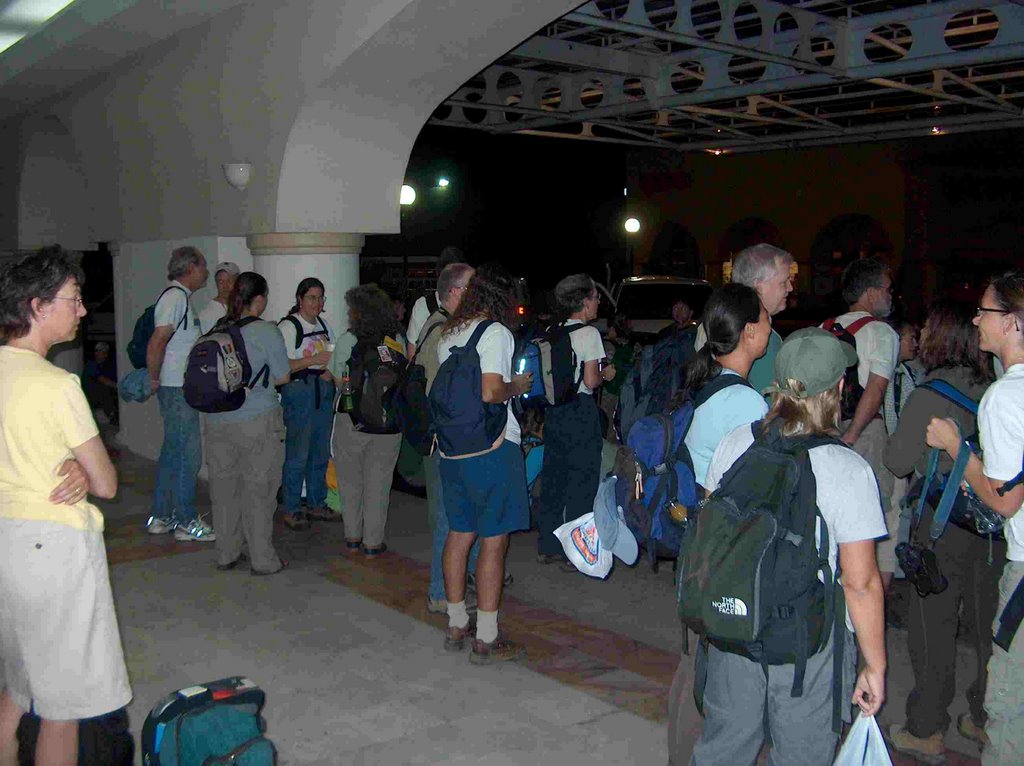
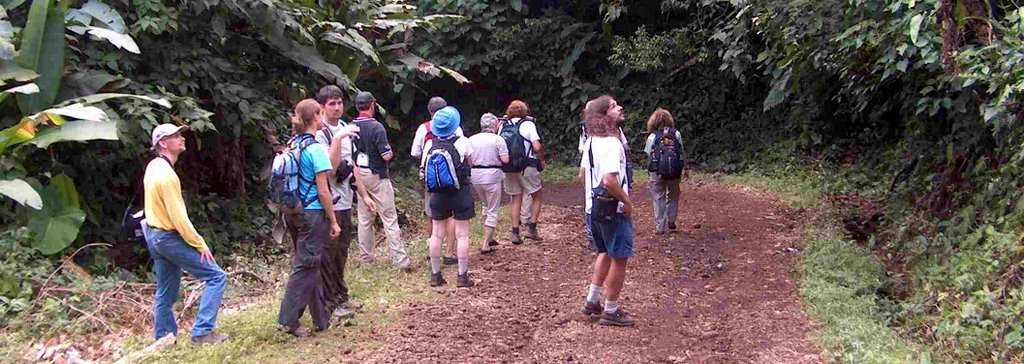
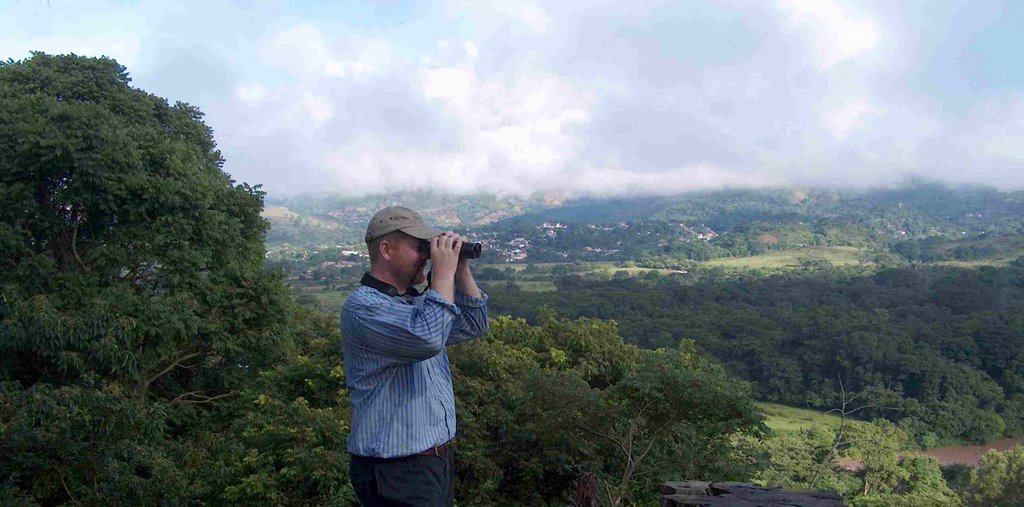
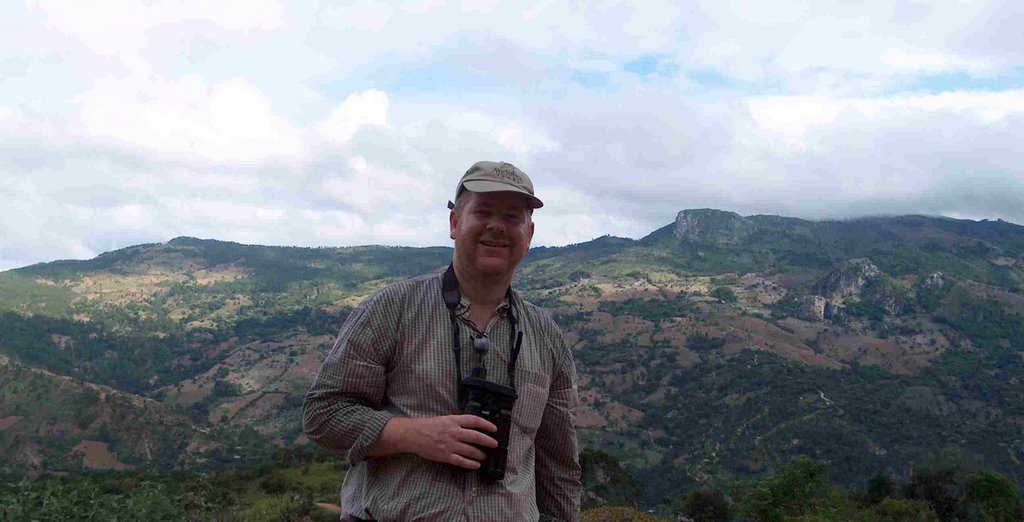
At 4:30am on Monday I joined these hardy souls for a two hour van ride from Veracruz to the Tuxtla Mountains for a day of birding.
With four vans of birders, it was a bit of a zoo, but most of us were able to see over 75 bird species, including such beauties as Keel-billed Toucan, Collared Aracari, Montezuma's Oropendola, and Red-fronted Amazon. We also heard Howler Monkeys. Very cool.
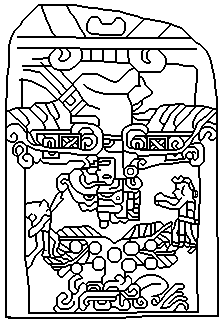
Some of us were lucky enough to see such goodies as Black Hawk Eagle and three out of range Black Swifts. The Tuxtla Mountains are an isolated low mountain range on the Gulf Coast just north of the Isthmus of Tehuantapec (where Mexico gets skinny in the middle), and they were pretty birdy. Lots of Olmec ruins in the area, including artifacts with some of the earliest ancient writing in the Americas. Birds, beautiful scenery, ancient ruins...it just doesn't get much better than that.
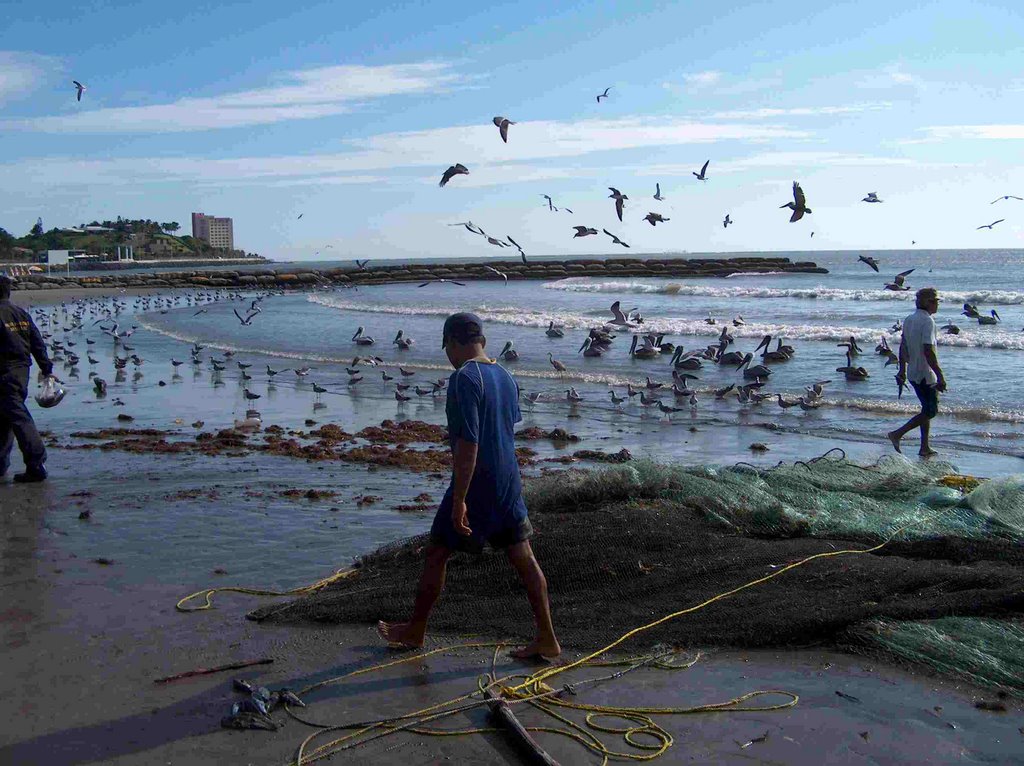
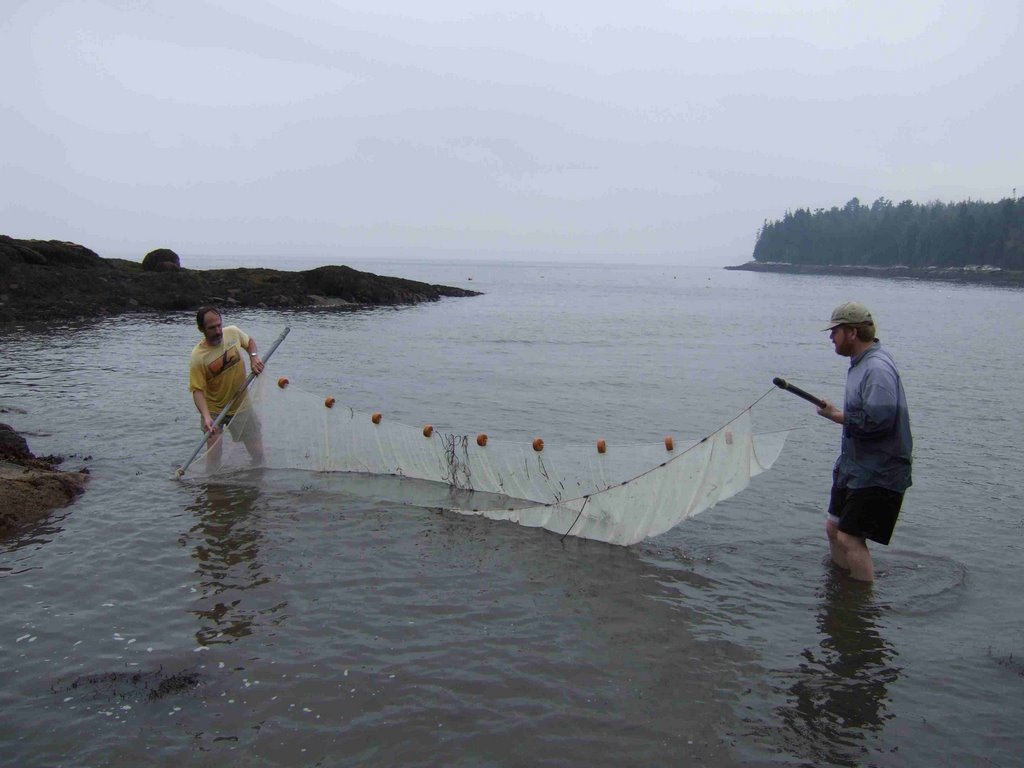
Laughing Gulls, Brown Pelicans, and Reddish Egrets are pretty common birds on the Gulf Coast. You could probably see them every day of the year. But what you might not see all the time, is large numbers of these birds running around right at your feet. On the beach outside my hotel in Veracruz, a large flock of these birds would gather every morning as the fishermen hauled in their gill net and sorted their fish. The gulls were everywhere, the pelicans were bobbing in the surf just a few feet offshore, and an egret ran between the fishermen working the net. Birds and humans, living together, sharing the beach, and making it work. Wish it were so easy to accomodate all bird species.
Sometimes we birders take ourselves too seriously. Perhaps if Weird Al were to present at the next ABA conference in Quito, Ecuador, he might parody us with something like this (below). With warmest regards and respect for the master, shake it with Al and Donny now! If you need a reminder of how the tune goes, and want to see Donny as a backup dancer, check it out here.
Uptight N Birdy!
They see me birdin’
With my bins on
I know they’re all thinking I’m uptight and birdy
Think I’m just uptight and birdy
Think I’m just uptight and birdy
Can’t you see I’m uptight and birdy?
Look at me, I’m uptight and birdy
I wanna roll with
The gangstas
But so far they all think I’m uptight and birdy
Think I’m just uptight and birdy
Think I’m just uptight and birdy
I’m just uptight and birdy.
Really really uptight and birdy.
I count all the birds that I can see
Audubon member since I was three
Sibley and Kaufman are the guys for me
What you lookin’ at, a chickadee?
I don’t use playback, to the contrary
Using tapes in the field makes birds too wary
Empids and jaegers, to me ain’t scary
Got Pete Dunne’s books in my library
I blog all day when I’m not birding
Sprint through big days like they was races
Been to a million hot birding places
You see me at all the rare bird chases
I’ll drive all night, then bird for three straight days
I know ten thousand birds, and all their ways
I can find all the regulars, and most of the strays
The way I pish up vagrants, you’d be amazed
I’ll stare at hawks all day in the sun
Til my eyes are bleary, just for fun
I don’t give up when the day is done
I spotlight nightjars, I’ve seen a ton
Short-eared Owl is my favorite bird song
I could band jays and warblers all the day long
I’ll ID any bird that you can bring on
Separate Semis and Leasts from across a big pond
They see me birdin’
With my Swarovskis
I know in my heart they think I’m uptight and birdy
Think I’m just uptight and birdy
Think I’m just uptight and birdy
Can’t you see I’m uptight and birdy
Look at me, I’m uptight and birdy
I’d like to roll with
The gangstas
Although it’s apparent I’m too uptight and birdy
Think I’m just uptight and birdy
Think I’m just uptight and birdy
I’m just uptight and birdy
How’d I get so uptight and birdy…
Dunno what this is about? Start here...
To understand where that came from, you probably have to start here...
I'm off on Monday to attend the North American Ornithological Conference in Veracruz, Mexico. If anyone else is down there, look me up for birding or bird conservation talk. I'm presenting a paper at 2:30pm on Saturday:
Fergus, R., T. Present, G. Butcher, P. Green, J. Cecil
GRASSROOTS ALL-BIRD CONSERVATION IN HUMAN-DOMINATED LANDSCAPES
While integrated bird conservation can become an agency-driven exercise in top-down planning and management, effective conservation needs public buy-in and participation to produce meaningful results in human-dominated landscapes. By encouraging individuals and communities to target their conservation efforts to species of local, regional, and global conservation concern, National Audubon Society programs promote an integrated all-bird approach at a grassroots level. Our aim is to address the needs of these species across a gradient of urban, suburban, and exurban habitats through conservation actions, and to monitor the impacts of these efforts on the species of concern. We integrate these activities with site-based conservation at Important Bird Areas, and bird monitoring efforts such as Audubon’s Christmas Bird Count, and cooperative programs including the Audubon/Cornell Great Backyard Bird Count and eBird. These home- and community-based bird conservation planning, habitat management, and bird monitoring activities are creating a grassroots network of people working to conserve birds in urban, suburban, exurban, and rural working lands in ways that are integrated with regional and global all-bird conservation efforts.
This morning, after heavy rains last night, there were quite a few Indigo Buntings in the fields and woods behind my office. In 20 minutes or so, I found 30 buntings, as well as 3 Chipping Sparrows, 4 Common Yellowthroats, 1 Black-and-white Warbler, and 1 Black-throated Blue Warbler. Surprisingly few migrating warblers brought down by the rain...maybe the landed elsewhere.
Is this the problem with birding? We've seen active birding and backyard birdwatching numbers declinging for a decade now. Is birding just too white 'n' nerdy? What would a culture be like where birding was cool? Where people of all backgrounds were more interested in birdwatching or hanging out in nature, than in this? Or is birding destined to remain 2Y-10-UR-D?
Check out the latest I and the Bird blog carnival at Don't Mess with Taxes. While my own blogging has been a bit telegraphic lately, but Kay from Austin graciously included a link to a post from one of my days in Guatemala.
But not the dangerous kind. More details here. Remember that there are highly pathogenic forms of H5N1 and low pathogenic forms that do not pose a risk to wild birds, poultry, or humans. So far, nobody has found the highly pathogenic H5N1 in North America.
According to this recent study, Archaeopteryx had feathered hind limbs that helped it glide from tree to tree, adding evidence that bird flight evolved from the trees down, rather than from the ground up. The article is available by subscription only, but the abstract is here.
Longrich, Nick, (2006) "Structure and function of hindlimb feathers in Archaeopteryx lithographica", Paleobiology 32(3):427-431.
Abstract.—This study examines the morphology and function of hindlimb plumage in Archaeopteryx lithographica. Feathers cover the legs of the Berlin specimen, extending from the cranial surface of the tibia and the caudal margins of both tibia and femur. These feathers exhibit features of flight feathers rather than contour feathers, including vane asymmetry, curved shafts, and a self-stabilizing overlap pattern. Many of these features facilitate lift generation in the wings and tail of birds, suggesting that the hindlimbs acted as airfoils. A new reconstruction of Archaeopteryx is presented, in which the hindlimbs form approximately 12% of total airfoil area. Depending upon their orientation, the hindlimbs could have reduced stall speed by up to 6% and turning radius by up to 12%. Presence of the “four-winged” planform in both Archaeopteryx and basal Dromaeosauridae indicates that their common ancestor used fore- and hindlimbs to generate lift. This finding suggests that arboreal parachuting and gliding preceded the evolution of avian flight.
After months of rumor, we finally can see the evidence that Auburn University researchers have for believing that Ivory-billed Woodpeckers still live in the Panhandle of Florida (see website here). So far, the evidence consists of some sitings (brief but including multiple field marks), lots of recorded double-knocks and "kent" calls, as well as bark scaling and large potential roost or nesting cavities. In short, perhaps better evidence than Cornell was able to get in Arkansas, but far short of proof. While critics at The Ivory-bill Skeptic are having a heyday with this, I'm glad this is all out in the open for everyone to see and hear. For one thing, the complete sound recordings are available online (here)--and though they may turn out to be the largest assembled collection of Blue Jay "kent" calls ever collected, if they can be proved to come from Blue Jays, or nuthatches, or whatever, they may have value at some point as conservationists and birders continue to deal with these unverified Ivory-billed Woodpecker reports.
My family and I spent a couple days last week on Hog Island at the Audubon camp. Last month the Common Eiders were molting and looking mostly brown. Now the males are almost entirely in alternate (breeding) plumage, and much sharper. Of course, last month most of the Black Guillemots were in alternate plumage, and now they are in basic (winter) plumage. Most of the Common Loons are now in basic plumage as well. Fun to see the changes in these birds through the seasons.
A week ago I took the family up for a working vacation to Maine and we stopped by a couple spots to look for rare birds. First stop was a Toys R Us store in Salem, New Hampshire, where a Northern Wheatear had put in a couple days performance hopping around on the roof top and the alley between the store and a Kmart. By the time we got there, the bird was gone. Strike one. Second stop was New Castle, NH for the Western Reef Heron. By this time we were running late and I only had an hour to scan the usual places where the bird had been seen. No luck. The bird was still around, someone found it that day at one of the locations I didn't have time to scan. By the end of the week the bird had disappeared, so hopefully someone in the Mid Atlantic states will find it closer to home and I can chase it again. But for now, that was strike two. Its been awhile since I double dipped (ie missed the birds) when chasing rarities. But its hard to look for birds when you are pressed for time.
After a week and a half of work, we ended up our trip at Antigua, Guatemala for an evening and morning of walking around the colonial city before flying back to the states. Not a lot of birds right in the town center, but did see a Beryline Hummingbird in the courtyard of our hotel. Driving back down to the airport in Guatemala City, a Bushy-crested Jay flew across the road, as did an Acorn Woodpecker--as if to send me on my way with a flash of color. We're already planning additional ethnoornithology research in the Ch'orti' and Q'eqchi' areas, and I'm hoping to find a way to support and expand the bird monitoring and conservation activites of Proeval Raxmu and the Ornithological Society of Guatemala. Guatemala has some spectacular birds, as well as some huge conservation and other social challenges. Many North American birds winter or migrate through Guatemala, further linking it to Canada and the United States. Its one big world, and we're all in it together.
Monday, September 11 found me high in the mountains above the highland Guatemalan town of Cobán. After hours of bus rides from Copán, Honduras to Guatemala City and then to Cobán, I hooked up with some researchers from the Proeval Raxmu project that trains Q'eqchi' Mayan villagers to monitor bird populations at several sites in the Alta Verapaz. By the time we got up to the monitoring site about an hour from Cobán, it was late in the afternoon. Resplendant Quetzals are in the area, but they were quite in the late afternoon rain. We did manage to find Barred Antshrike, Plain Wren, Slate-colored Solitaire, Chestnut-capped Warbler, Common Bush-Tanager, and Chestnut-capped Brushfinch. We heard lots of Plain Chachalaca on the way out. Driving back down in the dark, we stopped to watch a Mexican Whip-poor-will hunting from a perch near the road. As I got out of the car, I heard a Vermiculated Screech Owl and a Mountain Pygmy Owl calling up the slope in the twilight. A magical place! I look forward to going back!
We spent the night at Hacienda San Lucas, a great place just across the river from the ruins at Copán. After a great five course dinner (the best food I had on the entire trip), we retired to the guest rooms and a great night listening to the rain on the roof. In the morning, we hiked over to a nearby archaeological site Los Sapos, named for large toads carved into boulders on a hillside. Lots of good birds there, and around the hacienda. From the new yoga pavillion overlooking the river, we found dozens of species, including White-throated Magpie Jay, Oranged-chinned Parakeet, Orange-fronted Parakeet, Azure-crowned Hummingbird, Gray-crowned Yellowthroat, and Blue-crowned Motmot. My favorite were the pair of Collared Aracari--red, yellow, and black toucans--that came through right before breakfast.
Hacienda San Lucas was a real treat--with great birds and accomodations. We met some great people there, including owner and manager Flavia Cueva. If you can swing it, this would be a great place to spend some time if you are in the Copán area.
Saturday morning we loaded up our stuff and headed over to Copán Ruinas, Honduras. A Cinnamon Hummingbird and a White-collared Seedeater greated us in the town square. After dropping off our luggage, we headed over to the Copán ruins. Fantastic imagery of birds there, including macaw heads as the ball court markers, and a wild sculpture of a fish-eating water bird--maybe a cormorant.
Real birds were pretty common too. Several Masked Tityra called from trees in the site, and we were able to see Squirrel Cuckoo, Linneated Woodpecker, White-fronted Amazon, Orange-fronted Parakeet, Brown Jay, Streaked Flycatcher, Montezuma Oropendola, Rufous Mourner, and dozens of other species in and around the ruins and the picnic area just outside the gates. All in all a fantastic place, with great birds and great Mayan ruins.
Friday morning we walked along the river west of Jocotan and found additional species including Black Phoebe, Green Kingfisher, Black-necked Stilt, Spotted Sandpiper, and Blue-gray Gnatcatcher. Three males and a female Shiny Cowbirds were a bit of a surprise along a fenceline back near the main highway. Then we took a truck up to another aldea and found additional species including Ferruginous Pygmy Owl and Yellow-throated Euphonia. While I'd seen a couple Empidonax flycatchers each day, most were quick looks at silent birds. Today I was finally able to get good looks at a vocalizing bird--a White-throated Flycatcher.
On Thursday, we learned our lesson--ride a truck up the mountain and hike back down. Still, we walked a long way and I went through water like it was going out of style. We took a truck up to an aldea way above Jocotan and found some new birds including Orange-fronted Parakeet, White-collared Swift, Black-headed Saltator, and Black-vented Oriole. Ended the morning with about 30 species again, and more good info on Ch'orti' bird names.
Not a lot of forest in the Jocotan area. Most of the land is cleared and planted as milpa. Birds are fairly common around aldeas where there are more trees in the patios, and where there are trees along the edges of the milpas. While birding is undoubtedly better at higher elevations where there is still forest, our main assistant is more familiar with the birds around the milpas and patios where most people spend their time. Next time we'll have to go to additional aldeas farther out where the people may be more familiar with additional forest birds.
Wednesday turned out to be the best birding yet. We took a bus to San Juan Ermita, a municipio west of Jocotan, and hiked about 5 miles straight up a mountain above the caserío Miramundo. Great looks at a family of Bushy-crested Jays at a spring near Miramundo. We hiked around in the milpas and the lower reaches of the forest, and didn't have a lot of luck. Then we hiked up even higher along the road to where the road meets a creek. Here we finally found some interesting birds, including Prevost's Ground Sparrow, Grayish Saltator, Rusty Sparrow, and Yellow-faced Grassquit. Hiking back down the mountain, I ran out of water, tripped and lost my sunglasses, and was pretty parched by the time we reached the bottom at about 4pm. A long day, about 30 species. Note to self--carry more water!
Tuesday, September 5, we headed out early to walk around the aldea above Jocotan. We concentrated on finding the birds that our informant knows--and found about twenty species in a couple hours of walking around the milpas (corn and bean fields) and patios (yards). Very cool to see Turquoise-browed Motmot, Spot-breasted Oriole, Cinnamon Humminbird, and an immature Gray Hawk. Walking back down to town, we heard at least three quail and managed to flush one in an abandoned field--a Spot-bellied Bobwhite. We spent the afternoon going over stories and beliefs about local birds, as well as trying to identify several more that we had names for, but only in Ch'orti' and Spanish.
Monday, September 4 was my first day of ethnoornithology field work in Jocotan. I had come down to Guatemala to help Kerry Hull, a linguist from Reitaku University in Japan who studies Ch'orti' Mayan, identify the birds that he had collected Ch'orti' names and stories about. We spent each morning hiking around with Kerry's informants, and the afternoon trying to figure out the identification of other birds known by the local people, but that we hadn't seen yet.
The first morning we went up to an aldea above Jocotan, and found Clay-colored Robins, Social Flycatchers, Rufous-naped Wrens, Stripe-headed Sparrows, as well as vultures and doves in and around the yards or patios in the aldea.
As we were sitting in the patio of our main Ch'orti' assistant, he heard two wakos calling. They flew by, and we got a quick look--two Laughing Falcons. We collected some good stories about these birds, and recorded them in Ch'orti' and Spanish in the afternoon.
After five hours on buses and vans, we arrived at Jocotan (about half an hour from the Honduras border east of Chiquimula) in a pouring thunderstorm. Fortunately, the rain dropped several species of swifts down from their normal foraging areas higher up in the mountains. From my window at the hotel I was able to identify two Great Swallow-tailed Swifts, two Black Swifts, two smaller White-chinned Swifts, as well as 20 additional Cypseloides sp. swifts flying about in the rain before dark. 30 Lesser Goldfinches came in to roost in a tree near my window, and I was also able to spot two Blue-gray Tanagers, one Yellow-winged Tanager, a Great Kiskadee, two Tropical Kingbirds, and a male Purple Martin with a couple other Progne (probably Grey-breasted Martins) martins roosting on the cell tower in front of the hotel. Finally, some real Central American birds!
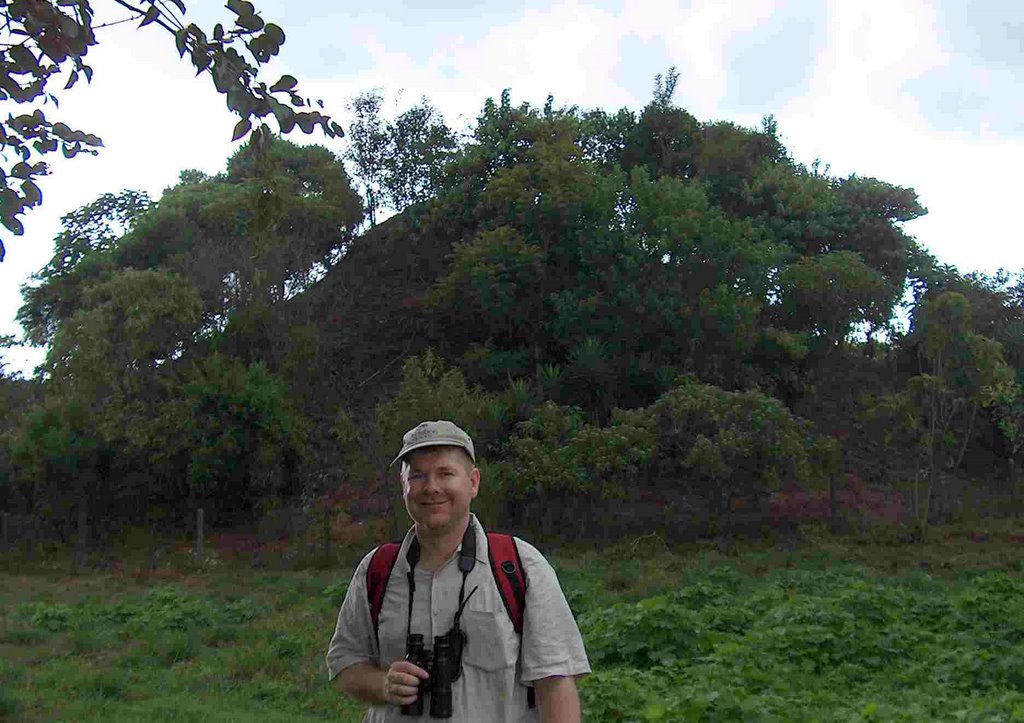
From the hotel, we took a taxi over to the Pre-Classic Mayan ruins at Kaminaljuyu--basically an archaeological park smack dab in the middle of Guatemala City. Here I am standing in front of one of the archaeological mounds. Not a lot of birds here, but did enjoy seeing three Eastern Bluebirds among the ruins. Interesting to wonder how they might have visited the site when it was inhabited 2,000 years ago. Also saw some Black Vultures and a Rufous-collared Sparrow...two more typically urban birds.
Back in the day, Kaminaljuyu was an important city, and one of the first places that we have record of rulers dressing up as bird gods to help legitimate their rule. Today, birds rule there again, as its parklike setting provides space for birds otherwise surrounded by the concrete jungle of Guatemala City.
After arriving after 10pm the night before, the first bird seen from the balcony of the Guatemala City Marriot was...Lesser Goldfinch. Followed shortly by Great-tailed Grackle and Clay-colored Robin. Off in the distance, a Leptotila dove--probably a White-tipped Dove--flew across the city. Great. All this way to see four birds easily seen in Texas!
A new paper to be published in the October issue of Emerging Infectious Diseases (and available now online ahead of print) reviews recent outbreaks of H5N1 HPAI, the species of migratory birds infected, and the potential for wild birds to spread bird flu to new areas.
The authors conclude that:
HPAI H5N1 spread rapidly across Eurasia during 2005 for reasons that are not entirely understood. Despite this rapid movement, effective introduction (i.e., under conditions allowing its spread) of the virus to the New World through migratory or vagrant birds seems unlikely. Few individual members of few waterfowl species migrate between hemispheres, and should a bird make the journey while shedding sufficient active virus to infect birds in the Western Hemisphere, newly infected birds would probably die before being able to transport the virus from the entry site. If spread of HPAI H5N1 to the New World occurs in its current form (e.g., through domestic or pet bird trade or smuggling), it should be readily detectable because of the large number of dead native birds likely to result.
Reference: Rappole, J.H. and Hubálek, Z. (2006) Birds and influenza H5N1 virus movement to and within North America. Emerging Infectious Diseases, October 2006 issues, available online at: http://www.cdc.gov/ncidod/EID/vol12no10/05-1577.htm
I'm off to Jocotan, Guatemala to do some ethnoornithology research with a Mayan linguist. Hope to post something from down there, but if not, I'll be back September 13. (photo:jocotan project)
A scout from church created a bluebird trail at my work for an Eagle Scout project a couple weeks ago. This morning I went for a little walk and saw three bluebirds sitting on one of his boxes. These birds won't nest until spring, but they seem to be checking out the boxes already. Hopefully they will find at least one to their liking.
Hoping to find some migrant shorebirds, I stopped by Bradford Dam in southern Bucks County on the way to work this morning. Most of the lake margin is covered with dying water hyacinths, so not a lot of good shorebird habitat. Only found 7 Spotted Sandpipers, and 4 Least Sandpipers on the vegetation, so kind of disappointing. There was a young Bald Eagle sitting on a log in the lake, as well as 2 Mute Swans, a single Canada Goose, 1 Great Blue Heron, and 4 Green Herons. Not what I was hoping for, but good to at least get a brief bird fix for the morning.
Check out my article on the bird flu in the Lawn & Garden Retailer magazine (here). Money quote:
By keeping bird feeders and birdbaths clean and by washing up thoroughly after servicing them, there is almost no way to contract H5N1. There is a much greater risk of tripping on your way out the door than there is of contracting avian flu or any other disease from backyard wild birds. The National Safety Council reports that trips and falls killed 16,000 Americans and sent more than 7 million others to the emergency room in 2003; less than 200 people across the globe have died from H5N1.
Here's a question--Who is going to step up to save the Gunnison Sage Grouse, perhaps the most endangered bird in the Lower 48? I was just out in Colorado for some Audubon meetings, and there is a real need to get some national attention on this bird. There is a local group Sisk-a-dee dedicated to protecting the birds, a conservation plan, and some serious efforts by the Colorado Division of Wildlife, but hardly anyone out there has even heard of, let alone embraced, this bird.
True, thousands have have travelled to see these birds. But how many people go to Colorado to see these birds, then don't lift a finger to do something for them after they get home?
How many of us can envision a world where there aren't just 5,000 Gunnison Sage Grouse on a good day, but maybe 25,000 or 50,000 of them across a larger expanse of their former range into Arizona and New Mexico?
Everyone was over the moon when we thought the ivorybill might have a second chance. While nobody seems to be able to find an ivorybill, here's a bird that we really can do something about still.
Is there a conservation through birding strategy that can help these birds? Some way to get more people to see, and then actually do something to help, these birds? What about a Sage Grouse Research and Visitor Center in Gunnison? A place where you can go to learn about the birds, take a guided tour to see them booming on their leks in the frigid cold of an early Colorado Spring? A center where summer interns and researchers can work out of as they struggle to learn more about these birds. A place on the map with a 40 foot sage grouse statue in front that makes the local community proud of their celebrity birds? Or a birding festival that fills the local hotels during the off season?
We have the tools. But the folks with Sisk-a-dee in Gunnison need our help. Ask not for whom the bell tolls, it tolls for these guys, and for our credibility as conservationists if we stand by and watch these guys go the way of Attwater's Prairie Chickens (down to about 40 birds in the wild).
Announced here. Follow the links to watch the Public Service Announcement here. Maybe a bit over the top scary, but for kids, an important message in some parts of the world. Some kids in Turkey died after playing with the heads of some slaughtered infected chickens, so maybe not a message we need here in the USA, but possibly critical elsewhere. Hopefully the kids will listen to Jackie Chan. He may do his own stunts, but isn't messing around with this bird flu!
Now, the part about "birds from somewhere else" making their birds sick...it may be true, but it wasn't clear if he was talking about wild birds or poultry imports. Wild birds are still not proven to be a primary carrier or transmitter of HPAI H5N1 avian influenza.
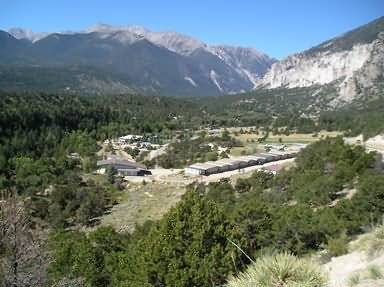
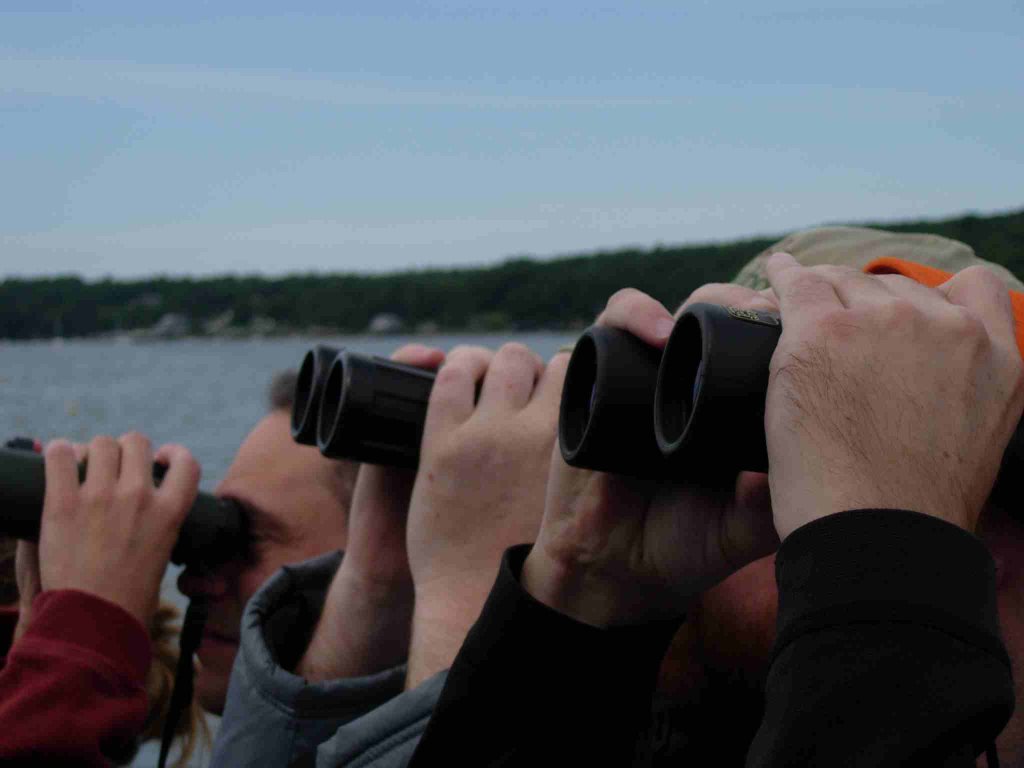
Friday I flew to Denver and drove three and a half hours up to Mt. Princeton for the Audubon Colorado Rendezvous. A spectacular meeting place along a creek below the cliffs of the 14,000 foot peak. Most of my time was spent in meetings watching the storms roll in and out of the valley, but great to see some old friends like Clark's Nutcracker, Townsend's Solitaire, and Mountain Chickadee. Heard Red Crossbills flying over several times but never got on them. Something was messed up with my binoculars, and I couldn't get them to focus fast enough. I thought it might have been sand in the focusing mechanism, but they are OK again now that I'm back in Pennsylvania, so wondering if it had something to do with the pressurized binocular tubes and the high altitude? If anyone has had anything like this happen to their Zeiss 7x42 Dialyts, let me know! It was a pain since I was pretty sure I had a Black Swift going over at one point, but couldn't focus the bins fast enough to get on it!
I love rare birds, and was dismayed a couple months ago when the USFWS decided not to list the Gunnison Sage Grouse as an endangered species. If a bird with a tiny range and a population of only 5,000 individuals (in a good year) doesn't count as endangered, I don't know what does.
While the Endangered Species Act has some problems--most notably the government doesn't enforce it enough, there is a movement afoot to get rid of the Endangered Species Act as we know it. Called "cooperative conservation", this would make endangered species protection voluntary, rather than mandatory. While I'm all in favor of voluntary action, and decided against a career in environmental law because I'd rather encourage people to do the right thing, rather than suing them to do it, sometimes you need the stick to go along with the carrot, and taking the teeth out of the Endangered Species Act will not help any endangered or threatened bird. A "voluntary" Endangered Species Act would be about as effective as a voluntary sales tax.
So, why post this on PA Birds? Those within the federal government who would like to stir up support for gutting the Endangered Species Act are staging road shows all across the country to try and sell their ideas and make a show of support, and that show may be coming to a community near you sometime in the next couple of months. If you care about rare and threatened birds, find a session near you, mark your calendar and do what you have to in order to get to this meeting and make a public comment in support of a strong Endangered Species Act.
I know we'd all rather be out birding, but if we don't stand up for the birds when we get a chance, someday there just won't be as many of the cool birds we'd all really like to see. If birders won't stand up for rare birds, who will?
More on these sessions from the Endangered Species Coalition (here).
While the website says that meeting attendance and commenting is first come, first served, and that speakers can only sign up at the session, word on the street is that there may be some dirty behind-the-scenes stuff going on to stack the speaker list in advance. So get there early, and if you aren't allowed to speak, let the world know about it.
This morning I made a quick stop by a water detention pond just north of the Giant supermarket in Quakertown. The basin is only about an acre in size and mostly dry, with a bit of water in spots and open mudflats, but it held 2 Solitary Sandpipers, 2 Lesser Yellowlegs, 20 Least Sandpipers, and 2 Semipalmated Sandpipers. Man, I sure miss the days of shorebirding the South Jetty of the Columbia River and the Bayocean shorebird flats in Oregon during the 1980s, or the last ten years of birding Hornsby Bend in Texas! I got spoiled on seeing hundreds or even thousands of individuals of dozens of species. Now shorebirds are a bit fewer and farther between for me.
Nights in Maine are great for watching the skies. After a day of workshops, we enjoyed exploring the galaxy--and more distant galaxies--under amazingly dark skies. I've lived in the city too long, and it was great to watch the Perseid meteor showers, scope out the moons of Jupiter, and look at the Andromeda galaxy, as well as other deep sky objects in Sagitarius.
We weren't the only ones watching the stars. Research has shown that many songbirds migrate at night and use the stars to help them navigate. While we were out looking at the stars, we could hear the flight calls of warblers going overhead. I'm still learning my flight calls, so hard to tell exactly which species were going over, but based on what we were seeing on the ground, maybe Black-throated Green Warblers, Northern Parulas, American Redstarts, and Magnolia Warblers.
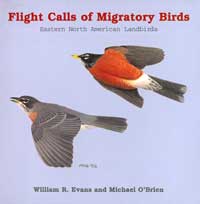
The best resource for learning the flight calls of migrant birds is online at oldbird.org. Get the CD. Its amazing and will open up a whole new world of night time birding. Fall migration is underway, so get a copy now. For another great view of the migration taking place each night, see the radar summaries at woodcreeper.com. Then head outside, hopefully to a dark spot away from city lights, and enjoy the celestial views of the sky and amazing sounds of the birds streaming overhead.
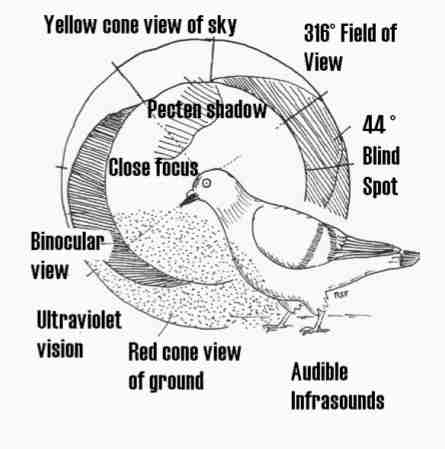
What do you do at the Audubon Leadership Workshop after a day of watching puffins and eagles? Why, you enjoy my presentation on how birds see the world, of course! I like this presentation, as it is a lot of fun to figure out how birds see and interact with their world. I haven't given this presentation for a while, but I've now added a lot of info from recently published research, and I'm set to take it on the road again. Next stop for this show: Houston Audubon Society meeting on November 8. If you've ever wanted to know what it is like to be a bird, this is the presentation for you!
On the third day of the Audubon Leadership Workshop on Hog Island, we took the Puffin IV out to Eastern Egg Rock to look for the puffins that Stephen Kress introduced back to the island beginning in the 1970s. It was late in the season, but we did manage to see four of these little beauties sitting on the water.
We might have seen more puffins, but there were four adult and three young Bald Eagles on the small island really stirring up the terns and gulls, so any other puffins in the area were probably smart to head out away from the island.
I am not the best on boats, especially when I keep my eyes glued to my binoculars looking for pelagic species. As we headed out, I told some folks that I wanted to see a Manx Shearwater. As we circled Eastern Egg Rock and the swells started to get to me, I kept up my vigil scanning the horizon with my binoculars while others watched the eagles. Finally, way off in the distance, I saw a shearwater skimming back and forth over the waves. Only a couple others were able to get on it before it disappeared, perhaps landing on the water. I was green, but I'd seen my bird!
On the second day of the Audubon Leadership Workshop at Hog Island, we took a break to explore the intertidal zone, or as I like to think of it, with over thirty species of invertebrates present, the Maine coast's great bird food larder.
Of course, crabs were everywhere. Most were green crabs (Carcinus maenus), and hermit crabs, but we also found one female Asian shore crab (Hemigrapus songuineus) in berry, as well as a few rock crab (Cancer irroratus). These guys are all good food for the many Herring Gulls and Laughing Gulls in the area, and at one point I found three American Crows feeding on the remains of a larger crab. Common Terns also munch on green crabs.
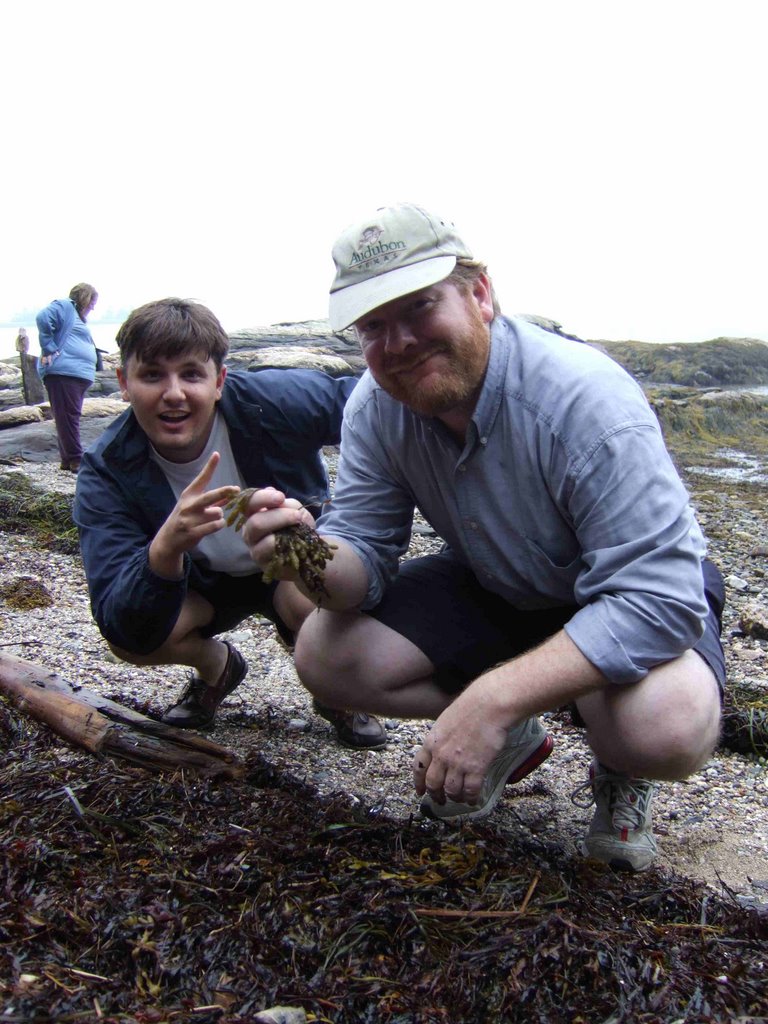
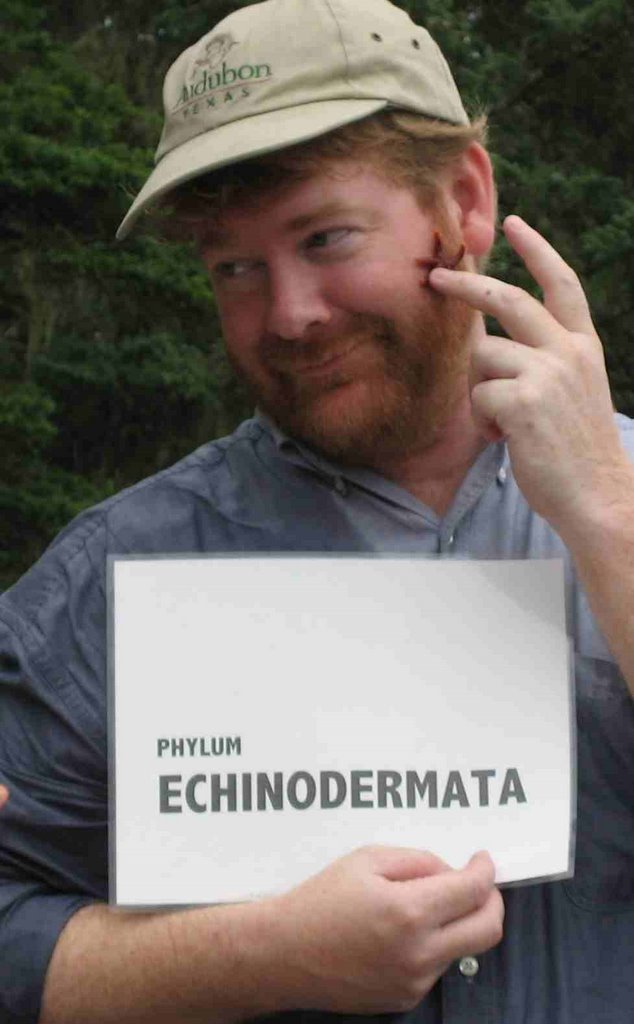
We also found two kinds of sea star. Here I am showing off my Blood Star (Henricia sp.), and we also found Northern Sea Stars (Asterias vulgaris). While these little guys are savvy hunters themselves, it isn't too uncommon to see gulls eating sea stars as well--especially the larger Glaucous Gull and Great Black-backed Gull. King Eiders also like to eat Asterias sea stars.
One denizen of the shore that was new to me was the clam worm (Nereis sp.), which make a good meal for shorebirds like Black-bellied Plover, Semipalmated Plover, Red Knots, and godwits, as well as gulls and waterfowl like the American Black Duck and Common Eider.
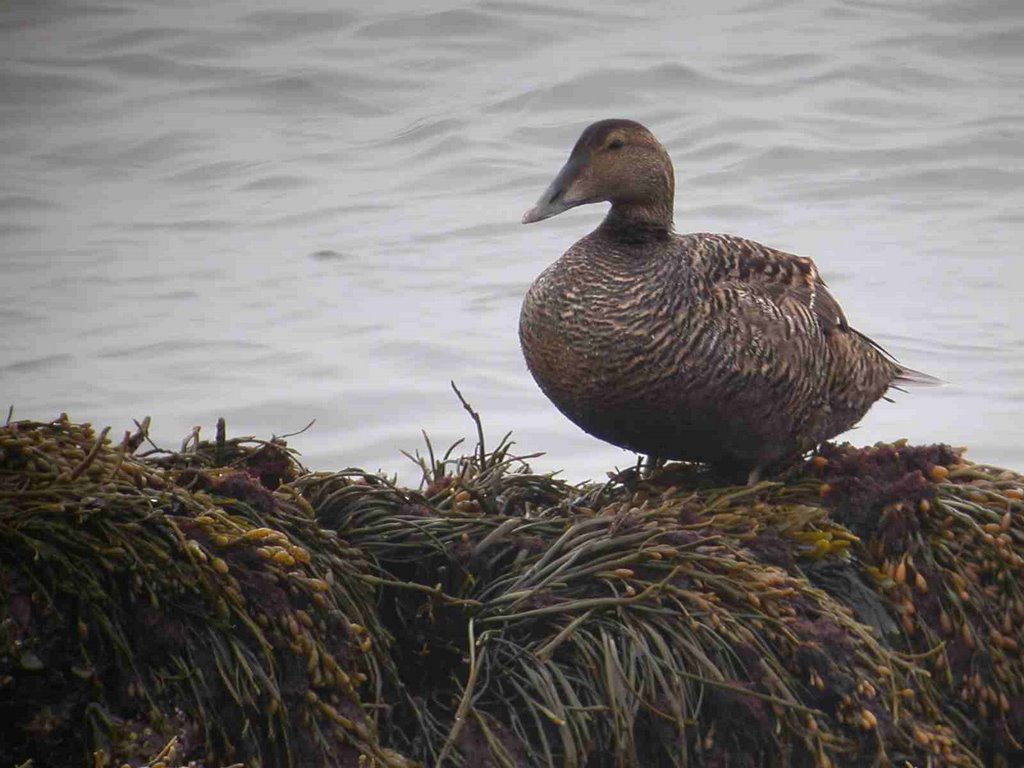
Of course, everywhere on the rocks we found barnacles, as well as blue mussels (Mytilus edulis) and horse mussels (Modiolus modiolus). These bivalves are the favorite food of the Common Eiders that are so common in Muscongus Bay. The sea ducks dive down and rip these mussels from the rocks, eat them whole, and grind them up in their gizzards, then excrete the shells as crazy blue droppings. Other birds that feast on mussels include American Oystercatcher and Black Scoter.
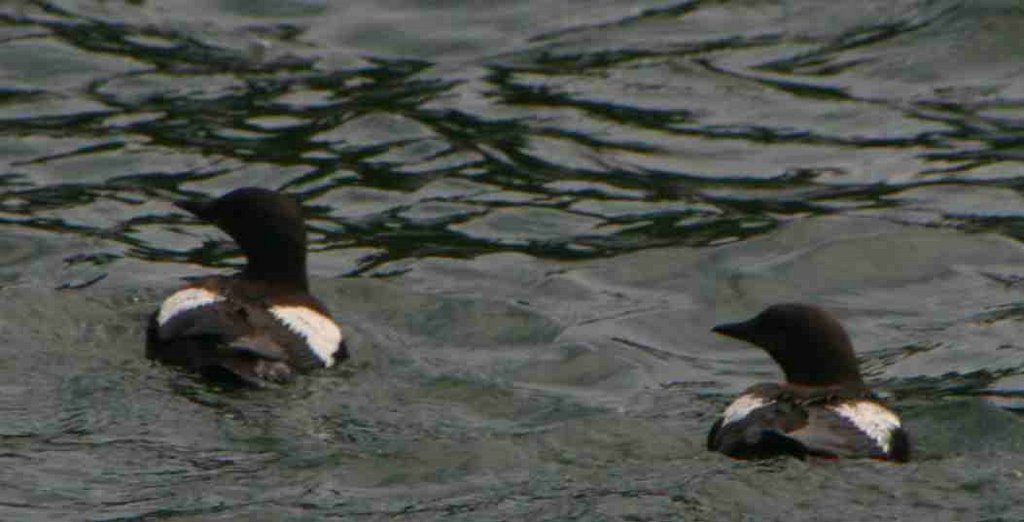
Rock eels (Pholis gunnellus) are the favorite food of the other most common Muscongus Bay bird--the Black Guillemot. We found a couple of these long fish--actually a gunnels--under rocks in the tide pools. The guillemots dive down and chase these fish among the rocks under water--a sight I'd love to see. Other birds that hunt these gunnels include Double-crested Cormorant, Great Cormorant, and Red-throated Loon.
My favorite animal of the day was probably the golden star tunicate (Botryllus schlasseri). We also found Sea Pork (Amaroucium stellatum) and white crusts (Didemnum sp.). I have to admit I've never seen a tunicate before, and I was quite taken by these strange little animals. The golden star tunicates are introduced from Europe, and I have no idea if any birds actually eat these little colonies since they are rather firmly attached to the rocks, but they are quite pretty and its possible that the free-swimming forms may be eaten by birds at sea.
Snails were common in the tide pools, especially the common periwinkles (Littorina littorea) and dog whelks (Nucella lapillus). We also found some of the smaller smooth or northern periwinkle (Littorina obtusata) and a few tortoise shell limpets (Acmaea testudinalis). Dozens of bird species eat periwinkles, including shorebirds like Purple Sandpipers and Ruddy Turnstones, and ducks like Common Goldeneyes, scoters, and Long-tailed Duck. Limpets may take a little more work to pry off of rocks, but some do get pulled off by eiders and oystercatchers.
Other bird food we found included beach fleas (Orchestia sp.), blood worms (Glycera sp.), and my favorite the twelve scaled worm (Lepidonotus sp.). Amphipods included the North Atlantic scud (Gammarus oceanicus) swimming sideways under rocks, where they seek refuge from the dozens of birds that eat them--pretty much any shorebird, seabird, or sea duck in the area.
After checking out the littoral bird food, we waded out to do some sceining. This brought in lots of three spined sticklebacks (Gasterosteus aculeatus), Atlantic silversides (Menidia menidia), bent mysids (Praunus flexuosus), and grass shrimp (Hippolyte sp.). Common Terns frequently take all of these species, as do many other species feeding in shallow water--including Snowy Egret and Brown Pelican. We also managed a medium sized sculpin (Cottidae sp.)--a fish favored by loons, mergansers, cormorants, and even Great Black-backed Gulls.
After a couple hours of exploration, it was clear that the world is a marvelous place full of strange creatures...and that there is a lot for birds to eat where water meets shore.
Arriving at Hog Island for the Audubon Leadership Workshop for Audubon chapter leaders, it was good to be back in the land of the Black Guillemot and Common Eider. These birds are fairly common close to shore here, and we saw dozens of them on the short boat tour on our first morning at the camp. We also got good looks at a Bald Eagle nest, as well as an Osprey nest, and diving Common Loons. Hog Island has a lot of great birds, and I spotted 63 species during the week, missing several others seen by workshop participants when I wasn't around--like when I was tanking up on the amazing homemade dishes served at every meal! Fresh air, spectacular scenery, great food, fantastic birds, good company...now that's a recipe for a good time--especially when you get the discounted Audubon rate! The Audubon Leadership Workshop may be the best kept secret in Audubon.
Driving up to Maine to help with the Audubon Leadership Workshop at Hog Island, I stopped off at Scarborough Marsh to look for Saltmarsh Sharp-tailed Sparrow. It was windy, late in the day, and maybe late in the season, and I didn't have a lot of time--a recipe for disaster when searching for a particular bird. There were lots of wading birds out at the end of Eastern Road into the marsh, including two Tricolored Herons (only one was previously reported) that I glimpsed as they moved through the distant marsh pans.
Finally, I ran into some local folks who told me I was right in the middle of the best place for the sparrows (the north end of Eastern Road near the pans), and eventually with their scope, I was able to see a couple birds. Both Nelson's and Saltmarsh Sharp-tailed Sparrows are here, and this time of year many of the birds are youngsters--making it a bit tricky to identify them as they pop up briefly in the middle of the marsh. However, I was lucky enough to see at least one that seemed to be a good Saltmarsh Sharp-tailed Sparrow based on breast streaking and gray cheek. I also saw one really, really pale young Nelson's, and several others that had to go unidentified. The birds didn't really fit my previous search image of them based on field guide illustrations. Much more flat-headed, long-billed, and much less colorful then I expected. Field guides don't always do it for you, so there's nothing like in-the-field experience with birds to help you really become familiar with them. I left wanting to spend much more time getting to know these guys. Hopefully next time I'm in their range I'll have more time to really study these strange little birds (photo: ctbirding.org).
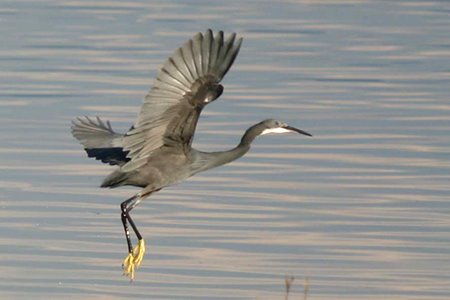
I just got back from a week in Maine (details forthcoming), and wasn't able to check online before I drove home...which is why I drove right past the $^@& Western Reef Heron that is being seen just off I-95 at Kittery Point in southern Maine. About once a year I miss a super spectacular bird by not being plugged in 24-7. Ouch! (photo: Surfbirds)
In the past six months, we've learned a lot about how bird flu is and isn't spread. Here's a great summary of what we know and are still looking at from Richard Thomas of BirdLife International:
1) The highly pathogenic form (HPAI) of H5N1 arose in poultry and H5N1 remains almost exclusively a poultry disease.
2) The major spread of the virus is caused by the international poultry trade, as has been stated publicly more than once by the United Nations Food and Agriculture Organization. As such, the US Govt should be investing in tighter border security if it wishes to prevent H5N1 entering the country. The recent report about tonnes of Chinese poultry meat entering the New York restaurant chain shows the US is playing Russian Roulette with H5N1. It is not the only recent report of poultry/poultry product smuggling into the US from infected areas.
3) Four human deaths have been caused by close contact with wild birds: women who were plucking swans for feathers in Azerbaijan. All other human cases have been caused by close contact with infected poultry or (in a very limited number of instances) through human-human transmission.
4) The total number of wild birds infected is in the thousands (cf. hundreds of thousands, as opposed to millions of infected chickens).
The biggest possible wild bird outbreak is currently ongoing at Ubsu-Nur, a lake that straddles the Russia-Mongolia border where there are reports of up to 10-15,000 dead birds. However, there is no official Russian Govt confirmation of the outbreak being H5N1, and early on there were reports of many dead rodents and fish at the lake - so it could just all be poisoning.
Prior to Ubsu-Nur, the largest alleged "wild bird" outbreak was at Qinghai Lake in China (where up to 6,000 birds were reported dead - mainly Bar-headed Geese). However, in recent months we've learned that Bar-headed Geese have been farmed and released at the Lake and elsewhere in north-west China for at least a decade, so how many of the geese were wild birds is not clear, nor were many of the corpses tested and confirmed as killed by H5N1 - possibly, like Europe, only a small proportion of the dead birds had the virus].
5) All wild, migrant birds testing positive for H5N1 have either been dead or dying. There is no properly documented case of a wild bird carrying H5N1 asymptomatically.
It is true that some Tree Sparrows in China were found to be carrying HPAI H5N1, but not the Z-Genotype that's causing all the problems. They're also not migratory. The other widely-publicised "asymptomatic wild bird" case were six "wild, migratory ducks" at Poyang Lake, China reported by Chen. However, the authors are unable even to say which species these birds were; one of the possibilities they give (Spot-billed Duck) has a resident population at the lake. I can send a list of other flaws in their methodology - not least of which is that they did zero poultry testing around the lake].
6) The best evidence for long-distance movement of the virus by wild birds was in Europe in winter/spring 2006. The scattering of dead/infected wildfowl were consistent with movements of birds fleeing cold weather in the Black Sea/Caspian Sea regions. Poultry had been infected for months in these regions before the virus's appearance in wild birds. Our "best guess" is wild birds became infected in poultry farm factory outflows. [The Ruegen Island (German) outbreak is very strange and points to a local source].
7) The US Govt is probably wasting its money on testing wild birds in Alaska using its current methodology. All the reports I have seen refer to researchers taking cloacal swabs. Fouchier reported (at recent FAO-OIE conference on wild birds) that artificially infected ducks DID NOT EXCRETE THE VIRUS IN THEIR FAECES; it was only present (and detectable) in tracheal swabs. Hence, a negative result from a cloacal swab may be just a false negative.
8) The virus has been endemic in South-East Asia for more than a decade. More than 16,000 healthy, wild, migratory ducks in Hong Kong have been tested during that period - and all found to be negative for H5N1 (subject to the proviso above about cloacal testing). Similarly, more than 12,000 samples from birds in Alaska from 1998-2005 were all negative for H5N1.
9) The westwards spread of the virus from China to Eastern Europe follows no known wild bird migration pathway; nor does the timing (spring in the east, autumn in the west) follow a plausible migration route. The introduction to Africa (Nigeria) was unquestionably through trade.
10) If there was a significant danger of H5N1 introduction into the US through mixing of Asian migrants with American migrants in Alaska, why has there been no outbreak of H5N1 in major destinations for Asian migrant birds, such as the Philippines, Australia and New Zealand?
Japan and South Korea both experienced outbreaks following importation of infected poultry meat. After stamping the disease out through culling and tightening their borders, neither has experienced further outbreaks. The US should take note.
Today is my 25th birding anniversary. Actually, the first date I have with a bird sighting was a Killdeer I saw 14 June 1977, and I made my first bird list for a cub scout requirement in July 1977. But 25 years ago today, I went from being a backyard birder, to a full-fledged birder and lister.
I had been an active herp enthusiast for several years, when I got invited to go on a week-long birding trip to Malhuer National Wildlife Refuge in eastern Oregon with Ron Keil, my junior high science teacher, and a couple van loads of other teachers and kids. We kept a bird list on that trip, and I got totally sucked in. While I only saw a couple lizards on this trip, I saw over 50 bird species, including my first Burrowing Owls, White-faced Ibis, Common Nighthawk, and American Avocets. It was life changing. Its all so burned into my mind that I can still tell you what I ate for dinner at the Malhuer field station on August 10, 1981--vegetarian spaghetti with zuchini, very tasty! Juice Newton's Queen of Hearts was climbing the pop charts, we watched the Perseid meteor showers from the top of Steens Mountain, and it was a magical time that changed the course of my life.
Birding is more than an obsession. It is a way of ordering your life--including your experiences and memories. Dates of important bird sightings and birding trips become etched in our psyches, and change our very souls. Many of us can tell you exactly when and where we were when that birding bug (and I'm willing to call it an infective virus) first hit us.
Me, I was twelve years old, twenty five years ago today, at Malhuer National Wildlife Refuge. For me, that is holy ground.
In 10 years of living in Texas, I waited in vain for one of these guys to show up again so I could chase it for my ABA list. Now that I'm in Pennsylvania, sure enough one is now hanging out in Estero Llano Grande State Park in Weslaco, Texas. Such is life. (photo: Erik Breden)
The American Birding Association has been struggling to find a new executive director, but the new appointment is now announced on the ABA Website. I won't spoil it here, so check it out if you're interested. Hope this turns out to be a good thing--good luck, guys!
As for changes here, I'm gonna try out this as my new banner...
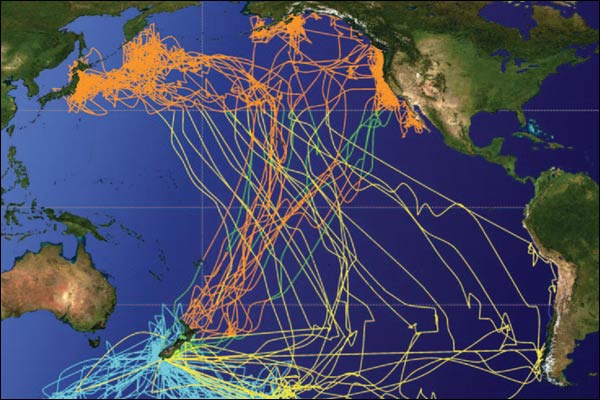
Imagine a 200 day 40,000 mile trip around the Pacific Ocean from California, to Japan, to New Zealand, and back again. Throw in some nice 180 foot deep ocean dives. Lots of good seafood. Now imagine doing that every year of your 30 year life. And you only weigh a pound and a half. Welcome to the world of the Sooty Shearwater. Check out this BBC report on a recent study tracking the migration of these birds. On this map the blue lines are breeding season movements, yellow is the northward journey, and orange lines are winter (our summer) movements and the journey back south. Simply amazing.
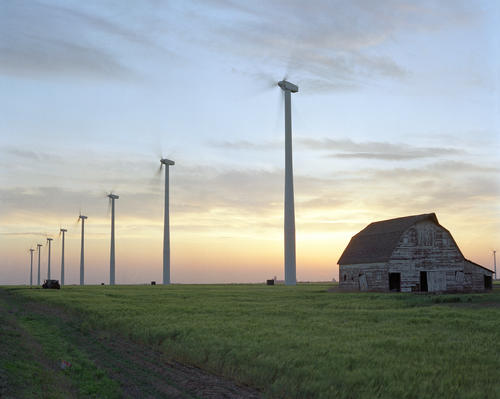
So, somebody wants to put a wind farm in your backyard. Maybe you want it, maybe you don't. Then somebody comes along and says that it might kill lots of birds. So, what do you do? How many birds get killed by windmills, anyway?
Here's what we know: researchers have found that on most modern wind farms, each turbine kills an average of 2.3 birds each year (read the latest NWCC report here).
So if they want to put a monster 500 turbine wind farm in your county, that might kill an estimated (reaching for the calculator...) 1150 birds a year. Still sounds like a lot?
It is estimated that the average house kills around 10 birds a year that smack into its nice picture windows. The average outdoor cat may kill 10 birds each year as well. There are about 100 million homes in the U.S. and maybe that many cats as well. Are you doing the math? We're looking at something like a billion birds killed by windows, and another billion killed by cats, each and every year. With an estimated 20 billion birds in the U.S. each fall, windows and cats may be killing about 10% of all birds every year.
How does that stack up against birds killed by windows. If you crunch the numbers found here, you'll find that there are currently something like 17,800 wind turbines in the U.S. At 2.3 birds per turbine, that's 40,940 birds killed by windmills each year.
Of course, these are estimates. There are some windfarms that kill more birds. Others kill fewer birds. If someone is proposing a windfarm in your area, make sure that they do their environmental studies to show that they're not going to build it in a major migratory pathway, or near too many nesting hawks or eagles. See if you can get them to do ongoing monitoring of the windfarm to make sure that they aren't killing inordinate numbers of birds.
All in all, the habitat destruction that takes place putting in the service roads for the windmills will probably be more damaging than the windmills themselves. Again, if you have a chance, make sure that those impacts are addressed. Maybe there should be some mitigation for habitat destroyed. Its probably going to come down to what you and your county are able to negotiate.
If wind developers do their homework, and do a good job choosing a site, then there shouldn't be too big a problem with a windfarm killing birds. If you want to oppose a windfarm on aesthetic grounds, that's another thing. Just remember that the window you have to look through to see the local windfarm is actually killing at least as many birds as the windmills themselves.
Now, that said, wind power's ability to reduce our need for fossil fuel burning needs for electricity generation is another question entirely...
Well, I'm not getting much traveling in lately, but my 2006 yard list is currently #2 in the state of Pennsylvania. OK, that's second place in the urban yard category. But, hey...you work with what you got. Latest addition--two Purple Martins seen about a quarter mile away across the creek. As long as I can see it from my yard, its in!
Pretty soon I'll have less time for yard birding. In the next three months I have trips planned for Maine, Colorado, Guatemala, Maine again, Mexico, Houston, San Diego, Austin...stay tuned, should be some bird reports in there somewhere!
OK, after all the great things I said about The Shorebird Guide (and its still a great book), I didn't find it very helpful in working out last month's ABA photo quiz. I had tried to do the quiz at work without all my books, and this book didn't ever get to where I needed to. To be fair, Sibley didn't help much either on this one. There's only so much you can get from a book...and a single online photo. Fortunately, its usually easier to identify birds in the field, as you usually get a better view (and size clues) from several angles. Oh well, better luck with this month's photo quiz!
OK, this is getting rediculous. After last week's story about the ibis with an arrow in it, now comes this news of a Red-tailed Hawk with a similar injury here in Pennsylvania. What kind of poor blighted soul would get enjoyment out of shooting at a big bird with a target arrow? Hope they can catch the bird...if only to get finger prints off that arrow!
Update: The bird has been captured and is doing well in rehab (see story here)
As a young birder growing up in Oregon, shorebirds were some of my favorites. They migrated through in fair numbers, but mostly through out of the way habitats that most people didn't even know existed. I remember some of my first attempts to observe and identify sandpipers, like the time I walked out through knee-deep mud into Siletz Bay, and was rewarded with my first ever views--very close views--of such gems as Black Turnstone, Ruddy Turnstone, and one of my first "rarities" a Semipalmated Sandpiper. The smell of the mud, the blinding sun, the close connection to exotic arctic-breeding birds...all hooked me on shorebirds for life.
Learning to identify shorebirds was a challenge. Many of them look very similar. After years of puzzling over them, mostly identifying them through trial and error (oh, and the errors there were!), it got easier until now, most of the time, I can identify most shorebirds I see quickly and at great distances.
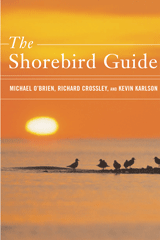
Now, Michael O'Brien, Richard Crossley, and Kevin Karlson have made it easier for most birders to feel comfortable identifying shorebirds in what Houghton Mifflin is billing as The Shorebird Guide (and yes, the italics are in the original title). And you know what, it clearly is the best shorebird guide out there--and there have been some fabulous shorebird titles come out over the past 20 years.
At over 460 pages, its impossible to do a thorough review of this book. It isn't one to be picked up and read through all at once; it is more appropriately a useful tool and study guide. The first section contains almost all of the identification material, with hundreds and hundreds of photos illustrating every shorebird species known to have occurred in North America. The photo captions explain how to identify each species as they change colors throughout their lifetime--which gives the reader the best idea ever of what the birds look like. The second half of the book contains more detailed description of the behavior, migration, molt, and vocalizations of each species--which helps the reader better understand the birds themselves.
Much is made about this book's (along with Pete Dunne's recent book's) attempt to teach the skill of identifying birds by their General Impression of Size and Shape (GISS). While Dunne's book tries to do this through words, this book mostly does this through stunning photographs which--while they do illustrate size and shape very well--also undermine the emphasis on those points by drawing more attention--through their absolute beauty--to the feathers and markings of the birds. Perhaps more "bad" photos of distant birds or silhouettes might have provided more useful here (though there are a fair number of shots such as these to look tantalize the reader). But hey, how often is your harshest criticism of a book that its illustrations that are "too" good?
And now a brief word of caution for the shorebirding tyro heading out to the mudflats with this book. While it contains most of the information you will need to identify these birds, it can't give you the skill and wisdom needed to actually do so. That will take some time and effort. By relying on size and shape, you may make snap decisions that are incorrect. I still mess up sometimes on distant Pectoral and Least Sandpipers when they are far away and I can't get a good size comparison to gauge their true size because these species look very similar to me without looking at plumage details. So, while using size and shape is a good first step in identifying these birds, don't be fooled into thinking that this will always be enough. Most of the time you'll need feather patterns and colors to back up your GISS identification. Especially if you think you are looking at an exciting vagrant shorebird from the Old World. GISS identification, while a skill of advanced birders, can wreck havoc on the intermediate and beginning birders, and can even throw an expert when used carelessly.
GISS is of greatest use in situations where lots of distant birds need to be identified and counted quickly without being able to see nuances of plumage--such as at a hawkwatch or while doing shorebird surveys (and if your going to take the time to find and identify shorebirds, you might as well count and report them so we can better track their movements and populations). But most of the time, wisdom will lead an experienced observer to use both GISS and careful feather inspections to confirm their ID. So, if you live in most of the country away from the coast, don't immediately think that the dowitcher you are looking at is a rare Short-billed because it looks too flat-backed and not round like it swallowed a grapefruit. If the bird gives you that impression, make sure you get confirmatory plumage marks and vocal clues.
That said, I absolutely love this book. Few observers will be so familiar with all shorebird species to not learn something new from this book, while the beginner will encounter an embarrassment of riches. It will still take a lot of field work to really learn to identify these birds out in the elements, but that chore is made much easier with this book. Some of the photos even serve as photo quizzes, which make readers really work out the identification for themselves--a very useful approach. Puzzling over one such photo, I learned more than I ever bothered to learn before about the differences between young and adult Black Oystercatchers. These birds are a cinch to identify most of the time, so the temptation is to pay them little mind, but this book brought me closer to appreciating them than I've felt for a long, long time. So, if you love shorebirds, you'll love this book. If you struggle with identifying shorebirds, this book will help you with that, while instilling a love for them in the very core of your soul.
Several big trees were cut down yesterday behind our house in the lot across the alley. While I hate to see trees come down (and I think the Carolina Wrens that hang out down there hated it even more than me, they were singing up a storm this morning, probably readjusting their territories), it does open up a wider view of the skyline and the creek down in the park--so maybe it will slightly improve some bird viewing from my back porch.
One of the tricky contradictions between birding and conservation is that many of the best places to see birds are actually not that great as bird habitat, and some of the best bird habitats provide horrible bird viewing. If all you want to do is see lots of birds, there are plenty of places to do that, and many people go birding without thinking much about conservation as long as they have their favorite couple of birding spots to go to regularly.
So...is it more important to provide habitat for birds (like the trees in my alley) or to provide bird viewing opportunities (like my wider view of the creek and skyline)? In the bigger scheme of things, bird habitat has to be more important. Now the trick is to get people to understand the habitat value of land and landscaping. Just because you have a bird feeder and 20 species of birds regularly visit your yard, doesn't mean that you have great bird habitat there. The problem isn't that such yards are a glass half full or empty as bird habitat, its that most people with a couple birds in their yard will think everything is hunky dory and not realize what they are still missing.
As for me, I hope that my wrens are able to remain in my neighborhood now that some of their favorite trees are gone--and I need to make longer-term plans for attracting more species to my own yard.
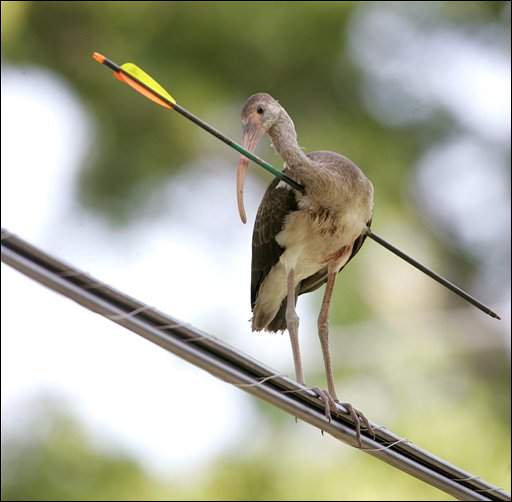
Here's something you don't see every day...an ibis on a power line. Then again, you don't usually see young White Ibis with arrows through their chest either. Apparently, somebody in Florida shot this bird with a practice arrow, and authorities spent two weeks trying to capture the bird to give it medical attention. When those efforts failed, they called off the attempt. Seems the bird is doing OK, hanging out with other birds, and can fly. But what an urban bird horror story!
Besides stray arrows, urban areas pose some of the greatest hazards faced by birds in North America. Fully 10% of all the birds in North America are killed each year by a combination of feral and outdoor house cats (1 billion killed each year) and plate glass windows (another 1 billion killed). That doesn't even count the tens of millions killed by collisions with cars or poisoned by pesticides, or any of the other urban hazards. Is it any wonder that many songbird populations are declining?
So, while bird feeders and handouts from people may encourage some species to hang with their human homies, the hood can be a dangerous place for many birds. One of our biggest challenges of the next century will be to find a way to co-exist with more bird species as the rate of urbanization and exurban residential development continues to escalate. One way to think about this is in terms of win-win or reconciliation ecology.
Can we create cities and suburbs that are as good for birds--even those that usually don't do well in urbanized areas--as they are for people? Can we envision housing developments or commercial districts with Sage Sparrows or Golden-cheeked Warblers living on the roof? Buildings that look more like shrubby or forested hillsides--both to us and to the birds (like the ACROS building in Fukuoka, Japan pictured here)? What is it going to take to start creating habitat, rather than just destroying it, every time we want to "develop" a piece of property? Yeah, baby! That's the kind of progress I'm willing to support.
May I recommend James Downard's excellent review (Part I and Part II) of Ann Coulter's latest anti-evolutionary arguments. The world is a complex place, and it takes some time and effort to wade through the evidence supporting evolutionary theory. In other words, not a task that should be trusted to a political pundit and NY Times best-seller writer without the requisite education.
Smuggled poultry products, not wild birds, are probably the greatest threat. Read this story here. Very few wild birds from infected parts of China will ever fly on their own to North America. Meanwhile, thousands of possibly infected geese, ducks, chickens, and pigeons are potentially smuggled into the US each year.
On my way into work this morning, I stopped at the bird blind at Peace Valley Nature Center for a little relaxation. 22 species of birds were at the feeders, including something I'd never seen before--a juvenile Eastern Towhee (see photo by Birdfoto). It spent most of its time on the ground in the bushes or grass below a couple feeders, but a few times it flew up onto a feeder or into a pine tree. In flight, huge white patches in the wings and white outter tail feathers might remind one of a mockingbird. Eastern Towhees are a species of conservation concern, as they nest in shrubby understory of forests that are the favorite food of the overabundant White-tailed Deer in the East. The nature center here has a deer exclusion fence around the bird feeding area...good to see that at least one baby towhee made it out of the nest there.
Finally, a new yard bird. While eating breakfast this morning, I caught a glimpse of a hummingbird flitting up into a tree on the back end of our lot. I got out the binoculars and was able to watch the immature Ruby-throated Hummingbird get chased around a dead tree by a female House Sparrow. Since our pet goldfish died this week, maybe a new hummingbird feeder is in order to take my kids' mind off the loss of Leoptodon the pet goldfish (named by my kids after the huge prehistoric sea reptile Liopluerodon).
There is a long American tradition of rulers or priests pretending to be birds in their rituals--going back at least to the Izapan culture in southern Mexico before 300 BC. These and similar rituals continued through Mayan and other cultures, including the birdman cult of the Mississippian cultures in Eastern North America up to nearly the time of European contact. Birds, with their ability to fly, seemed to represent many divine powers to these peoples. Some people still believe that the Mesoamerican Principal Bird Diety is important, and that it figures into prophecies concerning cosmic changes to occur in 2012. Apparently, the mystery of living with birds continues, with the bird symbols of the Ancients encouraging additional ways to experience birds beyond the evolutionary ecological paradigm of Western science.
We've all seen it. A grassy field with a muddy track through it, surveyors tape, and nearby construction equipment. For most people, a grassy field probably looks like a perfect light industrial or residential development site. But many of these apparently empty spaces are actually great bird habitat.
I visited one of these this morning. Three Grasshopper Sparrows were singing their high pitched trills in the grass (listen here), and at least half a dozen Savannah Sparrows were flitting about. Both of these birds are increasingly hard to find here in SE Pennsylvania, as their grassy habitat gets bulldozed to make way for sprawling development. A couple of Killdeer were running along the muddy construction road, with their fluffy babies, and an Eastern Meadowlark (another declining grassland bird) flew over as I was getting ready to leave. (Grasshopper Sparrow photo credit: BLM)
As I walked back to my car, I couldn't help but dream of light industrial development that protected grassland habitat--maybe huge low-slung buildings with grassy habitat actually growing on the roof. For a fleeting moment I envisioned myself as a commercial real estate developer struggling to create awesome bird habitat on the rooftops of my buildings. It sure was a better vision than the impending habitat destruction that was actually in front of me.
The latest edition of the American Ornithologists' Union bird checklist is out, announcing a new species of grouse for North America--the bird formerly known as Blue Grouse is now two species, Dusky Grouse and Sooty Grouse. Actually, these two birds were considered separate species by the AOU in the 1920s, but were lumped together as Blue Grouse in 1944. New DNA evidence suggests that they really are separate species, with the Sooty Grouse living in the coniferous forests of the coastal Pacific Northwest, and the Dusky Grouse living in montane forests of the Rocky Mountains.
So, for a while at least, all the field guides to North American birds will be out of date.
I first heard Sooty Grouse while searching for Spotted Owls near Mount Hood in Oregon as a kid, and saw my first Dusky Grouse sitting in a tree in Memorial Cemetery in Salt Lake City in 1993.
The new checklist supplement also makes a lot of rearrangements and changes to scientific names, based on latest research on relationships between species. So, lots of changes reflecting our growing understanding of the world of birds. Pretty fun stuff!
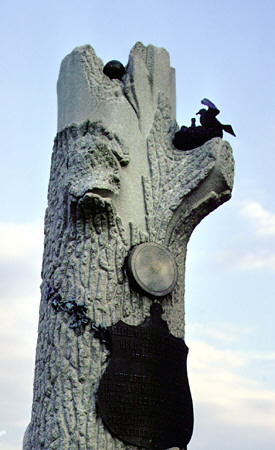
Took the family to Gettysburg this weekend to see the battlefield, and was struck by the Oak Tree monument to the 90th Pennsylvania Volunteer Infantry, featuring a nest with a mother and baby birds on a snag. Apparently, the tree was mostly obliterated and a robin's nest fell down during the battle, and a member of the 90th climbed the tree under heavy fire to replace the nest in the embattled tree. Even during war times, the best of human nature sometimes emerges to help birds placed in harms way by our own actions (photo credit: here).


 RSS Feed (xml)