RSS Feed (xml)
Most interesting bird of the morning was a leucistic (partial albino) Egyptian Goose at Peace Valley. The bird has been around for at least a month.

Skin Design:
Free Blogger Skins

 How far are you willing to go to get some free bird feeders and bird seed? If you are an experienced backyard bird watcher, and willing to count the birds at your feeder for 45 minutes every other day, then Project Wildbird will send you a whole load of good bird feeding equipment to participate in their ground-breaking research on seed and feeder preferences in backyard birds. If you can't commit to that level of bird observing, there are other ways to participate--but you'll have to provide your own feeders and seed.
  This morning I was on Bridget Butler's BEEKS radio program up in Vermont. We discussed the new Audubon Birds to Help resources. There seems to have been some static in the line, but you can listen to the online podcast. Our conversation took up the last 1/3 of the program.
 Last week our Hog Island Audubon Camp cruised out to Monhegan Island on the camp's new boat the Puffin V. On the way offshore we saw lots of Northern Gannets, a Red-necked Phalarope, and some scoters, but the highlight was this Mola Mola swimming next to the boat at point blank range.
 On Monhegan we saw lots of warblers and other migrants, including a Lark Sparrow--a bird usually found much farther west, but that shows up here each year as a vagrant. It was fun to see some Great Cormorants on the rocks at White Head, and we watched a school of tuna attack some baitfish--with some of the larger fish clearing the water while lunging at their prey. A few of us were lucky enough to see a Minke Whale as well. I also had a close encounter with a green snake while hiking back from White Head. Merlins were flying all over the island, and the group got very close looks at a Rusty Blackbird perched on top of a spruce tree.
 On the way back to Hog Island, the best bird was a juvenile Sabine's Gull first seen on the water (and photographed by Scott Weidensaul) and then seen in flight. It has been a long, long time since I've seen one of these beauties--so a special treat. Red-necked Grebes in flight and a few Surf Scoters and White-winged Scoters rounded out the birds as we cruised back into port. A great day of birding with some great company. (photos: Scott Weidensaul)
 Had a great time up at the Migration and Conservation workshop at Hog Island last week. Fun to bird with Scott Weidensaul, Peter Vickery, Alicia King, and the Hog Island staff and workshop participants. Great looks at over 120 bird species, including many warblers, migrating falcons, shorebirds, and some nice seabirds.
 This past week a TV crew filmed us at the Hog Island Audubon Camp migration and bird conservation workshop. Click here to watch the spot online--including a shot of me wolfing down blueberries.
 Next week I'm off to Hog Island for a Bird Migration and Conservation workshop. Last I heard there were a couple spaces left if you want to join me and Scott Weidensaul, Peter Vickery, and Alicia (Craig) King and the Hog Island staff for a week of birding, great food, and inspiration. Come walk where Roger Tory Peterson walked, and see where Steve Kress was inspired to bring Atlantic Puffins back to the Gulf of Maine.
 Snapped a shot of a bald Blue Jay this morning at Peace Valley park. Sometimes molting jays and cardinals look like this--see Cornell's page on this here.
 Another cool bird conservation outreach tool from Audubon. Fly flocks of birds over various landscapes and help them find safe and healthy stopover habitat. Click here to play!
 There's a great lesson from all of us that I get reminded of every year when I'm up at the Hog Island Audubon camp in Maine. Stephen Kress was working at the camp there when he conceived of Project Puffin, an attempt to bring puffin populations back to abandoned nesting colonies on islands in the Gulf of Maine. The puffins we get to see out at Eastern Egg Rock during the camp are only there because of Dr. Kress's efforts.
 While most of us don't have access to remote islands to practice the restoration of bird populations, many of us do have yards or property that can be improved for birds. Can you do on your property what Steve Kress did on his? Can you create a better environment that will attract and support birds that might have abandoned your neighborhood as homes and lawns replaced native habitats? Audubon's Birds to Help resources and other Audubon At Home materials are created in this spirit. Make the world a better place for you and the birds. You probably won't get a puffin in your birdbath, but you can make your property or yard more inviting to other native birds that need your help to thrive in our neighborhoods.
 Last week I got to help out with another Audubon Chapter Leadership Camp on Hog Island, Maine. We had 27 Audubon chapter leaders there for workshops and birding and magnificent food. In between exploring tide pools, hiking, and taking boat trips to see Atlantic Puffins, Black Guillemots, and Common Eiders, we spent a lot of time looking at warblers--some still tending their young and some migrating through. Highlights for me were a couple of Cape May Warblers--a warbler I don't get to see that often.
 Earlier this summer Audubon released a report on common birds in decline. Now Audubon has produced Birds to Help--a resource suggesting birds that homeowners and other private landowners can help in urban, suburban, and rural areas. While these aren't all the birds that need help, these are some of the birds that landowners can most easily help. They also represent birds that need help to thrive in most residential areas--so they are a good place to start if you want to help local birds.
.jpg) I got a call at work about a male European Goldfinch coming to a feeder near Core Creek Park in Langhorne. Its only 20 minutes from work so slipped over there on my lunch break. After half an hour of standing in the drizzling rain the bird came in and fed at the feeder for about 6 minutes at 12:30pm. (photo credit: Trev Feltham)
I got a call at work about a male European Goldfinch coming to a feeder near Core Creek Park in Langhorne. Its only 20 minutes from work so slipped over there on my lunch break. After half an hour of standing in the drizzling rain the bird came in and fed at the feeder for about 6 minutes at 12:30pm. (photo credit: Trev Feltham) Downtown Salt Lake City has some unique bird habitat. Here's a California Quail right on temple square downtown. The dome in the background is the historic tabernacle, home of the Mormon Tabernacle Choir.
 My favorite patch of habitat is the rooftop garden on top of the LDS Conference Center. How many other places let you walk around on their roof? Not many. Even fewer have a three acre meadow of native grasses and pine trees up there. So there's a lot more to do on temple square than getting a quick overview of Mormon history and beliefs. If you find yourself with a little time in downtown Salt Lake City, check it out. And let me know what birds you find on temple square.
 Ever hear of a Google Gadget? Its a small add-on to your Google search page that provides customized information to your browser. Now there's a rare bird Google Gadget that can bring you the latest rare bird info in real time as it is submitted to eBird. The eBird rare bird gadget sits right there on your Google search page, and whenever a rare bird is reported in your area, it shows up immediately--along with a note of who saw the bird, whether it has been confirmed by an eBird reviewer, and--perhaps best of all--a Google Map showing exactly where the bird was seen!
  Last night I figured out that with a little juggling I could manage a 15 minute stop at the Western Reef-Heron site in Brooklyn on my way to another appointment. I spent a restless night wondering if it was worth hauling my three kids over there after so much heartbreak. The bird had never been seen three days in a row, so it seemed a bit crazy to try again. And with limited time to search, it seemed like a recipe for failure. Besides, the polluted Coney Island creek inlet is hardly scenic, has been the scene of some strange goings on, and not the kind of place I'd really want my kids to spend a whole lot of time.
1) High School birding buddy David Bailey at Eva Calidris Bailey.
2) Fellow college radical Matt at The Underview.
3) Underground college paper mate Russell at In Medias Res.
4) Foodie and fellow birder Scott at Dallas Food.
5) The crafty and not so birdy Cheff Messy.
6) Favorite Austin musician and sometime birder Kim at Boneyard Media.
7) Texan birder John at Swampblog.
8) Winging It editor Rick at Aimophila Adventures (I'll get you that article soon, promise!)
 Jittery. Nervous. My own case of Reefer Madness. Lots of good birds to look at. OK, a few interesting birds to look at. Least Terns diving and carrying fish back to a nest somewhere. Common Terns flying around and feeding young. Black Skimmers doing the same. Then at one point a yellow and green Budgerigar flew past the 30 or so anxious birders watching the channel.
 And not just good for birds, good for home and business owners. These windmills go right on your house or business--bringing the benefits of windpower right to your rooftop. Check out the various models at PacWind. You could be the first one on your block to get one...unless you live on Jay Leno's block. He's already got one.
 Even if you didn't win a copy of Steve Kress's The Audubon Society Guide to Attracting Birds playing the IATB Sweepstakes, here's why you should get yourself a copy--its an absolutely amazing resource put together by a legend in the field of bird conservation. While there are literally hundreds of books out there on how to attact birds to your yard--this is one of the very best. Steve Kress has written several other books along this line, but this is the one where he had the freedom to put in all of the extra stuff that wouldn't fit in some of the other books.
 The Prize
 Yesterday I visited Mill Grove, where John James Audubon began his journey of discovering American birds, and where as a young adult he met and married his longsuffering wife Lucy. A lot has changed in the past 200 years. The landscape is now one of mature trees and highways, rather than agricultural fields. The Perkiomen Creek still flows past down below the house, and many birds enjoy the environs of this county park and Audubon Center.
 Here's the dirty little secret in the bird marketing world--real birders HATE the Audubon Singing Bird Clock. You know, the one with a different bird picture marking each hour and that gives that bird's call when the clock strikes that bird's hour. At $19.95 its a not an expensive gift, and its an all time best-seller in the bird merchandizing world. And maybe that's the problem with the clock--many birders just find too many incongruities between the worlds of birds and marketing. No offense to the clock people, many birders feel the same way about bird mugs, dishrags, or pillowcases. There's a wide divide between bird people and bird mug people.
 On Saturday, I woke up early and hiked up the mountain behind The Canyons at Park City. Lots of old friends up there--Virginia's Warbler, MacGillivray's Warbler, Dusky Flycatcher, and my favorite of the morning, four booming Ruffed Grouse. I love how you almost feel the low wingbeating of the grouse before you actually hear them. Its been probably ten years since I've heard these guys, so a real treat. (grouse photo credit: Utah DNR)
 Friday I flew to Salt Lake City to take part in some Global Warming meetings at Park City. On my way to the meetings I stopped by some of my old stomping grounds, including Farmington Bay. Fun to see American Avocets, Black-necked Stilts, and Cinnamon Teal--old friends that I don't get to see too much of out here in Pennsylvania. (photo credit:Sandra Bray/Great Salt Lake Audubon)
  Some birds are old friends that you only see now and again. This morning, on my way to work, I stopped by Pine Run to look for shorebirds. Walking back to my car, a Bobolink flew up out of the field and circled me while singing. This past weekend, I’d seen three Bobolinks in a horse pasture in Ambler, where I always see them on my birdathon, but this was my first one for Bucks County. (photo credit: USFWS)
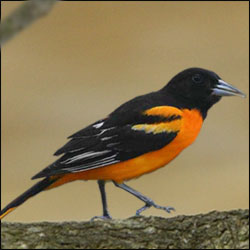
 A colorful assemblage of migrants at work this morning, including brilliant blue male Indigo Bunting and everyone's favorite orange and black Baltimore Oriole. Not much singing in the woods, Warbling Vireo, Northern Parula. A male Eastern Bluebird was defending a nest box from four dive-bombing Tree Swallows in the field by the barn. Common Yellowthroats were singing in the brush below the power lines. (photo: National Park Service)
 On the way to work this morning I found a nice breeding plumage Dunlin at Pine Run. This sandpiper, formerly known as Red-backed Sandpiper or Black-bellied Sandpiper, is a rare migrant in Bucks County, seen only a couple times a year if that, so a nice way to start the week. Also saw my first Solitary Sandpiper of the year at Pine Run, and a lingering Bonaparte's Gull at Peace Valley. (photo: USFWS)
 I was in DC yesterday, and busy this morning, so didn't check my email until 3pm--when I learned that yesterday Cameron Rutt had discovered a Yellow-billed Loon about 100 miles away near Harrisburg. It was still there this morning, so within an hour my 4th grader and I were in the car cruising west on I-78. By 5:30 we arrived, a few birders were still there, and the bird was in view. We watched it and followed it as it dove just offshore in the Susquehanna River. This is another bird that I had chased and missed several times as a kid growing up in Oregon, so it was sweet to finally see this bird. Its almost in complete alternate (breeding) plumage, which is another treat, since most birds that wander down to the Lower 48 from Alaska and Canada are in basic (nonbreeding/winter) plumage and not nearly as classy looking as this beauty! What a great bird to end the day! (photo: Cameron Rutt)
 Sitting at my desk the fun continued at work today, when a brilliant male Rose-breasted Grosbeak flew to the seed feeder a few feet from my window. It spent several hours there, off and on, munching on seeds. Each year I get dozens of emails at work from folks seeing these birds for the first time--they're always blown away and think they've found something totally rare and unusual. They are spectacular birds. Ah, Spring! (photo: Bedford Audubon).