


 RSS Feed (xml)
Monday, June 26, 2006
Peace Valley in the rain
Saturday I took a group of 15 cubscouts and leaders out to find birds at Peace Valley and it poured down rain the entire time. Fortunately, there were still plenty of birds visiting the feeders at the bird blind--so the kids got good close looks at Ruby-throated Hummingbird, Blue Jay, Downy Woodpecker, and a dozen other species. Then, down at the bridge, we saw a dozen more birds, including Great Blue Heron and a moulting and flightless but stunning male Common Merganser. Unfortunately, the Osprey was about a mile away perched in a tree--too far to really even scope it well for the kids, even if I hadn't left my scope in the car due to the rain. All in all, about 25 species and a lot of fun in the rain, with some birds, and a few minutes teaching kids how to pull out invasive exotic garlic mustard!


Friday, June 23, 2006
Animals in Translation
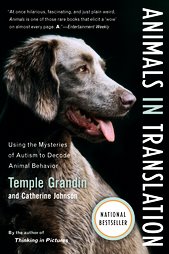 Last night I finished reading Animals in Translation by autistic animal researcher Temple Grandin. I always like Grandin's books, because she makes animal behavior so accessible to the average reader. In this book, she goes farther than she has before to explain just why animals do what they do. In doing so, she draws upon research in many academic fields, as well as her own experience designing humane slaughterhouses for domestic animals.
While most of Grandin's examples of animal behavior are based on studies of mammals, especially domestic livestock and companion animals, she does address birds at several points--including the remarkable case of the Grey Parrot Alex, which Dr. Irene Pepperberg has taught to speak rudimentary English, and which taught himself to spell simple words.
This is a great book for anyone that wants an introduction to what it is like to be an animal, including how much of our emotional and mental life humans share with animals. Humans and animals share much of the same brain chemistry, and Grandin does a good job of explaining what that means while exploring human and animal brain similarities and differences. Grandin is at her best when explaining the behavior of mammals--especially the livestock that she deals with. When she deals with bird migration, she seems to indicate that all birds must learn their migratory pathways--something that is only true for some birds. Most songbirds have their migratory pathways--at least the direction and distances--automatically programmed genetically.
Grandin may be in a unique position to explore the minds of animals, as her autism seems to make her process some information in ways similar to some animals. This allows her (with co-author Catherine Johnson, who is the mother of autistic children) to "translate" animal behavior in ways that the average person can easily understand and appreciate.
I really enjoyed this book, and would especially recommend it to my friends who think that humans occupy a priveledged position in the world based on their linguistic abilities. It was fun to think about music--including birdsong--as being an additional form of language, processed as such by the same area of the brain that handles human language, and to read about Dr. Con Slobodchikoff's findings that prairie dogs use nouns, verbs, and adjectives in their verbal communication, as well as speculation by some researchers that early human interactions with wolfs domesticated both humans and dogs--teaching dogs to be able read human body language as well as teaching humans to work cooperatively and defend territories.
Birding this morning, after reading this book, really had me thinking about the animals I was watching--and who I could see watching me. If you've ever wondered what it is like to be a dog, cat, bird or other animal, this book is an accessible place to start learning how to better translate animal behavior.
Peace Valley
Stopped by Peace Valley on the way to work this morning and picked up 38 species at the bird blind and trails around the nature center. Lots of birds still singing, including Yellow Warbler, Red-eyed Vireo, Indigo Bunting, and House Wren. Baby birds on their own included Carolina Chickadee, Northern Cardinal, and a short-tailed fledgling Gray Catbird begging and being fed by a parent.
Four male Brown-headed Cowbirds were displaying on the ground near the bird feeders at the bird blind--rushing towards each other with wings extended and drooped down, making a liquid sounding "gurgle-oo" call.
Very few water birds on the lake--two Green Herons hunting near the bridge, three Great Blue Herons (including one juvenile bird), eight mostly young Double-crested Cormorants, two female Mallard with young, and a single male Common Merganser.
Four male Brown-headed Cowbirds were displaying on the ground near the bird feeders at the bird blind--rushing towards each other with wings extended and drooped down, making a liquid sounding "gurgle-oo" call.
Very few water birds on the lake--two Green Herons hunting near the bridge, three Great Blue Herons (including one juvenile bird), eight mostly young Double-crested Cormorants, two female Mallard with young, and a single male Common Merganser.
Thursday, June 22, 2006
Monitoring migrant birds for bird flu
Bird researchers are cooperating to monitor migrant birds for H5N1 bird flu across North America. According to the latest Land Migration Monitoring Network of the Americas newsletter:
For more info on the search for H5N1 in Alaska, see the latest USA Today story here. Unfortunately, the story overstates the case for wild birds carrying the virus from Tibet to Europe last year.
In all likelihood, the virus was carried to Tibet and across Asia to Eastern Europe by poultry or poultry products. Mute Swans may have contracted the virus from infected poultry in Eastern Europe, then carried it to Western Europe in mid winter. We still have a lot to learn about how this virus spread last year, and FAO speculations about wild birds carrying the virus across Asia are apparently based on a faulty understanding of the migratory pathways of Asian birds. It is curious that the FAO continues to focus on the role of wild birds, while admitting that "human activities such as poultry production and trade are principally responsible for spreading the disease" (see article here).
LaMMNA has just successfully completed its first season of avian influenza monitoring and we thank all those who participated. A total of 33 member organizations from 21 states participated, representing a wide range of operations from small, single-operator stations to large multi-station observatories. They captured 20,000 birds during their spring operations at 40 stations. Of those, they sampled 1,000 birds with cloacal swabs, pulling tail feathers for DNA analysis. The samples are now on their way to UCLA for analysis.
For more info on the search for H5N1 in Alaska, see the latest USA Today story here. Unfortunately, the story overstates the case for wild birds carrying the virus from Tibet to Europe last year.
In all likelihood, the virus was carried to Tibet and across Asia to Eastern Europe by poultry or poultry products. Mute Swans may have contracted the virus from infected poultry in Eastern Europe, then carried it to Western Europe in mid winter. We still have a lot to learn about how this virus spread last year, and FAO speculations about wild birds carrying the virus across Asia are apparently based on a faulty understanding of the migratory pathways of Asian birds. It is curious that the FAO continues to focus on the role of wild birds, while admitting that "human activities such as poultry production and trade are principally responsible for spreading the disease" (see article here).
Cover-up on date of first H5N1 infection in China in 2003
According to this latest New Scientist article,
There have been other rumors of thousands of human cases in islolated areas of China. Unless we get good numbers on infections and deaths, we can't begin to really understand how widespread or dangerous this bird flu virus may be to people. I suspect that there has been thousands of unconfirmed, undocumented, or unreported cases--indicating that the virus may be slightly easier to contract than previously confirmed, as well as far less lethal than the current official numbers (228 cases, 130 deaths) indicate.
A man died of H5N1 flu in Beijing in November 2003 - two full years
before China admitted any human cases of H5N1. The death of the 24-year-old from bird flu came months before China even admitted H5N1 was circulating in its poultry. The man was tested for respiratory illness because of concern in the wake of the SARS epidemic.
It is not clear when the Chinese scientists who reported the finding discovered this, but they tried to withdraw their paper from the New England Journal of Medicine at the last minute on Wednesday. It was too late to prevent publication.
The case suggests that, as has long been suspected, many more people have caught H5N1 flu in China than have been reported, and for a longer time. The more human cases there are, the more chances the virus has to evolve into a human pandemic strain of flu.
There have been other rumors of thousands of human cases in islolated areas of China. Unless we get good numbers on infections and deaths, we can't begin to really understand how widespread or dangerous this bird flu virus may be to people. I suspect that there has been thousands of unconfirmed, undocumented, or unreported cases--indicating that the virus may be slightly easier to contract than previously confirmed, as well as far less lethal than the current official numbers (228 cases, 130 deaths) indicate.
Baby phoebe's wild ride
Yesterday, Steve from work called me just after I got home with a funny story. He was hearing a regular beeping sound as he drove home, and finally realized that one of the baby phoebes from the barn had fledged and ended up inside his car. That will teach him to park in the barn with the windows down! Steve was driving back to work to release the bird when he called me.
This morning, the phoebes were all off the beam near their nest. I guess yesterday was fledge day. Good luck little guys!
This morning, the phoebes were all off the beam near their nest. I guess yesterday was fledge day. Good luck little guys!
Wednesday, June 21, 2006
Ann Coulter--are you kidding me?
Ann Coulter's latest book Godless, has a whole section claiming that evolution is not real science, but all a pack of lies. Are you kidding me? How is it that the #1 selling book in America could be so outrageously wrong? I haven't had a chance to read it yet, but I've been hearing Coulter all over the radio recently. If anyone wants to send me a copy, I'd love to pick that section apart piece by piece. Meanwhile, folks looking for more info on evolution can start with some resources here.
Please, America. Buy whatever books you want. But don't get sucked in to thinking that Coulter is even on the same planet when she starts talking about evolution. Nothing we've learned about the world of living things in the past 150 years makes any sense without an understanding of the evolutionary history of life. Evolution is a fact, not fiction. You can't say the same for Coulter's claims about it.
Please, America. Buy whatever books you want. But don't get sucked in to thinking that Coulter is even on the same planet when she starts talking about evolution. Nothing we've learned about the world of living things in the past 150 years makes any sense without an understanding of the evolutionary history of life. Evolution is a fact, not fiction. You can't say the same for Coulter's claims about it.
More Phoebes
Seems like phoebes are the bird du jour right now. Artist and blogging friend Julie Zickefoose is taking care of and painting young pheobe orphans in Ohio, while three baby pheobes in the barn here at work are biding their time sitting on a ledge just outside their nest. They'll be flying off any day now. Its a scary time to be a baby bird. Good thing they don't know what they are in for!
Audubon's Phoebe
 In 1803, John James Audubon wrote about his experience with Eastern Phoebes nesting behind his house along Perkiomen Creek west of Philadelphia:
"When they were about to leave the nest, I fixed a light silver thread to the leg of each, loose enough not to hurt the part, but so fastened that no exertions of theirs could remove it. At the next year's season when the Phoebe returns to Pennsylvania I had the satisfaction to observe those [birds nesting in the Perkiomen] cave and about it. Having caught several of these birds on the nest, I had the pleasure of finding two of them had the little ring on the leg."
I live 20 miles upstream from Audubon's house at Mill Grove along the Perkiomen, and this weekend heard several phoebes down at the creek while catching crayfish with my kids. With over 200 generations of phoebes having come and gone since Audubon's time, if any of those phoebes have living descendants, it is statistically almost a certainty that the birds nesting under the bridge behind my house are the direct descendants of the birds that Audubon banded.
We are all connected without knowing exactly how, and its fun to get a glimmer of exactly how that happens. There's only 20 miles and 150-200 phoebe generations between me and the great J.J. Audubon.
Birding by ear in NYC
Another afternoon of Audubon meetings in NYC netted me sightings of crows, starlings, House Sparrows, and pigeons from the windows of 700 Broadway. After the meetings, I was greeted by a familiar sound (listen here) as I stepped out onto the sidewalk--the high rapid chittering of Chimney Swifts. Looking up, I couldn't see the birds initially, but then two swifts cruised across the sky between the rims of the urban canyon. Nice ot see a native bird making its way here in the heart of America's largest city. It was a magic moment standing there looking up, with dozens of passerbys streaming past me oblivious to the aerial dance occuring 150 feet above the street.
Monday, June 19, 2006
Why I blog about birds
While I'm convinced that some sort of addiction is at the root of why I bird, I think other brain chemicals like endogenous opioids may be responsible for why I blog about birds. When I was a kid, a large supportive birding community was one of the reasons I moved on to birds from an interest in reptiles and amphibians. Catching lizards gave me a physical rush, but was rather socially isolating in middle school. Birding, however, gave me a dopamine rush, as well as social support.
I've tried to remain a part of the birding community as I've gotten older, but it has gotten harder, rather than easier. For a long time, I was trying to bird almost every day, which made it hard to regularly bird with others who don't have the same schedule flexibility or intense birding drive. More recently, I've been busy with work and three kids. In some places I've lived, there hasn't been a strong and active birding community. And over the past 10 years, the internet has revolutionized the way that many birders interact. With birding listservs, it is far more common to know other birders by their email address and listserv posts, than by spending time with them in the field.
So, I started blogging about birds back in 2000...back before it was really called blogging. My initial bird blog was to post bird sightings from Hornsby Bend, the best birding spot in Austin, Texas. I was tired of tying up the TEXBIRDS email list with my daily sightings report, so I started up a website where I could write as much as I wanted. This served as something of a local rare bird alert, as well as a way to really talk about local bird distribution without annoying everyone else in Texas who didn't care about Hornsby Bend. Originally I coded these posts in HTML, and eventually started composing them with Netscape Navigator. You can take a look at some of those early proto-blog posts here, here, and here.
So, my initial blog was to help stimulate birding at my local patch, and to help build something of a birding community that I didn't find in Austin when I moved there. We had a local Audubon chapter, but it wasn't the active (some would say hyper-active) birding community that I craved. This first blog was an attempt at community building. And to further that end, eventually I discontinued it as a private blog, and set it up as more of a community bulletin board. It continues in that format today, as the Hornsby Bend Recent Bird Sightings page (see the sidebar there on the left).
I started my second blog--Urban Birdscapes--in January 2004 to promote urban bird conservation--the topic of my PhD research. This blog let me discuss issues I was interested in. It was also a way for me to keep up with media reports related to my research. I kept that blog going until I started working for National Audubon in late 2004. I'm still hoping to start an urban bird conservation blog on the National Audubon website, but that hasn't happened yet. And since I haven't finished the PhD yet, maybe I need to start up that blog again to help me get through the final writing stages.
At any rate, after I discontinued Urban Birdscapes, I started this current blog back in 2004 as I was preparing to make the move from Texas to Pennsylvania. I was finding myself with less time for birding, and really missing the dopamine rush. So, I tried to use this blog as another excuse to go birding. I reasoned that if I had to post something every day or two, then I'd have to go birding to get stuff to post about.
Well, that strategy hasn't always worked as my bird conservation work frequently keeps me busy. But, it has helped somewhat. I've taken more bird walks during the middle of my day, and taken some extra birding efforts here and there along the way. The blog has also given me another way to talk about some of the issues that I think are important. In particular, as avian influenza spread across the old world last year, and with increasing anxiety about it getting to the U.S., I've been able to use this blog to provide commentary on the latest media reports and scientific research related to the bird flu. I've also commented occasionally on the Ivory-billed Woodpecker search in Arkansas. And when there are interesting news articles or research about birds that catch my eye, its fun to talk about them here. Or to just ruminate, as in this post, about the whys behind it all.
I love birding, and when I can't be birding, I like to share my thoughts about birds and birding. It helps me feel like part of the birding community that nourished me as a young birder. And it allows me to explain my birding obsession to my non-birding family and friends.
Many bird bloggers also take photos of birds. I love that, but I have resisted photography for the past 25 years. I haven't wanted anything to take away from the buzz of the search for birds, and photography seemed to slow down the pace of the action. But I'm increasingly wishing I could share the actual birds I see, and their activities, with my blogging friends. S I'm starting to reconsider the time, energy, and money it takes to do some digiscoping or other bird photography. As long as it doesn't stand in the way of my getting a dopamine rush from birding, or cost me a fortune, then maybe I'm up for it. It may turn out that a desire to share bird photographs here become another example of this blog encouraging me to expand the scope of my birding activities.
I'm sure there are brain chemicals that lead us to seek social contact with others. A blog isn't the best way to get that kind of social contact or chemical buzz, but it helps a little. Since we can't all go birding together all the time, at least we can keep up with each other here in the blogosphere.
I've tried to remain a part of the birding community as I've gotten older, but it has gotten harder, rather than easier. For a long time, I was trying to bird almost every day, which made it hard to regularly bird with others who don't have the same schedule flexibility or intense birding drive. More recently, I've been busy with work and three kids. In some places I've lived, there hasn't been a strong and active birding community. And over the past 10 years, the internet has revolutionized the way that many birders interact. With birding listservs, it is far more common to know other birders by their email address and listserv posts, than by spending time with them in the field.
So, I started blogging about birds back in 2000...back before it was really called blogging. My initial bird blog was to post bird sightings from Hornsby Bend, the best birding spot in Austin, Texas. I was tired of tying up the TEXBIRDS email list with my daily sightings report, so I started up a website where I could write as much as I wanted. This served as something of a local rare bird alert, as well as a way to really talk about local bird distribution without annoying everyone else in Texas who didn't care about Hornsby Bend. Originally I coded these posts in HTML, and eventually started composing them with Netscape Navigator. You can take a look at some of those early proto-blog posts here, here, and here.
So, my initial blog was to help stimulate birding at my local patch, and to help build something of a birding community that I didn't find in Austin when I moved there. We had a local Audubon chapter, but it wasn't the active (some would say hyper-active) birding community that I craved. This first blog was an attempt at community building. And to further that end, eventually I discontinued it as a private blog, and set it up as more of a community bulletin board. It continues in that format today, as the Hornsby Bend Recent Bird Sightings page (see the sidebar there on the left).
I started my second blog--Urban Birdscapes--in January 2004 to promote urban bird conservation--the topic of my PhD research. This blog let me discuss issues I was interested in. It was also a way for me to keep up with media reports related to my research. I kept that blog going until I started working for National Audubon in late 2004. I'm still hoping to start an urban bird conservation blog on the National Audubon website, but that hasn't happened yet. And since I haven't finished the PhD yet, maybe I need to start up that blog again to help me get through the final writing stages.
At any rate, after I discontinued Urban Birdscapes, I started this current blog back in 2004 as I was preparing to make the move from Texas to Pennsylvania. I was finding myself with less time for birding, and really missing the dopamine rush. So, I tried to use this blog as another excuse to go birding. I reasoned that if I had to post something every day or two, then I'd have to go birding to get stuff to post about.
Well, that strategy hasn't always worked as my bird conservation work frequently keeps me busy. But, it has helped somewhat. I've taken more bird walks during the middle of my day, and taken some extra birding efforts here and there along the way. The blog has also given me another way to talk about some of the issues that I think are important. In particular, as avian influenza spread across the old world last year, and with increasing anxiety about it getting to the U.S., I've been able to use this blog to provide commentary on the latest media reports and scientific research related to the bird flu. I've also commented occasionally on the Ivory-billed Woodpecker search in Arkansas. And when there are interesting news articles or research about birds that catch my eye, its fun to talk about them here. Or to just ruminate, as in this post, about the whys behind it all.
I love birding, and when I can't be birding, I like to share my thoughts about birds and birding. It helps me feel like part of the birding community that nourished me as a young birder. And it allows me to explain my birding obsession to my non-birding family and friends.
Many bird bloggers also take photos of birds. I love that, but I have resisted photography for the past 25 years. I haven't wanted anything to take away from the buzz of the search for birds, and photography seemed to slow down the pace of the action. But I'm increasingly wishing I could share the actual birds I see, and their activities, with my blogging friends. S I'm starting to reconsider the time, energy, and money it takes to do some digiscoping or other bird photography. As long as it doesn't stand in the way of my getting a dopamine rush from birding, or cost me a fortune, then maybe I'm up for it. It may turn out that a desire to share bird photographs here become another example of this blog encouraging me to expand the scope of my birding activities.
I'm sure there are brain chemicals that lead us to seek social contact with others. A blog isn't the best way to get that kind of social contact or chemical buzz, but it helps a little. Since we can't all go birding together all the time, at least we can keep up with each other here in the blogosphere.
Why I Bird
I wanted to come up with a Top 10 reasons why I bird post, but could only come up with 5. So, here goes. The Top 5 reasons why I bird:
1) The chase. Going out and looking for birds provides a dopamine rush that satisfies my hunting instinct. There is a lot of recent brain research to suggest that our brains are wired to get a thrill out of anticipating rewards. Some get their kick from shopping, I get it from looking for birds.
2) I like being outdoors. I must get additional brain chemical satisfaction from being outside.
3) Beyond just being outdoors, I like to feel connected to the world around me. By looking for birds, I have to place myself in their world. That makes me feel more connected. Without that connection, I feel incomplete.
4) I think, really, at this point I'm completely addicted. I think I've birded so much, and flooded my brain with so many nice chemicals during birding trips, that its hard to function without them!
5) If I can't be birding, then I can get a dopamine rush just anticipating birding. So, I'm always just one thought away from getting a wanting-to-go-birding high.
I wish there were more intellectual or socially-responsible answers to why I like to bird. But really, when it comes down to it, those answers would really just be me trying to justify my own addiction. So, the bottom line. Q: Why do I bird? A: Dopamine and probably a handful of other nice brain chemicals.
1) The chase. Going out and looking for birds provides a dopamine rush that satisfies my hunting instinct. There is a lot of recent brain research to suggest that our brains are wired to get a thrill out of anticipating rewards. Some get their kick from shopping, I get it from looking for birds.
2) I like being outdoors. I must get additional brain chemical satisfaction from being outside.
3) Beyond just being outdoors, I like to feel connected to the world around me. By looking for birds, I have to place myself in their world. That makes me feel more connected. Without that connection, I feel incomplete.
4) I think, really, at this point I'm completely addicted. I think I've birded so much, and flooded my brain with so many nice chemicals during birding trips, that its hard to function without them!
5) If I can't be birding, then I can get a dopamine rush just anticipating birding. So, I'm always just one thought away from getting a wanting-to-go-birding high.
I wish there were more intellectual or socially-responsible answers to why I like to bird. But really, when it comes down to it, those answers would really just be me trying to justify my own addiction. So, the bottom line. Q: Why do I bird? A: Dopamine and probably a handful of other nice brain chemicals.
Friday, June 16, 2006
Birds, Evolution, and God
While religion and politics are two subjects that can easily shut down polite conversation, the previous post and the following image (bottom of post) sparked a moment of reflection.
I grew up in a conservative religious household and was taught that evolution was wrong and that God created the world 7,000 years ago. While I'm still an active member of my childhood religion, I've long since moderated my views. I'm now a card carrying evolutionist. I still believe in God, but I believe that the world is very, very old and that all life forms on the planet are related through familial relationships that go back hundreds of millions of years.
To me, that makes the world a richer place. Bigger. Older. More amazing. Rather than believing in a God who waved a magic wand and ushered the creation into being 7,000 years ago, I now see a God working out a plan of eternal progression through the choices and life experiences of billions of creatures over billions of years.
My views about God are personal, but my views about evolution are public. They are based on facts that are readily accessible to anyone. They are based on years of studying those facts. When I graduated from college, with my doubt about evolution intact, I enrolled in another university to study genetics, evolution, and ecology. I studied, and prayed, and tried to open myself up to the facts. And while we still have a lot to learn about how evolution actually happens, there are no facts available to discredit the observable reality that evolution has taken place, and continues to take place, here on earth.
With all due respect to the Bible, its an old book with an ancient understanding of humans and our relationship to the rest of nature. While there is much good to be derived from that book, and I value the depiction of Adam and Eve as stewards of nature, the Bible does not even begin to compare to modern science in its ability to describe, predict, and interpret the origins and continuation of the physical and biological world around us.
I rarely go birding on Sunday. That's my day of rest and I spend it at church and with my family. Sometimes I'll take my kids on a nature walk. And when my nine year old asks me about God, science, and the Bible, I explain that science is a great tool to help us understand the origins and workings of the world and its creatures, but that prayer and the scriptures help us understand how we should relate to that world, other people, and our more distant relatives--all the other creatures on earth. I'm a big genealogy nut (something else I picked up from my religion), and for me, birding is a family reunion with distant cousins. While that may sound strange to my traditional Christian friends (just as my belief in God is a puzzlement to many of my scientific colleagues), that's just part of the joy and mystery that I experience living with birds.

BTW, for more info on keeping discussions about God--which can only be experienced subjectively or from within a religious community--out of science classrooms dedicated to teaching of publicly observable truths, see here.
I grew up in a conservative religious household and was taught that evolution was wrong and that God created the world 7,000 years ago. While I'm still an active member of my childhood religion, I've long since moderated my views. I'm now a card carrying evolutionist. I still believe in God, but I believe that the world is very, very old and that all life forms on the planet are related through familial relationships that go back hundreds of millions of years.
To me, that makes the world a richer place. Bigger. Older. More amazing. Rather than believing in a God who waved a magic wand and ushered the creation into being 7,000 years ago, I now see a God working out a plan of eternal progression through the choices and life experiences of billions of creatures over billions of years.
My views about God are personal, but my views about evolution are public. They are based on facts that are readily accessible to anyone. They are based on years of studying those facts. When I graduated from college, with my doubt about evolution intact, I enrolled in another university to study genetics, evolution, and ecology. I studied, and prayed, and tried to open myself up to the facts. And while we still have a lot to learn about how evolution actually happens, there are no facts available to discredit the observable reality that evolution has taken place, and continues to take place, here on earth.
With all due respect to the Bible, its an old book with an ancient understanding of humans and our relationship to the rest of nature. While there is much good to be derived from that book, and I value the depiction of Adam and Eve as stewards of nature, the Bible does not even begin to compare to modern science in its ability to describe, predict, and interpret the origins and continuation of the physical and biological world around us.
I rarely go birding on Sunday. That's my day of rest and I spend it at church and with my family. Sometimes I'll take my kids on a nature walk. And when my nine year old asks me about God, science, and the Bible, I explain that science is a great tool to help us understand the origins and workings of the world and its creatures, but that prayer and the scriptures help us understand how we should relate to that world, other people, and our more distant relatives--all the other creatures on earth. I'm a big genealogy nut (something else I picked up from my religion), and for me, birding is a family reunion with distant cousins. While that may sound strange to my traditional Christian friends (just as my belief in God is a puzzlement to many of my scientific colleagues), that's just part of the joy and mystery that I experience living with birds.

BTW, for more info on keeping discussions about God--which can only be experienced subjectively or from within a religious community--out of science classrooms dedicated to teaching of publicly observable truths, see here.
First Modern Bird
 One of the things I love about birds and other animals, are the evolutionary ties that bind us together over hundreds of millions of years. Birds have been flying about since the Mesozoic Era, when our own ancestors were small creatures that looked almost nothing like us. A find published today in Science reveals the earliest known "modern" bird--something that looks like a duck or a loon. Earlier birds belonged to orders that have since died out, but this bird (Gansus yumenensis) appears more closely related to the birds that survived the extinction at the end of the Cretaceous Period about 65 million years ago. See a story about the find here.
Last Child in the Woods
 One of the highlights of my trip to Aullwood was getting to spend a little bit of time with Richard Louv, author of Last Child in the Woods. His book is a review of the importance of nature experiences for the development of children, and how Americans are losing those experiences and kids are suffering "nature deficit disorder" because of loss of accessible natural areas and increasingly indoor suburban lifestyles. While playing with some box turtles at the Aullwood center, Richard told a few of us about his experiences with box turtles as a kid.
 Before I was a bird guy, I was a ten year old wannabe herpetologist. We didn't really have turtles in Western Oregon, but we had a fair number of frogs, salamanders, and a few lizards and snakes. I spent hours and hours searching for them, dreaming about them, drawing them...basically eating, breathing, and sleeping them for a couple years starting in fourth grade. I eventually moved on to birds (more variety, larger support group, etc.), but still have a fondness for our little cold-blooded neighbors.
Environmental educators speculate about how important it is for kids to have good experiences with nature. I can trace my own career path as an environmental professional) back to those childhood moments, and so can many others. But how many of the other kids that were out catching snakes with me now think twice about animals or the environment? Experiences with nature would seem to be a necessary, but not sufficient, determinant of favorable environmental attitudes.
For me, life without birds, herps, and nature is only a pale shadow of a life. Going day to day without birds is like watching black and white television. Or like eating fat-free salad dressing. Like living in Plato's cave. I've gotta have my bird fix to make it through the day. Recently, my day to day birding has left me feeling a bit malnourished. I need more outside time with birds to cure my own case of nature deficit disorder.
Aullwood
 Just got back from a couple days at an Audubon Educators conference at the Aullwood Nature Center near Dayton, Ohio. Nice drive there and back, and some good walks there in the woods. I saw 50 species one morning in the woods including a nice female Yellow-throated Warbler that dropped down to look at us from high in a sycamore. Also, nesting bluebirds and Indigo Buntings. You know you are seriously addicted to birds when you only get the tiniest buzz from two hours and 50 species of Eastern woodland birds. Too many meetings, not enough birds! More cool were the Timber Rattlesnake and Massasauga in the nature center.
Monday, June 05, 2006
Fork-tailed Flycatcher
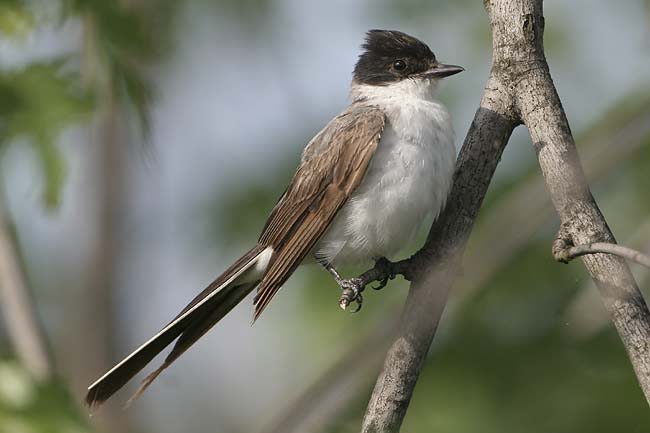 I had company all weekend, didn't have email access, and had a funeral to go to this morning--perfect timing for a rare bird to show up! When I got in to work today I found out about a Fork-tailed Flycatcher seen yesterday about half an hour away from my office. Finally, after the funeral, I took off with Paul Green to chase this nemesis bird along the Delaware River in Morrisville (photo: Adrian Binns).
Nine years ago, when my first daughter was a month old, I took her on her first chase...a three hour drive from Dallas to look for two Fork-tailed Flycatchers at Hornsby Bend in Austin. I missed them by a couple hours. Then, last year after I moved from Austin, another Fork-tailed Flycatcher stayed at Hornsby Bend for over a month. These South American birds often don't stay long, and it isn't uncommon to chase, and miss, Fork-tailed Flycatchers when they do show up.
Today was my lucky day. We got to the parking area near the river and could see birders up on the dike. We got there just in time to see it fly off through the trees. Ten minutes later, we found it again and got to watch it for over half an hour as it flew around at eye-level eating bugs off the leaves and branches of several trees. The bird is a first-year bird, with a short-worn tail and brownish flight feathers. A bit ratty looking, but a joy to see after all these years of waiting and missing it in Texas. This bird is apparently the first one to be found in Pennsylvania, so its a really good bird.
Friday, June 02, 2006
Book I wish I had written
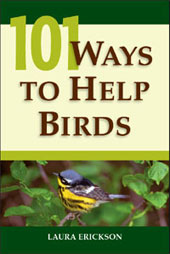 A couple of years ago, I was teaching a class on urban bird conservation at the University of Texas, when I learned that Laura Erickson, who I knew from the Conservationthrougbirding listserv, was writing a book entitled 101 Ways to Help Birds. She shared her 101 ideas with me, and I shared them with my class. I commented on a couple chapter drafts, and have been anxiously awaiting the book in print.
When I finally got the book, I was thrilled. It was everything I had hoped it would be...and more.
Before commenting on the content, let me just say that this is one of the most attractive books I've seen in a long time. I love the greens on the cover (great job, Wendy Reynolds), the stippled illustrations by Roger Hall, the sturdy off-white pages, clear typefont, and simple but very functional layout. In the days of cheap printing and maybe too-easy publishing, this book is everything a book should be and a joy to hold in the hand.
The layout of the book follows the premise of its title, providing 101 suggestions on ways to help birds, broken into 5 parts: helping birds at home, enhancing the natural habitat of your backyard, supplementing backyard habitat, helping birds away from home, and helping birds on a larger scale. These parts are further categorized into 22 sections that cover a wide range of topics from bird feeding and avoiding hitting birds in your car to green consumer tips. Each of the 101 ways to help birds is written clearly and concisely, with specific recommendations on how to help the birds. Each of the ways is backed up with the facts and figures needed to inform the reader of the nature of the threat faced by birds, as well as the best ways to address those threats.
If this book were just a collection of ideas on how to help birds, it would be well worth the cover price of $19.95. But happily, Laura Erickson draws upon her own experiences as a bird rehabilitator and educator to provide personal examples related to many of her tips. These range from the joys of providing food for a wintering Rufous Hummingbird--mealworms mixed in a blender with sugar water, to the heartbreak of dealing with songbirds injured by housecats. The authors experiences and gentle tone make this an easy read, and turns what could easily become a depressing subject (the numerous threats faced by birds) into a hopeful agenda for people wanting to do the right thing for their feathered neighbors.
There are a lot of great bird books out there right now, but this one isn't to be missed. Besides serving as a handbook of how to help birds, it could also serve as great gift for a neighbor, or better yet, a local political leader or civic official. The attractive cover and layout will ensure that the book is picked up, and the great information and delivery will ensure that it is actually read and frequently referred to as you and your neighbors take effective measures to help the birds.
Thursday, June 01, 2006
First case of humans getting H5N1 bird flu from wild birds
A recent outbreak report (here) indicates that several people in Azerbaijan most likely died after contracting bird flu from infected wild swans. These individuals were apparently illegally harvesting feathers from the swans, so they had very close contact with the birds and their body fluids. As with previous human cases, people contracted the virus only through close and prolonged personal contact with infected birds or family members. There still does not appear to be any real threat to humans from casual contact with wild birds. With close contact with birds or their secretions, infection can be avoided with the proper sanitary measures (see here).
Latest on Bird Flu and Wild Birds in Europe
Here's the press release:
Brussels, 31 May 2006
Avian Influenza: Results of EU surveillance in wild birds presented
The European Commission and the Community Reference Laboratory (CRL) for Avian Influenza in Weybridge have published the results of the surveillance for avian influenza in wild birds carried out in the EU over the past 10 months. The extensive epidemiological data was presented today at the FAO/OIE International Scientific Conference on Avian Influenza and Wild Birds, which is taking place in Rome this week. Although final figures are still being collected for February-May 2006, it is estimated that around 60 000 wild birds were tested for avian influenza in the EU during that period. This, combined with the 39 000 wild birds tested between July 2005-January 2006, means that almost 100 000 tests for the H5N1 virus have been carried out on wild birds over the past 10 months. Since February 2006, over 700 wild birds across 13 Member States have been found to be infected with the H5N1 “Asian strain” of avian influenza. However, a positive decline in the incidence of the disease in wild birds in Europe has also been noted over the past weeks.
Markos Kyprianou, Commissioner for Health and Consumer Protection, said “Extensive surveillance for avian influenza in wild birds and poultry has been one of the key tools used by the EU to fend off the virus over the past months. It is a fundamental component in minimising the introduction and spread of this disease which poses a serious threat to animal and public health. The Commission and the Member States are continually working to improve the preventive measures already in place against avian influenza, so as to ensure that we have the tightest possible defences against it. We cannot let down our guard when it comes to avian influenza, as it is likely to remain a threat for Europe and the rest of the world for many months to come.”
Between February 2006 and 21 May 2006, 741 cases of highly pathogenic avian influenza (most of them confirmed as H5N1) have been detected in wild birds in 13 Member States – Greece, Italy, Slovenia, Hungary, Austria, Germany, France, Slovakia, Sweden, Poland, Denmark, Czech Republic and UK. There have been only four outbreaks of H5N1 avian influenza in poultry in the EU, and all of these were swiftly eradicated following detection. No human case of the H5N1 virus has occurred in the EU.
There is considerable variation in the number of cases of highly pathogenic avian influenza in wild birds, ranging from 326 in Germany to 1 in the UK (see chart 1). The peak in terms of the number of cases in wild birds was reached in March with 362 cases (compared to 200 in February), with cases declining to 162 in April and 17 in May (until 21 May – see chart 2). The most commonly affected wild birds have been swans (see chart 3), representing 62,8% of the total, followed by ducks (16,3%), geese (4,5%), birds of prey (3,9%) and others (13%).
Following the major geographical spread of the H5N1 avian influenza virus from South-East Asia in 2005, the EU has intensified its programmes for the surveillance and early detection of avian influenza, both in wild birds and poultry. Almost €2.9 million has been made available by the Commission to co-finance Member States’ surveillance programmes for the period July 2005-December 2006 (see IP/06/172 ). Guidelines on enhanced surveillance for avian influenza in wild birds were also issued by the Standing Committee on the Food Chain and Animal Health. The intensified surveillance has enabled the Commission and Member States to gain a clearer view of the avian influenza situation in the EU, and to rapidly detect and respond to any outbreaks.
For the Commission and CRL presentations and the surveillance results, see here
Subscribe to:
Posts (Atom)


