Subscribe

RSS Feed (xml)

Powered By

Skin Design:
Free Blogger Skins

Powered by Blogger

Friday, July 28, 2006

Hawk with arrow

OK, this is getting rediculous. After last week's story about the ibis with an arrow in it, now comes this news of a Red-tailed Hawk with a similar injury here in Pennsylvania. What kind of poor blighted soul would get enjoyment out of shooting at a big bird with a target arrow? Hope they can catch the bird...if only to get finger prints off that arrow!

Update: The bird has been captured and is doing well in rehab (see story here)

Monday, July 24, 2006

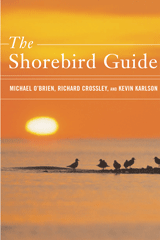
The Shorebird Guide

As a young birder growing up in Oregon, shorebirds were some of my favorites. They migrated through in fair numbers, but mostly through out of the way habitats that most people didn't even know existed. I remember some of my first attempts to observe and identify sandpipers, like the time I walked out through knee-deep mud into Siletz Bay, and was rewarded with my first ever views--very close views--of such gems as Black Turnstone, Ruddy Turnstone, and one of my first "rarities" a Semipalmated Sandpiper. The smell of the mud, the blinding sun, the close connection to exotic arctic-breeding birds...all hooked me on shorebirds for life.

Learning to identify shorebirds was a challenge. Many of them look very similar. After years of puzzling over them, mostly identifying them through trial and error (oh, and the errors there were!), it got easier until now, most of the time, I can identify most shorebirds I see quickly and at great distances.

Now, Michael O'Brien, Richard Crossley, and Kevin Karlson have made it easier for most birders to feel comfortable identifying shorebirds in what Houghton Mifflin is billing as The Shorebird Guide (and yes, the italics are in the original title). And you know what, it clearly is the best shorebird guide out there--and there have been some fabulous shorebird titles come out over the past 20 years.

At over 460 pages, its impossible to do a thorough review of this book. It isn't one to be picked up and read through all at once; it is more appropriately a useful tool and study guide. The first section contains almost all of the identification material, with hundreds and hundreds of photos illustrating every shorebird species known to have occurred in North America. The photo captions explain how to identify each species as they change colors throughout their lifetime--which gives the reader the best idea ever of what the birds look like. The second half of the book contains more detailed description of the behavior, migration, molt, and vocalizations of each species--which helps the reader better understand the birds themselves.

Much is made about this book's (along with Pete Dunne's recent book's) attempt to teach the skill of identifying birds by their General Impression of Size and Shape (GISS). While Dunne's book tries to do this through words, this book mostly does this through stunning photographs which--while they do illustrate size and shape very well--also undermine the emphasis on those points by drawing more attention--through their absolute beauty--to the feathers and markings of the birds. Perhaps more "bad" photos of distant birds or silhouettes might have provided more useful here (though there are a fair number of shots such as these to look tantalize the reader). But hey, how often is your harshest criticism of a book that its illustrations that are "too" good?

And now a brief word of caution for the shorebirding tyro heading out to the mudflats with this book. While it contains most of the information you will need to identify these birds, it can't give you the skill and wisdom needed to actually do so. That will take some time and effort. By relying on size and shape, you may make snap decisions that are incorrect. I still mess up sometimes on distant Pectoral and Least Sandpipers when they are far away and I can't get a good size comparison to gauge their true size because these species look very similar to me without looking at plumage details. So, while using size and shape is a good first step in identifying these birds, don't be fooled into thinking that this will always be enough. Most of the time you'll need feather patterns and colors to back up your GISS identification. Especially if you think you are looking at an exciting vagrant shorebird from the Old World. GISS identification, while a skill of advanced birders, can wreck havoc on the intermediate and beginning birders, and can even throw an expert when used carelessly.

GISS is of greatest use in situations where lots of distant birds need to be identified and counted quickly without being able to see nuances of plumage--such as at a hawkwatch or while doing shorebird surveys (and if your going to take the time to find and identify shorebirds, you might as well count and report them so we can better track their movements and populations). But most of the time, wisdom will lead an experienced observer to use both GISS and careful feather inspections to confirm their ID. So, if you live in most of the country away from the coast, don't immediately think that the dowitcher you are looking at is a rare Short-billed because it looks too flat-backed and not round like it swallowed a grapefruit. If the bird gives you that impression, make sure you get confirmatory plumage marks and vocal clues.

That said, I absolutely love this book. Few observers will be so familiar with all shorebird species to not learn something new from this book, while the beginner will encounter an embarrassment of riches. It will still take a lot of field work to really learn to identify these birds out in the elements, but that chore is made much easier with this book. Some of the photos even serve as photo quizzes, which make readers really work out the identification for themselves--a very useful approach. Puzzling over one such photo, I learned more than I ever bothered to learn before about the differences between young and adult Black Oystercatchers. These birds are a cinch to identify most of the time, so the temptation is to pay them little mind, but this book brought me closer to appreciating them than I've felt for a long, long time. So, if you love shorebirds, you'll love this book. If you struggle with identifying shorebirds, this book will help you with that, while instilling a love for them in the very core of your soul.

Friday, July 21, 2006

Gone

Several big trees were cut down yesterday behind our house in the lot across the alley. While I hate to see trees come down (and I think the Carolina Wrens that hang out down there hated it even more than me, they were singing up a storm this morning, probably readjusting their territories), it does open up a wider view of the skyline and the creek down in the park--so maybe it will slightly improve some bird viewing from my back porch.

One of the tricky contradictions between birding and conservation is that many of the best places to see birds are actually not that great as bird habitat, and some of the best bird habitats provide horrible bird viewing. If all you want to do is see lots of birds, there are plenty of places to do that, and many people go birding without thinking much about conservation as long as they have their favorite couple of birding spots to go to regularly.

So...is it more important to provide habitat for birds (like the trees in my alley) or to provide bird viewing opportunities (like my wider view of the creek and skyline)? In the bigger scheme of things, bird habitat has to be more important. Now the trick is to get people to understand the habitat value of land and landscaping. Just because you have a bird feeder and 20 species of birds regularly visit your yard, doesn't mean that you have great bird habitat there. The problem isn't that such yards are a glass half full or empty as bird habitat, its that most people with a couple birds in their yard will think everything is hunky dory and not realize what they are still missing.

As for me, I hope that my wrens are able to remain in my neighborhood now that some of their favorite trees are gone--and I need to make longer-term plans for attracting more species to my own yard.

Tuesday, July 18, 2006

Life in the city

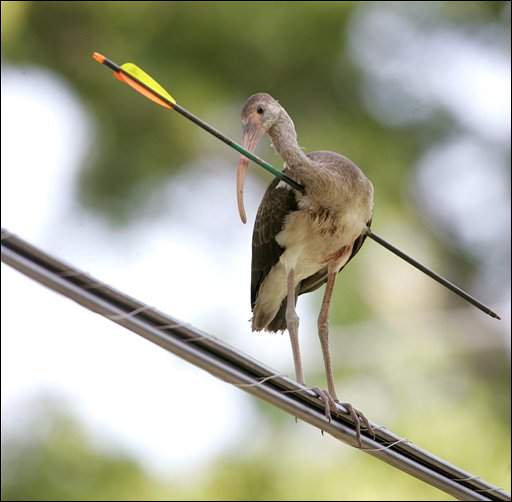
Here's something you don't see every day...an ibis on a power line. Then again, you don't usually see young White Ibis with arrows through their chest either. Apparently, somebody in Florida shot this bird with a practice arrow, and authorities spent two weeks trying to capture the bird to give it medical attention. When those efforts failed, they called off the attempt. Seems the bird is doing OK, hanging out with other birds, and can fly. But what an urban bird horror story!

Besides stray arrows, urban areas pose some of the greatest hazards faced by birds in North America. Fully 10% of all the birds in North America are killed each year by a combination of feral and outdoor house cats (1 billion killed each year) and plate glass windows (another 1 billion killed). That doesn't even count the tens of millions killed by collisions with cars or poisoned by pesticides, or any of the other urban hazards. Is it any wonder that many songbird populations are declining?

So, while bird feeders and handouts from people may encourage some species to hang with their human homies, the hood can be a dangerous place for many birds. One of our biggest challenges of the next century will be to find a way to co-exist with more bird species as the rate of urbanization and exurban residential development continues to escalate. One way to think about this is in terms of win-win or reconciliation ecology.

Can we create cities and suburbs that are as good for birds--even those that usually don't do well in urbanized areas--as they are for people? Can we envision housing developments or commercial districts with Sage Sparrows or Golden-cheeked Warblers living on the roof? Buildings that look more like shrubby or forested hillsides--both to us and to the birds (like the ACROS building in Fukuoka, Japan pictured here)? What is it going to take to start creating habitat, rather than just destroying it, every time we want to "develop" a piece of property? Yeah, baby! That's the kind of progress I'm willing to support.

Ann Coulter, if you really want to be smart...

May I recommend James Downard's excellent review (Part I and Part II) of Ann Coulter's latest anti-evolutionary arguments. The world is a complex place, and it takes some time and effort to wade through the evidence supporting evolutionary theory. In other words, not a task that should be trusted to a political pundit and NY Times best-seller writer without the requisite education.

Friday, July 14, 2006

This is how bird flu will get to the USA

Smuggled poultry products, not wild birds, are probably the greatest threat. Read this story here. Very few wild birds from infected parts of China will ever fly on their own to North America. Meanwhile, thousands of possibly infected geese, ducks, chickens, and pigeons are potentially smuggled into the US each year.

Baby Towhee

On my way into work this morning, I stopped at the bird blind at Peace Valley Nature Center for a little relaxation. 22 species of birds were at the feeders, including something I'd never seen before--a juvenile Eastern Towhee (see photo by Birdfoto). It spent most of its time on the ground in the bushes or grass below a couple feeders, but a few times it flew up onto a feeder or into a pine tree. In flight, huge white patches in the wings and white outter tail feathers might remind one of a mockingbird. Eastern Towhees are a species of conservation concern, as they nest in shrubby understory of forests that are the favorite food of the overabundant White-tailed Deer in the East. The nature center here has a deer exclusion fence around the bird feeding area...good to see that at least one baby towhee made it out of the nest there.

Hummer

Finally, a new yard bird. While eating breakfast this morning, I caught a glimpse of a hummingbird flitting up into a tree on the back end of our lot. I got out the binoculars and was able to watch the immature Ruby-throated Hummingbird get chased around a dead tree by a female House Sparrow. Since our pet goldfish died this week, maybe a new hummingbird feeder is in order to take my kids' mind off the loss of Leoptodon the pet goldfish (named by my kids after the huge prehistoric sea reptile Liopluerodon).

Thursday, July 13, 2006

When birds were gods

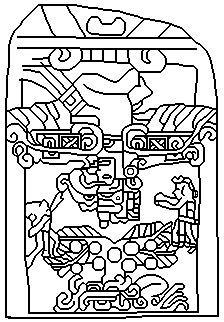
There is a long American tradition of rulers or priests pretending to be birds in their rituals--going back at least to the Izapan culture in southern Mexico before 300 BC. These and similar rituals continued through Mayan and other cultures, including the birdman cult of the Mississippian cultures in Eastern North America up to nearly the time of European contact. Birds, with their ability to fly, seemed to represent many divine powers to these peoples. Some people still believe that the Mesoamerican Principal Bird Diety is important, and that it figures into prophecies concerning cosmic changes to occur in 2012. Apparently, the mystery of living with birds continues, with the bird symbols of the Ancients encouraging additional ways to experience birds beyond the evolutionary ecological paradigm of Western science.

Friday, July 07, 2006

Grassland birds

We've all seen it. A grassy field with a muddy track through it, surveyors tape, and nearby construction equipment. For most people, a grassy field probably looks like a perfect light industrial or residential development site. But many of these apparently empty spaces are actually great bird habitat.

I visited one of these this morning. Three Grasshopper Sparrows were singing their high pitched trills in the grass (listen here), and at least half a dozen Savannah Sparrows were flitting about. Both of these birds are increasingly hard to find here in SE Pennsylvania, as their grassy habitat gets bulldozed to make way for sprawling development. A couple of Killdeer were running along the muddy construction road, with their fluffy babies, and an Eastern Meadowlark (another declining grassland bird) flew over as I was getting ready to leave. (Grasshopper Sparrow photo credit: BLM)

As I walked back to my car, I couldn't help but dream of light industrial development that protected grassland habitat--maybe huge low-slung buildings with grassy habitat actually growing on the roof. For a fleeting moment I envisioned myself as a commercial real estate developer struggling to create awesome bird habitat on the rooftops of my buildings. It sure was a better vision than the impending habitat destruction that was actually in front of me.

Brand new species

The latest edition of the American Ornithologists' Union bird checklist is out, announcing a new species of grouse for North America--the bird formerly known as Blue Grouse is now two species, Dusky Grouse and Sooty Grouse. Actually, these two birds were considered separate species by the AOU in the 1920s, but were lumped together as Blue Grouse in 1944. New DNA evidence suggests that they really are separate species, with the Sooty Grouse living in the coniferous forests of the coastal Pacific Northwest, and the Dusky Grouse living in montane forests of the Rocky Mountains.

So, for a while at least, all the field guides to North American birds will be out of date.

I first heard Sooty Grouse while searching for Spotted Owls near Mount Hood in Oregon as a kid, and saw my first Dusky Grouse sitting in a tree in Memorial Cemetery in Salt Lake City in 1993.

The new checklist supplement also makes a lot of rearrangements and changes to scientific names, based on latest research on relationships between species. So, lots of changes reflecting our growing understanding of the world of birds. Pretty fun stuff!

Thursday, July 06, 2006

Birdchaser on Space Shuttle Poop

You can read it all in the AP story here. For better or worse, my little comment is getting picked up everywhere.

Wednesday, July 05, 2006

Gettysbird

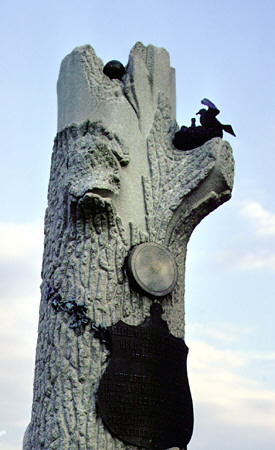
Took the family to Gettysburg this weekend to see the battlefield, and was struck by the Oak Tree monument to the 90th Pennsylvania Volunteer Infantry, featuring a nest with a mother and baby birds on a snag. Apparently, the tree was mostly obliterated and a robin's nest fell down during the battle, and a member of the 90th climbed the tree under heavy fire to replace the nest in the embattled tree. Even during war times, the best of human nature sometimes emerges to help birds placed in harms way by our own actions (photo credit: here).

Friday, June 30, 2006

Lake Nockamixon

Took off from work a bit early to get some fresh air and look for some birds up at Lake Nockamixon, a large lake about 10 minutes from my house. Juvenile Tree Swallows--sporting Bank Swallow-like chest bands--were active around the lake, as were Eastern Kingbirds near the fishing pier. A distant second year Great Black-backed Gull was late (or early). It and the Ring-billed Gull I saw there were flagged as unusual by the eBird filters. Nice to hear Ovenbirds singing in the woods--don't get those here at the Audubon Science Office.

Thursday, June 29, 2006

Essentially Dunne

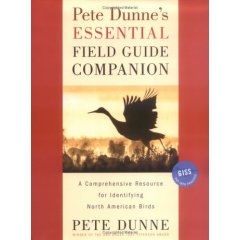
How much would you pay to travel across the country for a year birding with one of America's biggest birding celebrities? While such a trip might set you back tens of thousands of dollars, about $30 can get you the next best thing if you buy Pete Dunne's Essential Field Guide Companion. Reading this new book is like following Pete Dunne on an extended field trip across the continent as he rattles off his own impressions of over 700 bird species--including his own nicknames for the birds, tips on identifying them, their characteristic behaviors, and even unique aspects of the the way each species flies.

While labeling a book as "essential" is a pretty tall claim, what about this book might give someone the idea that they would really, really need it? First off, its important to discuss what this book is and isn't. Basically, this book is an identification guide...but not the traditional bird guide that you might take out into the field and hold up to see which bird picture matches the bird you are looking at through your binoculars. Perhaps the most amazing thing about this book is that it may be the first bird identification book in a hundred years to have no illustrations. That's right. Over 680 pages of how to identify birds, without a single sketch, drawing, painting, or photograph of a bird.

So, how are you supposed to identify birds without pictures? Here's where this book is different. While most bird identification books are designed to be taken into the field, this one is not. It isn't a field guide. As the title indicates, its a companion or supplement to your field guide--something that Dunne might call a Field Guide Helper (and if he was designing his own book cover, pattern if after a box of hamburger helper). Instead of reading it while looking at a bird, this book is designed to be read while looking at another field guide. It doesn't belong in your hand or backpack in the field, it belongs on your desk or table top next to your field guide.

Dunne explains that he wanted to write this book because he felt that the text in modern field guides is just too brief. He got frustrated working on the last edition of the Peterson Field Guide to Eastern Birds, because he wanted to include more text but there wasn't room. Dunne was also inspired by the old Audubon field guides, the ones with paintings by Eckleberry, that had lengthy written descriptions and notes about each bird. The modern Audubon photo guides also have a lot of text, more than the other more recent guides.

So, this book is intended to provide all the text that couldn't be put into a normal field guide, but that could help you better identify the birds you see in the field, but are still puzzling about when you get home. In this way, it is different than Kenn Kaufman's Lives of North American Birds, which is a field guide companion focused on the life history details for each species rather than bird identification issues. The other book which this one needs to be compared with is the new National Geographic Complete Birds of North America. The National Geographic book contains illustrations from their field guide, with expanded text giving additional information on how to identify the birds. So, what might make Pete Dunne's book more "essential" than the National Geographic book?

While it may not be possible to answer that question directly, an exploration of Pete Dunne's Essential Field Guide Companion quickly shows that it makes a unique contribution to the bird identification literature. First of all, instead of focusing on all the details of the plumage of each species, this book is meant to illustrate how GISS is put into practice. If you aren't familiar with GISS, this is your introduction to the Cape May school of birding, where General Impression of Shape and Size (GISS, pronounced jizz--but don't google that spelling!) is of primary importance, and color patterns often secondary. While the use of GISS as a primary identification technique goes back to the early days of birdwatching, Dunne has done as much as anyone to promote its use over the past few decades, beginning with the identification of distant hawks and falcons during migration, as outlined in the classic Dunne, Sutton, and Sibley book Hawks in Flight.

Pete Dunne's Essential Field Guide Companion provides almost a full-page Hawks in Flight style treatment to practically all the regularly occuring birds found in North America. Dunne and his wife traveled across the country to revisit all of these species while writing this book, so he claims that this book is the first bird identification book to be written in the field while watching each species. Reading the species accounts, you do get the feeling that you are there with Dunne as he calls out the identifying features while watching the birds. As I mentioned before, this may be the most engaging and valuable feature of the book, giving the reader a chance to vicariously bird with Dunne as he leads us to see all the birds of North America.

For each species, Dunne begins by offering us his own nickname for each species. Why would he do that? The idea is hardly original to Dunne, though he can be credited for resurrecting an idea first suggested long ago. According to Joseph Hickey in A Guide to Bird Watching (1943),
Not many years ago, Professor Samuel Eliot (perhaps thinking of beginners for the next thousand years) bravely suggested new names for some of the more mistitled species. The northern water-thrush, which isn't a thrush at all, he said could be called 'bogbird'...if one is still distracted with the multiplicity of bird names and often confused by species that look very much alike, a simple solution is to work out a series of private and temporary names for harder species. The two water-thrushes, for instance, could almost pass for twins. One has a yellow line over the eye, the other a white one. Many observers can never remember which has which. Try privately calling one the 'wihte Louisiana' for a while, and the other the 'yellow northern.' In a surprising short time, a once-vexing personal problem will have benn permanently settled. This trick can be extended to many other species..."


So, taking up the challenge, Dunne offers nicknames for all the birds in North America. While this feature is just a small part of his book, it has drawn many comments. Most readers will find some of the names useful, while others may leave them cold. Bronx Petrel (Rock Pigeon) doesn't do anything for me, and I'm puzzled as to why he called the Yellow-rumped Warbler (which already has a well-known moniker of 'butterbut') The Swarm Warbler. So, take them or leave them, perhaps the greatest charm of this attempt is a look into the mind of Dunne. You can see the inner wheels of the mind turning as he tries to come up with over 700 nicknames, and the names often say as much or more about Dunne as they do about the essential qualities of each bird.

For a book meant to be read alongside a modern field guide, the status and distribution sections that start each of the over 700 individual species accounts is perhaps the least helpful. If you have a good map from any of the modern field guides, you can tell at a glance where each species is supposed to be--so in this case, where a picture is worth a thousand words, the dozens of words spent describing the range of each species might have been better used elsewhere.

Sections on habitat are a bit sketchy, though one innovation Dunne employs is to list other birds or animals that each species is often associated with. Sometimes this is useful (maybe you can look for Northern Bobwhites where you hear Field Sparrows), other times not (while Golden-cheeked Warblers and Black-capped Vireos may be found in relative proximity in Central Texas, they usually occupy very different habitats, and you wouldn't necessarily look for both of them in the same locations). Another innovation that doesn't work as well for me is Dunne's classification of species based on their likelihood to wander and turn up outside of their normal range. Again, for a book that is meant to be read with a field guide, the little green circles in the Sibley guide or the lighter shaded range map colors in Kenn Kaufman's guide provide this type of information about vagrancy or species wanderings already.

The second half of each species account is where Dunne's book becomes more useful and interesting to me. His descriptions of each species attempt to be more lyrical and evocative than that usually found in field guides. Again, this isn't a feather by feather description of each bird--that type of info might be more easily found in the new National Geographic book, though even there the descriptions aren't usually that detailed--the best info on sexing and aging most species by feather details is probably Pyle's Identification Guide to North American Birds. What you get from Dunne is a description of his General Impression of Size and Shape (GISS) of each species. These descriptions are best read while looking at an illustration of the bird in a field guide--where a picture may be worth a thousand words, but only if one knows what to look for. Again, in this way its almost like having Pete Dunne in the field showing you what to look at in your field guide as you puzzle out the identification of a bird. If you've birded with a professional guide, you know that they do this all the time. This book allows Dunne to do this for all of us, since together we would make up a larger birding party than would be feasible to manage in the field!

For me, the most interesting sections of the species accounts are those noting the behavior and flight characteristics of each species. While some of this information is gleaned from the comprehensive Birds of North America life history accounts published by Cornell, they also reflect Dunne's experience with the birds in the field. If you are trying to identify birds in flight, Sibley's illustrations of birds on the wing are great, but doubly useful when linked to Dunne's notes about wingbeats and other aspects of the way the birds move or behave. I found these sections to be the most useful, and the most deserving to be called "essential".

Bird songs and calls are difficult for almost everyone to learn. Its easier when you can be in the field with an expert, and have each call and its distinctive features pointed out to you. While most field guides provide some description of bird sounds, Dunne here provides his own interpretation and hints at how to identify them. While a field guide is needed to accompany most sections of this book, the vocalization sections might be most profitably read while listening to a good bird CD collection like the Petersen or Stokes series.

Just like a field guide, this probably isn't a book you are going to sit down and read cover to cover--though most readers would learn a ton if they could. Its more for dipping into here and there. In a final analysis, how well does this book instruct the reader in the GISS school of birding, and how "essential" is it? While I enjoyed Dunne's descriptions and sections on behavior, flight, and vocalizations, its unclear to me that written descriptions are the best way to "illustrate" GISS principles. In the field, GISS are processed by a different part of the brain then language--so the trick here is that Dunne's descriptions require the formation of strong connections between two parts of the brain. To effectively use GISS, you have to be able to identify birds without using the language processing part of your brain. When pushed, the language processing part of your brain should be able to interpret--as Dunne has done here--the GISS that the other part of your brain has cued into. But all this takes practice, and experience with real birds. In some ways, Roger Tory Peterson's simple and almost impressionistic early field guide illustrations were perhaps even more effective at conveying the GISS of each species than any lengthy, jocular, or folksy description might be. I think we have yet to find the ideal way to teach people the GISS method of bird identification, though this book will be useful to most readers.

So, while "essential" might be a bit of an oversell (for which I'm sure we can thank Houghton Mifflin, rather than Dunne himself), this field guide companion will be useful to most birders, as well as a treat. It provides more information than most birders will master in a lifetime, as well as the closest approximation that most birders will get to actually birding with Pete Dunne in the field. As such, this book is valuable and fun to read, as in the final analysis, it provides a window into birds and the joys of birding that is essentially Dunne.

Other reviews of this book in the blogosphere:
Birding Gear Big Board
Living the Scientific Life
Aimophila Adventures

Wednesday, June 28, 2006

Favorite Bird Songs

John over at A DC Birding Blog has challenged us to come up with our 10 favorite bird songs. Along with first entries by Mike and Nuthatch, here's my list:

1) Anna's Hummingbird. Grew up listening to these guys as they colonized western Oregon from the south. They're tiny bodies puff up and it sounds like they need some serious WD-40 and their wheels are coming off. Listen here.
2) Barred Owl. I really like bird sounds at night, when they are almost disembodied from the birds that make them. I love the monkey-hooting of these guys when they really get agitated. Listen here.
3) Yellow-headed Blackbird. How can you resist this otherworldly song? When you are out in the marshes of the Intermountain West, their songs really help you connect to the place. Listen here.
4) Greater Prairie Chicken. In case you need proof that God has a sense of humor. Listen here.
5) Pileated Woodpecker. A big sound from a big bird usually found near big trees. Takes me back to the Douglas-fir forests of my childhood in Oregon. Listen here.
6) Chimney Swift. OK, I hear these almost every day, so they aren't so exotic. But to me, their sound represents the crackling of life as it splits the sky. Listen here.
7) Greater Sage-Grouse. More strange sounds from the Great Basin. You haven't lived until you've heard this coming across the sage flats at dawn. Listen here.
8) Common Loon. There isn't anything common about the calls of this ancient bird. If you've heard it in the summer on a lake surrounded by forest, you know you were hearing the soul of the wild north. Listen here.
9) Plain Chachalaca. What a name, what a sound. My kids are still going around the house trying to sound like this from our time in Texas. Listen here.
10) Upland Sandpiper. Night is falling across Central Texas and these guys are calling as they fly over on their way north. The sound, and the birds, slipping off into the darkness...Listen here.

Looking over my list, I seem to like strange sounds that represent places and times I've shared with birds in wild places. No sweet sounding notes for me. Give me the raw and otherworldly.

Our Bird Cousins

I've previously written about our evolutionary relationship with birds, making us all distantly related cousins. How distantly are we related?

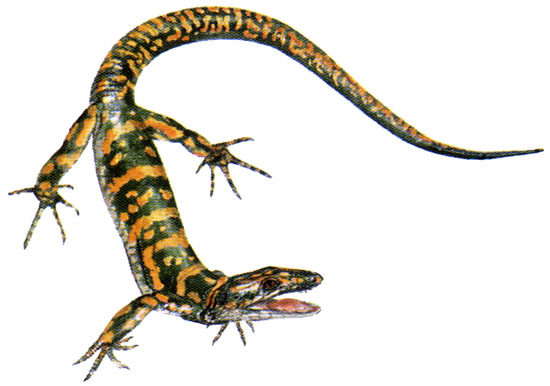
If you go back about 330 million years, there were no birds or people. If you could do your genealogy back that far, you would find that you shared ancestors with birds. These ancestors were four-legged animals similar to the fossils Westlothiana and Casineria. By about 313 million years ago, birds and humans still shared the same ancestors, amniotes similar to Protoclepsydrops and Hylonomus. (Image of Hylonomus from here, more images here)

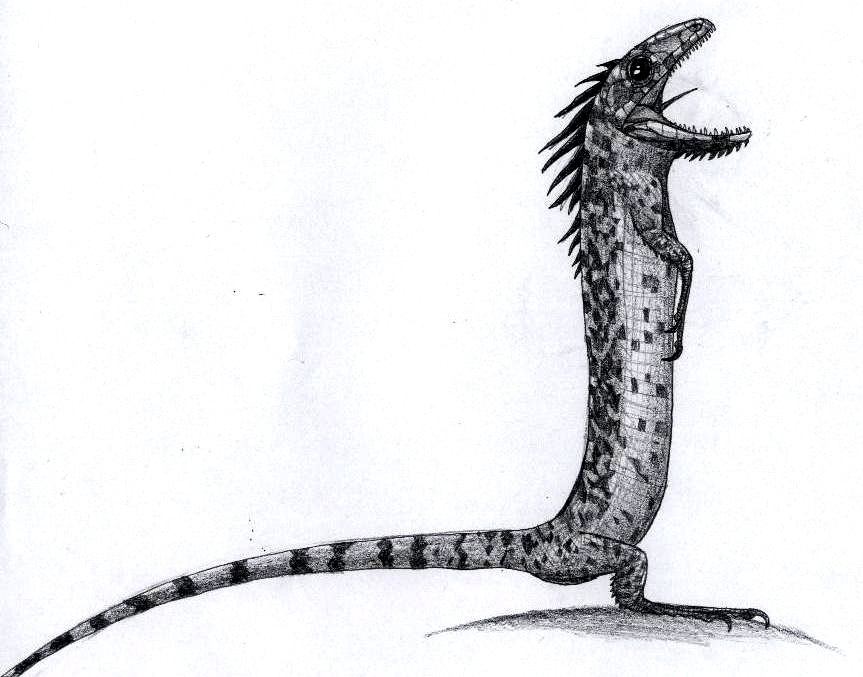
By 309 to 302 million years ago, the ancestors of birds had separated from our ancestors to become a distinct lineage that would include lizards, crocodiles, dinosaurs and birds. These early bird ancestors were similar to Petrolacosaurus, (image from here, more images here) , the oldest known diapsid reptile, which hales from the Rock Lake Shale of the Stanton Formation near Garnett, Kansas (perhaps to the chagrin of people in that state with other views about the origins of birds).

Our own ancestors at this time were more similar to Protoclepsydrops and Archaeothyris (image from here), some of the earliest synapsids. As you can see from these images, the ancestors of both birds and humans were pretty much lizard-people (perhaps another reason I always liked lizards?).


Over the past 300 million years, the descendents of Protolepsydrops and Petrolacosaurus have gone their separate evolutionary ways, though sharing the planet the entire time. Looking back now over perhaps 300 million generations of birds, and perhaps just a few million fewer generations of diapsids, mammals, primates, and humans, its perhaps easier to think that we are very different from each other. While in many ways this is true, part of the joy of living with birds is the quest to determine how much we share with our distant kin, as well as to wonder how our two different lineages could have given rise to so many wonderful creatures after separating from each other back in the Carboniferous. (Owl photo: here)

For more information on the the shared ancestors of birds and people, as well as the evolution of separate bird lineages, see the 2003 Journal of Molecular Evolution paper by Tuinen and Hadley here.

Floods

With all the rain in SE PA the last week, last night the creeks finally flooded. The Perkiomen behind our house is over its bank, blocking my normal way to work. The Neshaminy by my office is still in its banks near the office, but covered the road a couple miles down, forcing me to take an alternate route to get in this morning. On the way in I saw a Green Heron flying high above the Neshaminy, probably displaced from its favorite fishing areas by the high water. So, the bird and I were both a little put out this morning, but as a native Oregonian, I still enjoy a good downpour!

Tuesday, June 27, 2006

Birdchaser on Martha Stewart Radio

Just had a fun half hour with Margaret Roach and Andrew Beckman on their Homegrown show on the Martha Stewart Sirius radio channel. Good discussion on how to make your yard healthy for you, your family, and birds--including how to keep birds safe by keeping your cat indoors and screening your windows. Fun to take a couple calls about birds and talk with the Martha Stewart Living garden editors.

Monday, June 26, 2006

Ticked Off

Well, it finally happened. I suppose it was inevitable with all the time I spend outdoors. Sunday morning I woke up with what felt like a bruise on my thigh. But it wasn't a bruise, but the tell-tale bulls-eye rash where I had been bit by a tick two weeks ago. Yes, ladies and gentlemen, I have Lyme Disease. After a couple hours in the emergency room, I got a perscription for three weeks of Ampicillin and hopefully that will be the end of it. For now I'm a bit tired and achey, and the bulls-eye is spreading and hurts like a bee sting when I bump it.

Lyme Disease is a serious malady, and some folks are afraid to landscape their yards for birds because they are afraid to provide potential tick habitat. While I can empathize with that, the best thing to do is to part of the yard clear of vegetation, and then plant up the edges of the yard or other parts of the yard that you won't be walking through regularly. The deer ticks that carry Lyme Disease can even be in the lawn (though again, some claim that would be rare), so I'm not sure there really is a lot you can do to stop them vegetation-wise, though on Saturday I did hear You Bet Your Garden's Mike McGrath on NPR say you could spray your yard regularly with a garlic spray to drive out ticks and mosquitoes. Not sure how well that would work, (he seems to back away from that suggestion on his website) but I'm almost willing to try it. Other ideas are here.

Unfortunately, you can't spray the whole world, and if you are going to go outside, Lyme Disease is a potential problem in this part of the world. The little baby deer ticks are so hard to see, that you really have to be vigilant and do careful checks every day to make sure you don't have one on you. And even then, they could be easy to miss.

So, be safe out there. Know the signs of Lyme Disease, and get medical attention if you even suspect that you have been bitten by a deer tick or have symptoms. Treated early, it is pretty easy to take care of, but if left untreated, it can really mess up your life!
Nature Blog Network Fatbirder's Top 1000 Birding Websites