


 RSS Feed (xml)
During the summer of 1984, I was about to start my junior year of high school. I had been actively birding and chasing birds for three years, and had been a birdwatcher for several years before that. On August 11, I caught a ride to the Oregon coast with several birders. Of course, since I was a kid birder, I had to catch a ride, which was OK with me, since that got me out with some of the best birders in the state. It was a great time to be a kid birder, and I was starting to experience the rush of finding and documenting rare birds.
Sometime in the mid afternoon, several of us were looking for shorebirds on the edge of Lake Meares, which had been partially drained. I noticed a funny looking bird that I just couldn't place, since it didn't look like anything I knew. At first glance, it looked like a female Brown-headed Cowbird--with buffy edges to the feathers of the wings and back. But it was a shorebird. I only saw it for maybe 20 seconds, and it took me more than half that time to really understand that it was a shorebird, and not a cowbird.
Just as I was about to get someone else to look at it, the bird flushed. As it did, Jeff Gilligan, one of the best birders in the state, and the only one at the time with an Oregon list over 400 species, said excitedly, "did anyone see that shorebird when it flushed--it had really white outter tail feathers."
Of course, as a well-read kid birder, I knew what that meant. And that's when all the pieces came together in my mind. Buffy edges to feathers above, no breast streaks--just a buffy wash, plain face without noticeable supercilium, bright white tail feathers. Temminck's Stint!
I told Jeff and the others what I had seen before the bird flew off, thinking they would be really excited. This would be a first state record! "It was a Temminck's Stint!" I blurted out.
"No it wasn't," said Jeff.
"But I saw it clearly," I said.
"But," said Jeff, and this is what has since been burned into my mind, "you didn't see it long enough. You can't be totally sure of what you saw in that short of time. And you don't have any proof. It might have been something good. But it got away."
I wish I could say that I learned that lesson immediately. But I was a very active birder, with quick eyes, and a lot of skills. And I was seeing lots of rarities with other birders all across the state, especially at Malhuer National Wildlife Refuge during biennial trips to look for vagrants at the end of May and end of September. And I was out all the time, so I saw a lot of birds. And as you know, you don't always get the lingering look that you might want.
There was the female blackbird on the side of the road in Troutdale that had yellow eyes. YELLOW EYES! It HAD to be a Rusty Blackbird. I thought about that one for a long time before I decided, reluctantly, that I couldn't be totally sure of what I saw at 60 miles an hour. There was a Long-toed Stint, a Wood Sandpiper, and a Gray-tailed Tattler that I descovered and reported. Fortunately for me, I left the state eventually to go off to college, cooled off a bit, and Jeff's words of wisdom finally started to sink in to my rarity crazed mind.
Just because you are young, and the hottest birder around, doesn't mean that you can be sure of what you see in quick glimpses, especially when you half expect to see something rare at any moment. If you see something briefly, and it looks like an Ivory-billed Woodpecker, or a vagrant Yellow Wagtail, or a pteranadon--well, you know the pterandadon is a slip of the imagination. But what about the other two?
Quick glimpses of rare birds do not count. Period. Really, they shouldn't even be reported, except to your close friends, but even then as curiosities. What if tales. Fishermen call these "the ones that got away" and love to talk them up. Birders are usually more circumspect. Unfortunately, that means we often don't talk about our mistakes or relish those ones that get away. They don't count, and we don't want people to think we're rarity crazed, so we don't talk about them. If its all in good fun, it should be OK. But for most experienced birders, when they hear someone adamantly state that they were able to make out all the important field marks of a rarity in a split second, or in five seconds (which is often birderspeak for a split second), they just shake their heads. They may be respectfully quiet. But what they're really thinking is that you've lost it, crossed the line, slipped into a rarity-fever induced delirium.
Now I have no idea what's really going on down there in the Choctawhatchee. But when I read about a sighting of a bird flying through the trees for a few seconds, maybe flapping its wings eight times a second, and banking briefly to show the perfect Ivory-billed Woodpecker underwing, or flying quickly off a tree in the rain, the words of a much wiser and more experienced birder than myself come back to me: "You didn't see it long enough. You can't be totally sure of what you saw in that short of time. And you don't have any proof."
I know it isn't polite to say this. I was really ticked off that nobody believed my stint. Six months later I even put it on my state list for awhile. But if I'm thinking it, a hundred other birders better than me are thinking it. You're a bright kid. By all accounts a great birder. You could probably run circles around me on a big day. But do yourself a favor. Next time you see something flash by in the woods, and you think its an Ivory-billed Woodpecker, and you don't get a photo. Take a deep breath. Swear if you must. But don't tell a living soul, unless you can laugh it off as "one that got away."
Good luck with your search and your birding. I admire your drive and ambition. You're welcome to crash at my place any time you're in or around Philly. I'd love to go birding with you anytime. You want to be a superbirder, and chances are you will be. But the sooner you learn that your brain is way faster than your eyes really are, the sooner you'll get the trust and respect that you crave.
Be safe out there.
Wednesday, January 17, 2007


How Many Birds Could We Save?
The New York Times has an article today by David Leonhardt (login required) claiming that the Iraq War is costing us $1.2 trillion dollars. Since that is a difficult number to imagine, he shows how much we could do with that money if we weren't spending it in Iraq.
There are currently just over 1,200 globally threatened bird species in the world. For the price of the Iraq War, we could spend $1 billion on each of these birds. That's enough for a nice endowment to fund full-time staff dedicated to protecting these birds, and to buy habitat. We can't even imagine how much money this is. Even at a thousand dollars an acre in developing countries, that $1 billion could buy 1 million acres. That's 1,562.5 square miles. For every single rare bird in the world.
Of course, there are other ways to spend that money to help people around the world. No matter what you think about the Iraq War, that's a lot of money. And a lot of good things that will not happen because we've committed so many resources there.
BTW, that $1.2 trillion dollars is $4,000 from every man, woman, and child in America. That's before we pay interest on it, which we'll have to pay, since we borrowed this money from overseas. If President Bush had to fundraise like bird conservation organizations do, how many of us do you suppose would send in our $4,000 checks in response to a direct mail appeal to fund a war in Iraq?
How many of us want our money back?
There are currently just over 1,200 globally threatened bird species in the world. For the price of the Iraq War, we could spend $1 billion on each of these birds. That's enough for a nice endowment to fund full-time staff dedicated to protecting these birds, and to buy habitat. We can't even imagine how much money this is. Even at a thousand dollars an acre in developing countries, that $1 billion could buy 1 million acres. That's 1,562.5 square miles. For every single rare bird in the world.
Of course, there are other ways to spend that money to help people around the world. No matter what you think about the Iraq War, that's a lot of money. And a lot of good things that will not happen because we've committed so many resources there.
BTW, that $1.2 trillion dollars is $4,000 from every man, woman, and child in America. That's before we pay interest on it, which we'll have to pay, since we borrowed this money from overseas. If President Bush had to fundraise like bird conservation organizations do, how many of us do you suppose would send in our $4,000 checks in response to a direct mail appeal to fund a war in Iraq?
How many of us want our money back?
Tuesday, January 16, 2007
Birdchaser Silver Medal
Well, the 2006 Pennsylvania yard listing competition results are out, and I won second place in my division (tiny urban yard) with 53 birds. Not bad for number of birds seen from the back porch of a row house. I should have done more hawk watching, and maybe more night time migrant listening (I did get some nocturnal thrush calls that way). The yard at work won 20th place overall and 11th in the "big ole yard" category. Not to as good as I'd hoped I'd do, but I didn't get out much at work this year and was traveling a fair bit.
Haven't really started my 2007 yard list yet. Been pretty busy with some writing projects. And I'm really itching for a good rarity chase. Maybe those Pink-footed Geese in Rhode Island???
Haven't really started my 2007 yard list yet. Been pretty busy with some writing projects. And I'm really itching for a good rarity chase. Maybe those Pink-footed Geese in Rhode Island???
Thursday, January 11, 2007
Do we care about pink flamingos?
A couple months ago I mentioned briefly the demise of the plastic pink flamingo. I can't think of these plastic waifs without thinking of an essay about these guys written by Jennifer Price. Price has written about some of the quirky off-beat ways that we Americans experience nature at the dawning of the 21st Century. Now, she has an article in Grist magazine asking why more nature writers aren't writing about nature in cities, where most of us live and experience nature.
While she makes some interesting points, its not like there isn't a lot of people writing about nature in cities. John points out that there are lots of bloggers writing about urban nature. There are lots of academic articles about urban birds and nature, a good number of books about the subject, and every year there are several books on the topic out by nature writers. Besides Over the Hedge and Hoot this year, we've seen several actual documentaries about birds in urban areas in the last few years, including Pale Male and The Wild Parrots of Telegraph Hill. There's lots of media attention to birds and nature in cities.
I still have a question, though. With all the media attention to birds and nature in cities, do these stories and films really help people connect with nature in a meaningful way, or do they just re-enforce the distances that most people have between their daily lived experiences and the animals and natural processes around them? Does nature writing really bring people to nature? Or merely to a blog, an article, a book, or a film?
While she makes some interesting points, its not like there isn't a lot of people writing about nature in cities. John points out that there are lots of bloggers writing about urban nature. There are lots of academic articles about urban birds and nature, a good number of books about the subject, and every year there are several books on the topic out by nature writers. Besides Over the Hedge and Hoot this year, we've seen several actual documentaries about birds in urban areas in the last few years, including Pale Male and The Wild Parrots of Telegraph Hill. There's lots of media attention to birds and nature in cities.
I still have a question, though. With all the media attention to birds and nature in cities, do these stories and films really help people connect with nature in a meaningful way, or do they just re-enforce the distances that most people have between their daily lived experiences and the animals and natural processes around them? Does nature writing really bring people to nature? Or merely to a blog, an article, a book, or a film?
Wednesday, January 10, 2007
Check out I and the Bird
 The latest edition of I and the Bird is available online here. After taking a break from contributing the last couple of times, I managed to get a submission in for inclusion. Some great blog posts over there, check it out.
Monday, January 08, 2007
Something I miss about Austin
Last time I went canoing with my kids on Barton Creek in Austin, we enjoyed seeing turtles and ducks and this local Austin form of wildlife. He paddled over in another canoe, and seemed to be enjoying himself. Usually, we'd just see him on the side of the road pushing his shopping cart full of all his belongings. Ah yes, birding in Austin. You never know what you're going to see!
Best Ivory-billed Woodpecker Sighting Yet?
Auburn University researchers are reporting on a single-observer close-range encounter with a female Ivory-billed Woodpecker. Unfortunately, camera failure kept them from getting a photo. The sighting sounds very interesting. Here's hoping for more evidence soon.
Dead Birds in Austin
News story here. The city has closed down a large area of downtown Austin after "as many as 60" dead birds were found on Congress Avenue. This is a commercial area with few native birds, mostly Rock Pigeons, European Starlings, and House Sparrows. Great-tailed Grackles are the only native species common in this part of town, and often form large roosts in street trees. My guess, is that somebody got sick of the birds and put out some poisoned grain. That's the most likely way to kill a large number of ground-feeding birds in a small urban area. The hazard suits that workers are wearing and the street and building closures are perhaps an over-reaction based on bird flu and bioterrorism scares. A Google News Search is a good way to keep up to date on strange stories like this.
Size Matters...but so do the details
 This morning, on my way to work in low light and in the rain and from across the lake, I was able to pick out a Cackling Goose mixed in with the large Canada Goose flock at Peace Valley. At first I thought it was a duck, then it turned and I could see that it was a tiny goose with Canada Goose like plumage. Head was more rounded and bill was also shorter looking than Canada Goose. Even though the size difference was considerable, it was important to double check that against the Canada Geese in the flock to be completely sure. If the bird had been all by itself, it might have been tricky to be completely sure just how small the bird actually was. (photo:roysephotos.com
Cackling Goose is a rare but regular bird here, a few show up almost each winter, so it isn't unheard of. While my views were good enough to substantiate this identification, as I drove away, I wondered if this view would have been good enough to convince others if it was of a rarer species. Just as size matters, in birding, rarity matters. The rarer the bird, the greater the number of details that are expected before others accept a sighting. For a regional rarity like this, that occurs regularly, I can just report the sighting with minimal details, and it will make it into the county bird records. If I had found a much rarer bird, I'd be expected to provide a complete written record of my observations. If the bird had never occurred in the state before, I might also be expected to provide a photograph, before the record could be completely accepted. Same goes if I reported a bird that hadn't been reliably reported in over sixty years and that some already consider to be extinct.
Friday, January 05, 2007
Trolls and Anonymous Comments
This is a public blog, and you can see my name over there on the right as the blog owner. I welcome any and all comers to comment here about any of my posts. But I will not be allowing anonymous comments, pseudonyms, or troll comments here. We are all free to disagree with each other here, but we will do so respectfully. If anyone wants to discuss something without making their name known to the world, send me a private email and I can keep things off the record. Otherwise, we all need to meet on the same ground, in the open, and open to the same level of public courtesy and scrutiny.
Now, back to the birds!
Now, back to the birds!
Wednesday, January 03, 2007
Top 10 Birding Moments of 2006
Following the lead of Kris Purdy on the Utah Birds email list, here are my top ten birding moments of 2006. If you care to share a similar list, feel free to do so in the comments, or if you post it elsewhere, leave a link in my comments so we can all enjoy.
10) First Guatemala sighting of Shiny Cowbird. These aren't particularly spectacular looking birds, and we weren't sure exactly how rare this bird was when we saw them on the side of the road near Jocotan, but we got some really good close looks and that's what they were. I've submitted my sighting to friends in the Sociedad Guatemalteca de Ornitología.
9) Showing multiple hooting Barred Owls to my owl workshop participants at the Hornsby Bend Bird Observatory in Austin, Texas. The teenage girls from an afterschool environmental program were kind of freaked out, its not something that Tejana girls usually do. But it was cool, and the owls were very obliging.
8) The Barred Owl that I was able to see and share with others on the Wissahickon Valley Watershed Association birdathon. It was the middle of the day, we didn't think we had a chance of seeing the bird, but I was able to spot it high up in a tree and get it all riled up with some hooting. We didn't stay long, because we didn't want to disturb it too much, but it really put on a show for us once it got going.
7) Looking for, and finally finding, Budgerigars with Bill Pranty in Florida. These little birds are apparently disappearing quickly down there, where there used to be tens of thousands of them. We drove around for hours before we finally saw three fly onto a power line and then into a tree.
6) Seeing Red-vented Bulbul in Houston. Exotic introduced species are not high on most birder's lists, but I'm really interested in a) how these guys come to inhabit our cities and b) how they mostly stay under the radar of the birding community. These birds have been in Houston for over a decade, and we still don't know much about them.
5) Finding the Marbled Murrelet in San Diego county, and having other birders be able to relocate it later that week. Always nice to find rare birds while visiting a new area, and having the local birders be able to see them too.
4) Keel-billed Toucan in the Tuxtla Mountains. What more do I have to say, you don't see toucan's every day!
3) Fork-tailed Flycatcher fifteen minutes from my office. Having chased and missed this species before, and having one show up at my local patch at Hornsby Bend--and stay for over a month--within a year of my moving away from Austin, it was sweet to finally get to see this bird in North America.
2) Birding on Hog Island. Always good to go out to see the Atlantic Puffins and other birds on Eastern Egg Rock. Its just great to spend a week away from traffic noise, with birds I don't get to see every day. Everyone should treat themselves to a weeklong program out there. Very nice.
1) Soaring with Black-vented Shearwaters off La Jolla Cove, California. OK, I wasn't really soaring with them. But looking through the spotting scope, sharing the same wind off the ocean, it was almost like I was right there with them in another world. Peace.
2006 was a pretty good birding year, with more good moments than I can mention here. Not a huge species list for the year (just under 400 ABA area birds, and a couple hundred others in Mexico, Guatemala, and Honduras). Besides those other countries, I was able to bird in seventeen US states. Hopefully 2007 will bring even more adventures.
10) First Guatemala sighting of Shiny Cowbird. These aren't particularly spectacular looking birds, and we weren't sure exactly how rare this bird was when we saw them on the side of the road near Jocotan, but we got some really good close looks and that's what they were. I've submitted my sighting to friends in the Sociedad Guatemalteca de Ornitología.
9) Showing multiple hooting Barred Owls to my owl workshop participants at the Hornsby Bend Bird Observatory in Austin, Texas. The teenage girls from an afterschool environmental program were kind of freaked out, its not something that Tejana girls usually do. But it was cool, and the owls were very obliging.
8) The Barred Owl that I was able to see and share with others on the Wissahickon Valley Watershed Association birdathon. It was the middle of the day, we didn't think we had a chance of seeing the bird, but I was able to spot it high up in a tree and get it all riled up with some hooting. We didn't stay long, because we didn't want to disturb it too much, but it really put on a show for us once it got going.
7) Looking for, and finally finding, Budgerigars with Bill Pranty in Florida. These little birds are apparently disappearing quickly down there, where there used to be tens of thousands of them. We drove around for hours before we finally saw three fly onto a power line and then into a tree.
6) Seeing Red-vented Bulbul in Houston. Exotic introduced species are not high on most birder's lists, but I'm really interested in a) how these guys come to inhabit our cities and b) how they mostly stay under the radar of the birding community. These birds have been in Houston for over a decade, and we still don't know much about them.
5) Finding the Marbled Murrelet in San Diego county, and having other birders be able to relocate it later that week. Always nice to find rare birds while visiting a new area, and having the local birders be able to see them too.
4) Keel-billed Toucan in the Tuxtla Mountains. What more do I have to say, you don't see toucan's every day!
3) Fork-tailed Flycatcher fifteen minutes from my office. Having chased and missed this species before, and having one show up at my local patch at Hornsby Bend--and stay for over a month--within a year of my moving away from Austin, it was sweet to finally get to see this bird in North America.
2) Birding on Hog Island. Always good to go out to see the Atlantic Puffins and other birds on Eastern Egg Rock. Its just great to spend a week away from traffic noise, with birds I don't get to see every day. Everyone should treat themselves to a weeklong program out there. Very nice.
1) Soaring with Black-vented Shearwaters off La Jolla Cove, California. OK, I wasn't really soaring with them. But looking through the spotting scope, sharing the same wind off the ocean, it was almost like I was right there with them in another world. Peace.
2006 was a pretty good birding year, with more good moments than I can mention here. Not a huge species list for the year (just under 400 ABA area birds, and a couple hundred others in Mexico, Guatemala, and Honduras). Besides those other countries, I was able to bird in seventeen US states. Hopefully 2007 will bring even more adventures.
Tuesday, January 02, 2007
Size Matters?
 Some people have claimed that Ivory-billed Woodpeckers are so much larger than Pileated Woodpeckers that the difference is immediately obvious and that birds in the field can be identified almost by size alone, even when flying away quickly or through the trees. So, here's a photo of an Ivory-billed Woodpecker and a Pileated Woodpecker side by side, taken at the Harvard Museum of Natural History. You tell me, does size matter?
If you think that IBWOs are still so much larger than Pileateds, then you have to answer this--even if this Pileated is "overstuffed" and the IBWO is "understuffed" here, are the size differences so great that they would be immediately obvious in the field, especially under difficult viewing conditions, at a distance, without the ability to make an actual side by side comparison?
Here's some perhaps useless "facts" that show how problematic it is to depend on size to differentiate between these species. From the Birds of North America series, overall length of the two species is almost identical:
PIWO 40-49 cm
IBWO 48-53 cm
Northern Pileateds are the bigger ones, but still, this may not be a huge difference accurately observed on distant birds in flight.
As for weight, some have argued that IBWO is a lot heavier. Here's the "difference":
PIWO 250-350 g (248-297 g, mean 273 g for southern birds)
IBWO 454-567 g
While this might look like a big difference, here's the kicker. We only have three weight measurements for IBWO: "20 oz.", "1 lb.", and "weighed upwards of 1 lb." It is almost impossible at this point to know how accurate these measurements were, how they were made, or how precise. Even if these measurements were completely accurate and precise, with only three measurements we wouldn't have much to go on to determine what the true variation in size was with the species. So, without more information, it is best to take these measures with more than a grain of salt.
If this were a normal bird identification problem, we'd have many observers with experiece with both species in the field pouring over lots of photos of side by side comparisons to really show how different the two species are, and how reliable this feature is in the field. Right now we have none of that because we have no recent photos and no side by side comparisons of living birds. As with most everything else about IBWOs, their apparent size in the field is almost completely speculative at this point. If they really are bigger in Pileated in the field, then it still remains to be worked out how that really translate into a workable field character and under what conditions. We're a long way from having that, so any reliance on impressions of size (which are notoriously unreliable on lone birds anyway) as a field mark is completely premature in discussions of possible IBWO sightings.
Monday, January 01, 2007
First bird of the year
Perhaps in line with my thoughts about peace this New Years, my first bird for 2007 was a Mourning Dove sitting on the wires behind my house this morning. Hopefully, a token of peace. May we all find a measure of peace in troubled times this New Year.
Saddam, Birdwatcher
 For whatever else he was, according to this story, Saddam Hussein also apparently fed and cared for birds. I think its important to see Saddam Hussein as more than a monster. In many ways, he is us, and we are him. While he may have ruled with incredibly harsh violence, he apparently also had another side. When he was hung this weekend, both sides were killed. Rather then celebrate the death of a thug, which is all to easy, perhaps we should mourn the passing of a man who for whatever reasons, chose to follow a violent path, rather than remain in his garden feeding birds. The United States paid an enormous price to remove him from power. Now that he's dead, will we take a moment to reflect on how we may be more like our enemies than we might care to admit...both in our weaknesses, and in our more graceful moments feeding birds in our gardens. Saddam, I'm sure you will reap your eternal reward, but I for one am saddened by your passing...saddened for the Saddam who might have been, and for how we might all have been different as well. For a world where we could be sharing backyard birds in Iraqi gardens, rather than fighting each other there. Peace.
Friday, December 29, 2006
My Local Patches in Birder's World
Birder's World this month has guides to two of my local birding patches--Hornsby Bend near Austin where I wrote my master's thesis on the birds and sewage ponds, and Peace Valley Park five miles from my house here in Pennsylvania. These are two hot spots where I've spent a lot of time. Does that make me hot?
The Other Guys
Birder's World has just published The Other Guys, Auburn University ornithologist Geoffrey Hill's report of his Florida Ivory-billed Woodpecker search. I heard Hill and Mennill give their presentation about the search at the North American Ornithological Conference in Veracruz this past October.
A couple of notes on this article:
Hill reports on the Arkansas search started when "a kayaker spots a woodpecker in Arkansas in the inter of 2004." While this has become the official story, others have noted that Gene Sparling, the kayaker, was aware of an earlier report of Ivory-bills in the area by 1999 Pearl River IBWO searcher Mary Scott. So, the Arkansas report is not an independent report out of the blue by an anonymous kayaker, but the continuation of a crusade to find IBWOs that started in the Pearl River.
It's also clear that Hill was looking for IBWOs in Florida because he had just heard a few weeks earlier about the Arkansas sightings and he was "longing for an Ivory-bill search" of his own. So again, the Florida sightings are not independent, but rather came from a search inspired by reports from Arkansas, that fueled expectations that IBWOs were in Arkansas and perhaps elsewhere, just waiting to be found.
Their first sighting was of a flying bird by "novice birder" Brian Rolek. An hour later, Hill alone heard a double-knock. While Hill writes that "I left the area that weekend intrigued but a long way from convinced that we had found Ivory-bills." OK, that may be the official story, but as a birder, I wonder if there was more going on. We've all had the experience of missing a rare bird seen by others. This is frustrating, but never so frustrating as when someone you are with sees the bird and you don't. When that happens, your brain gets a little crazy. You really, really want to see the bird. Does that impact your judgement? Fuel your expectations? Did that impact this search in Florida? Hard to tell, but you have to wonder.
At the very least, Hill and Hicks were back the next weekend. What were they expecting to find? How anxious were they? Did they have cold clammy palms? Having chased lots of rare birds, I can only imagine how keyed up I would be if I really thought there was a bird as rare as the IBWO out there, and that I had almost seen it the week before. I would be very, very determined to get the bird!
So Hill and Hicks are out looking for the woodpecker that their associate saw the week before, and Hill thinks he may have heard. Hicks sees a bird fly. He describes it as a picture perfect IBWO--except he didn't see the bill. Its perfect. Is it too perfect? It sounds good. But brief view, with high expectations, can be a recipe for disaster when looking for a rare bird.
At this point, the whole team is surely convinced that IBWOs are there on the Choctawhatchee. Everything now becomes a search for evidence to support their claim. All doubt seems to have vanished. Was enough critical judgement expended to judge those two quick sightings?
The rest of the article goes on to detail their continued search for evidence of the woodpeckers. Not really a search for evidence, because they already think the birds are there, but a search for proof that the birds are there. We all know what they came up with...some interesting sound recordings, a couple more quick glimpses of birds that look like IBWOs, some large holes in trees, and bark scaled from trees. Lots of trees have large holes in them, and Pileated Woodpeckers are known to scale trees. The sound recordings? Who knows what are making those? But its impossible to prove that they were made by IBWOs. The thirteen sightings are all brief glimpses of flying birds--a tough sell to birders critical of brief rare bird sightings.
"The Other Guys" are out there again this year, with help from Cornell. Hill is "confident that we will succeed" in finding the IBWOs. It won't be long before the whole world will be able to judge that confidence for themselves.
A couple of notes on this article:
Hill reports on the Arkansas search started when "a kayaker spots a woodpecker in Arkansas in the inter of 2004." While this has become the official story, others have noted that Gene Sparling, the kayaker, was aware of an earlier report of Ivory-bills in the area by 1999 Pearl River IBWO searcher Mary Scott. So, the Arkansas report is not an independent report out of the blue by an anonymous kayaker, but the continuation of a crusade to find IBWOs that started in the Pearl River.
It's also clear that Hill was looking for IBWOs in Florida because he had just heard a few weeks earlier about the Arkansas sightings and he was "longing for an Ivory-bill search" of his own. So again, the Florida sightings are not independent, but rather came from a search inspired by reports from Arkansas, that fueled expectations that IBWOs were in Arkansas and perhaps elsewhere, just waiting to be found.
Their first sighting was of a flying bird by "novice birder" Brian Rolek. An hour later, Hill alone heard a double-knock. While Hill writes that "I left the area that weekend intrigued but a long way from convinced that we had found Ivory-bills." OK, that may be the official story, but as a birder, I wonder if there was more going on. We've all had the experience of missing a rare bird seen by others. This is frustrating, but never so frustrating as when someone you are with sees the bird and you don't. When that happens, your brain gets a little crazy. You really, really want to see the bird. Does that impact your judgement? Fuel your expectations? Did that impact this search in Florida? Hard to tell, but you have to wonder.
At the very least, Hill and Hicks were back the next weekend. What were they expecting to find? How anxious were they? Did they have cold clammy palms? Having chased lots of rare birds, I can only imagine how keyed up I would be if I really thought there was a bird as rare as the IBWO out there, and that I had almost seen it the week before. I would be very, very determined to get the bird!
So Hill and Hicks are out looking for the woodpecker that their associate saw the week before, and Hill thinks he may have heard. Hicks sees a bird fly. He describes it as a picture perfect IBWO--except he didn't see the bill. Its perfect. Is it too perfect? It sounds good. But brief view, with high expectations, can be a recipe for disaster when looking for a rare bird.
At this point, the whole team is surely convinced that IBWOs are there on the Choctawhatchee. Everything now becomes a search for evidence to support their claim. All doubt seems to have vanished. Was enough critical judgement expended to judge those two quick sightings?
The rest of the article goes on to detail their continued search for evidence of the woodpeckers. Not really a search for evidence, because they already think the birds are there, but a search for proof that the birds are there. We all know what they came up with...some interesting sound recordings, a couple more quick glimpses of birds that look like IBWOs, some large holes in trees, and bark scaled from trees. Lots of trees have large holes in them, and Pileated Woodpeckers are known to scale trees. The sound recordings? Who knows what are making those? But its impossible to prove that they were made by IBWOs. The thirteen sightings are all brief glimpses of flying birds--a tough sell to birders critical of brief rare bird sightings.
"The Other Guys" are out there again this year, with help from Cornell. Hill is "confident that we will succeed" in finding the IBWOs. It won't be long before the whole world will be able to judge that confidence for themselves.
Saturday, December 23, 2006
Rarest bird I've seen all year
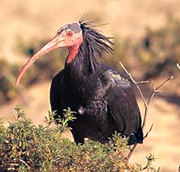 Today I was able to see a bird that has a wild population of less than 300 birds, a pair of Waldrapp or Northern Bald Ibis. This isn't a North American bird, its a North African bird. Today I saw a pair when I took my kids to the Philadelphia Zoo. According to BirdLife International, there are an estimated 227 individuals in the wild, though there are over 1,000 in captivity.
 This species has undergone a long-term decline and now has an extremely small range and population. Numbers are currently increasing, partly due to management actions and consequent improved breeding success. However, this improvement in its status in Morocco is very recent and the species may still be undergoing a continuing decline; in Syria its population appears to have declined dramatically in the past 20 years. The species is therefore retained as Critically Endangered because of its extremely small population undergoing continuing decline.(Photo:RSPB).
While I prefer birding to looking at birds in the zoo, zoo's are great to get you close to some very unusual birds and other animals. Today we got to hear the howl of a Humboldt Penguin. My kids got to race back and forth with five giant otters. We watched an American Crocodile slowly exhale bubbles through its nose underwater, a very active beaded lizard stretch and display, and have a king cobra follow our moves through the glass of its cage, and interact with dozens of other species. I've never been so close to a two-toed sloth (two feet, with no intervening glass, I could have touched it!)
The Philadelphia Zoo is great in that it has displays that allow you to get very close to many animals, including within inches of great cats. A small group of us were gathered around a Mountain Lion today when all of a sudden it perked up and totally fixated on something outside of its cage. We turned around to see what it was looking at, and there was my two year old playing in the bushes twenty feet away. Wow! We'll have to watch her when we go camping out west!
Tuesday, December 19, 2006
Keeping hummingbird feeders from freezing
The following tip comes from David Tracy, posted to the OBOL email list. David has a rare Costa's Hummingbird coming to a feeder in freezing cold Bend, Oregon. So, if you live where it gets cold, but want to keep a hummingbird feeder out (because who knows what kind of rare hummer you could get in the winter), here you go:
If you want to keep your feeder defrosted like one of the pros, go to
the local plumbing supply store. Not Lowes or Home Depot, they will only give you a blank stare. Here in Bend try Searing's on N.E. 2nd street. Invest the $8-10 for a clamp-on light fixture that looks like this (photo here).
Plug in a 125 Watt Infra-red light bulb, but don't get the red-glass type. Get an I.R. bulb with clear envelope, it casts a more natural light. Hang it using the adjustable, integrated clamp so it points at the feeder from one or two feet away. This is the way plumbers defrost frozen pipes. I plug mine up to a timer so it comes on an hour before sunrise and clicks off an hour after sunset.
Monday, December 18, 2006
Christmas Bird Count
Yesterday was the Upper Bucks Christmas Bird Count. I had a challenging area to cover--basically 5 miles of a major road between Quakertown and Coopersburg, with a mile of farm roads, commercial development, and subdivisions on either side. It was a beautiful day, sweater weather, but the birding was slow. I ended up with only 36 species after driving 82 miles and hiking about 2 miles. With no really accessible public land in this area, it was mostly roadside birding. Highlight was probably a Marsh Wren in a small cattail marsh behind a movie theatre, and American Tree Sparrows and Swamp Sparrows in an abandoned field/stormwater detention basin next to a Kmart. Not exactly a day in the wilds, but fun to explore birdlife on the urban fringe.
Postscript: I just got an email from Bill Etter, the count compiler. Turns out this is only the second Marsh Wren to be reported on this count since it started in 1968, the only other sighting was in 1992. So, looks like my strip mall birding really paid off this time!
Postscript: I just got an email from Bill Etter, the count compiler. Turns out this is only the second Marsh Wren to be reported on this count since it started in 1968, the only other sighting was in 1992. So, looks like my strip mall birding really paid off this time!
Saturday, December 16, 2006
New eBird mapping tool rocks!
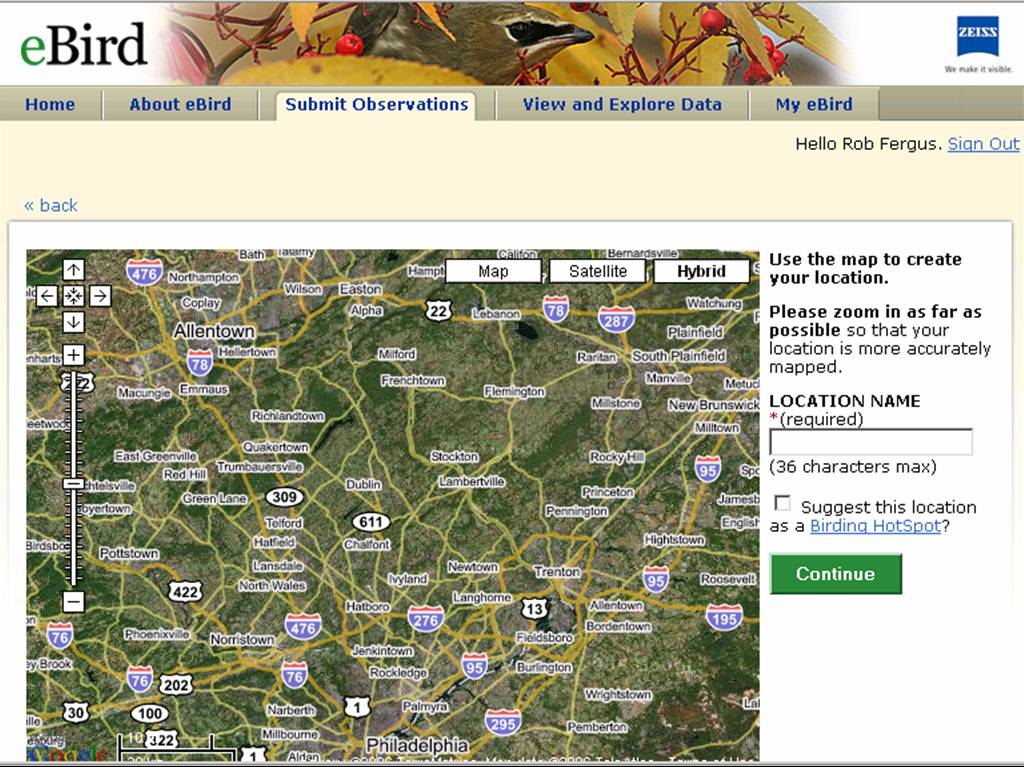 If you haven't seen the new Google mapping tool in eBird, its time to give eBird another look.
In the past, it was fairly easy, but still a bit cumbersome in eBird to add new sightings from new locations. Either you had to use the slow mapping tool, or open up something like Google Earth and toggle back and forth to add latitude and longitude readings from Google Earth into eBird.
No more. Now you can add new sighting locations very quickly using the new Google mapping tool directly in eBird.
The other day I had a Yellow-bellied Sapsucker fly up onto a tree while I was in my car sitting at a light. I never reported it to eBird, even though it was my first of season sighting, because it was just a little bit inconvenient to go through the three minute process to set up a new sighting location in eBird.
But yesterday, with the new mapping tool, I was able to add the new location and report my sighting in less than a minute.
So, if you've struggled with adding new locations in eBird in the past, give it another look. Its fantastic and easier to use than ever.
Friday, December 15, 2006
Conservation Through Birding
I've recently taken on the ownership/moderation of the Conservation Through Birding email group. There have been a lot of good discussions there over the last few years about how to get folks interested in conservation through their interest in watching birds. Check out the archives for lots of good ideas from some of the best birders and bird conservationists in the country, and join us for future discussions.
Has it really come to this?
Junkscience.com has declared the Ivory-billed Woodpecker "rediscovery" in Arkansas as one of its Top Ten Junk Science Moments for 2006. CBS has picked up on the theme, listing the Ivory-billed debate in its story on feuds and frauds in recent science. Perhaps this isn't the best day for my friends at the Cornell Lab of Ornithology.
Tuesday, December 05, 2006
NPR on Bird Flu
An NPR story today reviews the latest paper indicating that poultry may pose the greatest risk of transmitting H5N1 avian influenza to the United States. While NPR usually does a decent job of reporting, this bit had me in stitches:
Wild chickens. Now that's scary!
If the avian flu did reach the United States through wild birds, some say the virus wouldn't necessarily devastate the poultry industry, because chickens are usually raised in sealed barns. But growing numbers of chickens are now raised as free-range poultry. By law, free-range birds must spend part of their lives outside, where they can mingle with wild chickens.
Wild chickens. Now that's scary!
Birdchaser on Audubon Website
Links to my blog posts about the Hog Island Audubon Leadership Camp are online here. I'm planning on another great week in Maine this summer. Great food, great birds, great place! If you are an Audubon chapter leader, why don't you join us?
Thursday, November 30, 2006
I and the Bird #37
For the latest best posts in the world of bird blogging, I and the Bird #37 is online here.
Tuesday, November 28, 2006
To Bird, or Not to Bird
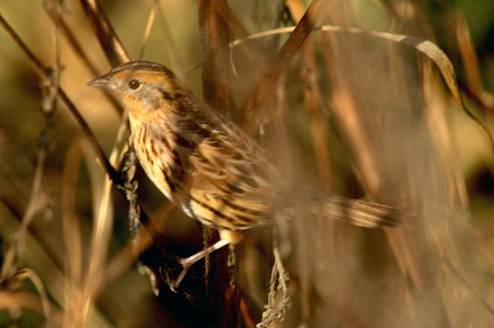 This weekend, birders found a LeConte's Sparrow in a weedy field near my house. Dozens of birders have been there each day since then. Everyone has seen it. Except for me. So far, I have chosen not to chase it (photo:Howard Eskin).
Moment of full disclosure. I've seen hundreds of LeConte's Sparrows in Texas--so I do not need to see this as a life bird. Also, though I've lived in Pennsylvania for almost two years now, I am not actively pursuing a Pennsylvania State List. And though I do keep a Bucks County list, I haven't had a desire to really given it as much attention as it would need to be taken seriously. So, my bird listing interests are not as high as they have been at other times and places in my life. Given that, any other reasons I may give for not chasing this LeConte's Sparrow may be suspect to anyone who has other birding priorities.
That said, my biggest concern about chasing this bird is that it is a small shy bird that feeds on the ground in tall grass. The only way to see it is to stomp around in its habitat until it flies, and hopefully lands where you can see it. If it flies and lands on the ground again, you have to keep chasing it and making it fly until it lands up on top of a weed or somewhere else where you can get a good look at it. While I don't have a problem with doing this to a bird once and a while, with dozens of people chasing this bird every day, I have to wonder about the negative impacts that chasing this bird might have.
According to the American Birding Association code of ethics, the primary concern of birders should be the promotion of birds and their environment. Birders are to "avoid stressing birds or exposing them to danger" (1b). Birders are also supposed to "stay on roads, trails, and paths where they exist; otherwise keep habitat disturbance to a minimum" (1d). While it isn't my job to be the birding ethics police, I do not think that it is possible to see this bird without violating these two parts of the birding code of ethics.
Some have told me that, what the heck, the damage is already done. Others are already stomping around in the grass. The bird is already being chased. We might as well all get in on the fun. This is the tragedy of the commons, the idea that as long as a resource is being exploited, we might as well get our due share. The "everyone is doing it" defense doesn't make me feel very good.
Others are claiming that the bird isn't being disturbed too much. Maybe just for a few minutes at a time over the course of the day. While the bird is only being seen that often, I'm not so sure that that it isn't being disturbed more often.
After the furor dies down, I'll probably wander over to this place to see if the bird is still around. I'll be interested to see how much habitat damage has been done, and will continue to puzzle over the ABA birding code of ethics. While its not easy to sit out a bird chase in your own neighborhood, its a bit easier to do when you aren't too worried about missing a bird for a precious list. Would I be so hesitant to chase a bird and join in a group habitat trampling exercise if the bird were an Arctic Warbler or Painted Crake, rather than a bird I've seen hundreds of times?
Saturday, November 25, 2006
Turkey Day with the kids
 Thanksgiving morning we were busy getting ready to have company over, so we had to postpone our annual Wild Turkey search until Friday. Last year we dipped on Wild Turkeys near Lexington, Virginia, but this year, with some local knowledge, we did much better, finally coming across fourteen Wild Turkeys foraging in the woods off 3 Mile Run near Lake Nockamixon. We also found a Gray Fox out in another field. The three kids all got good looks, so it was another satisfying Turkey Day. (photo:Michigan DNR)
Thursday, November 23, 2006
Extinct Bird Rediscovered
It isn't the Ivory-billed Woodpecker. Its a duck, the Madagascar Pochard. Pretty exciting news if you're into rare birds.
Bird is the Word
When you say "bird", does it sound rhyme with "word" or does it have another sound? You can take a nifty quiz to distinguish what kind of American accent you have. I took it and the results came out spot on for this native Oregonian:
Funny how we can pick up our favorite actor's voice on television from two rooms away in the house, but sometimes we still struggle with the voices of common birds. More on how to become a better bird listener later. Meanwhile, what kind of American accent do you have?
| What American accent do you have? Your Result: The West Your accent is the lowest common denominator of American speech. Unless you're a SoCal surfer, no one thinks you have an accent. And really, you may not even be from the West at all, you could easily be from Florida or one of those big Southern cities like Dallas or Atlanta. | |
| The Midland | |
| Boston | |
| North Central | |
| The South | |
| The Inland North | |
| Philadelphia | |
| The Northeast | |
| What American accent do you have? Take More Quizzes | |
Funny how we can pick up our favorite actor's voice on television from two rooms away in the house, but sometimes we still struggle with the voices of common birds. More on how to become a better bird listener later. Meanwhile, what kind of American accent do you have?
Monday, November 20, 2006
Craneberries
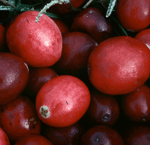 We're coming up on one of my favorite holidays--Thanksgiving, or better yet Turkey Day. I love that we have a holiday that features a bird as a central feature. I'm not a big fan of domesticated turkeys, but really love to watch Wild Turkeys. I haven't seen any for several months, so maybe its time to go on a turkey search.
Meanwhile, not many people know that cranberries were originally called craneberries, because their flowers look like cranes and early English settlers to North America also saw cranes feeding on the berries. We really ought to make more of these bird connections to Thanksgiving--a national day of thanks, and birding!
(photo:David Foster)
Thursday, November 16, 2006
Brant at Peace Valley Park
 On my way to work this morning, I finally saw the Brant goose that has been hanging out at Peace Valley Park for at least the past week or so. This coastal goose is a rare but pretty much annual visitor to this part of Pennsylvania--not easy to find, but something to look for each fall and winter. The bird at Peace Valley was all by itself swimming in the water off one of the boat launches at the park. Smaller than the abundant Canada Geese that spend the winter here in huge flocks, this sharp little goose is a lot of fun to see. A small goose I saw in a very distant flock of flying Canada Geese at Peace Valley about a month ago was very probably this individual. (photo:Dave Saunders)
Project Feeder Watch
Its that time of year again, time to start counting the birds at your feeders for fame and fortune...or at least for science. Brought to you by Cornell Laboratory of Ornithology, Audubon, Bird Studies Canada, and Nature Canada, Project Feeder Watch has helped us gain a better understanding of birds at feeders across the country, and gives everyone a chance to contribute meaningful observations towards creating this larger picture of how birds respond to our efforts to help and attract them. I started out the morning with just a Carolina Chickadee, Blue Jay, and two House Finches at the feeders. I'll watch the feeders off and on today and tomorrow, finally reporting the highest number of each species seen at one time. I'll do this every other week until April, reporting the numbers to the online database, and having a blast at the same time. Join Project Feeder Watch, and help us keep track of the birds that we all enjoy.

Wednesday, November 15, 2006
Did I ever mention my book?
 I'm fascinated by the relationships that people have with birds. Purple Martin landlords, folks that put up and maintain those Purple Martin houses across the country, have some of the most interesting experiences and relationships with their birds. A couple years back, I wrote a book about these birds and the people who care for them with Robin Doughty, my graduate work advisor at the University of Texas at Austin. Its a fun little book. See if your local library has a copy, or get one for yourself (and other copies for your friends!). You can read a review by Ro Wauer here.
Sonic Bird Telescope
How about a way to identify birds by sound as they pass high overhead? New Scientist reports that researchers are experimenting with this technology to help them identify distant flying birds that might pose a threat to aircraft. Sounds like another good tool for bird observatories. Can I get one for my yard?
Monday, November 13, 2006
Peace
 I've found a new stress management tool. I close my eyes. I'm standing on the rocks overlooking La Jolla Cove. The waves are crashing below me. A couple hundred yards out, Black-vented Shearwaters are streaming past just over the waves. Heaven.
(photo: Henry Detwiler)
Vindication
One of the worst things you can do as a birder is to report rare birds that nobody else is able to find. Sure, it happens some times. But if it happens all the time, people will start thinking you are making things up. As a birder, all you really have is your reputation. And you just can't survive as a birder with a reputation for making up rare bird sightings.
So, after I alerted the San Diego birding community to my Marbled Murrelet sighting, a bunch of folks showed up the next day to look for it. They found a lot of birds there that I had missed (especially since I didn't have a scope), but no murrelet. The next day, they were out there looking again. I was planning to be there too, but was up to late working on a presentation, and skipped out. The birders there were able to find a Brown Booby, which is a rare bird that was on many San Diego County birders's most wanted list, but no murrelet.
Sunday was my last morning in San Diego, so I joined a half dozen or so birders back at La Jolla. We saw lots of Black-vented Shearwaters offshore, a close Sooty Shearwater, and many other birds, but by the time I left just after 8am to catch my flight back home, there had been a distant Common Murre flyby, but no murrelet.
Fortunately, just after 9am the remaining birders were able to see my bird, as the Marbled Murrelet flew close by the point! They were also treated to several other good birds, including a Craveri's Murrelet.
While I wish I could have seen the booby and the other murrelet, I am really happy that others were able to see refind the Marbled Murrelet I reported. I was starting to get worried that San Diego birders might think I was all wet. Whew! Thank you bird, for finally showing up again! And if my sighting helped spark a memorable week of bird sightings from La Jolla Cove, that just makes it all the sweeter.
San Diego, I hope I can get back there soon. You have some great birds, and patient birders. Thanks for sharing. You gotta love it!
So, after I alerted the San Diego birding community to my Marbled Murrelet sighting, a bunch of folks showed up the next day to look for it. They found a lot of birds there that I had missed (especially since I didn't have a scope), but no murrelet. The next day, they were out there looking again. I was planning to be there too, but was up to late working on a presentation, and skipped out. The birders there were able to find a Brown Booby, which is a rare bird that was on many San Diego County birders's most wanted list, but no murrelet.
Sunday was my last morning in San Diego, so I joined a half dozen or so birders back at La Jolla. We saw lots of Black-vented Shearwaters offshore, a close Sooty Shearwater, and many other birds, but by the time I left just after 8am to catch my flight back home, there had been a distant Common Murre flyby, but no murrelet.
Fortunately, just after 9am the remaining birders were able to see my bird, as the Marbled Murrelet flew close by the point! They were also treated to several other good birds, including a Craveri's Murrelet.
While I wish I could have seen the booby and the other murrelet, I am really happy that others were able to see refind the Marbled Murrelet I reported. I was starting to get worried that San Diego birders might think I was all wet. Whew! Thank you bird, for finally showing up again! And if my sighting helped spark a memorable week of bird sightings from La Jolla Cove, that just makes it all the sweeter.
San Diego, I hope I can get back there soon. You have some great birds, and patient birders. Thanks for sharing. You gotta love it!
Friday, November 10, 2006
Marbled Murrelet at La Jolla Cove
 Driving back down to San Diego from San Elijo Lagoon, I stopped off to look for seabirds at La Jolla Cove. Lots of pelicans and all three local cormorant species on the rocks. I spent maybe 45 minutes scanning the water offshore, hoping to see a shearwater or some other sea bird. At one point I was enjoying the sparkling green eye of a distant Pelagic Cormorant, when on the edge of my view through my binoculars I saw a black and white bird dive. I was a bit frustrated, since the bird had been clearly visible but I hadn't noticed it while looking at the cormorant.
 Eventually, the bird surfaced, and I was able to watch it on and off for about 15 minutes. It was a couple hundred yards offshore, and all I had were my Zeiss 7x42s, so I didn't get killer looks, but it was good enough to get the basic pattern of black above, white below, with white patches on each side of the back over the wings and side of rump. Also, the white of the face met a black cap at the eye line, with white extending back onto the neck as a collar. All of this pretty much added up to Marbled Murrelet. After double checking references back at my hotel room to make sure it wasn't something even more exotic (like Long-billed Murrelet from Asia or Kittlitz's Murrelet from Alaska), and realizing that this is an unusual bird in San Diego County, I emailed the local birding community. I grew up with these birds in Oregon, but don't get to see them much any more, so this was a nice treat. (photo:camacdonald.com)
California Gnatcatchers in San Diego County
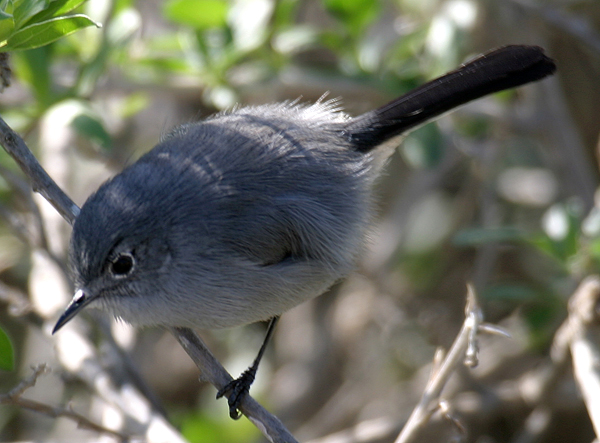 If you Google California Gnatcatcher, you can find lots of information about this endangered species, including that there are about 2000 pairs of these birds left in the United States. What you can't find as easily online, are directions for how to find these birds in San Diego County. If you find yourself flying into San Diego, and want to know where to go find California Gnatcatchers, here's the post for you.
After landing in San Diego, I got the rental car and cruised north on I-5. I had read that San Elijo Lagoon north of San Diego had lots of gnatcatchers, so that's where I headed first. Turned out to be the right call, as I was able to find several California Gnatcatchers within 20 minutes of arriving at the lagoon about lunch time.
Directions: Exit I-5 at Lomas Santa Fe Drive in Solana Beach. Head west towards the beach and turn right onto Rios Avenue. Drive just over half a mile to the end of the road and park. There is a trail heading down towards the lagoon (map here). After maybe a quarter mile, the trail splits. Stay straight (don't turn left). I had four California Gnatcatchers in the short coastal sage shrub between the trail split and the large dead-looking tree 100 yards down the trail.
Lots of other birds in the area, including Cassin's Kingbirds, Wrentit, Bushtits, California Quail, and Western Scrub-Jay. Had to whisk the Audubon's Warblers away with a stick. Same with House Finches. All in all, I was there for maybe 45 minutes and saw 50 species in the brush and on the lagoon. Looks like the gnatcatchers are pretty easy to find there, I just walked slowly until I heard a gnatcatcher like call and waited. Eventually at least four of them were busy feeding in the bushes near the trail. I had them in sight for maybe 15 minutes before they moved on. If you are looking for these guys, just walk slowly and enjoy the trail and the lagoon while you wait for them to appear.
I really enjoyed these little tail-wagging birds, and got great looks at the mostly dark under tail, as well as the dark slate gray plumage. These are amazing little birds, well worth the effort to go out and see. (photo: David Nelson)
Wednesday, November 08, 2006
Red-vented Bulbul in Houston
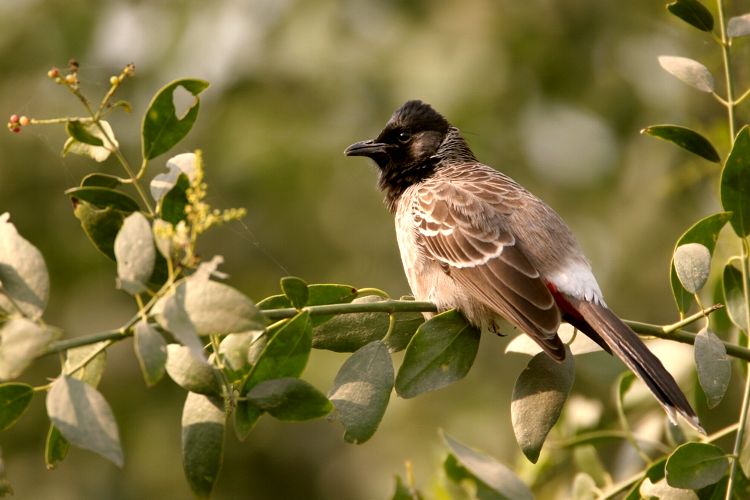 Finding myself with a couple hours to spare today before my talk at Houston Audubon, I decided to go on another exotic urban bird quest. After picking up a rental car at Hobby Airport, I cruised over to The Heights, an early 20th Century neighborhood of cottage style homes just north of I-10 in search of Red-vented Bulbuls. Birders have reported these Asian birds in Houston off and on for about 10 years. These birds have a reputation for being very aggressive invaders in new settings, but so far we don't know a lot about how they are doing in Houston.
On a tip from a local birder, I drove to the corner of E 5 1/2 Street and Frasier Street (map here), and sure enough almost immediately I saw a single Red-vented Bulbul in a tree. It flew back and forth across E 5 1/2 street several times, eating berries from one of the trees near the lumber yard. After I parked the car, I walked back and got closer looks before it flew off behind the house north of the road and disappeared.
Questing for exotic urban birds isn't for everybody, especially when they aren't considered established or listable by the American Birding Association, but exotic urban birds are a part of our American avifauna now, like it or not, so we might as well start keeping track of them.
Bulbul hunters should be advised that these birds may be scattered over 100 square miles of the Greater Houston area, though The Heights seems to be one area where they are more often reported (other recent Heights locations include 7th and Arlington). Check the TEXBIRDS email list archives (here) for any recent sightings, and please report your sightings online as well. No matter how you feel about introduced exotic urban bird pests, its a good idea for us all to keep track of the strange birds in our midsts--if only to know if they are causing problems with our native birds.
(photo: justbirds.org)
Tuesday, November 07, 2006
Off to Houston...and San Diego
I'm heading down to Houston tomorrow to present at talk on how birds see the world to the Houston Audubon Society. Then I'm off to San Diego to give a talk on avian influenza and other emergent diseases to the Wild Bird Feeding Industry Annual Meeting. Hope to see some old birding friends and some birds I don't get to see much of these days, and make some new birding and bird friends as well. Stay tuned for updates.
Monday, November 06, 2006
All Hands! Rare birds need help this week!
 Habitat for two of the rarest birds in North America, Gunnison Sage Grouse and Lesser Prairie Chicken, is under threat. Here is notice from Audubon Colorado conservation chair SeEtta Moss:
Last week Audubon Colorado, a few Audubon Chapters and individuals filed formal "protests" on the scheduled oil & gas drilling lease sale for parcels that have Gunnison Sage-Grouse and Lesser Prairie-Chicken leks and habitat. So far these parcels have not been withdrawn from lease sale eligibility on November 9.
Please take 20 minutes to send a fax/letter/email to the person in charge of this gas & oil lease sale, Sally Wisely who is the state director of the Bureau of Land Management (tho some parcels are on Forest Service land, the BLM does the oil & gas leasing for all federal and some private lands). We need to let Ms. Wisely know that there are many Coloradoans who are concerned about our Gunnison Sage Grouse and Lesser Prairie-Chicken populations.
It is best to send a fax, but if not convenient then send either a letter or an email to the addresses below. Be sure to put your full name, street address and city on your comments and sign those comments you fax or send by letter. If you have ever viewed either Gunnison Sage-Grouse or Lesser Prairie-Chickens, or intent to do so, please note that. If you are a birder, please note that and add info about your traveling to see birds.
I think it is helpful to copy your comments to both Senators Allard and Salazar, but you have to fill in their online webforms as noted below. And please copy your text and send it to me as I will use the summary information (ie, you have received comments from X number of birders, and X number of persons who still want to view X) in the comments I send to her.
Points to make (please rephrase in your own words as they devalue form letters):
--You strongly oppose the lease sale of parcels with Gunnison Sage Grouse and Lesser Prairie-Chicken leks and habitat.
--Keeping these parcels, identified in the protest filed by Audubon Colorado, in the lease sale is jeopardizing the existence of populations of these species.
--That Gunnison Sage Grouse is listed as a Species of Special Concern by the State of Colorado.
--That Lesser Prairie-Chicken is listed as Threatened by the State of Colorado and has been granted Candidate status under the Endangered Species Act.
--Colorado Division of Wildlife is putting a lot of time and effort into protecting existing populations of both Gunnison Sage Grouse and Lesser Prairie-Chicken.
--Gunnison Sage Grouse is a very imperiled species with fewer than 3,500 birds teetering on the brink of extinction.
--Lesser Prairie-Chicken—parcels in this lease sale encompass 6 active leks that account for the majority of the known birds on the Comanche National Grasslands. Lesser Prairie-Chickens have been declining on these public lands since 1989 with only about 38 males counted in 2006.
--Relying on a 1991 Oil & Gas Leasing EIS for Lesser Prairie-Chickens and a 1993 Oil & Gas Leasing EIS for Gunnison Sage Grouse violates NEPA regulations. These old and outdated EIS’s do not include current information of species populations and risks, nor recent research on the impacts of oil & gas drilling on these species.
--The parcels that have leks or habitat for Gunnison Sage Grouse and Lesser Prairie-Chicken must be withdrawn from this and future lease sales
Thank you in advance for helping protect Gunnison Sage-Grouse and Lesser
Prairie-Chicken in Colorado.
SeEtta Moss (email copy of your comments to prairie.grouse@yahoo.com)
----------------------------------
FAX: 303-239-3799
Attn: Sally Wisely, State Director
Letter:
Sally Wisely, State Director
Bureau of Land Management, Colorado State Office
2850 Youngfield Street
Lakewood, Colorado 80215
Email: sally_wisely@co.blm.gov
Senator Allard:
http://allard.senate.gov/public/index.cfm?FuseAction=Contact.Home
Senator Salazar:
http://salazar.senate.gov/contact/email.cfm
Friday, November 03, 2006
More low pathogenic H5N1 bird flu in USA
Tests of wild ducks from New York state provide the latest evidence of the low pathogenic form of H5N1 avian influenza in the United States. Again, with increased testing of wild birds, we should find many more cases of these relatively harmless strains of bird flu.
November First Friday
 Amy at Wild Bird On the Fly has a birding short fiction contest each month. Its a good opportunity to get the creative juices flowing. While I didn't win, here's my submission for this month.
Your Kindness We Praise
Pumpkin John thought the small wispy clouds in the otherwise piercing blue sky looked like down feathers. Maybe goose feathers. As he started back to the house, he watched his son emerge from the corn field, head down, his mind obviously somewhere else. Mose would be sixteen next month. Was he already making rumspringa plans? Pumpkin John stared at the clouds, willing himself not to think of the latest whisperings.
Halfway across the pasture, he turned quickly upon hearing the soft explosion of wingbeats from almost underfoot. Oddly, the bird landed in the open, not far away, staring intently at the bearded bear of a man in the wide-brimmed straw hat. Happily, Mose had also seen the bird, and only needed half a whisper and a nod to take off for the house.
Within minutes, dark dresses emerged from the house, straw hats ran from the barn, some coming directly, while others sped elsewhere before returning with others. Boom Amos, Balky Ike, Annie, Rebecca, and Chicken Dan. All with binoculars. Yonnie, Mary, Samuel, and Butcher Joe trailing closely behind.
From State Highway 39, a passerby who took the wrong exit off I-77 could only wonder about the dozen Amish men, women, and children gathered in a wide circle in the middle of the field. Within the circle, binoculars were shared, as the small buffy striped bird stared back intently from behind its dark mask. It shouldn’t be here, out in the open, away from cover. But here it was, surrounded, revealing no emotion, nor anything else. An October surprise.
Finally, the bird answered the intent stares by uttering a short, mechanical tic-tic-tictictic, tic-tic-tictictic.
Pumpkin John, under his breath, almost instinctually responded:
O Gott, Vater, wir loben dich und deine Güte preisen wir.
The rest of the circle replied in kind, singing Das Loblied quietly, in unison, the bird motionless in their midst.
After a final glimpse through binoculars, the circle dispersed into the chill autumn breeze, hearts lifted, as the Yellow Rail looked on.
Rusty Blackbirds
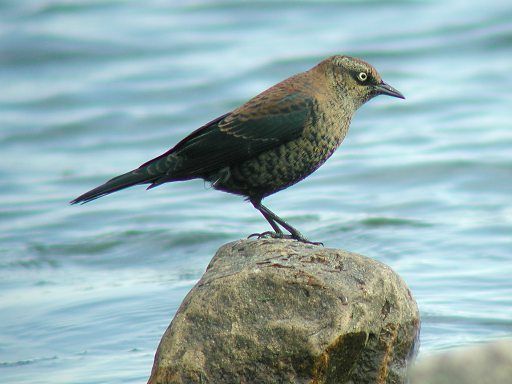 This morning felt like a Rusty Blackbird morning so I checked out the corn field and woodland edge behind my office. Sure enough, two Rusty Blackbirds flew up out of the field into a tree where I could get a good look before a flock of Red-winged Blackbirds all flew up and the birds moved off. Nice time of year to get out and look for these birds, which we all know are slipping away with huge population declines of over 80% over the past 30 years.
 I absolutely love these birds. They have such great plumage this time of year, with the rusty feathering and the wild yellow eyes look like they are glaring, just challenging any and all comers to deny their blackbirdness. I just can't get enough of them. They are hard enough to find that they are a treat to see these days. A good way to start out the day.
(photo: Brian Boldt)
Wednesday, November 01, 2006
Birding Bling
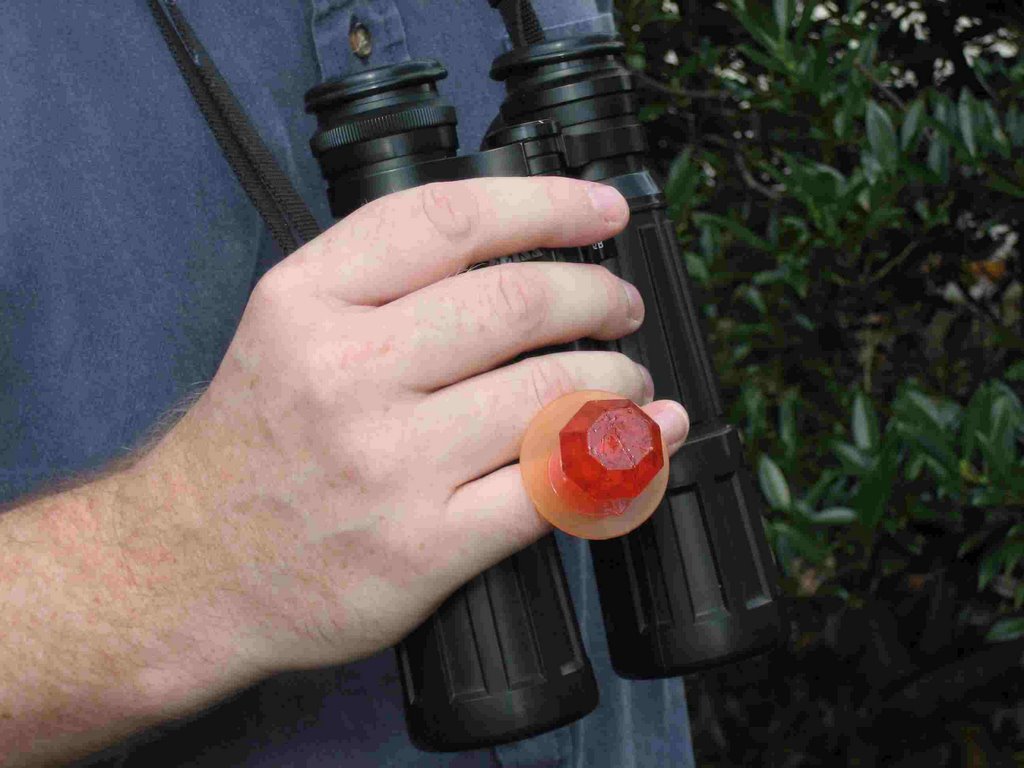 Today I found the perfect birding accessory in the leftover trick or treat candy bowl at work--a strawberry Ring Pop. For an adult sized mouth, it is hard to suck the Jolly Rancher style candy jewel on the ring without making those squeaking noises that songbirds really love. While birding with my Ring Pop this afternoon, a Ruby-crowned Kinglet came in to check out the noise was. Remember, you read it here first. Pretty soon, everyone will be birding with these babies.
Birding has actually been pretty decent the last few days. Saw a female Redhead with the migrant ducks at Peace Valley on Monday. A stop at the fields at Sailor's Point at Peace Valley yesterday netted lots of sparrows, including two Fox Sparrows and fifteen Savannah Sparrows. This morning at Pine Valley on my way in to work I had two Vesper Sparrows with dozens of Savannah Sparrows and Swamp Sparrows in the meadow restoration area (but no sign of the Yellow Rail reported from there yesterday). The temperature has been pleasant the last few days, hopefully it will stay this way for awhile before winter moves in.
Thursday, October 26, 2006
Birdchaser in Birder's World Magazine
 Check out my latest book reviews in the brand spanking newly designed and even cooler Birder's World magazine. Pretty sweet cover of a Northern Hawk Owl, eh?
 While I wouldn't go so far as to call Birder's World the Playboy of bird magazines, the new look is pretty sexy.
Birdchaser caught on film
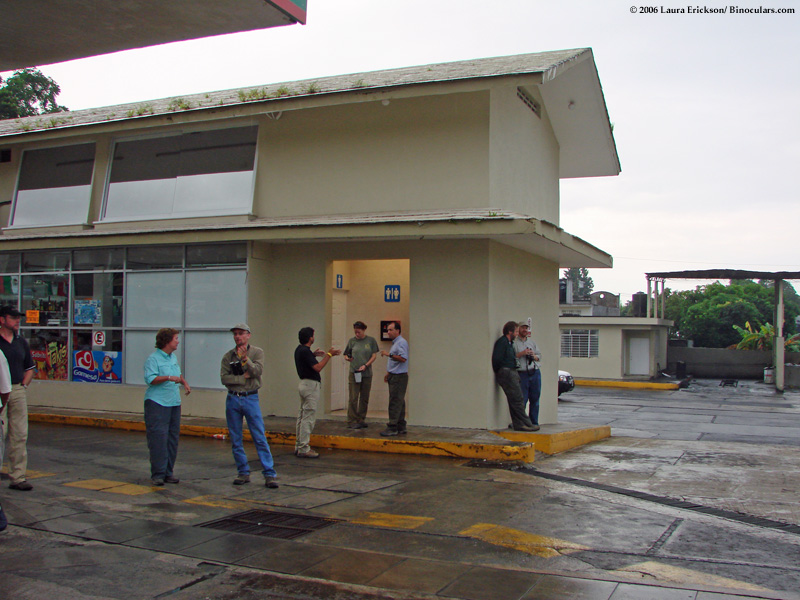 Earlier this month on my trip to the Tuxtlas in Mexico, I was caught on film by 101 Ways to Help Birds author and birderblogger Laura Erickson. While most of the birders in the four vans were busy looking at a Red-billed Pigeon, I was hobnobbing with Purple Martin Conservation Association founder Jamie Hill. That's us over there on the right side of the building. Not a great photo? Can't tell its me?
  OK, here I am at lunchtime, obviously having too good of a time on my Columbus Day vacation jaunt through Veracruz. Actually, I wish I could remember what I was chuckling about. Must have been good though, because normally I just have a twinkle in my eye, rather than a full blown belly laugh thing going on. But oh, its so great to be out birding!
Say hello to my leetle friend
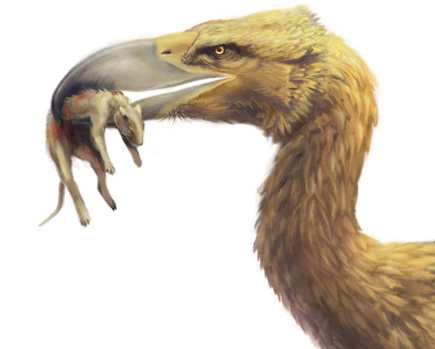 OK, he isn't exactly little. And if he were still alive, he probably wouldn't be my friend. He's a 10 foot tall bird with a horse-sized head sporting a giant eagle beak. He could gulp down giant possums in a single gulp. He's a 15 million year old species of phorusrhacid--large flightless birds that roamed the Americas after the dinosaurs were wiped out at the end of the Cretaceous. See here for more details of the discovery of the skull and foot bones of this bird in Argentina.
Birdchaser in I and the Bird blog carnival
Check out the latest I and the Bird for the best recent bird and birding blog posts.
Wednesday, October 25, 2006
Audubon Backyard Birds FAQ
 Audubon has just posted a new backyard bird FAQ page. Perhaps a good resource for a bird club or anyone else who gets frequent emails about the following:
--Why does a male cardinal continuously bang against the windows of our house?
--What kind of hawk is this in my backyard? Should I stop feeding the birds?
--Can you recommend a squirrel-proof feeder?
--When is the best time to hang a nesting box? How big should it be?
--I found a baby bird out of its nest and hopping around our backyard. What should I do?
-- An ugly, bald bird just showed up at my feeder. It resembles a cardinal but it has a blue head. What is it?
--There is a white bird in my yard. Is it an albino or some kind of rare species?
--I live in Massachusetts and saw a small black and white woodpecker in my backyard. Could it be a baby Ivory-billed Woodpecker?
The answers to these questions are online here.
33,850 birds tested in USA for H5N1 bird flu
Based on the latest numbers posted by the National HPAI Early Detection System (HEDDS), researchers have tested over thirty thousand wild birds in the US for dangerous H5N1 avian influenza viruses. So far, no signs that HPAI H5N1 has crossed over to the US with migrating birds from Asia or Europe. You can see a breakdown of how many birds have been tested in each state here.
Tuesday, October 24, 2006
UGA study identifies North American wild bird species that could transmit bird flu
The following news release comes from the University of Georgia provides interesting information on how various North American species respond to HPAI H5N1.
Athens, Ga. – University of Georgia researchers have found that the common wood duck and laughing gull are very susceptible to highly pathogenic H5N1 avian influenza viruses and have the potential to transmit them.
Their finding, published in the November issue of the journal Emerging Infectious Diseases, demonstrates that different species of North American birds would respond very differently if infected with these viruses. David Stallknecht, associate professor in the department of population health at the UGA College of Veterinary Medicine and co-author of the study, said knowing which species are likely to be affected by highly pathogenic H5N1 viruses is a vital component of efforts to quickly detect the disease should it arrive in North America.
“If you’re looking for highly pathogenic H5N1 in wild birds, it would really pay to investigate any wood duck deaths because they seem to be highly susceptible, as are laughing gulls,” said Stallknecht, a member of the UGA Biomedical and Health Sciences Institute. “It was also very interesting that in some species that you normally think of as influenza reservoirs – the mallard, for instance – the duration and extent of viral shedding is relatively low. This may be good news since it suggests that highly pathogenic H5N1 may have a difficult time surviving in North American wild birds even if it did arrive here.”
Working under controlled conditions in an airtight biosecurity lab at the USDA Agricultural Research Service’s Southeast Poultry Research Laboratory, the researchers determined how much of the virus was shed in the feces and through the respiratory system of several species of wild birds. The work was jointly funded by the United States Poultry and Egg Association, the Morris Animal Foundation and the USDA.
“We chose birds that, because of their behavior or habitat utilization, are most likely to transmit the virus or bring the virus here to North America,” said lead author and doctoral student Dr. Justin Brown.
The species studied were: Mallards, which are often infected with commonly circulating, low-pathogenic avian influenza viruses in North America and Eurasia; Northern pintails and blue-winged teal, which migrate long distances between continents; redheads, a diving species; and wood ducks, which breed in Northern and Southern areas of the United States. The laughing gull is a common coastal species ranging from the Southern Atlantic to the Gulf Coast.
Stallknecht explained that in low-pathogenic avian influenza, most of the virus is shed in the feces of birds. The virus then spreads as other birds drink from contaminated water. The study found that in highly pathogenic H5N1 avian influenza, however, the birds shed most of the virus through their respiratory tract.
Stallknecht said that with this knowledge, scientists can detect the virus in live birds more effectively by swabbing the birds’ mouths and throats.
“Doing avian influenza surveillance is pretty tricky because there are a lot of species differences and there are also seasonal differences,” he said. “So you’ve got to pick the right species at the right time and you’ve got to collect the right samples.”
In a related study scheduled to be published in the December issue of the journal Avian Diseases, the researchers have quantified how long the virus persists in water samples. They found that highly pathogenic H5N1 avian influenza viruses don’t persist as long as common low-pathogenicity strains. In some cases, persistence times were reduced by more than 70%. This could affect transmission and supports the idea that these viruses may not have much of a chance of becoming established in North America.
Stallknecht said the finding is encouraging, but cautions that it’s difficult to put it into context without results from a study his team is currently working on that will assess the minimum amount of virus it takes to infect a bird.
This month, the researchers also received the first $875,000 of a planned three-year grant totaling $2.6 million from the Centers for Disease Control and Prevention. The grant will be used for an ambitious project that will take a broad look at the possibility of human contact with avian influenza viruses.
In the first phase of the project, the researchers will examine the prevalence, persistence and distribution of the viruses in various environments. In the next phase, they’ll work with state public health departments to determine the groups of people who – by virtue of their occupation or recreational activities – are likely to come into contact with the viruses. The researchers then will assess the ability of low-pathogenic avian influenza viruses to infect mammals so that the risk of human contact can be put into perspective.
“With this information, public health officials will be able to better understand the human health risks associated with both low-pathogenic and highly pathogenic avian influenza viruses in both domestic and wild bird populations,” Stallknecht said. “Many of these potential risks are not very well understood or even defined, and it is possible that they could be very effectively controlled with simple preventive measures.”
Athens, Ga. – University of Georgia researchers have found that the common wood duck and laughing gull are very susceptible to highly pathogenic H5N1 avian influenza viruses and have the potential to transmit them.
Their finding, published in the November issue of the journal Emerging Infectious Diseases, demonstrates that different species of North American birds would respond very differently if infected with these viruses. David Stallknecht, associate professor in the department of population health at the UGA College of Veterinary Medicine and co-author of the study, said knowing which species are likely to be affected by highly pathogenic H5N1 viruses is a vital component of efforts to quickly detect the disease should it arrive in North America.
“If you’re looking for highly pathogenic H5N1 in wild birds, it would really pay to investigate any wood duck deaths because they seem to be highly susceptible, as are laughing gulls,” said Stallknecht, a member of the UGA Biomedical and Health Sciences Institute. “It was also very interesting that in some species that you normally think of as influenza reservoirs – the mallard, for instance – the duration and extent of viral shedding is relatively low. This may be good news since it suggests that highly pathogenic H5N1 may have a difficult time surviving in North American wild birds even if it did arrive here.”
Working under controlled conditions in an airtight biosecurity lab at the USDA Agricultural Research Service’s Southeast Poultry Research Laboratory, the researchers determined how much of the virus was shed in the feces and through the respiratory system of several species of wild birds. The work was jointly funded by the United States Poultry and Egg Association, the Morris Animal Foundation and the USDA.
“We chose birds that, because of their behavior or habitat utilization, are most likely to transmit the virus or bring the virus here to North America,” said lead author and doctoral student Dr. Justin Brown.
The species studied were: Mallards, which are often infected with commonly circulating, low-pathogenic avian influenza viruses in North America and Eurasia; Northern pintails and blue-winged teal, which migrate long distances between continents; redheads, a diving species; and wood ducks, which breed in Northern and Southern areas of the United States. The laughing gull is a common coastal species ranging from the Southern Atlantic to the Gulf Coast.
Stallknecht explained that in low-pathogenic avian influenza, most of the virus is shed in the feces of birds. The virus then spreads as other birds drink from contaminated water. The study found that in highly pathogenic H5N1 avian influenza, however, the birds shed most of the virus through their respiratory tract.
Stallknecht said that with this knowledge, scientists can detect the virus in live birds more effectively by swabbing the birds’ mouths and throats.
“Doing avian influenza surveillance is pretty tricky because there are a lot of species differences and there are also seasonal differences,” he said. “So you’ve got to pick the right species at the right time and you’ve got to collect the right samples.”
In a related study scheduled to be published in the December issue of the journal Avian Diseases, the researchers have quantified how long the virus persists in water samples. They found that highly pathogenic H5N1 avian influenza viruses don’t persist as long as common low-pathogenicity strains. In some cases, persistence times were reduced by more than 70%. This could affect transmission and supports the idea that these viruses may not have much of a chance of becoming established in North America.
Stallknecht said the finding is encouraging, but cautions that it’s difficult to put it into context without results from a study his team is currently working on that will assess the minimum amount of virus it takes to infect a bird.
This month, the researchers also received the first $875,000 of a planned three-year grant totaling $2.6 million from the Centers for Disease Control and Prevention. The grant will be used for an ambitious project that will take a broad look at the possibility of human contact with avian influenza viruses.
In the first phase of the project, the researchers will examine the prevalence, persistence and distribution of the viruses in various environments. In the next phase, they’ll work with state public health departments to determine the groups of people who – by virtue of their occupation or recreational activities – are likely to come into contact with the viruses. The researchers then will assess the ability of low-pathogenic avian influenza viruses to infect mammals so that the risk of human contact can be put into perspective.
“With this information, public health officials will be able to better understand the human health risks associated with both low-pathogenic and highly pathogenic avian influenza viruses in both domestic and wild bird populations,” Stallknecht said. “Many of these potential risks are not very well understood or even defined, and it is possible that they could be very effectively controlled with simple preventive measures.”
Monday, October 23, 2006
More H5N1 bird flu in US
With increased testing of wild birds in the United States, we shouldn't be surprised to find more avian influenza viruses. However, so far all of the H5N1 viruses found have been low pathogenic forms that do not pose a risk to poultry or humans and are unrelated to the virulent asian H5N1 bird flu. The latest positive results of low pathogenic H5N1 come from Green-winged Teal in Michigan.
Friday, October 20, 2006
Report Sick or Dead Birds
Thanks to concerns about avian influenza, there is now a website telling you where to report sick or dead birds in each state. So, next time you find a dead bird, here's where to go.
Thursday, October 19, 2006
Lark Sparrow, kaching!
During my lunch break today I joined Paul Green for a quick dash over to a local farm where a Lark Sparrow has been making an appearance. We quickly found the weedy draw where the bird is hanging out, but the bird didn't show itself right away. Did see three Palm Warblers and my first-of-season Ruby-crowned Kinglet, along with a half dozen other species. Finally, I found a big flock of sparrows, but they flushed down to the other end of the draw. Within a few minutes, a couple birders down there started waving us over...there it was, a juvenile Lark Sparrow with all the trimmings. This is the fifth county record, and the first to be photographed. A nice Western US bird for my Bucks County list.
Plastic Flamingos Faced with Extinction
According to this LA Times story, the factory that has produced 250,000 plastic pink flamingos a year for the last half century will close its doors next month. Don't know what more to say about this one. R.I.P.
Wednesday, October 18, 2006
Bank Swallows and Common Loons about to disappear
In case you haven't heard this yet, there is a proposal to get rid of the common names of some familiar North American birds, including Common Loon, Eared Grebe, Ring-necked Pheasant, Dovekie, Rock Pigeon, European Starling, Bank Swallow, White-winged Crossbill, and Saltmarsh Sharp-tailed Sparrow.
In Frank Gill and Minturn Wright's new book Birds of the World: Recommended English Names, the names of these birds are replaced by Great Northern Loon, Black-necked Grebe, Common Pheasant, Little Auk, Common Pigeon, Common Starling, Sand Martin, Two-barred Crossbill, and Saltmarsh Sparrow.
So what are the chances that these names will be adopted by the American Ornithologists' Union Committee on Systematics and Nomenclature, the group that decides on the names of birds? Well, Frank Gill was the head of the International Ornithological Congress committee that worked through regional sub-groups to come up with all these names. The current AOU committe members that will have to vote on these recommendations are Richard C. Banks, Carla Cicero, Jonathan L. Dunn, Andrew W. Kratter, Irby J. Lovette, Pamela C. Rasmussen, J. V. Remsen, Jr., James D. Rising, and Douglas F. Stotz.
Keep your ears to the ground, but English bird name changes appear to be on the horizon. There are even more changes than those I listed here.
Other bloggers with thoughts on this include:
Birds Etcetra
Aimophila Adventures
In Frank Gill and Minturn Wright's new book Birds of the World: Recommended English Names, the names of these birds are replaced by Great Northern Loon, Black-necked Grebe, Common Pheasant, Little Auk, Common Pigeon, Common Starling, Sand Martin, Two-barred Crossbill, and Saltmarsh Sparrow.
So what are the chances that these names will be adopted by the American Ornithologists' Union Committee on Systematics and Nomenclature, the group that decides on the names of birds? Well, Frank Gill was the head of the International Ornithological Congress committee that worked through regional sub-groups to come up with all these names. The current AOU committe members that will have to vote on these recommendations are Richard C. Banks, Carla Cicero, Jonathan L. Dunn, Andrew W. Kratter, Irby J. Lovette, Pamela C. Rasmussen, J. V. Remsen, Jr., James D. Rising, and Douglas F. Stotz.
Keep your ears to the ground, but English bird name changes appear to be on the horizon. There are even more changes than those I listed here.
Other bloggers with thoughts on this include:
Birds Etcetra
Aimophila Adventures
Frank Gill on Ivory-billed Woodpecker "Rediscovery"
I was able to get a copy of Frank Gill's brand-spanking-new Ornithology text book (3rd edition). Here's what he says about the Ivory-billed Woodpecker:
Interestingly, there is a questionmark next to the rediscovery year in the table of rediscovered birds thought to be extinct for at least 50 years.
Even more encouraging are the rediscoveries of species thought to be extinct (Table 21-1). Among them, the Ivory-billed Woodpecker has by far the highest profile. Last seen for sure in 1944 in the Singer tract of Louisiana, the majestic Ivory-billed Woodpecker, or Lord God Bird, is the signature species of the old-growth bottomland forests of the southeastern United States (Figure 21-7). One of the largest woodpeckers in the world, the Ivory-bill first was hunted by Native Americans and then was collected as a desireable rarity by early ornithologists. Critical bottomland forests were cut. Despite regular reports of sightings of Ivory-billed Woodpeckers, in teh absence of any confirming photograph, Ivory-bills became as legendary and elusive as Elvis himself.
Then, a report by a kayaker in southeastern Arkansas on February 11, 2004, followed by 4 seconds of video, sparked fevered excitement, renewed hope, and led to a public media blitz in April 2005 (Fitzpatrck et al. 2005). Field teams searched the bottomlands. Additional land was secured to protect the ecosystem. Local entrepreneurs and townships profited from the rush of ecotourism. But the woodpecker disappeared, prompting professional debates and doubts (Sibley et al. 2006; Fitzpatrick et al. 2006; Jackson 2006). This spike of rediscovery, however, revitalized the hopes of conservationists everywhere. Other lost species also might survive if such a large and dramatic species as this one could persist undetected for 60 years (pp. 651-52).
Interestingly, there is a questionmark next to the rediscovery year in the table of rediscovered birds thought to be extinct for at least 50 years.
Friday, October 13, 2006
I saw an Ivorybill!
Maybe only 30 feet away, great looks as it hitched its way up a tree. Even saw the large whitish bill! It was an unmistakable Ivory-billed Woodcreeper in the Tuxtla Mountains of Veracruz. Perhaps the only real ivorybill species left on the planet?
I was able to attend the Auburn Ivory-billed Woodpecker talk at the North American Ornithological Conference in Veracruz last week. While I'd like more than anyone to know that Ivory-billed Woodpeckers are out there somewhere, the Auburn team still doesn't have any confirmatory evidence that the birds are really there in their Florida study site. A couple brief sight records--with one or two that initially sound better than the Cornell sightings in Arkansas--that are by themselves not sufficient evidence. Some sound recordings of kent calls and double knocks--which could be explained by lots of other things like deer and other woodpeckers out in the swamps. Large holes in trees and trees with bark stripped off--who knows what else can do that to a tree.
While I wish the Auburn team luck, I was concerned that they:
A) Tried to pull off this search all by themselves, which means it was usually just one grad student sleeping in a tent in the woods for months at a time wandering around in the swamp. I guess they thought they had a slam dunk case and that it wouldn't be so hard to get a photo of the birds they thought they were hearing all the time.
B) At the NAOC talk Hill made it clear that they rejected the possibility of using tape playback to attract the birds. I just don't get that. While I can understand not wanting to disrupt the routine of what might be the most endangered bird in North America, if it still exists, what the world really needs is a good video of the birds so we can all agree that they are still out there. Tape playback is not THAT disruptive. Any serious birder knows that, and should know that it is the best way to get a good look at a bird. For what some are claiming is the most secretive bird in North America, if you really think you have one in your area, play the darn tape to make it come in so you can get video footage! Otherwise, you just won't have the evidence you'll need.
C) Some of the published sight records in this published study are just awfull. A big bird flying through the swamp? No color, no field marks, just size (which is impossible to judge accurately all the time) and shape (which can be subjective, especially when you have ambitions to get a sighting of a rare bird). Some of these "sightings" should have been rejected by the initial observer and not included in the paper. While I applaud the Auburn team for publishing "everything" they have, I have to question the judgement about some of what is included as "evidence".
D) While there was a question and answer session at NAOC after the talk, nobody really asked any hard questions of the Auburn team. Me included. Somebody asked why they hadn't climbed up to look into some of the large tree cavities for feathers (answer: it was scary to climb up there, and they're just starting to do that now). Others asked why the tone of the kent calls seems to vary so much in the different recordings (answer: we don't really know enough about the calls of these birds to answer that). Another asked why they think they couldn't get photos (answer: we didn't really search that big of an area, only maybe two square miles and we didn't have enough people on the ground to find the birds). The more these guys answered questions the more it seemed like they were really just not that prepared for their search. Maybe they thought it was going to be easier to find the birds than they first thought, since they thought they were hearing the birds almost as soon as they started looking. I heard their presentation described as Amateur Night at the Ivorybill Improv. While that may not be the most charitable way to describe it, it sure was easy to get the impression that the Auburn team hadn't really done what it takes to deliver the goods.
E) These guys had Ivory-bills on the brain. They weren't just out for a kayak trip down the river. They were motivated by a desire to find "their own" ivorybills the weekend right after the Cornell announcement. With a full belief that Cornell had proved that ivorybills were still "out there", maybe it was a bit too easy for them to convince themselves that the quick looks at birds and strange sounds in the swamp were indeed the birds they really wanted to see. While the Auburn team admits that they can't yet prove that the birds exist, I didn't see much sign of their being skeptical about the birds really being there. They really believe it. If they can eventually prove that the birds are there, then great. If not, we'll have to find another explanation. Some already believe that these guys just got caught up in an ivorybill hysteria and convinced themselves that they had the birds.
Without a photo, or better yet, a video, there's plenty of reasons to be skeptical about the continued existence of the Ivory-billed Woodpecker, and about the claims of those who think they've seen them. While there is plenty of room for hope and giving people the benefit of the doubt, we should still closely examine all the "evidence" on both sides. The birds are either out there, or they aren't. While it may be too early to determine that ivorybills are actually extinct (long overdue searches are ongoing), when you really look at the evidence, there's a lot of reasons to doubt that anyone has actually seen one of these birds in a long, long time.
I was able to attend the Auburn Ivory-billed Woodpecker talk at the North American Ornithological Conference in Veracruz last week. While I'd like more than anyone to know that Ivory-billed Woodpeckers are out there somewhere, the Auburn team still doesn't have any confirmatory evidence that the birds are really there in their Florida study site. A couple brief sight records--with one or two that initially sound better than the Cornell sightings in Arkansas--that are by themselves not sufficient evidence. Some sound recordings of kent calls and double knocks--which could be explained by lots of other things like deer and other woodpeckers out in the swamps. Large holes in trees and trees with bark stripped off--who knows what else can do that to a tree.
While I wish the Auburn team luck, I was concerned that they:
A) Tried to pull off this search all by themselves, which means it was usually just one grad student sleeping in a tent in the woods for months at a time wandering around in the swamp. I guess they thought they had a slam dunk case and that it wouldn't be so hard to get a photo of the birds they thought they were hearing all the time.
B) At the NAOC talk Hill made it clear that they rejected the possibility of using tape playback to attract the birds. I just don't get that. While I can understand not wanting to disrupt the routine of what might be the most endangered bird in North America, if it still exists, what the world really needs is a good video of the birds so we can all agree that they are still out there. Tape playback is not THAT disruptive. Any serious birder knows that, and should know that it is the best way to get a good look at a bird. For what some are claiming is the most secretive bird in North America, if you really think you have one in your area, play the darn tape to make it come in so you can get video footage! Otherwise, you just won't have the evidence you'll need.
C) Some of the published sight records in this published study are just awfull. A big bird flying through the swamp? No color, no field marks, just size (which is impossible to judge accurately all the time) and shape (which can be subjective, especially when you have ambitions to get a sighting of a rare bird). Some of these "sightings" should have been rejected by the initial observer and not included in the paper. While I applaud the Auburn team for publishing "everything" they have, I have to question the judgement about some of what is included as "evidence".
D) While there was a question and answer session at NAOC after the talk, nobody really asked any hard questions of the Auburn team. Me included. Somebody asked why they hadn't climbed up to look into some of the large tree cavities for feathers (answer: it was scary to climb up there, and they're just starting to do that now). Others asked why the tone of the kent calls seems to vary so much in the different recordings (answer: we don't really know enough about the calls of these birds to answer that). Another asked why they think they couldn't get photos (answer: we didn't really search that big of an area, only maybe two square miles and we didn't have enough people on the ground to find the birds). The more these guys answered questions the more it seemed like they were really just not that prepared for their search. Maybe they thought it was going to be easier to find the birds than they first thought, since they thought they were hearing the birds almost as soon as they started looking. I heard their presentation described as Amateur Night at the Ivorybill Improv. While that may not be the most charitable way to describe it, it sure was easy to get the impression that the Auburn team hadn't really done what it takes to deliver the goods.
E) These guys had Ivory-bills on the brain. They weren't just out for a kayak trip down the river. They were motivated by a desire to find "their own" ivorybills the weekend right after the Cornell announcement. With a full belief that Cornell had proved that ivorybills were still "out there", maybe it was a bit too easy for them to convince themselves that the quick looks at birds and strange sounds in the swamp were indeed the birds they really wanted to see. While the Auburn team admits that they can't yet prove that the birds exist, I didn't see much sign of their being skeptical about the birds really being there. They really believe it. If they can eventually prove that the birds are there, then great. If not, we'll have to find another explanation. Some already believe that these guys just got caught up in an ivorybill hysteria and convinced themselves that they had the birds.
Without a photo, or better yet, a video, there's plenty of reasons to be skeptical about the continued existence of the Ivory-billed Woodpecker, and about the claims of those who think they've seen them. While there is plenty of room for hope and giving people the benefit of the doubt, we should still closely examine all the "evidence" on both sides. The birds are either out there, or they aren't. While it may be too early to determine that ivorybills are actually extinct (long overdue searches are ongoing), when you really look at the evidence, there's a lot of reasons to doubt that anyone has actually seen one of these birds in a long, long time.
Thursday, October 12, 2006
Macaw Mountain Bird Park, Copan, Honduras
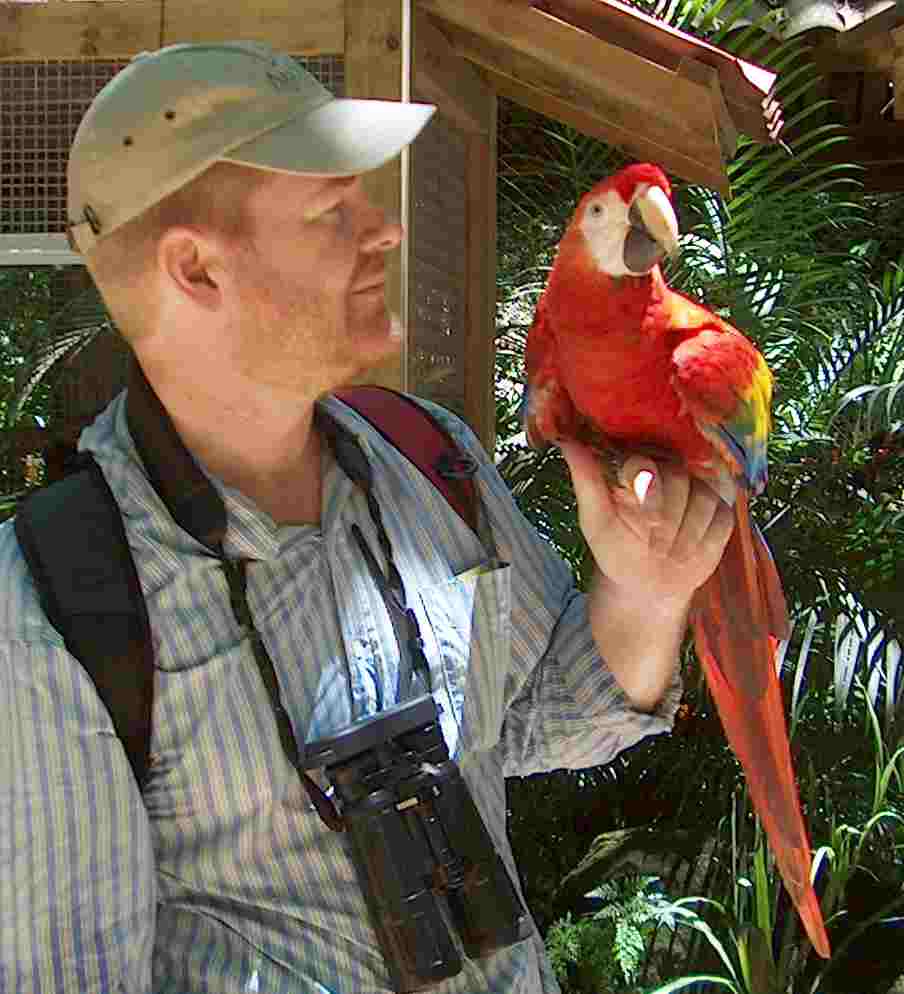
Last month when I was in Honduras, I was able to tour the incredible Macaw Mountain Bird Park in Copan. Macaw Mountain hosts dozens of Central American parrots in outdoor flight cages along a scenic creek valley in a tropical forest. The birds are mostly abandoned pets that are too acclimated to people to be released into the wild. It was great to see these birds, and to at the conclusion of the tour to interact with some of the birds as well. You can feed toucans and aracaris, as well as hold parrots and macaws. Its like a petting zoo for adults. Macaw Mountain does a valuable service in educating Hondurans about their local birds, and they provide a home for birds in need. If you are lucky enough to make it to Copan, swing by for a nice tour and enjoy the birds.
Mystery Birder
OK, kudos to whoever can be the first to identify this mystery birder and blogger who I met up with on my birding trip to the Tuxtlas. A field guide won't help you, but maybe surfing my blogroll will?
Subscribe to:
Posts (Atom)


